Ruth at Al’s Farewell
31 August, 2011
Thank you all for coming today to be with Al …..
When I was trying to plan this Farewell to Al, my brain went into overwhelm several times with the most spectacular episode occurring on Friday night – I wanted to make sure everything was perfect for his send-off to his next big adventure, that we could together somehow today sum up the essence of who he was and what was important to him in life – I wanted to do things in the right order, make it all flow perfectly, tell the right stories, have the perfect music, the perfect readings, make sure family and friends didn’t repeat stories, etc, etc, After my meltdown on Friday, I realised that this was impossible and that if Al had been in the room with me, he’d have been saying, “Come under my arm and have a cuddle for a few minutes and don’t worry – trust yourself, you’ll know what to do.’
So I woke up Saturday morning and I DID know what to do ….. we were going to get together in one place around Al, we were going to play some of the music he loved, hear from some of the people he loved, listen to Rabbi Shulamit grant his last request ….. and then, we were going to go back to our house, sit out in the sun if it’s a nice day, eat and drink, talk about him some more and probably cry – at least I know I will – and after today we’ll go on carrying him in our hearts and keep on remembering things he said and did – funny things, touching things, irritating things.
So, that’s what we’re going to do!
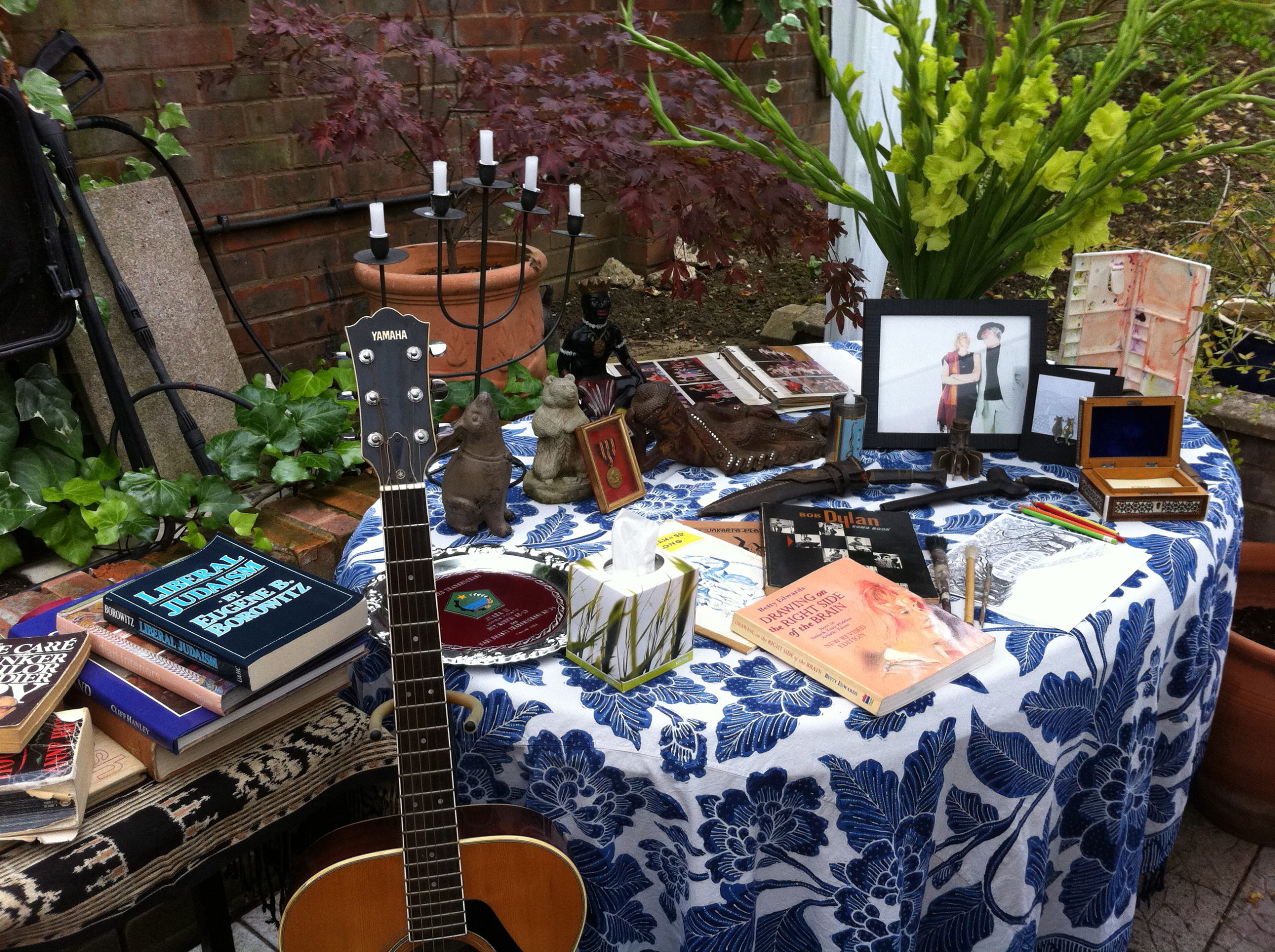
We all know that – in no particular order – he came from New Orleans and loved the place and was devastated after Katrina, that he went to Vietnam as a civilian, that he lived and worked all over the world with impoverished people to help make their lives a little better, that he loved his American and English family and friends, had a very strong set of values about right and wrong, was passionate about books, theatre, musicals, that he taught himself guitar, loved history and politics, was a true socialist, loved Asia, always had 5 books on the go, was a walking encyclopaedia – although strangely enough was not always right!, loved shaggy dog stories, hated exercise apart from high adrenalin activities like parachuting, scuba diving, and trekking in the Himalayas, that he loved to tell stories – usually more than once! –
That he overwhelmingly curious and was a seeker all his life……..
We all know that Al always introduced me as his “third and last wife’, that the night I met him in Jakarta at a theatre group, he came up to me and said “You’ve got to come out and have dinner with me “, to which I replied “Why’ to which he replied “Because I’ve always wanted to go out with a woman I could look in the eye!†So I did. We danced all night – as usual I lost my shoes in the crowd which he eventually found, we ended up in a sweaty heap in the middle of a huge traffic roundabout under a statue of Rama and talked all night.
We were together for 24 years and as you all know we had a good many ups and downs about numerous things. This last 4 years when I looked after Al was a hard time for him and me, but it was also a very special time. We often said that even though a lot of things had seemed to fall apart we felt blessed in that we could be together right then. I remember one particular afternoon shortly before he passed away when we were having a cuddle and just being quiet. We started talking about what true intimacy and connection with another person was and we decided that that was what we had at that moment …… and it felt like the best thing in the world …..so peaceful.
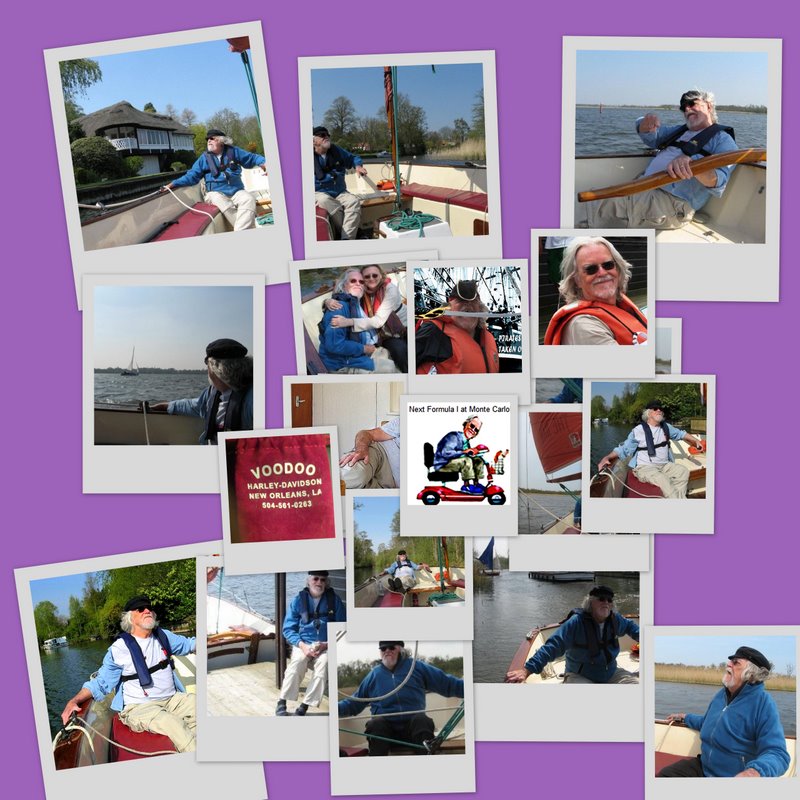
Al was a fighter always looking for the next way to fix his body ….. one of the last doctors he talked to in Oxford was refreshingly blunt – he said – go out there and live your life! Al asked if it was ok to go sailing now and the doc said “do it’. The next Monday we went up to the Northampton Sailability club – a place with specially adapted boats for disabled people and we went out in a 2 person sail boat. It was a calm day and he loved it. The following Monday we went again – this time the sky was almost black and the water dark grey and the wind was gusting. We sailed away from the pontoon hanging on for dear life. We never did quite understand the ins and outs of the sails and the wind (but Al would tell you he did!) but Al was in his element – I was more than a little terrified. We decided to try and go in after an hour. He turned to me and said, ‘doesn’t it say a lot about our relationship that we can now do this together as a team’. I agreed and told him I loved him. I’m so glad he had that day – he was walking on air, excited and connected to life again. That is how I will remember him, doing a goofy grin and being my lovely Bear.
Rossella, Al’s granddaughter
I find myself once again on an airplane to London, coming to the end of a great journey. Except this time, it isn’t my own.
Al was never the granddad that could teach me to ride a bicycle or swim; and due to the distance between England and all the places I’ve lived in so far, our visits weren’t as frequent as either of us would have liked.
I do however have terrific childhood memories of a lovely cottage in the countryside with a big garden to explore, cats to chase, cakes to eat and best of all: a squeaky staircase leading to the cosiest bear cave I’ve ever set foot in.
My grandfather was always a rebel, something I learned at a very early age when he let me sit in the front seat of a tiny, yellow convertible. “But my mommy says I’m too small to sit in the front!” I guiltily admitted. “Well, we just won’t tell her then, will we?” he readily replied, teaching me a most valuable lesson: mothers’ concerns become quite irrelevant when it comes to riding in a convertible with a wonderful man.
There was also a certain play-doh bucket behind his favorite chair in the living room.
Those were the days when he and Ruth were smokers and rolled their own cigarettes. It took me years to finally realize why rolling a cigarette out of what was in the play-doh bucket had to be our little secret, and to this day it tickles me to realize how hopelessly hippy he was.
A true child of the sixties, he spent his lifetime seeking knowledge and thrill across the world; appreciating life in its every crazy aspect.
In the past years granddad and Ruth’s has been the home base for all of my life changing journeys. I would visit them on my way TO somewhere and then again on my way back.
Unfortunately I’d be so overwhelmed with emotion (stress from the impending departure or recovery from culture shock) that I’m afraid I wasn’t very present and willing to sit down, listen and empathize with the phase of life they were going through. My grandfather on the other hand would seem to know exactly where I was coming from. Whether I was wrapped in Indian fabric or heading to the outskirts of Sydney to ride horses, he would have an appropriate speech prepared on life and how glorious it is. Nothing would phase him, in fact it all seemed rather normal to him at time when maybe other people didn’t quite understand the logic behind my decisions.
Most importantly, granddad thrived on knowing all about my life. I’ve never met anyone else who would call me to his room, slap the empty side of the bed and exclaim “come here! sit down! tell me about your life”. I took it for granted, and I now realize: as simple of a request as it may seem, how often does it actually happen?
There wasn’t one judgmental bone in his body. Every sentiment or concern I expressed was completely valid and precious to him.
It’s hard in times like these to gather one’s thoughts about life, death, how we feel about losing someone and what they meant to us.
I am a confident person, however my biggest fan and confidence booster is now gone for good and I know I’ll miss the little things. I’ll miss the bed where I would sit and talk if I wanted to, or observe his latest grand project in the making while he sketched away on a pad, groaning from time to time and asking Ruth to bring him something to eat – preferably something sweet.
I’ll miss the simple pleasure of sitting in a living room together watching television, sharing a meal
It may not have been a conscious effort, but his sense of adventure and, really, lack of fear led up to what became a novel worthy life story. This obviously rubbed off on my mother, and eventually and unsurprisingly, me.
I am twenty-two years old and I have lived in four continents, worked a variety of jobs and had my heart broken one too many times. I know this is a lifestyle I probably wouldn’t have adopted had it not been for my grandfather, and although it has its downsides, I’m quite convinced the best is yet to come.
Ian, Al’s son
Eulogy for a Character:
I’d like to start with a definition.
Char.ac.ter
1- the aggregate of features and traits that form the individual nature of some person
2- an outstanding person: one of the great characters of the century
3- an odd, eccentric, or unusual person: he’s quite a character
Yes these are all things that could define my dad. Actually I’m pretty sure they had to make up those definitions to define him! He was indeed a character who had character. I’d almost be willing to bet money that the character of “Most Interesting Man in The World†was modeled on my dad.
They also say a man can be defined by the friends he has made and the family who loves him; having met many of his friends and being part of his family I can easily see what made my dad such a character.
I have not had the good fortune to know my father as well as many of his friends and other family members and much to my regret I did not get to spend nearly as much time with him as I could have wished for, but that made me value the time I did have with that him much more:
Sometime during my junior high or early high school years I got to spend one summer with my Dad back when he was living in Reston Virginia and it was one of the best times of my life. I don’t remember all of the details, my memory of days gone past is fuzzy at the best of times, but I do remember going white-water canoeing on the Upper Potomac at one point. However, my clearest memory was the day he took me to an Airshow and I got to go up for a ride in a rebuilt Stearman Biplane, an Aerobatics Biplane and me with a horrific fear of heights. It was an experience that was both terrifying and exhilarating and a memory I wouldn’t trade for anything in the world. Looking back through the years I can say with honesty that that was one of the few points in life where I ever felt truly alive and I love my dad even more for giving me that experience.
It’s been a very long time since that fond memory and though I only got to see him one other time after that I know that he spent every day doing his best to live, right up to the very end. And that I think was his greatest quality; showing others how to live.
Forgive me a bit for descending a bit into geekery here, but I am what I am and I think dad would be tickled by the analogy; In a recent episode of Doctor Who, “Vincent and the Doctor” in which the Doctor and his companion Amy Pond shared an adventure with the tormented Vincent Van Gogh. At the very end of the episode the Doctor is comforting Amy when she thinks that nothing they did for Vincent made any difference in the end and the Doctor says; “Life is a series of good things and bad things, I believe we added quite a bit to his pile of Good Things.”
And that is what dad did for me and for all of us, he added a lot to all of our piles of good things.
Nancy, one of Ruth’s oldest friends and, for the last 17 years, Al’s friend, too
Ruthie has asked me to say a few words about Al, to remember him by – as if we could ever forget.
Ruth, of course, has known Al for ever and a day, they’ve been adventuring together for 24 years, overseas, in America and in England. I got to know him when he came to live and work here, as the husband of my very dear friend.
And when I sat down to think about him, I always saw him with Ruth. Al and Ruth, Ruth and Al. So this is a tribute to Al – and to Al and Ruth.
What was Al like? He was big, he was untidy, he lived with Ruth – and he loved her.
He loved to talk and to eat and to play – with his family and his friends – and especially with Ruth.
He loved politics, he read history and he devoured the news – and he and Ruth would spend hours talking about the world and everything within it.
He loved religion and philosophy and big ideas, and he wrote and he googled and emailed and he talked – and he saved his most insightful and most intimate thoughts for Ruth.
He sailed and he played guitar and he read book after book – and he did everything with enthusiasm and he liked doing everything best – with Ruth.
Ruthie was his greatest fan, his strongest supporter, his beloved wife. He simply adored her. They drove each other mad, they made each other laugh, they loved each other through and through. We all know that about them, that is Al – and Ruth.
Al was a socialist and an admirer of the NHS. In recent years he spent a lot of time admiring it up close and personal as he suffered from increasing ill health. But I think it’s fair to say that many of the nurses and doctors who looked after Al admired him too – for his determination, his will and his fight to keep going.
He loved life and he loved Ruth and he didn’t want to leave her – but in the end, despite Ruth’s wonderful care, the hospital’s ceaseless cure and his own strength of will, he died, in peace – with Ruth – as always – by his side.
It is my privilege to speak today, in memory of a fine man, who had a wicked sense of humour and a big heart.
As family and friends you’ll have your memories of Al, too. If you’d like to share your memories back at the house, that would be wonderful. But if, like Al, you like to save all the best things for Ruth, please talk quietly to her, or write to her afterwards – these memories of Al are precious to her.
Thank you.
Rabbi Shulamit Ambalu
Hesped for Al Straughan
I first met Al when he came to our local synagogue one Saturday morning with his friend Davida. It’s a very funny thing, because we had a special kind of service on that day, one we had just started doing, and which we only do two or three times a year. If it had been the usual kind of morning event, I think Al might have listened with polite attention and we would never have seen him again. But I clearly remember this. There was no sermon on that morning. There was hardly any of the usual ritual. But there was this. A short piece of text and a long and wholehearted discussion. No one told anybody what to think, much less what to believe. This was our Jewish experience at its realest, lots of people in the room and lots of different opinions. And at the heart is this, the notion that it is in the struggle, in the argument, in the spaces between our different positions that we might find the truth. Al was taken aback. He was, in our English way of saying it, gobsmacked. He loved that it was real, and also, with his passion and background in the theatre, he loved the sense of drama and story. With his instinctive pull toward metaphorical truth, and a respect for the mystical, Al came back. And he kept on coming back.
As his health declined he managed somehow, to keep on going. He talked about his spiritual life. He conjured up the emotional high of the Baptist revivals, the dogmatic certainty of the Catholic Church, the tensions of the faith inside his childhood home. He had an instinctive distrust of religious conviction. His many years of living in the Far East were not only vital outlets for his passionate drive to mend the world, what we call, in Hebrew, tikkun olam. They also brought him into contact with a gentle and open spirituality wrapped up in a way of life.
But this was somehow not quite enough. When his health declined in the last twelve years of his life, one of his many pursuits was a wide ranging novel, Shadowmirror. This winding mystery novel, set in his childhood New Orleans, explored parallel planes of existence, the relationship of men and women; voodoo and even had a Jewish thread. It was this Jewish thread that led him to the synagogue, ostensibly for further research.
But Al quickly found what he did not know his heart was looking for. Here, no one would tell him what he had to believe.
He was only asked to learn, to practice and to think. These three were not without their challenges. Always a willing student, he read voraciously, and kept a list of questions to ask me. Yet it was difficult to marshal his thoughts. His wide raging intellect would nimbly leap from topic to topic, and it wasn’t always easy to see where next his thoughts would jump. His most common question was “why’. His declining health made Jewish practice enormously difficult. Yet he came to synagogue whenever he could, and he made an impression on everyone who knew him. I think the last time he came; he told the leader of the choir that when she sang he felt the heavens open. He was well loved. He was a loveable, honest man of strong convictions and character, and he gave his spiritual struggle everything he could. I am only sorry I never knew him at his physical best. But I knew him at the time when he was perhaps, at his spiritual best. He struggled, till the end, for coherence and meaning, a struggle, we learn, that is never complete. Al told me that he thought a lot about the book of Job as many people do when they are sick. Job is a book that refuses the quest for an easy set of answers. Job must hold fast to his own hard earned truth.
Al was looking for this underlying truth, the unity, or one-ness, behind our different languages, our different cultures, different ritual expressions. He wanted to get to this ultimate truth, this essential indivisible One. This was the drive between every one of his free ranging questions, his voracious reading, and his practise of meditation. And though it sounds so simple, finding this truth, and holding on to it, is a complex, challenging struggle. He gave it his best. And the struggle, too, for the essential, undivided One, in turn sustained him.
Zichrono nl’veracha, may his memory be for a blessing.
Zvi Friedman – a member of the synagogue
31 August, 2011
Al was a big man with a passion for the big questions in life, questions of science and religion.
Sadly, because he’d been so unwell during the last year or so of his life, we didn’t have many opportunities to sit and talk about these things.
Here is a book belonging to Al, which he insisted that I read. It’s a book about astro-physics, by a Japanese American academic Michio Kaku and it’s called “Parallel Worlds, the Science of Alternative Universes and our Future in the Cosmos’.
This was clearly a book that Al treasured. Page after page are marked with coloured stickers, indicating passages, some heavily underlined, that were for Al of great importance. Some are labelled, such as this one; it says. “Survival of intelligence.”
I have to say that I didn’t get too far into this. It’s complex stuff, demanding a commitment to the philosophy of astro-physics strong for Al, but less so for me.
Yet it would have been good to have had the opportunity to talk more about these great ideas.
But Al’s spirit is now free of our trivial earth-bound concerns.
Somewhere in my mind is the hope that his intelligence will survive, and perhaps he will now know more about his future in the cosmos.
But for we who remain, well, I feel I’ve lost a friend.
Mandie and Paige
We’ve known Ruth and Al for 8 years, and was very sad to hear of Al’s passing. Al and Ruth touched our life’s in a big way more than what I think Ruth realises, I’ve never met such warm hearted, wonderful people who I didn’t realise existed in this world. We feel so privileged to have known them both. They have been there for my daughter and myself more than my own family and friends. One thing I’ll remember Al for was the day he called me in the lounge and gave me an envelope which had a card and money inside it, he said “Ruth and I don’t have much but we know what its like to have hard times and we would like to give you this to help go towards helping you out, as I believe if you do a good thing for someone it will be returned back and you and Paige mean a lot to us†. Well Ditto Al you meant a lot to us and we will never forget you and what you believed in.
Mandie and Paige xx
Addis
I’ve known Alton for over 60 years. So many memories!
As boys we often built houses out of cardboard naming them VAN THUTCHER MANSIONS,
why, I don’t know. We then joyfully would burn them with great pleasure adding sound
effects of screams. Perhaps this was early creativity?
We suffered through the years in a school we hated. Then with freedom, I fled to NY.
Alton to college. He was frequently here. Lord, we were so young!
I remember drinking cheap wine and passing out behind the carousel in Central Park.
. . all night. Alton insisted we spent a lot of time talking with Alan Ginsburg one
night. I don’t remember. . . .Wonder if Mr. Ginsburg did?
As the years passed, we stayed in touch. I remember when Deidra was born, I saw her
grow up.Then her little one. Alton was all over the world, and I was also.
These last years were hard, I know. He always stayed close via email and the
telephone. When I didn’t hear, I knew things were bad. Ruth, you were his anchor.
Bless you. . .
Thorton Wilder said the best tribute to the dead is not grief, but gratitude.
I will close with these words.
Thank you Alton-
Charlie Blank
August 19, 2011
Kathy & I send our sympathies to you and Ruth. Alton was a month younger than I and we went through school together and then off to LSU. We roomed together just before I married. Celeste was a frequent visitor. I remember Addis, who lived across the street from Alton while we were growing up.
The last time we corresponded, we differed about the afterlife. He could not believe that there was not something after death; I called it the Great Void. We would enjoy arguing passionately about such things.
Leslie Posner (and Nathan Cohen)
30 August, 2011
The sad news came on Tuesday, the earthquake on Wednesday , the hurricane warnings and landfall on Thursday to Sunday. This week’s mid Atlantic blockbuster meteorological drama, with its previews, performances, curtain calls and reviews felt like a cosmic salute to a mega force husband, father, and dear friend.
After all of these years of roller health and optimistic endurance, helped greatly by Ruthie, he went out with a shake, rattle, and strong whoosh–leaving debris in his wake.
All of us who love him, and those he loved–Ruth, Deidre, Rosella, and Ian–are trying to find our balance again. Here in Baltimore, we walk carefully through fallen branches and downed wires, and wait for the electricity to come back on.
He kept the lines buzzing between us for over 35 years, wherever we were, and was recently pushing me toward Skype, yet another new level of communication, along with Indonesian, which he encouraged me to pursue.
I am in no hurry to sign on now, as I know that the connection can never reach far enough, that the messages will no longer be returned.
But I have many memories to rewind, including those of our late June visit, and promise to help all of you keep sharing them as best we can.
Donna (Davida) Huchel
28 August, 2011
(Met Al in 1983; collaborated on numerous theatre projects in Indonesia and Herndon/Reston, Virginia.)
Al Through My Eyes
Al forged many enduring friendships as he navigated a world which never seemed quite big enough to contain him—or his enthusiasm. Mine was one.
If I had to use a single word to describe Al, it would have to be “capital C†Creative. The creativity that allowed him to restructure government ministries, found businesses, return to school for a Master’s in set design, write two novels and change bare stages magically into other worlds— a pre WWII Cabaret, a Transylvania mansion, the second smallest town in Texas, a pajama factory, an IRA hideout. This creativity gave Al the ability to imagine, during his long years of illness, a miracle cure, followed by a pain free existence which would allow new travels, new businesses, new adventures.
Along with the optimism wrought of his fertile imagination came an appreciation of what he had in the real world—and at the top of that list was his Ruthie: his lifeline, rudder, sounding board, and incredible “first mateâ€! While he “sailed†through many cultures and cultivated many lasting friendships along the way, Al never lost the love of his Louisiana roots (evidenced in his 2nd manuscript and 30,000 conversations with me), nor the mighty appreciation of his adopted English homeland, and all it did for him.
Al , as everyone who knew him appreciates, lived BIG in this world. No reason to think he’ll do otherwise in the next!
Curtis and Dee Wood
Austin, Texas, USA
28 August, 2011
Been there, done that.
That’s what comes to mind when I think of Al. He lived a full life- fuller than most- and enjoyed a wealth of experiences. And yes, it was hard to find somewhere Al hadn’t been, or something he hadn’t done.
While he was here in the states exploring yet another religious belief system, I heard him referred to as having “an old soul”. If, indeed, souls come and go through various bodies and times here on earth, I do believe Al had been here and back more than once.
I’ll remember his Indian cooking–always a delight to the tastebuds, and his passion for the theater. And his passion for Ruth. He knew what a treasure he had found when he met Ruth and didn’t hesitate to snatch her up as his mate for the rest of his life. I never did get to thank him for coming back to Texas for awhile, where I had the good fortune to meet both of them.
Thank you, Al, for doing another gig in Texas and for including Curtis and me on your list of lifelong friends.
Niamh and Graham
August 29, 2011
Thank you so much for all the love expressed through your post. Graham and I were privileged to know Ruth and Al in the Maldives where we shared many a fun evening and became really good friends. There was a infamous Murder Mystery Dinner party that will forever stick in my memory!! Probably helped that I am a great musical theatre addict as well.
Our return to the UK was pretty much at the same time as Ruth and Al and I have been aware of Als’ health probs over the recent years. We were just speaking on the phone a few weeks ago about him feeling well enough to come up and visit us in Norfolk in September. I love the photos of Al in good heart.
We shall miss him greatly.
Simon Barnes
26 August, 2011
A lot of people thought Al was an unlucky guy. I am in a unique position to know that he was not. He was one of the luckiest guys on earth, because he loved and was loved by [Ruth] for 24 years.