I don’t earn much from my website directly, but every now and then an unexpected perk arises. The largest (in monetary value) to date was a recent trip to New Orleans, where I was invited by BlogHer to speak on a panel at a Women & Business Summit.
The invitation arrived at a poignant moment. I was born in New Orleans, but we set out on our globetrotting life when I was two, and rarely visited thereafter. For years I kept thinking: “I must go see the place,” but there was always somewhere else to go. When Katrina hit, I realized that I had missed my opportunity to know the city as it had been – it will never be the same New Orleans again.
New Orleans meant far more to my dad, who was born and partly raised there (as were many of our ancestors, stretching back to before the Civil War). During the last ten years of his life, he put a lot of time and research into writing a novel set in the city, but health problems made it impossible for him to visit before he died. Ironically, this trip gave me an opportunity to look into what we could do to finally bring him back to New Orleans in style, if only as ashes in an urn.
The event I came for was put on by Hyatt for a select group of travel industry professionals and meeting planners. The aim was to persuade them to book events at Hyatt properties, and to promote the Hyatt brand for women travelers in general. As the Hyatt folks told us, women decide 82% of travel expenditures, 41% of conference attendees are women, and 37% of Hyatt revenues come from women – so Hyatt is looking closely at women’s travel needs, and wants to make sure that women travelers know that.
The opening remarks included a welcome from Michael Smith, who was General Manager of the iconic Hyatt Regency New Orleans when Katrina struck in August, 2005. Although the hotel was severely damaged, its window facades blown out and even interior walls ripped away, he and his staff were able to keep it running to serve as headquarters for local government and emergency relief.
They managed to stay open until December, 2005, then the hotel closed for a $275 million “transformation” – a project that Mr. Smith oversaw – until it finally re-opened in October, 2011. This is both a real and symbolic boost for New Orleans, which has not yet recovered from the devastation.
Bringing in a group of eagle-eyed travel pros during the hotel’s shakedown cruise was brave: things weren’t yet running entirely smoothly. But the organizers shrewdly cast this reopening as a chapter in the city’s renaissance. The master of ceremonies for the show was Trish Regan, a TV journalist who covered the Katrina disaster on the ground for six weeks, and came to love the city. Her tales and Michael’s made this a story about people, rather than about a hotel chain or a corporation. The result is that we all want Michael, his staff, and the city to rise again, and we perceive the hotel as part of that. So we’re less inclined to carp about things like elevators with minds of their own. 😉
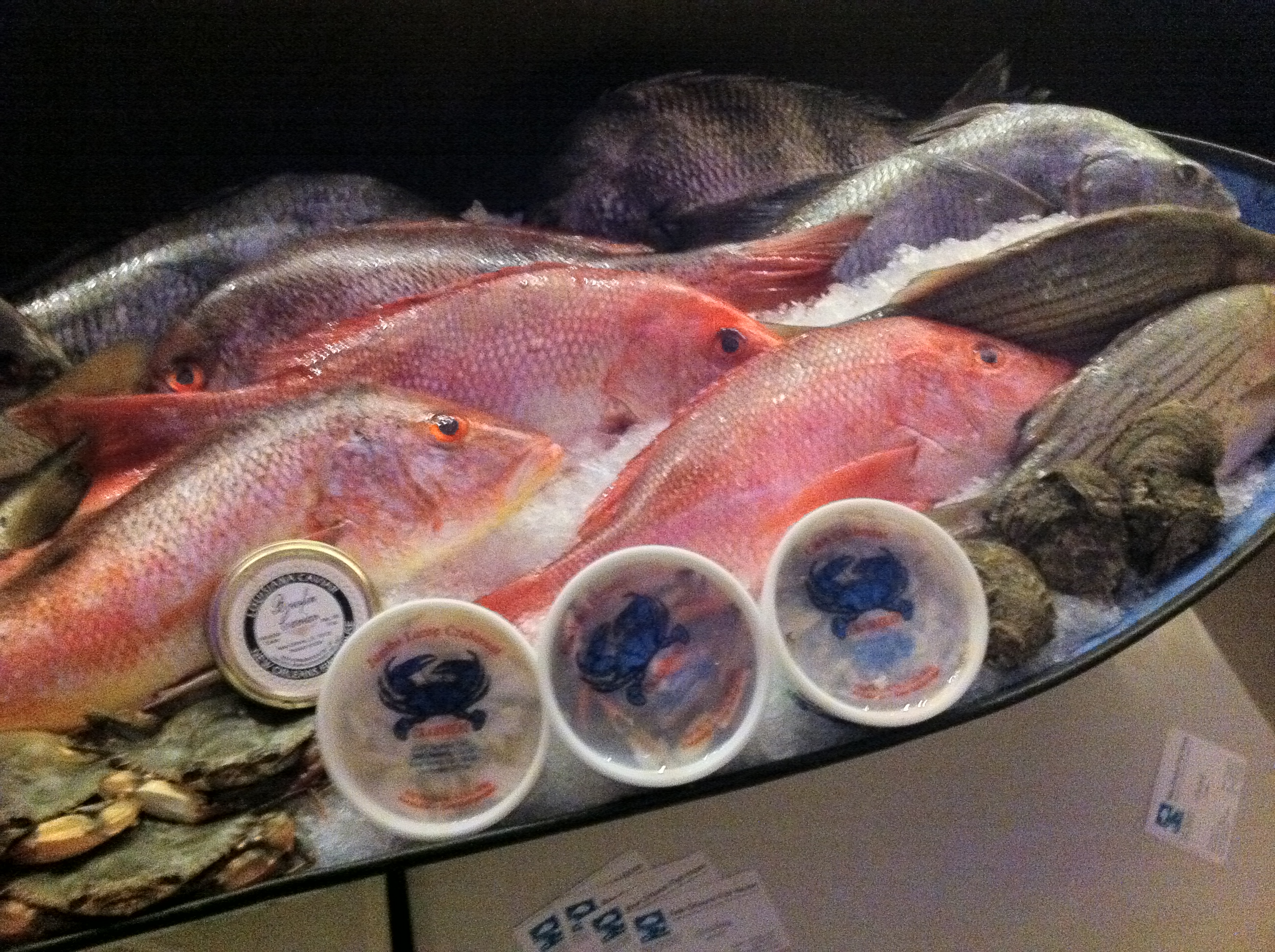
Aside: In general, the hotel was running very well, especially the catering: we were treated to several excellent meals. I particularly liked Hyatt’s emphasis on sourcing great food from the nearby region. I’ve long been a fan of eating local, and this is all the more important since the Gulf Coast oil spill has devastated Louisiana’s fishing industry. Further, in a city renowned as New Orleans for a great culinary tradition, it would be idiotic and shameful not to emphasize local specialties made from local ingredients.
My part in the proceedings was small. After the opening speeches, there was a talk by Melissa Fisher, an anthropologist studying women on Wall Street. It was a bit of a stretch for her to bring her talk around to women and business travel, which may illustrate how little the topic is studied. Then Elisa Camahort Page of BlogHer gave us a look at BlogHer’s very interesting research on women and social media.
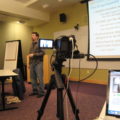
Then my fellow panelists (Holly Burns and Diane Cu) and I were invited onstage to answer questions such as “What creates a memorable travel experience (good and bad)?” and “What motivates a woman to share that travel experience?”
My answer to the latter was to quote something Trish had said earlier: “My job is to tell people stories.” Well, that’s not actually what I get paid to do (though I would like to), but being a storyteller is such a huge part of my personality that I can’t not do it. Trish had also recommended: “When you travel, do some field reporting of your own – get to know a community.” Which is exactly what I love to do.
The audience seemed interested, listening closely and asking questions even though we were the last item before lunch. A notable difference from the tech conferences I usually attend, aside from the gender ratio, was that nobody except us bloggers had her head buried in a laptop or iPhone – they were actually giving us their full attention.
In the afternoon, the attendees broke into small groups to discuss and recap the day’s topics. This gave the Hyatt staff opportunity to hear from their customers, which probably was – certainly should have been – the point of the whole event. I didn’t attend any of these sessions, but from other conversations I gleaned a lot of what they probably heard about the concerns, needs and desires of women traveling on business.
I have traveled a great deal on business myself, usually alone (I have often found myself the only woman traveling solo in business class on a flight). I don’t seem to be a representative sample, however: most of the women I heard from were far more concerned with basic safety than I am ever conscious of being. Oh, I am careful and do not expose myself to danger, but I just don’t think about it much one way or the other.
What concerns me more is loneliness. I hate eating meals alone and being in a hotel room at night with nothing to do but work or watch TV. But I’m not a hanging out in bars type, and I empathize with most women’s preference not to get hit on by random men. Women traveling alone tend to gravitate towards one another, given a chance – that’s how I ended up helping to smuggle an ostrich out of Africa…
But, if you don’t like eating or hanging out in a hotel bar alone, how will you find those other women? Here’s where hotel chains could help. An interesting experiment during the Women & Business summit was a smartphone app custom-designed by a company called Yapmo. It was meant to help attendees interact during and after the conference, for Hyatt to ask them questions during and after, and maybe to help them retain an ongoing sense of community. Build out this online community of women, and there’s a good chance that some of them will cross paths from time to time in Hyatt hotels around the world. An added benefit for the community members would be networking outside our usual industry boundaries, which could lead to some serendipitous outcomes.
I’d be interested in participating in such a project, from both the software and community angles – and you can bet I let Hyatt know it!
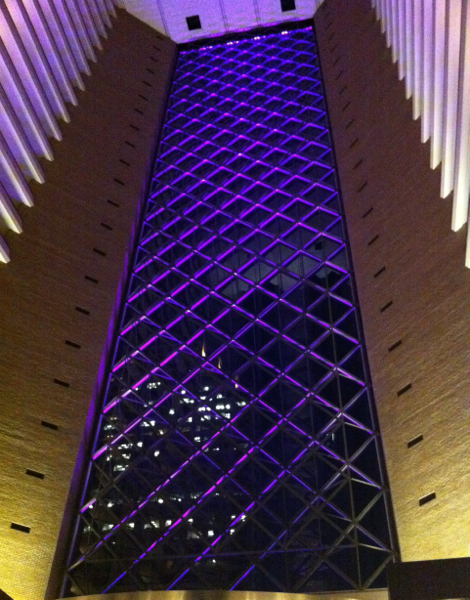
photo at top: interior of the new Hyatt Regency New Orleans