This song, the second in the show, is built around a pun. Peccato means “sin,” but the phrase Che peccato is used like the English “What a shame!”
The singers are Don Silvestro, the priest, and Clementina, the mayor’s daughter, who has a crush on him (which he, secretly, reciprocates) and goes daily to confess sins that she hasn’t actually committed, just to have an excuse to talk to him.
includes a slogan ("Italy leaves a mark") which reminds me of the tourism campaign Spain has been running for years (that one with people sporting Dali’ mustaches) – didn’t it have exactly the same slogan?
As for the website… oh, dear god. They reportedly spent 45 MILLION euros for a site that lacks basic features (such as an RSS feed) that we have come to expect from a modern website. It has technical problems which anyone in Italy who knows anything about the web (and that’s a lot of us) is gleefully (and ruefully – our tax euros wasted!) tearing to bits.
Given my own skills and biases, what I first noticed was the English translation. Here’s a sample paragraph which I did not have to look hard to find:
For having more precise vision click on “+”: in this way it will be visualized an historical period in the detail.
For having, instead, one vision of entirety click on “-” and the period will be visualized a large historical period contain more events. The period comes shown in the Timeline to the right of the zoom: the blue bar will increase or decrease the dimension based on your choice.
This kind of laughably bad translation, like the manuals we so often see with Chinese electronics, gives the consumer no reassurance that there is anyone competent standing behind the product (the product, in this case, being Italy).
^ Someone else in need of a good translation service. The title on this clip in YouTube is "Rutelli inglese maccheronico" – Rutelli’s maccaronic English. Maccheronico (maccaroni-like) is the term Italians themselves use for heavily Italianized English (or other language).
Until a few weeks ago, I might have said that my Italian was good enough that I could translate an English text into decent Italian – not quickly, but I could do it, in fact had been asked to do it several times at the office (we have an office full of Italians, why ask me?).
Then we put this supposed skill of mine to the test. Ross is applying to attend Woodstock School next year. The application form includes recommendations to be done by various teachers and other people at her current school, none of whom (except the English teacher) reads or writes comfortably in English. So the form needed to be translated into Italian.
I took a first cut at it, and thought I had done a reasonably creditable job. Then Ross took it in hand, and came out with something completely different. I realized that my translation had been understandable, and grammatically fairly correct, but probably about as funny to a native Italian speaker as the text above is to a native English speaker.
Around the same time, Antonio, one of the delightful people I met at barCamp Roma, commented about me on his blog: Cavolo l’ho sentita zittire e mettere in riga decine di uomini con un italiano corretto, ma inglesissimo! – "Cavolo! I heard her shut up and straighten out dozens of men in very correct – but very English – Italian." Okay, I’m slightly embarassed about the shutting up and straightening out (not exactly my intention, but definitely my character). But the very correct and very English Italian… hmm.
I stand before you now, chastened and humbled: my Italian is good, but I sure as hell don’t speak or write like a native.
And this is a lesson that many Italians have yet to learn. Just because you can read and understand another language well, and maybe even translate well from that into your mother tongue, does not mean that you can translate in the other direction with comparable competence. If you need a text to sound professional and persuasive, leave it to an expert.
So… I’m looking for someone to translate my resumé into Italian…
All this God-inspired romance is interrupted by the arrival of a travelling prostitute named Consolazione –
Consolation
– with that name, she could be a denizen of Dogpatch! – who distracts all the men from their wives, apparently because it’s their last chance for an extramarital fling.
Uomini, eccomi!
Men, here I am!
E’ arrivata Consolazione
Consolation has arrived.
Consolazione di nome e di fatto
“Consolation” by name and in fact
Per consolarvi ho certi argomenti
I have certain ways to console you
Prova per credere
Try it to believe it
Facciamo un patto
Let’s make a deal:
Se dopo voi non restate contenti
If afterwards you aren’t content,
Sulla parola di Consolazione vi rimborso la consumazione!
Tutan[khamen]… [everything in the room] – come up and see me!
UOMINI Consolazione Consolaziò-ò-ò
men: Consolation
Tu sei l’ultima occasione
You’re the last chance/last sale
Non possiamo dire no
We can’t say no
Voglio la Consolazione
I want Consolation!
La volete?
You want it?
UOMINI Si!
Yes!
Io ve la dooooooooo, siiii
I’ll give it to you, yes!
UOMINI
Consolazione consolazione, dammi tutto tutto dammi consolazione!
Consolation, give me everything, give me consolation.
* Te la do – “I’ll give it to you” – to give “it” is used as a euphemism for a woman to give sex.
God, however, has something up his sleeve to take care of this little setback. Toto, the (unmarried) village idiot, has been hanging about the sidelines of this scene, too dense to know what to do with a woman. God suddenly gives him the necessary knowledge, and he shoulders aside the other villagers to reach Consolation, who takes one look at his, er, talents, and closes the door on everyone else, leaving them to go back to their wives.
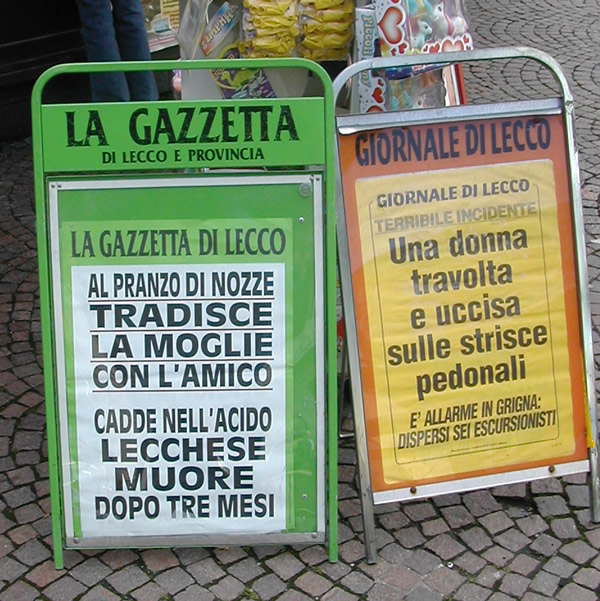
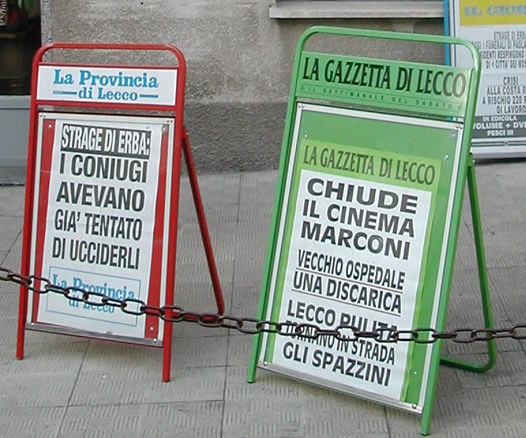
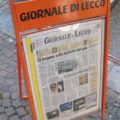
Clean Lecco – the street cleaners return to the street (I hadn’t noticed they were missing).
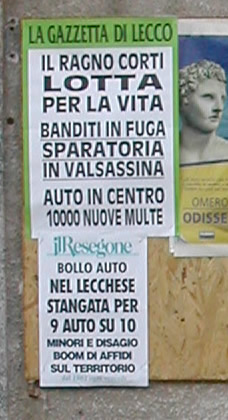
The “spider” Corti fights for life. At first glance, this headline seems very strange, but if you live in Lecco, you know what it’s about: the Ragni [spiders] of Lecco are a longstanding club of local mountaineers, famous for exploits such as the first ascent of K2.
Bandits on the run – shoot-out in Valsassina
Autos in the center [of town] – 1000 new traffic fines
Car taxes in the Lecco area – sting for 9 cars out of 10
Minors and disagio – boom in foster care in the area. Disagio is difficult to translate. Agio means comfort, feeling at ease. Disagio is the opposite, but it’s also used as a bureaucratic/social service term for severe family troubles, economic and social disadvantages, etc.