Italian Slang Dictionary: intro A B C D E F G I L M N O P Q R S T U V X Z
Caca
[ca-ca] Means poop, of course. Used with/by children, or ironically.
Cacchio
[KAHK-yo] A mild replacement for cazzo.
Cagare
[cah-GAR-ay] To shit.
- Si stanno cagando sotto – “They’re shitting themselves below [with fear]”.
- Non mi caga niente – “He/she doesn’t shit me anything,” i.e. “He/she doesn’t give a shit about me. ” In some areas, this means “I don’t give a shit about him/her” while you would need Non mi caga per niente to mean “he/she doesn’t give a shit about me.”
- Mi fa cagare – “It makes me shit” – “It disgusts me.”
- Va a cagare – “Go shit!” Used as an alternative to vaffanculo.
Cagacazzo
[CAH-ga-CAHZ-zo] Cagare + cazzo = “a shit dick”. (???) A rompiballe.
Cagata
[cah-GAH-ta] A shit, used of a worthless event or action or object. Can be used similarly to minchiata or cazzata : Ho fatto una vera cagata (I did something hugely stupid).
Canapa
[CAH-na-pa] Marijuana.
Canna
[CAHN-na] Literally a cane, as in bamboo, but used for a joint/reefer/ doobie – a marijuana cigarette (for which I don’t know the current American slang!).
Casino
[cah-ZEE-no] This has two basic meanings: “a lot” or “a mess”.
- Mi piaci un casino is a slangy (but not rude) way to say “I like you a lot.”
- Io ci sono stato un casino di volte = “I’ve been there a ton of times.”
- E’ stato un casino = “It was a huge mess.”
Not to be confused with casino’ (the accent on the final o indicates that the stress is on that syllable, so pronounce it [cah-zee-NO]). This means casino in the American sense – a place where you gamble.
Cavolo
[CAH-voh-low] Literally, cabbage. Used as a mild replacement for cazzo: Non si sa che cavolo vuole (“No one knows what the heck he wants”).
- Col cavolo! – Literally, “With cabbage!” but used as “Like heck!”
Cazzarola
[CAHTZ-a-roll-a] Another mild replacement for cazzo, used when you realize in the middle of the phrase that you shouldn’t say cazzo in present company. The Italian equivalent of using “frick” for “fuck”.
Cazzata
[caht-ZAH-tah] Something stupid. Ho fatto/detto una cazzata – I did/said something stupid. As Dario Fo has pointed out, a cazzata is something stupid, whereas a figata is something great. (Thank Alice Twain for that tip!) See also minchiata.
Cazzo
[CAHT-zoh] The quintessential Italian swearword, the one you’ll probably hear most often. A vulgar term for penis, but used in many contexts much as “fuck” is used in English:
- Che cazzo vuoi? – “What dick you want?” – What the fuck do you want?
- Che cazzo! “What dick!” – WTF!
- Non rompermi il cazzo – “Don’t bust my dick” – Don’t hassle me.
- Testa di cazzo – dickhead
- Cazzo! – Shit!
- Non fa un cazzo – He/she/it doesn’t do shit. Hence, fancazzista – one who does nothing.
- Stare sul cazzo – “To stay on one’s dick” – to annoy terribly.
- Sono cazzi tuoi – “Those are your dicks” – That’s your problem.
- Fa i cazzi tuoi – “Do your own dicks” – mind your own business. If you want to be a little politer, say Fa i cavoli tuoi.
- Cazzi amari – “bitter dicks” – bad stuff.
Cazzo d’Oro
[… doro] “The golden prick.” Said of a man who marries money by dint of his sexual prowess, at which point he can attaccare il cappello.
Chiappe
[KYAHP-pay] Butt cheeks. Often used in muovere le chiappe – move your butt, get a move on. Or alzare le chiappe – lift your butt up (out of that chair and do something). Chiappe can be used as a politer substitution for culo. It can also be a surname!
Cesso
[CHESS-oh] A rude word for toilet, but also used to describe a very disgusting place or a very ugly woman.
Chiavare
[kya-VA-ray] To fuck.
Citrullo
[chih-TROOL-oh] Derived from cetriolo (cucumber) – used of somone large, lumpy, and rather flavorless/dense. You can use this in polite company – just don’t let the person you’re referring to hear you!
Coglionare
[coal-YONE-ar-ay] To make a fool of, see coglione below.
Coglione
[coal-YONE-ay] A vulgar term for testicle, but also used to mean idiot (Che coglione! – “What an idiot!”). Apr 5, 2006 – Used in this sense by Berlusconi to define people who intended to vote against him in the recent election (which he lost, barely). Il Corriere della Sera translates coglione as “dickhead.”
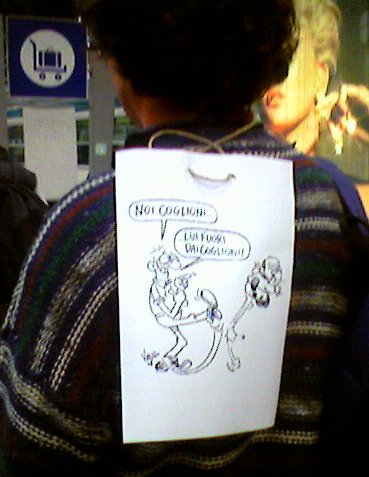
- Fuori dai coglioni – “Get out of my balls” (“stop bugging me,” but on the rudeness scale equivalent to “fuck off”). As in the political cartoon shown above, worn by people intending to vote against Berlusconi: “Us morons, him out of our hair.” For a milder version, use fuori dalle palle.
- Non rompermi i coglioni – “Don’t bust my balls.” (Don’t hassle me.) For a slightly politer version, substitute palle or scatole, milder terms for balls.
- Bisogna avere i coglioni quadrati – “You need to have square balls” (a lot of nerve/guts).
- Rincoglionare – to make stupid.
Controcazzi
[CON-tro-CAHT-zi] “Counter-dicks”. Used in the phrase Con i controcazzi, meaning “with every possible accessory, fail-safe, feature, etc.”
Cornuto
[cor-NOO-toh] “Horned” – literally, “cuckolded, betrayed.” Used similarly to the American “loser” – but MUCH more offensive. More used in southern Italy than northern, with the accompanying “Hook ’em Horns” hand gesture.
Cozza
[KOTZ-ah] Literally, “mussel” (shellfish), but used for an ugly woman. Funny that there’s no equivalent for a really ugly guy…
Cozze, alle
[AHL-lay KOTZ-ay] Literally “at the mussels” (as in the mollusk you eat), but used to mean exhausted, done in, or in a mess. (This phrase is not particularly rude – nobody’s shocked by shellfish. Unless maybe it means “only ugly women are left at this party” or something to that effect.)
Crucchi
[KROOK-kee] A nasty word for Germans, exactly like “Krauts” in English. (I’m sure they have their own nasty words for Italians…)
Cuccare
[KOOK-kar-ay] To rimorchiare successfully. This is a Lombard/Milanese useage.
Culattone
[cool-laht-TONE-ay] Derived from culo, roughly translates as ass bandit. A rude word for a gay man.
Culo
[COOL-oh] Ass or asshole, but also used to mean luck. Che culo! therefore does not mean “What an ass!” but “What luck!” or “You’re so lucky!”
Also used in Gli faremo un culo cosi’ – “We’ll make them an asshole this big” (with hands held apart to show just how big): “We’ll rip them a new one.”
Mettilo nel culo – “Put it in your ass”, similar to vaffanculo, is equivalent to the American “Shove it”.