[TAHK-kee-NA-ray] To hit on, attempt to seduce. What the young people use today instead of rimorchiare.
Tette
[TET-tay] Tits. Not to be confused with tetto, roof.
Tirare un Pacco
[tee-RAHR-ay oon PAHK-ko] “To throw a package”- to stand up, e.g. not show up for a date. The phrase is not rude – the action certainly is!
Tirarsela
[tih-RAR-seh-la] Literally a reflexive form of “to pull”, but used as “to give oneself airs.” Se la tira tanto – S/he really gives him/herself airs (really thinks he/she is something). Not particularly rude.
Tiro Mancino
[TEER-o mahn-CHEE-no] “A left-handed throw”.
Troia
[TROY-ah] Prostitute. The name derives from Troy, the city, because Helen betrayed her husband with a Trojan, and therefore became a slut. The movie of that name did not get an Italianized title.
Trombamico/a
[trom-bah-MEE-ko/ka] (Male/female) Fuck buddy. (This seems to be a new coinage among the young; older people are telling me – rather wistfully – that they’ve never heard it.)
[vahk-CONE-ah] Big cow. Used similarly to porcona.
Vaffa’nbagno
[vah-fahn-BAHN-yo] “Go do it in the bathroom” – polite paraphrase for vaffanculo.
Vaffanculo or ‘ffanculo
[vah-fahng-COOL-oh] Va a far[lo] in culo – “Go do it in the ass,” but used like “fuck off.” Survives in the US (sort of) as “fungoo” or “fungo”.
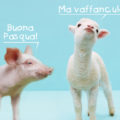
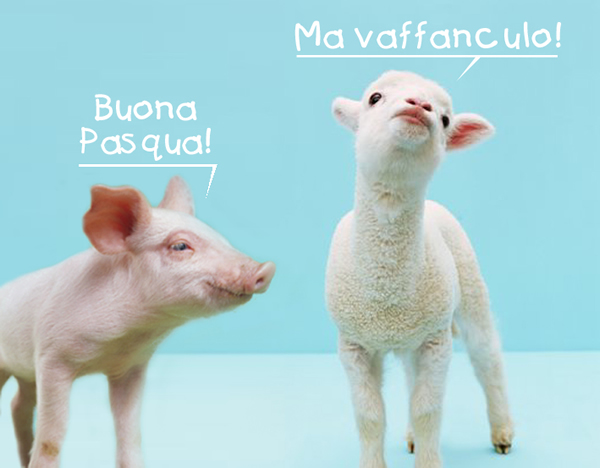
image at top: A reader sent me this from I know not what source (happy to give credit when I find it). The piglet says: “Happy Easter.” The lamb replies: “Go fuck yourself!” – lamb is the traditional Easter meal!
Viados
[vee-ah-DOSS] From a Brazilian term meaning “two ways” or “two-way street”, this term is used for transgender prostitutes.
[ah-chee-DEN-tay] A darn thing, usually used in the negative, as in Non mi ricordo un’accidente – I don’t recall a thing. In normal useage, an accident (as with a car) is un incidente.
QT adds: Ti venisse un accidente – “May you have an accident,” an ill-wish which apparently refers more to serious illness (heart attack, stroke, etc.).
Accidenti
[ah-chee-DEN-ti] A mild expletive, in a league with drat, darn, heck.
Apprezzamento
[ah-pretz-a-MEN-toe] Not a rude word, this translates roughly as “appreciation” or “comment”, but it’s used most often in apprezzamenti pesanti (pesanti = “heavy”) for the kind of “appreciative” comment made to a woman that would cause her husband, boyfriend, etc., to react angrily. Such comments are often followed, in the news reports, by violence.
Arrapare
[ar-ra-PAR-ray] To become sexually excited.
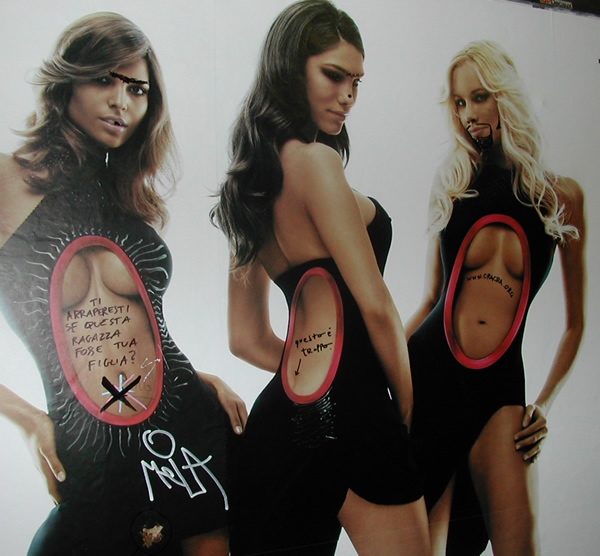
The graffiti scribbled on this poster says: “Would you get hot (ti arraparesti) if this girl was your daughter? – This is too much. – www.cracra.org”
Attaccabottoni
[ah-TAHK-ka-bot-TONE-ee] Literally a “stick-to-buttons”. A long-winded bore. Someone who “grabs you by the lapel” and won’t let go. This term is not particularly rude, except to the person to whom you apply it!
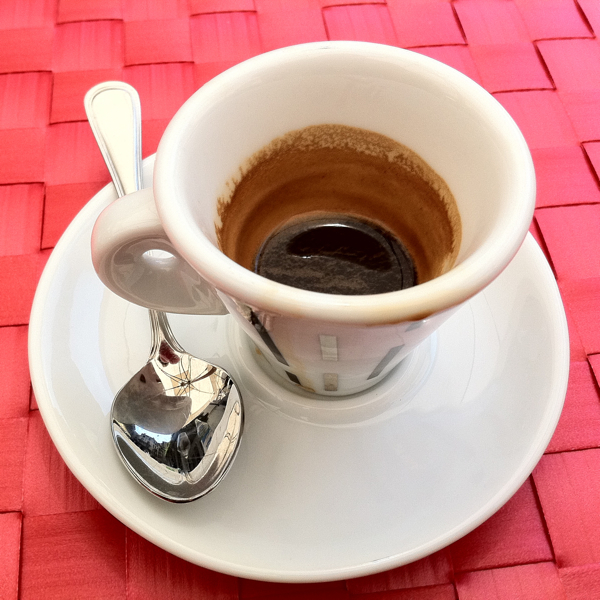
Although Italy has some of the best coffee in the world, Italians don’t drink nearly as much of it as you might think. My own routine, which I suspect to be fairly average, is:
one at home at 7:30, before starting my commute
one fairly soon after arriving at work, around 10 am
one right after lunch
If I’m having a particularly sleepy day I might have one sometime between 10 and 1 (pre-lunch) and/or, very rarely, one in the late afternoon. Five a day is unusual for me, and many people I know consider four overdoing it ¬– though I did talk to a barista once who said he used to drink 12 espressos a day.
Most people I’ve observed in this part of the country (Milan / Lombardia) stop with the post-lunch espresso. Some have an espresso after dinner, especially if they plan to be out later, but I don’t see many ordering post-dinner coffees in restaurants. At home we only make coffee at night if dinner guests want it for their own drives home.
It’s true that espresso is concentrated, but, per average serving, it contains less caffeine than American coffee, and Italians do not have the American habit (which I sometimes miss) of keeping a warm mugful on your desk or table and sipping at it for hours.
When foreigners come to Italy, the clash of caffeine culture can be funny. A Swedish colleague once apartment-sat for us in Milan. As part of his orientation, I took him downstairs to our usual coffee bar (which also made excellent gelato), introduced him, and asked them to treat him nicely. They talked for months afterwards about his peculiarities: he habitually ordered double espressos, which baffled them. For starters, a double won’t fit in the standard single espresso demi-tasse cup, and they disliked the aesthetics of serving espresso in a cappuccino cup. He also mostly lived on gelato that month (it was August), which, while they appreciated the compliment to their gelato, is not standard Italian behavior!
The other day, I overheard a young Italian woman on the train discussing a foreign guest who had visited their home. “We made a moka of coffee, and she thought it was all for her. She drank the whole thing!” “I could never drink that much coffee!” exclaimed her friend, “I wouldn’t sleep for days!”
When Italians make coffee at home, they most often use the moka, a screw-together pot you put on top of the stove. These come in capacities from 1 to 10 cups, and a family may own several sizes, to cope with various occasions. But a four-cup moka makes less coffee than you’d find in a Starbucks “tall” – no wonder the American guest was confused.
Yes, you can get fancy home espresso machines here just as you can in the US, but, to make consistently good espresso, they require a high degree of maintenance and skill. Most Italians can’t be bothered, especially when they can get better coffee for far less fuss at the bar down the street. (Though a few make it a point of fetishistic pride to be able to make at home a coffee “just as good as you get at the bar.” In counterpoint, some espresso machines in bars are decorated with the slogan “REAL coffee you can only get at the bar.”)
Coffee made in the moka can also involve more or less fuss, and is quite a different thing from bar espresso. It took me years to acquire the taste, and I still haven’t learned to make it consistently good. But I got tired of trying to reproduce the consistency and flavor of good American-style filtered coffee. I think that this winter, when I want a big hot drink, I’ll stick to chai.