Category Archives: Italy

An Italian Middle School

Rossella’s middle school experience is no pleasure to think back on; in short: it was a mess. As I mentioned in my article about elementary school, we had thought that Ross was getting bad grades in elementary because she was bored, so we chose a challenging middle school, Milan’s grandly-named Educandato Statale Setti Carraro dalla Chiesa. It had been founded as a boarding school for the daughters of Napoleon’s officers (hence the old name, “Collegio delle Fanciulle” – girls’ boarding school – by which it is still known by many). Nowadays it’s a public school, but still housed in a beautiful old palazzoin the center of Milan. Well, beautiful for a school. The conte who built it had ambitions that far outran his cash, so after building this huge place he had little money left for the interiors. There is a lot of tromp l’oeil marble, as well as interesting ceiling frescoes in some classrooms, and several statues of Napoleon.

I don’t know how long ago it became public, but the school to this day runs by its own rules. Unlike most public schools, it is academically selective; Ross got in by being personally recommended by two alumni. It is also “integrated,” meaning that all grade levels are housed in a single facility with a single administration; this, too, is unusual. And it’s not fully co-ed: the school admits a few boys in the elementary school, but in middle school no new boys can enter (the school claims not to have the facilities for them), and there are no boys in high school at all. There are only four or five boys at each middle-school grade level, kept together in one class section; Ross ended up in the section with no boys at all. Which was probably all to the good: those few boys get way too much attention, and some of them come out with grossly swelled heads. A friend of Ross’, a boy one year older, happened to go to the same school, and Ross’ prior acquaintance with him was much resented by his female classmates, even though there was no romance in it.

Unusually for Italy, Setti Carraro has boarding facilities for a few students, but it’s all rather sad. Ross volunteered to stay there for two separate one-week periods, when Enrico and I both had to travel. She thought it an adventure, but the girls who were there year-round did not, and after Ross described it, I understood why. The boarding group was too small to form a community, and they didn’t have much opportunity to socialize outside of boarding, so it was a very dull life for them.

Setti Carraro prides itself on academic rigor and teacher quality. As I’ve mentioned before, it doesn’t take much to get qualified as a teacher in Italy (though that is changing), so teaching methods tend to be a combination of tradition and personal inclination. Many teachers rely heavily on rote memorization, which is easier for teachers, but not effective for many kids. Most Italian parents see nothing wrong with this, because it’s the way they learned themselves. No allowance is made for differences in learning styles or strengths.

We had attended a presentation about the school before selecting it for Ross. They told us then that the kids would be in school until 5 pm, Monday through Friday, but that lessons ended around 2:30, leaving time for a break and then study hall, so that by the time they reached home they would have no homework to do. This turned out not to be true. Some days they had classes until 4:00, and most days they came home with homework anyway. By the end of the first year, parents were protesting vigorously, but nothing changed, and we were told that this had been the pattern, year after year.

I am still trying to figure out what, exactly, “homework” means in Italy. My understanding of the term, based on experience elsewhere, is that it’s something you do on your own to reinforce or practice what you’ve learned in class. Here, however, the kids were often told to study something entirely new on their own at home, and often needed their parents’ help to absorb new material. The books were not always helpful, being written in a heavy academic style that even I found hard to follow (though I read general Italian very well). We spent hours tutoring Ross, and this is the norm for many families. I don’t know how families with multiple children are expected to cope.

Homework was also assigned for most vacations. During the summer between 6th and 7th grade, we spent several hours a day for the entire month of August helping Ross with homework, or at least trying to keep her on track to get it all done. This did not make for a relaxing vacation for anybody.

Ross’ grades continued poor through 6th grade. We hoped that, after the first year, things would settle down, she’d get into the demanding rhythm, etc. She was very conscientious about getting her homework done (and remains so to this day – one good outcome of this school), but it was never enough.

I attributed her ongoing woes to culture clashes, teaching styles, “could try harder”, whatever – grasping at straws, really. By February of her 7th grade year, I realized that there had to be something else going on. We had Ross tested by a child psychologist in Milan, and it turned out that, while extremely intelligent (no surprise there), she has some problems in concentration and memory – you could call it borderline Attention Deficit Disorder, but we didn’t bother to pursue a definitive diagnosis. The label would do her no good in the Italian education system, which barely recognizes dyslexia, let alone more “exotic” learning problems. (In the Italian press, ADD is widely reported as something that American parents invented so they could drug their children into passivity.)

This is another hole in the Italian system which makes me crazy: very few teachers have any training in recognizing or coping with learning disabilities. It’s likely that some things are overdiagnosed in the US, but many lives have been ruined by the failure of educational systems to recognize or address real problems. Ignoring learning disabilities is certainly not the answer.

I tried to explain Ross’ problem to the teachers, without much success. It was hard enough for me, motivated as I was, to figure out different ways of presenting information so that she could absorb it more effectively. Teachers with little training and no motivation weren’t likely to get far, and most of them didn’t try. In the end we all agreed that it would be best for Ross to go to a less demanding school for 8th grade.
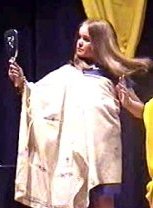
CassiopeiaThe one area in which Ross was able to shine at Setti Carraro was acting. The best teacher they had (and she was very good) believed in drama as a form of literature, and a way of learning literature. In 6th grade, they studied Greek myths, and did a series of short plays based on myth. Everyone got at least one major role, but Ross was a particular hit as Cassiopeia, the vain queen who brings down the curse of Venus. It was also noted, and duly exploited, that she learned everyone else’s lines as well as her own – no memory problems there, interestingly. In 7th grade, they did excerpts from “Orlando Furioso,” where Ross played Sacripante, a Sancho Panza sort of character, wearing a pillow for a paunch, and stomping around in my oversized Tibetan boots.

Schoolbooks: Part of the Cost of an Italian Education

Education through university level is basically free in Italy, at least in theory. You don’t pay tuition at most schools, but there are costs, including buying textbooks every year. There is something of a used-textbook market (in the Milan area, dominated by a chain of bookstores called Il Libraccio), but the publishing companies dilute its effects by frequent new editions. The teachers play into the system by insisting on the new edition, or changing the books entirely. I wonder if they get a kickback…?

The Ministry of Education has set theoretical limits for how much a family should be required to spend per child per year. According to a consumer group, this limit is 280 euros for 6th grade (the first year of middle school), 108 euros in the second year, and 124 euros in the third – the expense is front-loaded on the first year, as some books may be used throughout the three-year cycle of middle school. This consumer advocacy  group found that 34% of the families surveyed in Rome and Milan had spent more than the ministerial limit.

The limits are naturally higher in high school. Our daughter’s choice of liceo artistico (art high school) may be the most expensive option of all: besides a full quota of books for academic subjects, there are books for art history, and the ongoing expense of art supplies.

There are no lockers in Italian schools, so whatever books and supplies you need for class each day must be carried from home, in bulky backpacks. Years ago, parents began to complain that the number of books required each day was excessive, resulting in very heavy backpacks. Pediatricians pitched in with tales of childhood back pain and scoliosis, so a decree went forth from the Ministry of Education about the maximum weight a child could be made to carry (I think it was expressed as a percentage of body weight). How this was to be enforced was never specified; it would have required coordination among the teachers to decide who would require what books to be brought on any given day. I doubt that it was ever enforced. Backpacks with built-in wheels are popular, like that rolling carryon luggage that people use on planes, but, like the luggage, they are unstable, tending to flop sideways and twist your wrist, and the wheels only make them heavier when you have to tackle stairs. Backpacks are more comfortable to carry than old-fashioned leather satchels, but older adult commuters fondly remember the satchels – the habit was to drop them on the floor by your feet, whereas backpacks stay on backs and bash into everyone around them on the bus.

From what I remember of American public schools, books were lent by the school to each student every year. Presumably this was part of the school budget, and therefore covered by the parents’ taxes. American schools also have lockers to keep books in, though you then have the problem of forgetting at school a book you need for homework. When I was looking for a school for Ross in California, I found one that had resolved that problem by giving each student two full sets of books: one for school, one for home. Must have been expensive for the taxpayers, though.

How to Get (Slightly) Better Customer Service

David Pogue of the New York Times has written a series of articles on “Customer Service Cluelessness,” in which he postulates that the incorrect billing many of us suffer from various companies is actually a money-making stratagem: most of us won’t notice small discrepancies on our bills, or won’t spend the time to communicate with the companies to get them fixed, so the companies get to keep the bulk of their ill-gotten gains.

As I mentioned before, Tiscali, my former ADSL provider, tried to stick me for € 570 back in July, after I had left their service. But that was only the end (I hope) in the Tiscali saga.

That began two years previously, when I was first trying to get ADSL up and running in Milan. I applied online in April, had some paperwork problems, and didn’t actually receive the modem until June. Then there were problems with the line, which would have to be fixed by Telecom Italia, and Tiscali told me that could take weeks – by which time I expected to be out of the country. I told them: “Call me as soon as it’s fixed;” the only other way for me to know it was working would have been to test it myself every day.

I didn’t hear anything. I returned to Milan on September 10th, 2001, and called tech support again the next day.

“Oh, that was fixed back on July 11th,” he said, “Why don’t you try it now?”

I tried to go to to CNN, but couldn’t get through. “Still not working,” I said.

“Try our site,” he said.

I did. It had a news feed. And that was how I found out about the Twin Towers. “Something very bad is happening,” I said, and hung up on him.

The good news was that the line was in fact working. However, when the bill arrived, they had billed me back to July, wanting me to pay for two months in which I had not been using it, because I didn’t know it was working.

I called customer service. “We got it working in July,” they said, “so we began billing in July.”

“I was home and could have used it til August,” I replied, “but you were supposed to TELL me it was working, and you didn’t.”

“The technician tried to call.”

“He must not have tried very hard. We have an answering machine. Or why didn’t he send email?” No satisfactory answer was forthcoming.

I decided to make a formal complaint. The customer service rep said I should write all the details in an email and send it to an anonymous customer service address.

“Fine,” I said. “I’ll copy it to your president. What’s his name?”

“That’s not necessary,” said the lady stiffly. And she refused to tell me the name. I was surfing the net while on the phone with her. A few clicks later, I found Tiscali’s corporate site.

“Ah, here he is: Renato Soru. Okay, let’s try renato.soru@tiscali.com…”

She went into a panic. “He’ll never read it!” she said.

I wrote a long message with all the details, being careful to give praise where that was due (“The customer service rep was very polite, even when I was screaming at her.”) and to explain what went wrong and where, and what kind of restitution I was expecting.

Renato Soru did read it, or at least his secretary did, and she replied politely that Dr. Soru thanked me for letting him know how things were going in customer service. She claimed that I would still have to pay for those two months, but in fact I was never billed for them, either through oversight or because someone realized that I shouldn’t be.

Writing to the big boss is an old trick in the US, but it seems that Italians are not used to it. It will still get results even in many US companies, if nothing else to get you off upper management’s back. Of course the email address of the president/CEO is not going to be posted on the website, but it’s usually pretty easy to guess: try variations on firstname.lastname@companyname.com, firstinitiallastname@, etc.; something is bound to work. webmaster@companyname.com may never answer you, but the president might.

Now we’re having a big hassle with Telecom about overbilling (to the tune of 500 euros). It’s time to write another letter…

Hospital Stay

I have suddenly landed a temporary but demanding job: nursing my daughter. Ross fell off her horse Sunday afternoon, onto hard ground, and broke her humerus just below the shoulder joint.

The emergency room was humming – it was a beautiful day, everyone was out getting hurt. Just before we got there, an ambulance had brought in a young man in motorcycle leathers, who looked pretty severely injured. According to a conversation I heard among the nurses, Lecco gets a lot of motorcyclists – and accidents – on sunny weekends. Another young man had been out hiking in the mountains, slipped on a patch of ice, and banged his head and chin.

They quickly got Ross through an initial examination and x-ray, drew blood, then took us up to a room on the orthopedic ward. Ross was trembling when the anesthesiologist came to talk to her; given recent family horror stories with hospitals, we were all terrified that she had to go under anesthesia. But those stories took place in the US and the UK. So far, I have no complaints about Italian health care. [later on, we had an Italian horror story to add to the family history]

The anesthesiologist gave her a sedative, and off we went to surgery. Ross told me later that, by the time they actually got her into the operating room, she was giggling and wondering why she had been so scared. She lay there looking at all the bustle around her, wondering if they had a machine that goes “ping!”

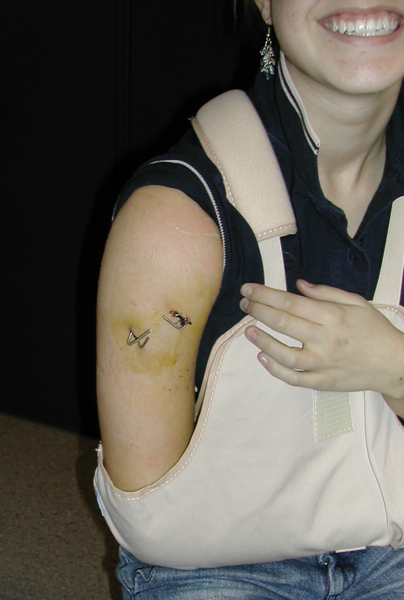
We had arrived at the emergency room at 5:15; by 7:15 she was under. The surgeon had to pull the bone back into place, and then put in three wires to hold it while it heals; Ross is also wearing a sling-and-strap to hold her arm against her body. Her right arm. No drawing in art school for a while.

Giulio (owner of the private stable where we now keep Hamish) and Viola (his daughter, Ross’ classmate and riding buddy) came racing down from their ski weekend to be there, and passed the time during surgery regaling me with stories about their numerous family sports injuries (they ride and ski, Giulio and Viola compete seriously at both). As Giulio pointed out, it’s lucky this happened right before Christmas vacation, so Ross won’t miss too much school.

Giulio also demonstrated the usefulness of the small-town grapevine: when he heard the name of the surgeon, he called his sister-in-law, who happens to work at the hospital as an orthopedic surgical nurse. She said that we were lucky: this surgeon’s a good one. And she came by the next morning to see us in person. If we need any inside information on this case, we’ll know where to get it.

There was a spare bed in Ross’ room, so I was allowed to stay with her. The first night she was in a lot of pain, understandably, but since then has bounced back with most of her usual energy and sense of humor. They let her out yesterday (Tuesday), and today she’s gone back to school (the doctor said there was no reason she shouldn’t, as long as her arm doesn’t get bumped). She’ll need to have the bandage changed every 3 or 4 days, to ensure that no infection enters where the wires are; those will come out after 25 days, and she has to keep wearing the sling til then. So I’ll be accompanying her to doctors a lot, as well as helping her dress, wash her hair, etc. As I said, it’s a job. But that’s what moms are for.

Jan 19, 2004

Rossella‘s arm has healed well. The wounds (from the surgery) were so clean that her bandage needed changing only three or four times over the month. Last Tuesday we went in for a final x-ray and, seeing that everything looked fine, the doctor pulled out the wires, using a pair of common (even somewhat rusty) household pliers. According to Ross, it felt weird, and the idea was gross, but it didn’t actually hurt.

So now she’s down to band-aids over the holes, and only needs to wear the sling at night. We’re trying to schedule physical therapy; in the meantime, she can use her right arm again, as long as she avoids swinging it out from the shoulder – no dancing the Funky Chicken..

The hospital staff were amused: Ross is the only patient in their experience who wanted a picture (while the wires were still sticking out – her arm looked like a construction site), and to keep the wires as a souvenir. But, as they noted, this attitude coincided with the Clockwork Orange t-shirt she was wearing.

Of course she wanted to keep the wires; she couldn’t wait to tell her schoolmates: “Piercing? Hah! I’ll show you REAL piercing.”


Apr 27, 2004

Ross has healed up fine from breaking her arm in December, and is back in the saddle of her beloved Hamish. She’s had some moments of fear, but is gradually feeling comfortable riding again (it was totally up to her to do so; her father and I might have been just as happy for her to give it up now).

High (School) Society

In America, high school is hell. The movie The Breakfast Club (1985) used sharply-delineated characters to illustrate the social divisions that exist in many/most schools: the jock, the prom princess, the stoner, the brain, the geek. It’s a caste system, where positions are won by looks, money, or athletic ability, and the hierarchy is maintained by ostracism, teasing, and violence.

Columbine focused attention on the extreme results: the outcast loners who exacted bloody revenge. Steps have been taken to prevent recurrence; weapons searches have been instituted (in many schools, simply increased), conflict-resolution courses and post-trauma counseling are offered. Yet bad stuff continues to happen, some of it perpetrated by the top dogs on the underdogs, some of it by underdogs using weapons to shift the balance of power. The underlying problem has not changed: there are still top dogs and underdogs.

One solution being tried is separation: if you can’t survive in a normal high school, go somewhere else. The Harvey Milk School in New York city was created for gay students who were mercilessly bullied in other schools.

The New York Times (“School Away From School,” Dec 7, 2003) now reports on virtual high schools, where kids can do high school coursework at long distance, with testing, grading, and teacher support provided online. Some of the virtual school students interviewed had suffered in the high school social system, others feared what they themselves might become under social pressure. Some are simply too smart, and several grades ahead of their age group (a proven recipe for social disaster), others suffer various degrees of distraction/ADD, and find they can concentrate better at home.

Homeschooling (where the parents do the teaching themselves) is also common in the US. For some families, this is a religious choice; for some, it’s about quality (or special needs); for many, it’s probably both.

You have to wonder what the kids are missing in all of these non-standard school experiences. A fair amount of misery, to be sure. But what happens after high school, when they suddenly have to deal with all sorts of people? (Yes, I know that many homeschooling parents go to great effort to ensure that homeschooling does not cut their kids off from the usual kid experiences and contacts; I also know some whose main reason for homeschooling is to keep the kids away from “bad influences.”)

There’s got to be a better way for adolescents to get an education. I don’t have definitive answers, but I’ve been thinking hard about examples I’m familiar with from other parts of the world.

At Woodstock, tolerance was and is the norm, and violence is rare. In my four years of high school, I only heard about one incident in which a guy even tried to hit somebody. (He missed, and smashed his hand into the wall.) Severe bullying and teasing were fairly uncommon in my day, and as far as I know still are.

There are plenty of differences among Woodstock students – nationality, race, religion, wealth, background, you name it. But there’s no caste system. There are jocks, brains, prom queens, and stoners – and they’re often the same people. Maybe this is because the school is so small that we all had to fill multiple roles. My roommate was a basketball player and a cheerleader, played in band and orchestra, and worked on the yearbook. I was a journalist and public works artist, worked on the yearbook, wrote a student handbook (my first manual/user guide), and was president of the dorm. Another classmate was student body president, on several sports teams, and was a yearbook photographer. Of course we all had plenty of schoolwork to do as well. Maybe we just didn’t have time for the rubbish that goes on in American schools.

The rigid social divisions of American high schools don’t seem to exist in Italy, either. Ross tells me that there are some cooler kids, though in her current class she can’t tell me who they are or what makes them cool. Her middle-school class had an alpha male, so-considered partly because of his trendy clothing. Her current class has some kids who don’t interact much; she is studying the problem, trying to figure out how to involve them more in the social life of the class. In any case, they don’t seem to be particularly bullied or teased.

Maybe the American emphasis on competitive sports is part of the problem. Italian schools don’t do sports in the same way. They have physical education classes, and Ross’ current high school has after-school basketball, but it doesn’t seem to be a big deal. Lecco is an athletic town, and many kids do competitive sports, but elsewhere, either as individuals or with teams that are not related to the schools. So athletic ability is not particularly noticed in school.

Woodstock has plenty of sports, but, in my day, being an athlete didn’t carry more cachet than any other accomplishment. I don’t recall anybody swooning over a guy because he was captain of this or that team. Good sportsmanship was considered more important than winning (though winning was also fun).

Perhaps Woodstock and Italian schools have less strife for very different reasons. In Woodstock’s case, it’s partly due to the extreme variety among the students: there are so many differences that no single group can easily rule the roost.

What works in Italy may be homogeneity: everyone in a given school is very similar to everyone else in background and experience, and any differences are smoothed down, de-emphasized. There are no accelerated classes for extra-smart kids, and those with disabilities (physical or learning) are, as far as possible, mainstreamed into regular classes, with extra teaching support provided right there. This also applies to recent immigrants, who generally attend regular schools and lessons, with some extra help for Italian language.

So what goes wrong in American schools? I’m groping here, but maybe the problem is an intolerant heterogeneity. America is still a melting pot, but American culture demands that people fit in, and take on the same values as some fictive majority. Kids are especially conservative, and not inherently politically correct, so this is played out more overtly in school than later in life. Now there’s a scary thought: is American high school simply a microcosm of what’s going on, clandestinely, in American culture at large?

Note (Oct 7, 2010): Sadly, there have been cases of bullying at Woodstock in more recent years. And it’s all gotten much worse in the US.