This trip gave me food for thought on many topics, so I’ll divide this account into subheadings.
Travel Reading
Milan’s Linate airport no longer has a newsstand once you pass security, so buy your reading material before you go through! There’s a big magazine/book store near the check-in counters.
I did have a book with me: I re-read Roger Zelazny’s “Lord of Light” after many years, and greatly enjoyed it. But I read fast, so it wasn’t long enough to get me through the 10-hour flight from Madrid to Chicago (especially when that turned into an 11-hour flight – all four Iberia Airlines flights I took on this trip were late)Airport bookstores tend to be disappointingly stocked – best-selling trash and not much else. “The Da Vinci Code,” which I had read at my dad’s house in a fit of boredom and curiosity to know what the fuss was about, is not great literature. It’s very poorly written and the plot is only minimally interesting; the “big revelation” was already familiar to me since my dad read “Holy Blood, Holy Grail” years ago and told me all about it. But “The Da Vinci Code” continues to sell, along with many derivative and imitative works, plus everything else Dan Brown has ever written. Which I will never bother to read – hell, even the jacket blurbs are poorly written!
I made sure to hit a Barnes & Noble bookstore before I left Las Vegas, so on the return trip I read Sharpe’s Rifles and Master and Commander – though I didn’t plan it that way, both are series about the British military during the Napoleonic Wars, one set on land and the other at sea. A further similarity: in both, the English hero’s best friend and staunchest supporter is Irish. Both are rich in detail about military structure, equipment, etc. And both are superbly written, though O’Brian’s “Master and Commander” has more humor, most of it sly and understated.
Security
Security was a different process in each of the four airports I passed through on this trip. In Milan, I had to place my feet (with my boots on) onto a new shoe-sniffing machine. In Chicago, I had to remove my laptop from my backpack and put it through the x-ray machine separately, which seemed pointless as they didn’t do anything particular to it.
Leaving Las Vegas, I was one of many randomly selected for the full treatment – separate line, remove boots, my laptop got swabbed and sniffed, and I got the full wand treatment, plus patting along the sides of my ribcage (by a female security person). I did not get the third-degree bra-grab that some American women have complained to the press about. FYI, a full-body pat-down for all passengers has been routine at Indian airports for as long as I can remember, carried out discreetly behind screens by same-sex security personnel. I guess it’s new to Americans, but has never been a big deal to me. I’d rather get felt up than blown up.
Fortunately, I am a paranoid traveler, and had allowed myself plenty of time at the airport, so the extra time in security wasn’t a problem. Some people who did not check in so early risked missing their flights.
Tsunami
Tsunami news in America, as everywhere else in the world, focuses on the local. Italian headlines concentrate on the handful of Italian dead (with several hundred still missing). Lecco’s papers, even more narrowly focused, were about the one Lecchese confirmed dead and three more missing.
Other countries’ news media are no different. These local obsessions usually get on my nerves, but an article by Italian journalist Beppe Severgnini, published in “Il Corriere della Sera” a couple of days after the tsunami, pointed out that bringing the global down to the local is the only way for some people to grasp it. I grudgingly admit that he’s got a point.
For myself, I hope that no news continues to be good news. One story I’ve heard so far through the Woodstock grapevine is that a Sri Lankan alum a few years younger than myself (I knew his older sisters) was vacationing on Sri Lanka’s east coast with his family. They were the only survivors at the hotel where they were staying, and took four days to find each other at various hospitals (though fortunately their injuries were only minor).
Media
You can learn a lot about a country from its advertising. One theme in the US is ads about products and services designed to let you work ALL THE TIME: “Turn your car’s passenger seat into an office.” “You can never afford to lose important data” – the photo shows a guy with a laptop beside a pool, beavering away while people around him are relaxing and having fun. No wonder so many Americans crave the laid-back (as they perceive it) Italian lifestyle.
Globalization
I didn’t get to see much of the Consumer Electronics Show that we went to Vegas for – most of that time we spent tucked away in a hotel suite with our hosts, Toshiba America Electronic Components, doing demos by appointment.
We did have a few hours here and there to hit the show floor, and had to wade through the crowd every time we arrived or departed from the hotel or (god help us) tried to get lunch or coffee. So I was able to observe other attendees, and what a study that was – globalization in action! The largest single group of attendees might still be white American men, but there were very large minorities of Japanese, Chinese, and Indians, who together outnumbered the white guys.
The group we were working with from Toshiba was a microcosm of this trend: the top bosses are Japanese, two senior marketing managers are Indian (both living in the US for many years), one engineer is a recent arrival from India, and one is Japanese. There were also two women, one Chinese-American and one Caucasian.
Personally, I cheer at this: I want to see India do well, and, now that the Indian entrepreneurial spirit is finally being unshackled from government regulation, it undoubtedly will do very well. Ethnic Chinese already run much of Asia’s economy, so it’s no surprise that China is moving into position to dominate the world economy, and not just because of its huge population. I was thinking about this from Day 1 of CES (January 6th), so I was wryly amused at this week’s fanfare over a National Intelligence Council report drawing similar conclusions. You don’t need to work for the CIA to see where the world economy is heading.
Standing in the extra-security line leaving Las Vegas airport, I fell into conversation with a young Indian man carrying a shoulder bag from the CES show. It turned out that he’s from Delhi, and runs an export business from India, China, and Thailand into the US and Europe. He had come to CES to see what new technologies might be helpful in his business. He asked what I had been doing there, and I told him about TVBLOB. “For example,” I said, “You can create your own custom TV channel, and broadcast it anywhere in the world.” He got it instantly: “I could create a channel for my subscribers, and show them new goods they’d be interested in!”
Alienated
I’m beginning to wonder where in the globe I’m “from” nowadays. Most Americans I spoke to assumed I was foreign, at least during the first few days of the convention. Apparently my accent has become mid-Atlantic, and to Americans I sound British. I pick up accents quickly, however, so I suppose I was sounding more American by the end of the show, although much of my conversation was in Italian, with my Italian and Bulgarian colleagues.
Customer Service, Good and Bad
Kudos to Macy’s: When the lady at the cash register realized we were foreign (at least, one of us was), she told us we were entitled to a discount with an “International Savings Card”. To get it, all we had to do was go to the gift wrap window and show proof of overseas residence; the card gives an 11% discount on just about everything at Macy’s.
Big thumbs down for FedEx: They screwed up the outgoing shipment of our box of demo equipment because the people in Milan didn’t know what forms were needed, so it got hung up in Memphis and barely arrived in time to be useful. To send it back, I went down to the Hilton Business Center. The young lady there tried for quite a while to get her FedEx software to accept the shipment with appropriate insurance, but something was wrong, and she needed tech support for the software. This was on a Sunday, the day the CES show ended, and we then discovered that FedEx’s tech support office is not open on Sundays. Which is absurd for an international shipping company. So I shipped it UPS, which cost 50% more, but the box departed Las Vegas and arrived in Milan without further hassles.
Las Vegas
I’d never been to Las Vegas before. It’s not the sort of place I would have chosen for a vacation, and I will never go there again unless I have to – once is quite enough.
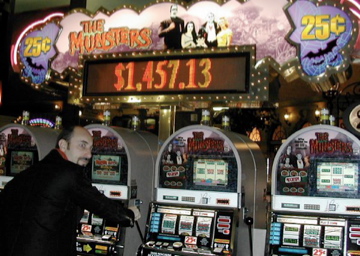
For a hyper-attentioned person like myself, Las Vegas is exhausting, especially inside the casinos. The casino floors are a wilderness of slot machines, thousands of them, with flashing lights, animated displays, moving numbers, and sound. They come in an infinite variety, with themes from TV shows, video games, movies, even the game Monopoly. Gambling (or “gaming,” as it is euphemistically called) is forbidden to minors, so you have to be at least 18 to get near these machines, and in fact most of the bettors are far older, which makes the childishness of the decor frankly bizarre. Is gambling supposed to be related to childhood in some way? Are the manufacturers mixing metaphors of childish and adult “play”?
Perhaps I shouldn’t be so hung up on dignity; everything about Las Vegas proclaims it a Disneyland for grownups. The glamour is all fake: cheap rhinestones and “crystal” chandeliers, gleaming brass, colorful carpets. Most of the shows are meant to be sexually titillating (even some for women – at least we have equality), but bare breasts and simulated sex are as far as they go, at least in this part of town. The only show I got to see was the free one outside the Treasure Island casino, presumably toned down for a general audience. It was one of the stupidest things I’ve ever seen.
I did buy a new (cheap) video camera, so was able to get some fun footage.