Category Archives: travel

On the Road in Arkansas, Oklahoma, and Texas

Dec 27-30 , 2005

I left home early on the morning of Dec 26th (with Enrico driving, bless him) to go to Milan’s Malpensa airport – unfortunately, Milan’s only hub for trans-Atlantic flights is the airport furthest away from Lecco, it takes us nearly two hours to get there.

I was flying Alitalia, an airline of dubious quality – the standard joke is that “Alitalia” stands for “Always Late in Takeoff and Late in Arriving.” At least check-in was efficient. Other US-bound flights I’ve taken from Malpensa have checked in with extra security at a cordoned-off area at the end of the airport, but Alitalia doesn’t do this, even though the flight was direct to Chicago. Which puzzles me. Do we assume that United, Delta, and British Airways are more likely to be targeted for nastiness, even when flying to the same destinations?

Enrico and I had a second coffee together and said goodbye, and I proceeded to security. It was fortunate that I was ahead of schedule, because it took about 20 minutes to get through – everybody in Italy seemed to be anxious to leave, now that the obligatory “Natale con i tuoi” (Christmas with your family) was over.

We boarded on time, then sat on the runway for about an hour, for no reason that was made clear to us passengers. I heard one finally ask a stewardess about it, who said: “Oh, the pilot announced that, when he said we were third for takeoff. Each takeoff slot is half an hour.” (I may be misquoting her numbers, but that was the gist.)

Since all flight schedules include at least half an hour of padding, we were pretty much on time arriving in Chicago, so I had a comfortable margin to get through immigration, retrieve my luggage, and recheck it to my final destination. At immigration, as usual, I was asked what I had been doing in Italy, and got the usual blank look when I replied that I live there. I don’t know why this is always a shock to immigration agents. Some even say rather aggressively: “Well, welcomehome.” As if I should repent of ever having left. I guess they are so accustomed to dealing with people desperate to get into the United States that they can’t conceive of anyone voluntarily leaving.

I was directed to the red channel for customs, for no reason that I could determine. The reason was even less clear when they did not open my luggage at all. The guy typed on his computer for a while, then said I was free to go. ???

I checked my bag with American Airlines and took the train to their terminal, where I had about two hours to kill before my connection to Little Rock. First, of course, I had to go through security again. This meant taking my laptop and videocamera out of my backpack, and putting them in separate bins along with my jacket and my boots. Then having to put it all back together again at the other end. <groan>

I had a neck and back massage – a truly useful airport service after hauling heavy luggage around and then sitting for ten hours. I ate half a bagel (we don’t get bagels in Italy), and got on the little bitty plane to Little Rock.

My college roommate Stephanie and her mom were there to meet me. We ate, then drove to Russellville where Steph’s parents live. I met their very exuberant pair of Scotty dogs, had a shower, and collapsed.

The next afternoon we hit the road for Tulsa, Oklahoma, where Stephanie lives. I didn’t mind the ride, because Steph is good company, and the scenery was different from what I’m used to, though not intrinsically fascinating. The sunset was so vivid that we suspected something had been burning. We later learned that brush fires were raging in northern Texas and Oklahoma. The area is suffering a drought and “burn bans” are in effect in both states, meaning, I suppose, that you can’t burn your trash or light a campfire. New year’s fireworks were still on sale, although reportedly at least one of the brush fires was started by kids playing with fireworks. Apparently the states cannot interfere with trade by banning the sale of fireworks, no matter how sensible it would be to do so in conditions of severe dryness and high winds.

We spent a couple of days in Tulsa, I did some errands, including buying a cellphone. The nice man from Tracfone with whom I exchanged emails hadn’t been able to help with a fast enough alternative payment method for me to buy a phone from their website, but I found a cheap one ($20) at Wal-Mart, and bought a 150-minute/one-year card (for $90) so that the number will not expire, and this phone will work immediately on any of my family’s future visits to the US.

I should mention that Tracfone’s online activation process was smooth and easy – a pleasing contrast to so many websites which are just too damned hard to use!

Thursday we left for Texas, staying overnight in Dallas with a Woodstock alumnus and his family. I hadn’t actually met Steve (class of ’68) before, but I know several of his classmates (e.g., Tom Alter), and Woodstockers always find plenty to talk about – sometimes to the sheer boredom of those around them! (Steph bore up heroically, and Steve’s family was clearly used to it.)

Friday we made our leisurely way to Austin, stopping to shop at an “outlet mall” along the way to buy clothing, mostly for Ross. I tried to get a picture of the highway sign for “Italy, Texas”, but somehow, throughout the trip, almost everything I wanted to film was backlit.

That evening we met my brother Ian for dinner at the Iron Works barbecuerestaurant downtown – a classic Texas BBQ joint where you order at a window and carry your own food and drink to your table. I had a combo plate of beef brisket, sausage, and beef ribs, with the standard sides (potato salad, pinto beans, white bread). Heaven on a sectioned paper plate.

Saturday we had to do still more shopping, as I realized that I had left behind somewhere one of the two pairs of jeans I’d packed. I found that a regular Gap store can have better sales than a Gap outlet store. Hmm. Post-Christmas sales are a wonderful thing – practically everything I’ve bought this trip has been half price, sometimes when I wasn’t even expecting it and was already happy with the marked price.

We also went to the downtown branch of Whole Foods Market, Austin’s celebrated home of health-conscious food (and other eco-friendly products), recently moved to a huge new building with underground parking. It was very busy, and we were sardonically amused to note that at least half the cars in the crowded garage were enormous SUVs. Not what I would have expected from the Whole Foods crowd…

New Year’s Eve saw the event I had come to Austin for: a party at Spankyville, the place made famous (as far as my readers are concerned) by my video last February. Julia and Dani celebrated the completion of their new kitchen by roasting an entire pig and inviting all of Julia’s family, and dozens of other friends from all over the world. Their goddaughter brought along her boyfriend and his band, The Four, so we had good live music, tons of excellent food, and very fine company. Someday I will have to do video interviews with Julia’s amazing extended family.

On New Year’s day Steph had to return to Tulsa. My brother Ian and I drove to Aunt Rosie’s farm outside of Coupland,Texas, and had a New Year’s meal of black-eyed peas, along with ham, corn bread, and sweet potatoes. I had not known that, in the American south, you eat black-eyed peas on New Year’s for the same reason that Italians eat lentils: to ensure prosperity in the coming year. My aunt refused to let me do a load of laundry at her house, and made me promise not to do it elsewhere: doing laundry on New Year’s day means washing a member of the family out of your life. I hadn’t known that, either.

Monday I spent quietly, mostly in the hotel, resting up in anticipation of the extreme busy-ness to start the next day.

Tuesday I had to check out of my hotel by noon, but my flight wasn’t til 10 pm. I dropped my luggage at Julia and Dani’s, then went to an Indian restaurant in north Austin to lunch with two Woodstock alumni: one member of the class of ’45, one of the class of ’95. Both were great company, and agreed that it was time to restart Woodstock “curry club” lunches in the Austin area. Ruth (’45) then very kindly drove me back to Spankyville, where I wrote, read, and relaxed until Julia and her family came home from an outing, and we all pitched in to help with dinner (video of which will be forthcoming).

Ian drove me to the airport, and I was off to my next adventure. More to come…

 

Welcome to Spankyville: Texas Hospitality, with a Twist

shot Feb 13, 2005, 2:59 mins, 10.4 MB

compressed with Sorenson Squeeze at 360 kbps video, 96 kbps audio

music by Crosby, Stills & Nash

I’m just back from my third trans-Atlantic trip in six weeks, this one an emergency visit to Austin, Texas, where various of my relatives seemed to be dying. My aunt Rosie did indeed look like death when we arrived, but improved over the week; it now seems that she will survive this latest crisis. (Rosie’s health problems were originally caused by botched surgery, a long, painful story that I will go into some other time.)

Rossella volunteered to accompany me and shore me up emotionally, which she did very effectively. We stayed in hotels near the hospital and of course spent a lot of time at the hospital, but also saw a number of friends and relatives, and a good bit of Austin. I didn’t bother to rent a car; we got rides a lot of the time, and taxis are cheap. We also did an unTexan amount of walking, one day making a circuit from St. David’s hospital on 32nd street, through the University of Texas campus, down to 12th and West Lynn for lunch with a friend, and back again to 21st where we finally called a cab back to the hospital. Warm spring weather was an inducement to be outdoors – the Texas air smelled wonderful after three weeks of rain, and we knew we’d be coming back to more winter in Lecco (where it’s snowing today).

Aside from the circumstances, it was nice to be back in Austin, where I had passed some of my college years. The city has grown a lot, vertically downtown and horizontally towards the edges, but most of the areas familiar to me looked much the same, with funky houses and lots of trees. Sadly, many of the beautiful, twisty Texas live oaks are dying of oak wilt, leaving brown swathes among the green.

more Spankyville here!

Deirdré Does Vegas: CES 2005

This trip gave me food for thought on many topics, so I’ll divide this account into subheadings.

Travel Reading

Milan’s Linate airport no longer has a newsstand once you pass security, so buy your reading material before you go through! There’s a big magazine/book store near the check-in counters.

I did have a book with me: I re-read Roger Zelazny’s “Lord of Light” after many years, and greatly enjoyed it. But I read fast, so it wasn’t long enough to get me through the 10-hour flight from Madrid to Chicago (especially when that turned into an 11-hour flight – all four Iberia Airlines flights I took on this trip were late)Airport bookstores tend to be disappointingly stocked – best-selling trash and not much else. “The Da Vinci Code,” which I had read at my dad’s house in a fit of boredom and curiosity to know what the fuss was about, is not great literature. It’s very poorly written and the plot is only minimally interesting; the “big revelation” was already familiar to me since my dad read “Holy Blood, Holy Grail” years ago and told me all about it. But “The Da Vinci Code” continues to sell, along with many derivative and imitative works, plus everything else Dan Brown has ever written. Which I will never bother to read – hell, even the jacket blurbs are poorly written!

debunking Dan Brown

I made sure to hit a Barnes & Noble bookstore before I left Las Vegas, so on the return trip I read Sharpe’s Rifles and Master and Commander – though I didn’t plan it that way, both are series about the British military during the Napoleonic Wars, one set on land and the other at sea. A further similarity: in both, the English hero’s best friend and staunchest supporter is Irish. Both are rich in detail about military structure, equipment, etc. And both are superbly written, though O’Brian’s “Master and Commander” has more humor, most of it sly and understated.

Security

Security was a different process in each of the four airports I passed through on this trip. In Milan, I had to place my feet (with my boots on) onto a new shoe-sniffing machine. In Chicago, I had to remove my laptop from my backpack and put it through the x-ray machine separately, which seemed pointless as they didn’t do anything particular to it.

Leaving Las Vegas, I was one of many randomly selected for the full treatment – separate line, remove boots, my laptop got swabbed and sniffed, and I got the full wand treatment, plus patting along the sides of my ribcage (by a female security person). I did not get the third-degree bra-grab that some American women have complained to the press about. FYI, a full-body pat-down for all passengers has been routine at Indian airports for as long as I can remember, carried out discreetly behind screens by same-sex security personnel. I guess it’s new to Americans, but has never been a big deal to me. I’d rather get felt up than blown up.

Fortunately, I am a paranoid traveler, and had allowed myself plenty of time at the airport, so the extra time in security wasn’t a problem. Some people who did not check in so early risked missing their flights.

Tsunami

Tsunami news in America, as everywhere else in the world, focuses on the local. Italian headlines concentrate on the handful of Italian dead (with several hundred still missing). Lecco’s papers, even more narrowly focused, were about the one Lecchese confirmed dead and three more missing.

Other countries’ news media are no different. These local obsessions usually get on my nerves, but an article by Italian journalist Beppe Severgnini, published in “Il Corriere della Sera” a couple of days after the tsunami, pointed out that bringing the global down to the local is the only way for some people to grasp it. I grudgingly admit that he’s got a point.

For myself, I hope that no news continues to be good news. One story I’ve heard so far through the Woodstock grapevine is that a Sri Lankan alum a few years younger than myself (I knew his older sisters) was vacationing on Sri Lanka’s east coast with his family. They were the only survivors at the hotel where they were staying, and took four days to find each other at various hospitals (though fortunately their injuries were only minor).

Media

You can learn a lot about a country from its advertising. One theme in the US is ads about products and services designed to let you work ALL THE TIME: “Turn your car’s passenger seat into an office.” “You can never afford to lose important data” – the photo shows a guy with a laptop beside a pool, beavering away while people around him are relaxing and having fun. No wonder so many Americans crave the laid-back (as they perceive it) Italian lifestyle.

Globalization

I didn’t get to see much of the Consumer Electronics Show that we went to Vegas for – most of that time we spent tucked away in a hotel suite with our hosts, Toshiba America Electronic Components, doing demos by appointment.

We did have a few hours here and there to hit the show floor, and had to wade through the crowd every time we arrived or departed from the hotel or (god help us) tried to get lunch or coffee. So I was able to observe other attendees, and what a study that was – globalization in action! The largest single group of attendees might still be white American men, but there were very large minorities of Japanese, Chinese, and Indians, who together outnumbered the white guys.

The group we were working with from Toshiba was a microcosm of this trend: the top bosses are Japanese, two senior marketing managers are Indian (both living in the US for many years), one engineer is a recent arrival from India, and one is Japanese. There were also two women, one Chinese-American and one Caucasian.

Personally, I cheer at this: I want to see India do well, and, now that the Indian entrepreneurial spirit is finally being unshackled from government regulation, it undoubtedly will do very well. Ethnic Chinese already run much of Asia’s economy, so it’s no surprise that China is moving into position to dominate the world economy, and not just because of its huge population. I was thinking about this from Day 1 of CES (January 6th), so I was wryly amused at this week’s fanfare over a National Intelligence Council report drawing similar conclusions. You don’t need to work for the CIA to see where the world economy is heading.

Standing in the extra-security line leaving Las Vegas airport, I fell into conversation with a young Indian man carrying a shoulder bag from the CES show. It turned out that he’s from Delhi, and runs an export business from India, China, and Thailand into the US and Europe. He had come to CES to see what new technologies might be helpful in his business. He asked what I had been doing there, and I told him about TVBLOB. “For example,” I said, “You can create your own custom TV channel, and broadcast it anywhere in the world.” He got it instantly: “I could create a channel for my subscribers, and show them new goods they’d be interested in!”

Alienated

I’m beginning to wonder where in the globe I’m “from” nowadays. Most Americans I spoke to assumed I was foreign, at least during the first few days of the convention. Apparently my accent has become mid-Atlantic, and to Americans I sound British. I pick up accents quickly, however, so I suppose I was sounding more American by the end of the show, although much of my conversation was in Italian, with my Italian and Bulgarian colleagues.

Customer Service, Good and Bad

Kudos to Macy’s: When the lady at the cash register realized we were foreign (at least, one of us was), she told us we were entitled to a discount with an “International Savings Card”. To get it, all we had to do was go to the gift wrap window and show proof of overseas residence; the card gives an 11% discount on just about everything at Macy’s.

Big thumbs down for FedEx: They screwed up the outgoing shipment of our box of demo equipment because the people in Milan didn’t know what forms were needed, so it got hung up in Memphis and barely arrived in time to be useful. To send it back, I went down to the Hilton Business Center. The young lady there tried for quite a while to get her FedEx software to accept the shipment with appropriate insurance, but something was wrong, and she needed tech support for the software. This was on a Sunday, the day the CES show ended, and we then discovered that FedEx’s tech support office is not open on Sundays. Which is absurd for an international shipping company. So I shipped it UPS, which cost 50% more, but the box departed Las Vegas and arrived in Milan without further hassles.

Las Vegas

I’d never been to Las Vegas before. It’s not the sort of place I would have chosen for a vacation, and I will never go there again unless I have to – once is quite enough.

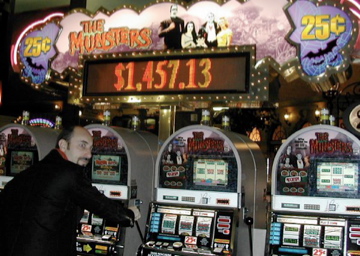
For a hyper-attentioned person like myself, Las Vegas is exhausting, especially inside the casinos. The casino floors are a wilderness of slot machines, thousands of them, with flashing lights, animated displays, moving numbers, and sound. They come in an infinite variety, with themes from TV shows, video games, movies, even the game Monopoly. Gambling (or “gaming,” as it is euphemistically called) is forbidden to minors, so you have to be at least 18 to get near these machines, and in fact most of the bettors are far older, which makes the childishness of the decor frankly bizarre. Is gambling supposed to be related to childhood in some way? Are the manufacturers mixing metaphors of childish and adult “play”?

Perhaps I shouldn’t be so hung up on dignity; everything about Las Vegas proclaims it a Disneyland for grownups. The glamour is all fake: cheap rhinestones and “crystal” chandeliers, gleaming brass, colorful carpets. Most of the shows are meant to be sexually titillating (even some for women – at least we have equality), but bare breasts and simulated sex are as far as they go, at least in this part of town. The only show I got to see was the free one outside the Treasure Island casino, presumably toned down for a general audience. It was one of the stupidest things I’ve ever seen.

I did buy a new (cheap) video camera, so was able to get some fun footage.

Dancing Horses: The Lipizzaner Stallions

For Easter vacation we went to Vienna. There’s so much to do there that we barely got started; we’ll definitely have to go again.

The highlight of the trip, fulfilling a 30-year dream for me, was seeing the Lipizzaner stallions perform at the Spanische Hofreitschule. The event fully lived up to my hopes and expectations.

For my non-horsey readers: the Lipizzaners are the famous “dancing” white stallions who perform highly skilled and specialized dressage, in a tradition dating back 400 years.

They generally perform only twice a week, and there aren’t very many places for spectators, so you need to book well in advance – I wandered onto their website in mid-February and snapped up the last three tickets for the Saturday before Easter. The site is confusing; had I realized at the time how much those seats were going to cost, I might not have booked. But then the email confirmation arrived saying that the reservation could not be canceled, so we decided, what the hell – once in a lifetime, it’s bound to be worth it. And it was.

It’s a beautiful show of acrobatics and athletics, but it’s also about the relationship between man and horse. At the Lipizzaner museum and in the show program notes, we learned that riders begin at age 16, first learning to ride on an experienced stallion. After four years or so, when and if he’s judged ready, a rider is given his own young horse to train, which will take another four years. Later still, he will be expected to train other riders and help them train their horses; part of the selection process includes an assessment of the rider’s ability to pass on what he knows. Throughout his career, a rider will be responsible for the same small group of horses ­ ideally, a horse is always ridden by the same rider, for up to 20 years.

So what you see is the result of a long-term partnership in which man and horse know each other very well. So well that the horses appear to perform their magic entirely of their own will ­ the rider’s signals are so subtle that you don’t see him move from his ramrod-straight position in the saddle. The most we observed was a twitch of the heel here and there.

The riders also keep very straight faces, almost never displaying any emotion or even a well-deserved sense of accomplishment. At the end of each exercise, the only sign that anyone’s been working hard (and they have been!) is that the horses are foaming at the mouth and the riders are red in the face.

There was one exception to the poker-face rule, one of the senior riders, who didn’t quite smile, but nonetheless looked kind. And Ross swears that, when his young horse was acting up (slightly) during the show, she saw him giggle. We agreed that he looks like someone you’d want to take riding lessons with.

Unfortunately, that’s a dream that Ross could never live, without a revolution: the Hofreitschule is totally a guy thing. The horses are all stallions, and the riders all men. As far as we could discover, there has never been a female rider. I’ll have to dig a little deeper and see whether the notion has ever crossed anyone’s mind.*

* Aug, 2006 – A reader wrote to point me to an article showing that women do indeed ride Lipizzaners – but in South Africa, not Vienna.

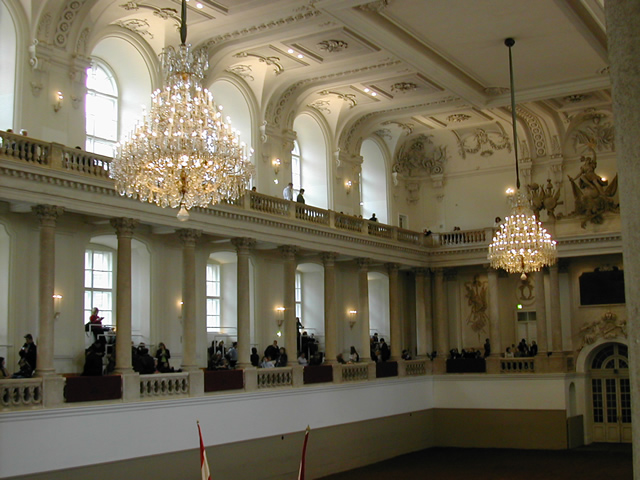
photo above: the performance hall, rightly called the world’s most beautiful manege

Fearsome Flying

“Homeland Security Secretary Tom Ridge said yesterday that he believes security crackdowns over the Christmas holidays, including the cancellation of some passenger flights into the United States, averted a terrorist attack. But intelligence on the threat was so wispy that U.S. officials may never know for sure, he said.”

By John Mintz, Washington Post Staff Writer

Thursday, February 5, 2004; Page A10

It’s not for me to judge the real level of risk, but here’s a thought: al Qaeda doesn’t actually have to get terrorists onto planes now, they only have to make the US government think they will. The flight cancellations and delays cost millions to the airlines and individuals affected, and scrambling US Air Force jets to escort planes is surely also expensive. Maybe all these precautions prevent real threats from being carried out; no one wants to take the chance, of course. But maybe al Qaeda is just toying with us and enjoying the ensuing mess.