Category Archives: what I do

Online Marketing

… if that’s the right term. I’ve been doing something online for about years now, but I’m not sure what to call it. Is it marketing? Customer service? Tech support? It’s hard to define because it partakes of all of these – and that’s a clue to what makes it effective. My resumé lists the details of what I’ve been doing; more explanations and thoughts are here, and on the other pages in this section (links on the left).

The Making of an Online Career

Riding the Cluetrain

I first heard about the Cluetrain Manifesto from a customer who thought my style a good example of how a company could put the manifesto into practice. Which is a great compliment, since I had evolved this style based on what I felt was right for the company and comfortable for me personally. But, from a corporate point of view, what’s the ROI in riding the Cluetrain? The Cluetrain site doesn’t provide any case studies.

What the Gurus Are Saying

Brand New Branding: “Forget what you knew about branding. The Web changes everything. Four experts explain how and why” – Darwin magazine, July 2001

scott bedbury: “The Web has increased the consuming public’s ability to rant or rave about a company or service. Smart companies now recognize the necessity of being responsive to the criticisms, in real-time, and of making sure the brand is consistent€”and is as good as it can be€”wherever it shows up, and even after the sale has been made. The tools the salespeople use to sell it, public relations efforts and follow-up customer service all must reflect brand values and impart a consistent brand image. ”

regis mckenna: “The Internet is not a broadcast medium like television. It is much more of a service medium in which you allow people to interact and exchange information with you.

john hagel: “…they’d think, ‘No product is perfect. You mean my customers are going to talk with each other about my product’s flaws?’ Then I would say, ‘I’ll go on the Web and find at least five discussion forums where people are actively discussing your products and services.’ The point is, this is not a choice. It is going to happen. The only choice you have is how to participate in that discussion.

© 2001 Darwin magazine

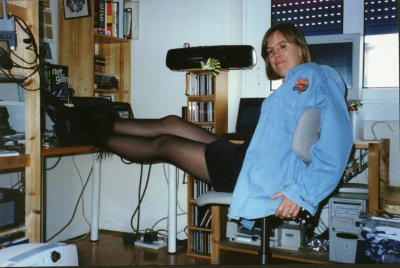
The Infamous Miniskirt Photo: Give the Customers What They Want!

The photo above first appeared on the Adaptec website in April, 1998.

Over the years some of my colleagues griped that having a picture like this on a corporate website was “unprofessional,” and I suppose it was. But (a) why does “corporate” have to mean “boring”? and (b) there’s a story behind it.

It all started with a (rare) vent of my own to the Adaptec discussion list, titled “How NOT to Obtain Customer Service.”

Which I later followed up with “How Not to Obtain Customer Service – a Final Peeve”, which included this throw-away comment: “I used to wear miniskirts to conferences, precisely because this made everyone assume that I was a purely decorative booth bimbo. I then enjoyed the shock on people’s faces when I proved to have a brain or two in my little head after all!”

I wasn’t surprised when this resulted in several requests like: “How about a couple of mini skirt photographs to prove your point regarding Deirdre being a female name?” I laughed them off, until I received this plaintive note: “I’ve had a really tough week. I could really stand to see you in a miniskirt.” So I dutifully put on my miniskirt and had my husband take the picture, and posted it on the site for the benefit of our list subscribers.

Time marches on… I still adore the denim “Born 2 Burn” shirt and the cowboy boots, but, sadly, don’t  fit into the miniskirt quite as well as I did…

Website Content & Management

Some of my work on the Adaptec/Roxio sites can still be seen, courtesy of the Wayback Machine (not quite in their original form – graphics may be missing – but you can get the gist). I personally wrote most of the material for these sites, except for the marketing brochure-type pages (product datasheets, etc.).

The CD-R section of the Adaptec site (which in those days got about 70% of total traffic to the Adaptec site) included technical and support information, and included applications such as:

  • The CD-R database, to help users choose a CD recorder with specific capabilities, and find out which version(s) and features of our software were supported with specific recorders.
  • The CD-R Media Bargains board, an ante-literam Web 2.0 application. This was a custom-designed database where anyone could post information about where to buy CD-R media – deals they themselves were offering, or had found elsewhere.
  • The Disc Reading Troubleshooter, a wizard-style web application that helped users determine why a disc they had recorded could not be read/played (there were many possible reasons) .

CD-R Central was a separate community/marketing site used to support various marketing campaigns, with a different look and feel from the main Adaptec site.

I led the design and development of the first Roxio site – pre-spinoff (January, 2001) – which included a user community area, and other features that would now be classifed as “Web 2.0.”

Comments on Adaptec/Roxio Sites

9/21/98 – Found every solution for my CD-RW. Keep it up.

7/26/99  – As CD-R/CDR-W’s grow in popularity, so does the need for information. The Adaptec Web-site has become a one-stop invaluable resource for novice, as well as expert PC users. Its extensive wealth of information is not only comprehensive and up to date, but well designed.

8 Jan 2000 – I operate a professional recording/mastering and CD design/manufacturing company. I am completely amazed with your website. Particularly the fact that you have links with full details of blank CDR media with prices etc. This is VERY cool… we found blank inkjet printable CDRs at a fraction of what we have been paying which means we can pass the savings on to our customers… and we have you to thank for this.

3 June 2000 – I’m new to digitizing audio, so I found your web site very informing and useful. I went through most of the articles listed on the music page. Very easy reading.

Your troubleshooting section is easy to navigate and very helpful.  What a refreshing change from a lot of others!

Thanks very much for an excellent Website.  The article “Capturing and Encoding for VideoCDs” provided me with all the information that I needed for capturing from an NTSC video source. Your Web Authors and Content Providers have produced a very informative and user friendly site.

Fanmail (I’m Blushing)

8 Nov 1997 – There are heaps of useful information on the Adaptec web site, though if you start out at the main home page it’s hard to find the CD-R/CD-RW stuff. If you want to look at it, try this URL: http://www.adaptec.com/support/cdrec [link no longer works]

It gives you rundowns (not always complete or consistent, but better than I’ve found elsewhere) on Adaptec’s software. Perhaps more important, it gives basic information about which software supports which hardware, which filetypes are supported in which operating systems, and like that. When the time comes, that’s also where they post patches, upgrades, and such. The honcho is a Dierdre something who has a presence in the newsgroups as well and has demonstrated a great capacity to ignore the flack, keep her cool, remain cheerily offhand, and focus on constructive substance. We need more Dierdres.

Having just started a job with a PR agency (I’m a former magazine editor), I’m acutely aware of the value of the abovementioned qualities. Please keep up the good work.

Subject: Adaptec in trouble ?
20 Nov 1997
From: nobody@REPLAY.COM (Anonymous)
Newsgroups: alt.philips.cdr.discussion

Are things going bad for Adaptec Software Products ? Why is it that “Adaptec CD-R (Deirdre’ Straughan) adaptec_cdr@wnt.dc.lsoft.com” (who also monitors a mailing-list for Adaptec Software Products) in all his replay’s includes a URL to the Adaptec Software Products site on the WWW.

I have heard about direct marketing, but is lurking around in usenet trying to drag CDR-users with some problem’s to a commercial-site not somewhat overdone ? Is this the way to stay alive for a company ?

Some research:

Author: “Adaptec CD-R (Deirdre’ Straughan)” <adaptec_cdr@wnt.dc.lsoft.com> 179 unique articles posted.

Number of articles posted to individual newsgroups (slightly skewed by cross-postings):

  • 68 comp.publish.cdrom.hardware
  • 46 comp.publish.cdrom.software
  • 22 alt.comp.periphs.cdr
  • 21 alt.cd-rom
  • 4 alt.2600.warez
  • 2 comp.sys.ibm.pc.hardware.cd-rom
  • 1 alt.binaries.warez
  • 1 alt.philips.cdr.discussion

All these posting’s contain one or more links to the Adaptec Software Products site on the WWW. I doubt if the advice given by this person is objective.

Subject: Thanx
Sat, 29 Nov 1997

Dear Ms. Straughan,

Just a few lines to thank you and your company for an excellent product in CD Creator Deluxe. One of the contributing factors in buying the program was seeing your intelligent and informative responses almost daily in the various newsgroups. It’s rare these days to see such dedication and interest given to the average consumer. Keep up the good work, and may I take this opportunity to wish you and the team a happy and prosperous New Year.

EMail Encounters: Anecdotes of a Professional Life Online

I’ve spent probably half of my working life answering email. And therein lie a number of tales…

Some people were convinced I had to be mailbot, because I answered so quickly. As I told them: “If we had a mailbot this good, we’d be selling that instead of CD-R!”

The Unexpected Response

It seems that when people write to a general address at a company, they don’t necessarily expect a response, and are surprised when they get one.

I often received extremely abusive messages from people who were angry about products, service, or whatever. I usually managed to respond calmly and politely. Most of the time, the second email from these people was a great deal politer, and a few even apologized for their previous harsh tone. On two memorable occasions, the answer was: “Ohmygod, I’m so sorry! I never thought a real human being would read that!”

Which is a sad statement about how some companies handle their email – how has it happened that this medium, which was supposed to help companies communicate with customers, is routinely used so badly that, when customers write, they don’t even expect a reply?

Bringing in the Big Guns

Perhaps this is why many people, in their very first contact with a company, come in with  bazookas blazing: “If you don’t make me a happy customer, I’m going to sic the Better Business Bureau, the Federal Trade Commission, and a pack of lawyers on you.” Or “I’m going to write to all the major magazines about how rotten you are.” As if they had to greet me with a kick in the teeth in order to get my attention.

Again, many of these people backed off as soon as they got any sort of polite and semi-competent response from the company. But it makes for a tiring workday, being barraged with abuse from people who assume that you won’t help them unless they’re nasty.

Perhaps we’d all suffer less stress if we started from the assumption that the people whose job it is to help us actually want to do so, and only escalate to threats if they fail to take that job seriously.

There were two types of aggressives who made me laugh:

  • “I’m going to put up a nasty website about you. You obviously don’t understand the power of the Internet!” (The second sentence is an actual quote that I remember very clearly – I received that message a few years ago, but, even then, trying to tell me about the power of the Internet was a clear case of ‘trying to teach Granny to suck eggs.’)
  • “I’m a journalist and write for [blank] magazine – you’d better make me happy or your name will be mud.” (Not an exact quote, but the gist was clear.) These were both amusing and irritating. By the time I left Roxio, my own newsletters had a combined circulation of over 190,000. I think that qualifies me as a well-read journalist, no? But I always bit my tongue and handed those guys over to the PR folks,  who would give them whatever special treatment they deserved.

Myself, I never treated anyone special. Or rather, I treated everyone the same. I truly felt that all customers deserved the same consideration, and all of their problems and gripes should, as far as possible, be resolved.

This runs counter to the current wisdom of “Customer Relationship Management,” which says that you should use fancy software to determine who your most valuable customers are (those who have bought the most and are most likely to buy again), and make sure that they are kept happiest (offer them special deals and so on – the same principle as frequent-flyer mileage).

Many times, the sheer fact of my answering the email kindly, even if all I could say was that I couldn’t help, reversed the customer’s attitude towards the company and “saved the day.”