Bollywood Rising – Watching Hindi Movies at Woodstock

dancing to “The Beedi Song” from Omkara

When I attended Woodstock School, I never saw Hindi movies. This was partly a matter of logistics: Mussoorie’s two cinemas were available to us only on Saturdays, and a dark movie hall struck me as good mostly for getting groped by strange men – not something I was anxious to encourage; I got enough of that elsewhere in India. (I did venture once or twice, with a gang of friends, to see a rarely-offered English-language film.)

But Hindi films were such a large part of Indian culture that I couldn’t help being aware of them. We heard, and sometimes even sang, fun-silly songs with refrains like “My name is Anthony Gonzales!” or Chal, chal, chal, meri hathi, o meri sathi… (“Let’s go, my elephant, my companion.”)

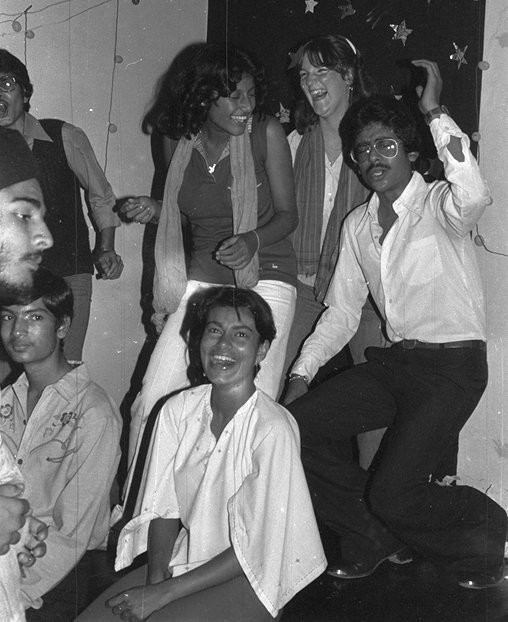
During our senior year (1980-81), the original Om Shanti Om, a disco ditty, took India and the school by storm – we played it, to enthusiastic reception, at every school dance (as shown above) …but most of us (even some of the Indian students) still thought Western music and movies were cooler.

Our opportunities to see films of any kind were limited – there were no VCRs or DVD players in those days, and Indian television offered only one state-run black-and-white channel, Doordarshan. The sole television set on campus belonged to Brij Lal, our Hindi teacher, who used it mostly to watch cricket.

These days, Woodstock students have far more choices in entertainment: satellite TV and DVD players in every dorm, and of course you can watch DVDs and Video CDs (widely available in India, and cheaper than DVDs) on your laptop. Mussoorie’s cinemas have both closed down, but are not much missed (though people do happily go to the fancy multiplexes in larger cities).

At the same time, Hindi movies (now bearing the epithet “Bollywood”) have gotten better. The stories can still seem ridiculous to cynical American tastes: full of improbable coincidences, with plot points that often hinge on non-Western cultural norms. Bride & Prejudice worked as an update on Jane Austen’s classic because the “transgressions” of the sisters would seem shocking only in a relatively conservative culture like India’s.

Bollywood eye candy has also improved. Though Indian female stars have always been gorgeous, some of the male stars I observed in the 70s could get away with a bit of a paunch straining their fashionable safari suits. No longer. Nowadays they all work out with professional trainers, with results that speak for themselves.

All this, plus a larger Indian population at the school, has led to burgeoning interest in Bollywood movies among Woodstock students – not least, my daughter, whose current dream is to meet Shahrukh Khan. I was amused to have a houseful of (mostly) American exchange students enthralled by this year’s big hit, Om Shanti Om.

And I could understand why. It’s a great, goofy, fun movie. And, contrary to what some reviewers have said, you don’t have to understand all the Bollywood in-jokes to find it amusing.

So what if everyone bursts into song every ten minutes? That just adds to the fun! (And fans of western musical theater can enjoy themselves picking out the musical and scenographic borrowings from “The Phantom of the Opera” in the climactic scene.) Oh, yes – our old friend Arjun Rampal is in it, too.

If you’re new to Bollywood, I highly recommend Steve Alter‘s new book, “Fantasies of a Bollywood Love Thief” as an introduction.Among many other things, the book is a sort of production diary for Omkara, an Indianized retelling of Othello directed by Vishal Bhardwaj, who also composed the wonderful music.

As soon as I finished the book I rushed out to buy the movie, which is excellent. I can tell good acting when I see it, though I’m having trouble with the dialog: the VCD we bought has Hindi subtitles instead of the promised English, and my Hindi has not yet come back strongly enough for me to follow complex sentences in hifalutin’ semi-Shakespearean language which is at the same time in a western Uttar Pradesh dialect!

How Doors Are Kept Open in India

What is this strange wedge of wood doing between the door frame and the door?

There are lots of ways to keep doors and windows closed, but what about when you want to keep them open on a windy day? Our home in Italy has many windows, and doors that open onto balconies, which I mostly like to keep open when the weather’s not too cold. But, when there’s any wind at all, they bang shut – which is especially annoying when we’re trying to sleep at night!

I have often reminisced about these useful little items that are common all over south Asia (as far as I know), but don’t seem to have penetrated anywhere else.

Here it is deployed to keep the door open:


Flipped over on its hinge, it jams the door open – no amount of wind will slam it shut!

Simple, cheap, effective. Why can’t we have something like this on our doors and windows in Italy?

What’s Life Like at Woodstock?

Scenes in the Quad

The Woodstock Quadrangle has long been the hub of school life. Elementary school students line up here before classes start in the morning, and play games after school. Students of all ages gather during recess, lunch, and teatime, pass through on their way to music lessons and practices, and, in good weather, may practice right in the Quad. The school’s administrative offices are clustered around the Quad, along with elementary and middle school classrooms.

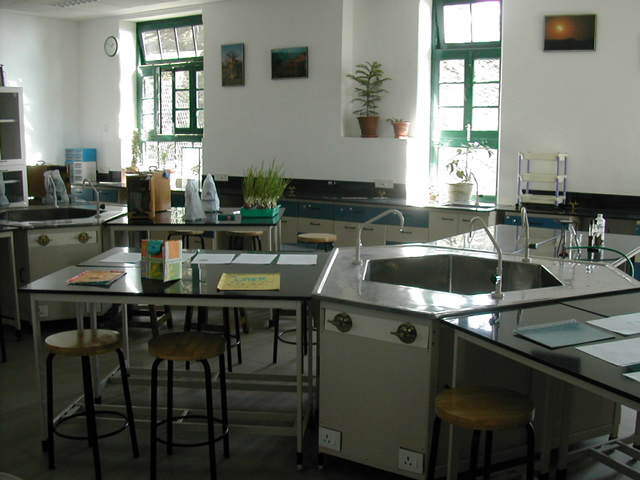
In sum, it looks like pretty much like any other school, science labs (above) and all.

Um, well, we do have giant spiders – 
just like Hogwarts
!

Workspaces – “Office” is Where the Laptop Is

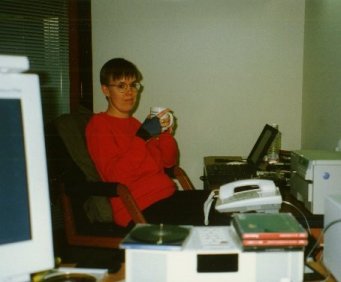
I must be the perfect modern employee. In my 20+ years of working life, I have rarely had an office or even a cubicle to call my own, and haven’t particularly wanted or missed one.

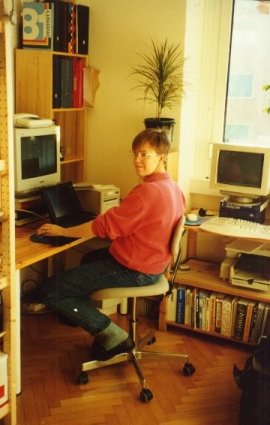
my office at home in Milan

In the three-room apartment that was our home in Milan for 13 years, my workspace (when I wasn’t in a shared office) was a corner of our bedroom. The temporary cubes I was assigned on my visits to Silicon Valley were a comparative luxury!

But, even in cramped conditions, working at home had advantages: if my daughter was sick and had to stay home from school, or if public transport was on strike (as happens frequently in Italy) and I couldn’t get to the office, it just didn’t matter. As long as I had a computer and an Internet connection, I could be productive wherever I was.

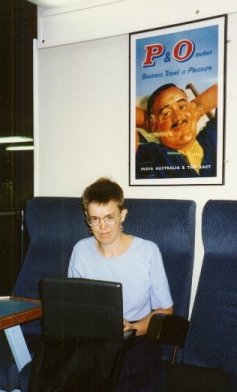
with my laptop on a P&O Ferry

I began travelling extensively for work around 1994, so I always had a laptop (in addition to or instead of a desktop computer), and was accustomed to working anywhere, anytime.

This became a standing family joke: we would stage pictures of me working in unlikely places: on a P&O ferry from Calais to Dover, at the top of a snowy Alp, on a beach recliner in Martinique.

working at my in-laws' home in Roseto

I did not actually work in any of those places – I do know how to take a vacation. But not being tied to a desk meant that I could work, when I chose, anywhere in the world. I didn’t have to take vacation time to be present at the obligatory family holidays halfway across Italy: I could spend time with the family and still get my work done.

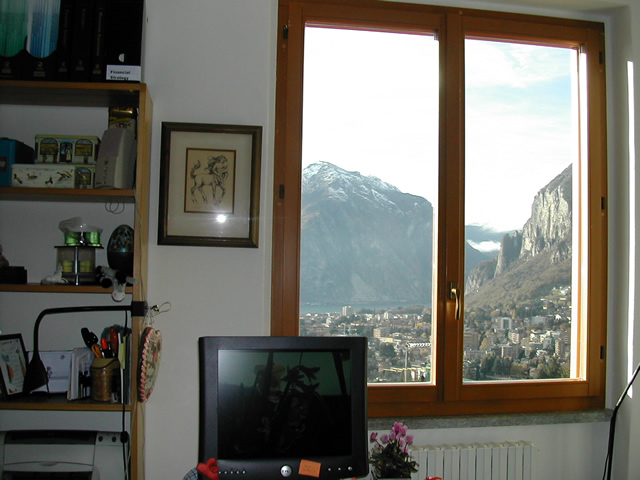
In our new home in Lecco, I have a small home office with a spectacular view – who needs a corporate corner office?

the view from my studio, Lecco

But that’s not enough to keep me in one place. My colleagues at Sun don’t much care where I am physically located (and are scattered all over the world themselves, both in Sun offices and at home), so I can pick up my laptop and go wherever I want to. With my Sun badge, I can waltz into any Sun office in the world and use a desk and high-speed Internet – but I don’t have to.

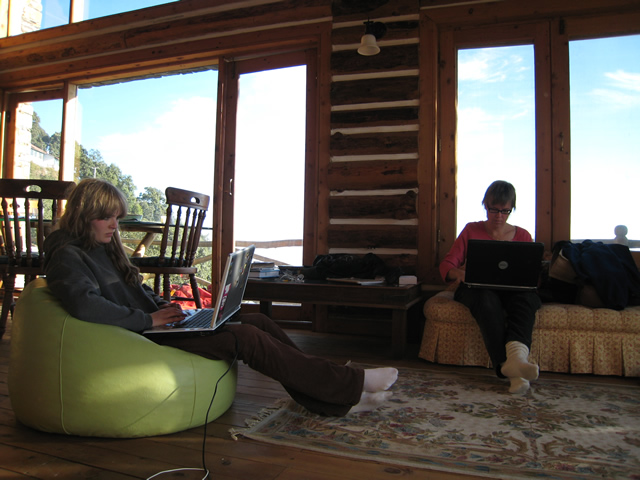
Right now I’m in India, visiting my daughter at my old school. Thanks to the hospitality of a classmate, I’m in a comfortable home with a more-than-decent Internet connection. I can even use Skype to keep in touch with my colleagues. The only thing lacking is a desk, but, hey, I’ve still got a lap.

working from the Bothwell Bank guest house, Mussoorie

And the view ain’t too shabby, either.

How about you? Are you ready to give up a cube or office?

Deirdré Straughan on Italy, India, the Internet, the world, and now Australia