Note: If you are squeamish about surgical procedures and pain, there are parts of this you really don’t want to know about.
Part 1: early-mid July, 2010
I’ve been suffering from sinus infections for at least 25 years, perhaps s a result of living much of my life in very polluted environments (Bangkok, Pittsburgh, Milan). Chronic sinus problems are so common that I’m sure many of you can empathize. But this latest bout is probably the worst I’ve ever experienced.
It’s not so much the pain. There is pain, but not the screaming headaches and “bend over, and feel like someone stabbed you in the face” pain I’ve experienced in the past. Maybe I’m not getting the pain of stuff sloshing around because my sinuses are so full of gunk that there’s nowhere for it to slosh. I’ve seen the CT scan, so know this to be true.
But I can feel this in my upper teeth on the right side, and the hinge of the jaw. I’ve had TMJ for years as well, figured this was more of that (grinding my teeth lately, for unrelated reasons), but it also seems to be a symptom of the infection.
And there’s a horrible smell that I can sense, not exactly in my nose, but inside my head somewhere (maybe the vomeronasal organ?), like something died and is rotting in there. Getting this gunk out will probably be a disgusting process, but I’ll be glad when it’s gone.
This pain isn’t even really manifesting as pain. It somehow gets translated into “I feel so awful I want to cry,” and shattering fatigue. Tylenol with codeine dissipates the feeling, whether because it is in fact relieving pain, or because the codeine is enough of a high to take the edge off the mood. (Yeah, I’m a big-time druggie if codeine can do that to me.)
For years I have resisted the idea of sinus surgery. People I know who’ve had it report that it works for a while, then doesn’t. My sinus doctor in Colorado wanted to operate, but, as far as I could tell, he just liked doing surgery. He never did anything to convince me that it would be effective.
—————–
Part 2
I don’t remember exactly when the above was drafted; between severe illness, and tumult in other parts of my life, much of this summer went by in a blur. I had taken antibiotics for an acute sinus infection back in February, as, indeed, I have done at least annually for many years. That round of medication calmed things down, but I never felt fully cured. I had suspected for years that a colony of something had taken up permanent residence in my sinuses, and over time had become resistant to various antibiotics. I could tell a new doctor, “No, that antibiotic probably won’t work” – and I was always right. You’d think that would be a clue, no?
By Memorial Day weekend (end of May) I was feeling bad enough to seek a doctor here in my new home in San Francisco. My friend Jeffrey suggested using Yelp to get a recommendation, and he was the one to find San Francisco Otolaryngology. I called just before the holiday weekend but, not surprisingly, it was impossible to get an appointment anytime soon, especially with the strongly-recommended Dr. Jacob Johnson. So I didn’t make one. I treated myself as best I could with nasal rinses (neti pot), and got through the immediate crisis.
By the July 4th holiday weekend, I just couldn’t go on any longer. I called again, and was able to see Dr. Brian Schindler in the same practice. He rinsed out my nose (squirting saline up one nostril, siphoning it out the other) and collected samples for culturing (he got charmingly excited over snot). This was a big “Well, duh!” moment for me. Why, in 25 years of infections, had no doctor ever thought to culture the stuff? Why had I never suggested it? From my adolescent experiences with having third-world diseases in Bangladesh and India, I was used to the idea that you take samples, find out what’s growing in you, and treat accordingly, rather than prescribing random medicines in hopes that something will work.
I saw Dr. Schindler on a Thursday or Friday; the culture wouldn’t be done til the following week. But my condition by then was so awful that he wanted to start me right away on Augmentin (antibiotic). “I don’t think that’ll work,” I said. “Maybe not, but it’s less toxic than some of the alternatives. Once we get the culture back, we’ll change it if we need to.”
I got an almost frantic call on Monday: “Go to the pharmacy right away and pick up a prescription for Ciprofloxacin, come in and see the doctor again ASAP.” The bug in there was pseudomonas, a bacterium which doesn’t respond to any other antibiotic. I’d taken cipro before and didn’t like it, but there wasn’t any other option. Sometime around then they did a CT scan: yup, looks pretty gummed up in there.
After two weeks on cipro I wasn’t any better. Dr. Schindler said he could “tap” the sinus to flush it out more vigorously, but he was afraid that the natural openings the stuff needed to drain out of might be so swollen by infection that not much could come out. He suggested balloon sinuplasty, a new procedure analogous to angioplasty: a catheter is inserted and a balloon inflated, to widen the natural sinus-to-nose openings.
Although I’d never had anything remotely surgical done to me before, I was by then so miserable that I would have agreed to anything. The upside was that this made me a patient of Dr. Johnson, who turned out to be just as wonderful as everyone on Yelp had said (though I liked Dr. Schindler, too).
We scheduled the surgery in a hurry; it was performed on July 29th at the San Francisco Surgical Center, in the same building as SF Otolaryngology. I hadn’t been aware of this new trend in American medicine: small surgical centers can be quicker and cheaper for outpatient surgery than hospitals.
It is possible to do balloon sinuplasty under local anesthesia (in fact, if I’d been able to wait a few weeks, I might have participated in a study to do it right in the doctor’s office). Since I didn’t know how I would react to other kinds of anesthesia, I initially opted for local. But I did expect to be given Valium or some such to help me face it more calmly (I’d never done anything like this, remember?). Somehow that was overlooked during the admissions procedures, so, when they finally came to take me into the operating room, I was stark, trembling terrified. (As well as exhausted – hadn’t slept from nerves and pain – and very ill.) We mutually decided to do anesthesia after all.
It was the best sleep I’d had in months. Unfortunately, when Dr. Johnson had finished enlarging the hole into my left maxillary sinus and was ready to start flushing water through it, they woke me up, so that I wouldn’t breathe the stuff into my lungs. I suppose to prove I was conscious, I had to hold the dentist-style aspirator. This was all very nasty and painful.
Then he did the balloon thing on the right side. Also painful. But I was still anesthetized to some extent, so I guess it could have been worse.
When everything was done and my brain was beginning to work again, I finally asked the doctor a question that had been on my mind for some time: how did someone who was clearly of south Indian origin come to be named Johnson? Turns out it’s not uncommon among south Indian Christians (I’ve spent a lot of time in north India, not much in the south).
I was given Vicodin, got home (yes, accompanied), spent the rest of the day tweeting and sleeping in a haze of pain. The next day I started working again (from home), and was soon back in the office a few days a week, working from home the others. I was even doing vigorous physical exercise, moving boxes of stuff around Sun’s Menlo Park campus to prepare for a major office move. I probably should have been resting and recovering.
Because it wasn’t over. During a first post-surgery visit, Dr. Johnson squirted water up my nostrils and aspirated it out so hard that the cartilage in my nose flattened under pressure. This is not usual; all we could figure was that it had been softened by years of nose-blowing. It sprang back immediately, but I felt bruised the next day. The flushing showed that there was still gunk in there (which I already knew).
I had been on the cipro for six weeks. I was feeling physically somewhat better, but emotionally a mess. Having plenty of reasons to be under stress, I didn’t think much about this. But, after spending one night crying and thinking about cutting myself, I looked up the side effects of ciprofloxacin. Sure enough, they include depression. I stopped taking it immediately.
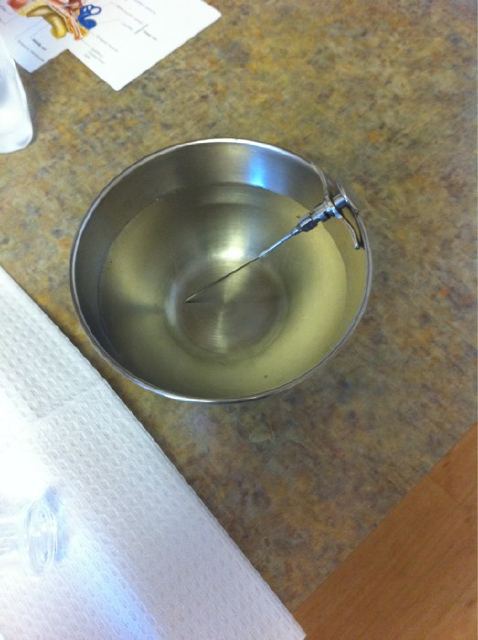
In any case, it wasn’t working very well, if at all, on the pseudomonas. The next option was to “tap” into the sinus. This means driving a large needle and catheter (picture below) from the inside of your nose into the sinus cavity, then pushing saline through that and out the natural opening to flush out the sinus.
The first time, this took several hours of preparation (mental, for me) and gradual local anesthesia, which was unpleasant in itself: it involved shoving a sharp spike wrapped in cotton with anesthetic on it deeper and deeper into my tissues, then me sitting there with a large metal whisker hanging out of my nose while it took effect. Dr. Johnson does that three times, to numb the soft tissues. It doesn’t anesthetize the bone.
Then he held the side of my head while he shoved a large metal spike through the bone into the sinus cavity. (He told me to close my eyes so I wouldn’t freak out over the size of it going in.) “This is going to hurt,” he said, and he was correct. Hearing something crunch and squeak through your own bone is also uniquely creepy.
He then attached a tube to the metal catheter and flushed saline through it. This, too, was painful and, for the right sinus, was like pushing mud through a straw. Everything (saline, blood, pus) drained out my nose into a kidney tray. It had the same horrible odor I’d been living with inside my head for months, which is the characteristic smell of pseudomonas.
The left side was more painful to get the catheter into, but less painful to flush, and the stuff that came out was mostly clean. So at least we wouldn’t have to worry about that side anymore.
I went home, took a painkiller, and whimpered a lot. There was some improvement over the next few days, but soon the gunk was back.
A week later we did it again, but this time only the right sinus. The procedure hurt horribly again, but seemed to be more effective: the next day (Sept 11) I felt so much better that I took a long walk in the city. However, by Wednesday the bacteria were clearly back in full production. We did the tap again Friday (yesterday), only to try to tame the beasts long enough for me to get through my duties at Oracle OpenWorld next week; neither of us expect this to resolve the problem. This time was the worst because the catheter slipped out and he had to punch it in again. I may never forget what that felt like.
Unfortunately, all this pain has in a sense been for nothing: something’s still living in there (he took a culture again just to make sure it’s still the original pseudomonas), and we have to get it out.
The next step is more-invasive surgery. Whereas the sinuplasty ballooned open the natural opening without cutting, this time he’ll cut, to enlarge the natural opening from the sinus into the nose. When you use a neti pot, you don’t actually get much fluid into the sinus: the negative pressure of water streaming past the small sinus opening pulls some of the gunk out, rather than it washing out. With a larger hole, I can squirt or pour fluids into the sinus to attack the beasts directly. Then it will be up to me, I guess, to self-medicate as much as needed.
So… I’m scheduled for more surgery. Fun.












 : copy editing, managing the review process, and (ongoing) marketing – keep an eye out for video! Also provided care and feeding and a quiet place to work for one of its authors,
  did an insane amount of work for this book, spending many late nights and long hours to write nearly 1000 pages (before final publishing layout) of mostly original material: 57 topics covered in over 150 new scripts and 150 new one-liners (beyond Brendan’s existing