Of course , our family is far from typically Italian. Even my husband’s family isn’t very typical: his mother moved around a great deal while she was growing up, and had only two brothers (who both died young), and Enrico’s father was an only child – hardly the norm in his day! So the close family isn’t numerous, and what we do have is spread all over northern Italy. (Let’s not even start on my side of the family.)
Enrico and his brother also moved around a lot in their youth (thanks to their parents’ teaching careers), both went to grad school in the US, and Bruno now teaches in Norway. Their mother (widowed two years ago) lives in Abruzzo (Italy’s central east coast). So getting together for the holidays will always involve travel for somebody. And this is the first big difference between us and most Italian families: I need to find some statistics to support this hypothesis, but my hunch is that most Italians marry within their hometown – what choice do they have, since they mostly stay there all their lives!? Extended families don’t have to go far to see each other every day, and getting together for Christmas is no big deal.
Perhaps for this reason, there is no tradition in Italy of sending Christmas cards. Everyone to whom you might want to send holiday greetings is near enough that you can deliver your greetings in person. If you do live far away, there’s not much point in Christmas cards: the Italian post office is historically so unreliable that your Christmas greetings might arrive in time for Easter – if at all.
So, for those of my friends and family who may be wondering why I stopped sending Christmas cards or even letters years ago, that’s the reason – or at least the excuse!
We do try to bring the family together most Christmases. Last weekend Enrico brought his mother up from Abruzzo. This unfortunately meant that she spent a lot of the week alone in our house (though Ross was very good about coming home straight after school to make lunch for her).
Enrico and I had a not-unusually-frantic week before Christmas – final classes for him, for me work as usual including four hours’ commute most days (I stayed home Tuesday, intending to work, but ended up in bed with a migraine instead). We did the usual last-minute shopping for presents and to stock the house with holiday food:
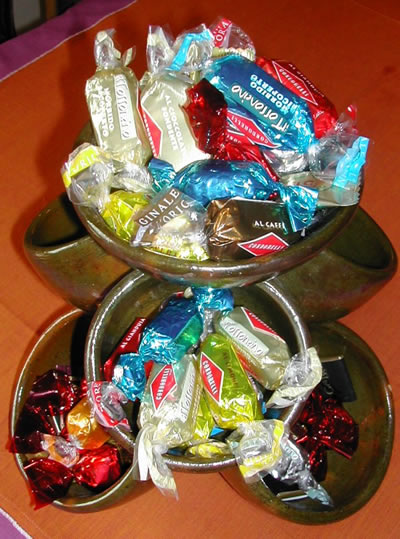
Well, sweets are easy. But what to do about our main holiday meal? Do we even have a family tradition? When Enrico’s grandmother was alive, for the Christmas first course she made passatelli in brodo – a tradition from her side of the family, which came from Emilia-Romagna (though she herself was born in Brazil). When, in later years, we had Christmas in Abruzzo, we often had scripelle in brodo, which I adore. But Enrico forgot to get the scripelle (eggy crepes) while he was there, and no one in the family knows how to make them.
During our TVBLOB holiday lunch, I asked some of my colleagues about their family traditions. We have people from all over Italy (as well as the UK, Japan, Israel, Australia, and the US), so there was a wide variety. Italy’s south seems to lean towards various forms of pasta al forno (oven-cooked pasta, e.g. lasagne), while the north, broadly speaking, prefers broth-based first courses. Enrico voted for tortellini in brodo (which a Milanese colleague also told me was traditional in his family), while I was dubious that we needed pasta at all, since I had decided to make turkey with stuffing and mashed potatoes – none of which is part of any Italian tradition. Several colleagues told me that their families eat agnello (lamb) for their Christmas main course. I like agnello, but don’t know how to cook it, while I do know how to cook turkey.
My colleagues are mostly much younger than I am, and still have Christmas at their parents’ homes with Mamma to do the cooking. In our family, I am the lady of the house, and in charge of the holiday cheer – a responsibility not to be taken lightly.
Friday evening Enrico and I managed to meet up in Lecco to do some food shopping, including a stop at Rusconi, Lecco’s finest macelleria (butcher). We bought a piece of beef for brodo (broth), and a beautiful rolled roast of veal with chestnuts and lard, which I planned to make for Saturday dinner when Bruno and Ingvild arrived from Norway (where they get lots of great fish, of course, but meat is expensive).
Also traditional during the Christmas season are Italian winter fruits (apples, pears, mandarin oranges) and exotic fruits from all over the world. I’m not sure why the exotics, but it means that our fruttivendolo (greengrocer) had stuff that even I’ve never seen, from South America I guess, as well as the more familiar mangoes, papayas, and lichis.
My coup for Friday was getting Rossella‘s big Christmas present: a pair of shoes she had told us she lusted for. Ross every year well before Christmas starts telling us about all sorts of gifts she’d like – just in case we didn’t have any ideas of our own. This gives us plenty of scope to surprise her – she doesn’t know which, if any, of the requested items she will receive (certainly not all, given her expensive tastes and our limited budget).
She had described these shoes in loving detail, along with where to get them, and mentioned that they were the last pair in the store. When I arrived, the owner remembered her trying them on the day before, and was surprised at my attempt to make a surprise of the gift: I refused to have it “wrapped” in a bag with the name of the store on, and didn’t even let them put their sticker on the anonymous gift wrapping they did.
Of course I ran into Ross on the street in Lecco five minutes later. “Did you get me something?” she asked mischievously. “Nope,” I said, pressing my anonymous cloth shopping bag under my elbow. “I’m just going to give you money, and you can buy what you want.” Later we passed by the shoe store window together and Ross gasped: “They’re gone!” “Oh, were they there? I guess I missed them. These other ones are cute…” I can’t believe she fell for it – I’m not that good an actor. But she claims that she was genuinely surprised on Christmas morning, and she certainly was genuinely delighted.
Saturday morning Enrico and I did more shopping, finally managing to find the fresh chestnuts that I needed to make stuffing. I use a recipe from Martha Stewart, but Martha has it easy: she can buy chestnuts frozen or canned. I have to buy them fresh, then roast and peel them myself. Here they are just before roasting:
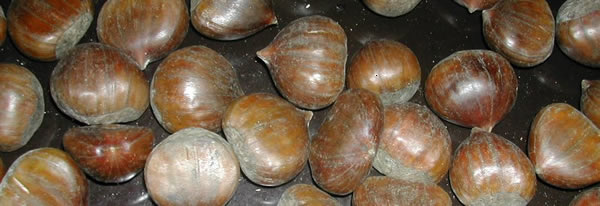
Each one had to be pricked with a knife so that it wouldn’t explode in the oven. It took me halfway through Sunday to get them all ready to be added to the stuffing.
Our plan to have the veal roast for Bruno and Ingvild’s welcome dinner was thrown off: they arrived very late Saturday night after a horrendous day of travel (Denver and Heathrow weren’t the only airports having weather problems). So we had to eat the roast on Sunday, although Christmas Eve (la vigilia di Natale) is traditionally a day of “fasting” – or at least, in modern times, light eating in preparation for the feast to follow. And we did have the tortellini in brodo that Enrico wanted, for Sunday lunch. (The leftover homemade broth was used in risotto last night.)
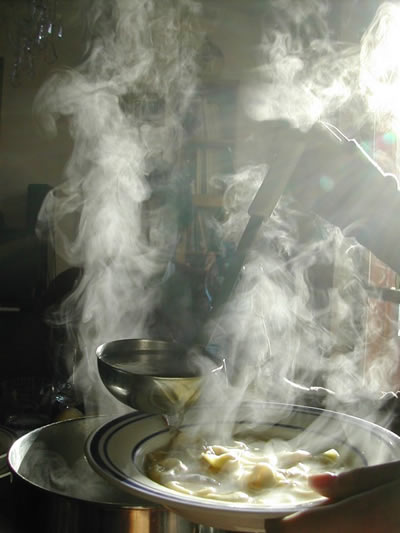
On Sunday I made the cornbread and did everything else needed for the stuffing – had to make cornbread from scratch since I can’t get cornbread mix here. Someone on the Expats in Italy forum gave me a localized recipe using polenta. The result is not so great that I’d really enjoy eating the cornbread on its own, but it’s fine for use in stuffing, with a pleasantly gritty texture.
Some regions and families in Italy celebrate (with a big meal) right after midnight mass on Christmas Eve (which, once midnight has passed, is Christmas morning, I guess). Here in Lecco it seems that everyone goes to mass: Ross and her friends stopped in at Lecco’s main church at midnight with the idea of attending mass, but found it too crowded to hang around. Instead, they had their own version of Christmas eve dinner.
I think the Lecchesi after mass generally go home and to bed, waiting to open presents the next morning, as we did. Ross is now old enough, and stays out late enough, that we actually had to wake her for this! While I was waiting, I put the stuffing into the oven to bake, and started preparing the herb mixture for the turkey.
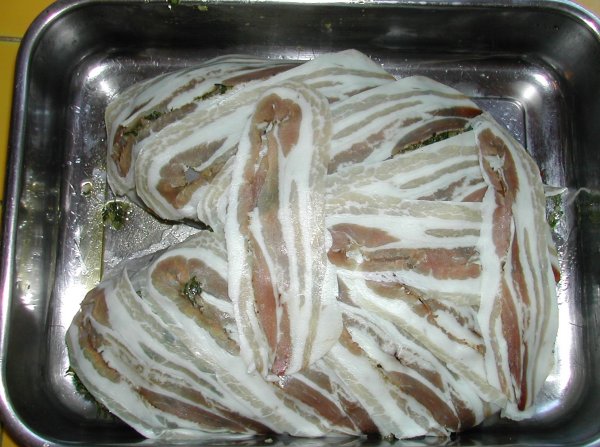
Our oven isn’t big enough to fit an entire turkey: I cook a turkey breast, using a recipe that calls for putting a mixture of herbs, onions, and lemon zest under the skin. Italian turkey breasts are packaged without the skin, so I spread the herb etc. paste over the bare breast and then layer on slices of pancetta (bacon):
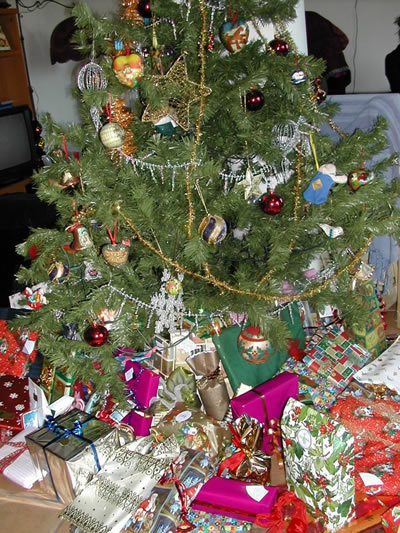
Then we went to open presents, as you might guess by the shapes: lots of books! (The amount of reading we do is also NOT typical of Italian families.)
We drag out present-opening as long as possible, taking time to enjoy each others’ gifts (and reactions). By the time we got through the pile, the stuffing was cooked and it was time to put the turkey in.
Italian poultry always takes a lot longer to cook than American recipes expect – maybe there’s less water in the meat? The recipe wanted me to cook the turkey for less than an hour, but it took more than two before the meat thermometer registered done.
We didn’t just sit there hungry and waiting, however: we had a wonderful antipasto. Bruno and Ingvild always bring lots of yummy salmon with them (they say it’s the only thing that’s relatively cheap in Norway). Salmon can be found year-round in Italy, but a lot of it is sold at Christmas: it has become a standard holiday luxury item. We ate two types (one smoked, one marinated) with toast, butter, and mustard sauce, which was plenty to hold us until the rest of the meal was ready. After the antipasto everyone drifted away from the table again, browsing through their Christmas books, drinking prosecco, and (in my case) checking email.
We re-set the table and got lunch onto it by around 2 pm. I have finally learned how to make mashed potatoes from scratch really well: the trick (thanks to the Silver Palate cookbook) is to cook the potatoes very soft, drain them, heat a mixture of milk and cream separately, then beat the two together with a hand mixer.
After lunch, I took a nap.
In the evening, we noshed some more on salmon and turkey, then watched “Brokeback Mountain” – not very Christmassy, I know, but I had got it for Ross for Christmas because she loved it, but I had never seen it myself. Wow. Amazing movie. I dreamed about it afterwards.
Today is Santo Stefano, St. Stephen’s day, also a national holiday in Italy – a wise tradition, I think, as we all need time to recover from holiday excesses. This is the day when families traditionally go on a gita (daytrip), but I let Enrico go with the in-laws – after a frantic week, I’m enjoying the peace and quiet at home. Ross has left for Bormio where she and a bunch of friends are renting a house together for a week. Their original idea was to ski, but there’s no snow (this winter so far has been unusually warm and dry) – the poor dears will have to make do with the hot springs.
* A Note on Panettone
I actually don’t like panettone all that much. But we learned a trick from Julia while we were staying with her and Dani back in April (for Rosie’s funeral). At the time, Italy’s traditional Easter cake, colomba (shaped like a dove, sort of) was already available in stores. I brought one as a gift for Julia and Dani. Julia said it was similar to Mexican pan dulce, and treated it the same: sauteed in a pan with lots of butter. Yum!
This turns out to work very well with panettone, too: the warmth and slight crispness make it much more interesting.
What (and from where) are your holiday traditions?