Tag Archives: Indian food

The Classic Indian Bun Omelette

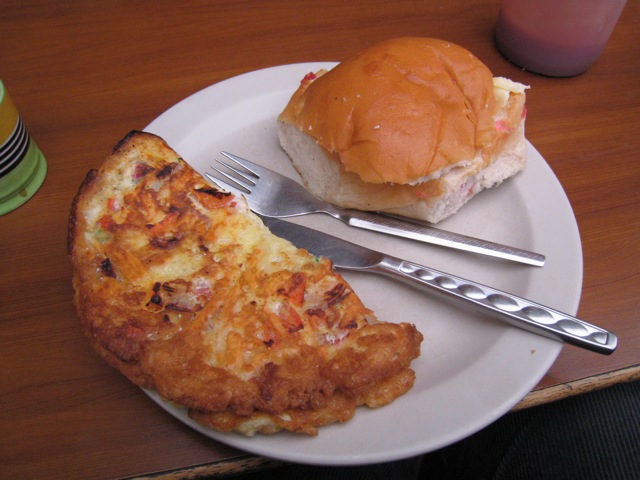
This one includes tomatoes and probably green chilis, and was served on a bun with funky pink and green candied fruit.

Recipe:

  1. fry onions in butter until soft (or brown, if you like)
  2. fry tomatoes too, if you’re using them
  3. add eggs lightly beaten with a little milk
  4. add green chilis (chopped into small rounds) and fresh cilantro/coriander
  5. flip to cook the other side
  6. when cooked, fold in half and serve alongside bun as shown above or (better) fold into quarters and serve ON bun. Bun should be toasted in the same pan so it gets nice and greasy.
  7. Have sweet, milky tea with it.

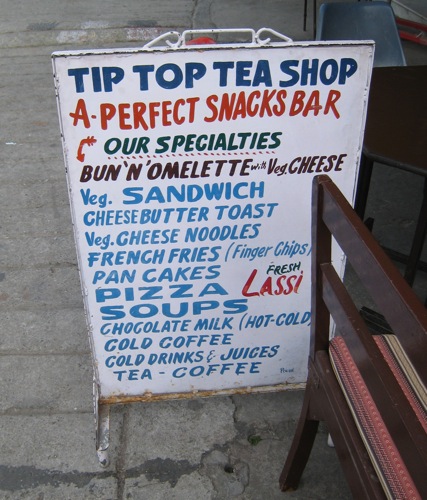
Above omelette courtesy of Mussoorie’s Tip Top Tea Shop at Char Dukan:

Tip Top Tea Shop

In case you’re wondering: cheese noodles is Ramen or Wai Wai noodles with cheese stirred in so it melts while the broth is good and hot.

Rajdhani Thali: Great Food, Great Price

Last day of shopping in Delhi, Ross and I still had presents to buy, and it had been impossible to get the neo-graduates out of bed at a reasonable hour. So we found ourselves facing a line of state emporiums that were mostly closed for lunch. After a few minutes’ glance around one or two that were still open, we decided to head to Connaught Place to find some lunch for ourselves.

We struck it lucky: right on the corner was Rajdhani Thali, which looked clean and appealing, and proved to be very good.

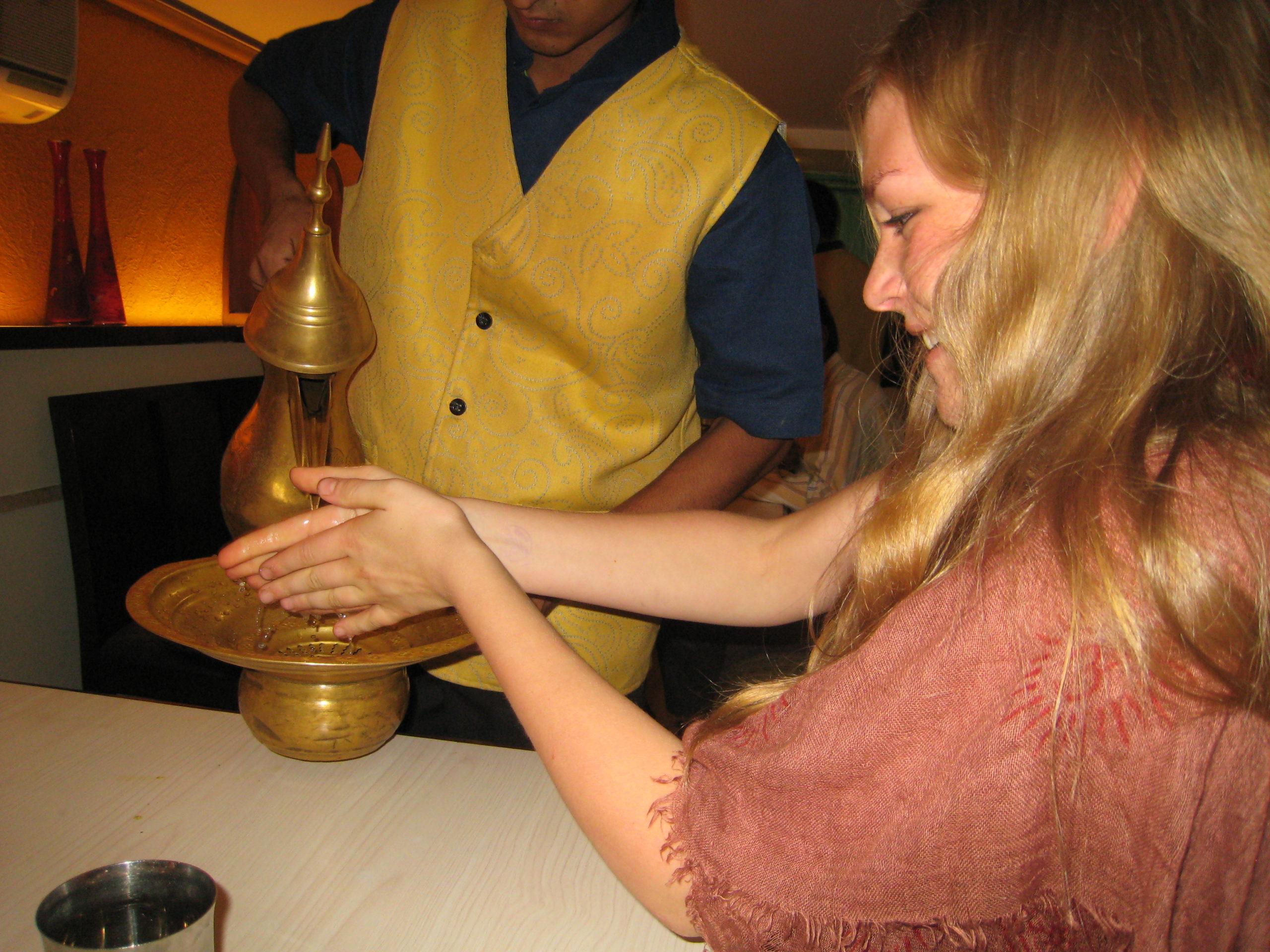
It’s a set meal (which I suppose varies with the day and season), at a fixed lunchtime price of Rs. 168 (about $4) each. After you sit down, a man comes around with a ewer and washbasin so you can wash your hands (because you’re going to be eating with them!).

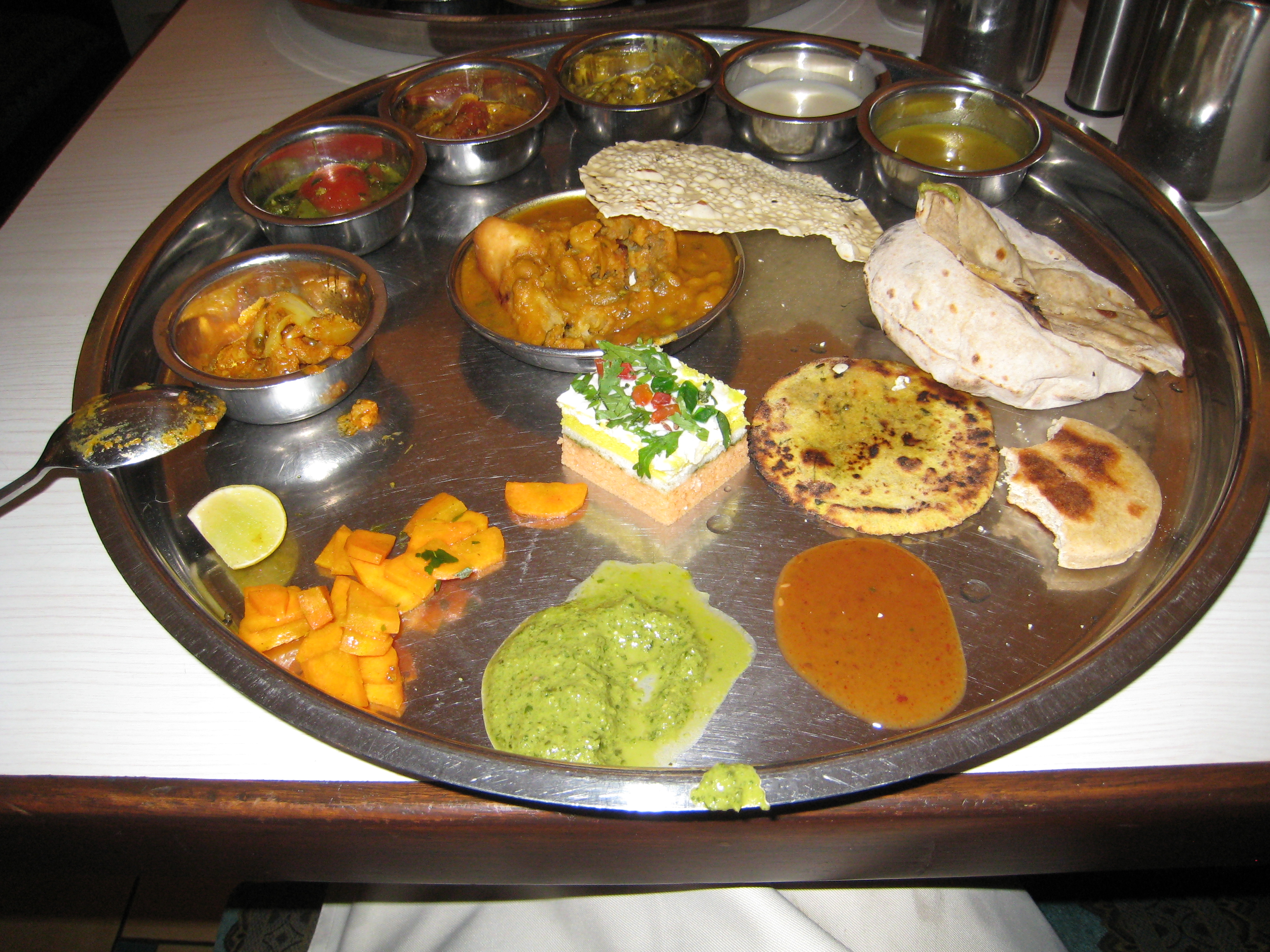
Then the thali – a big, stainless-steel tray – is brought out, empty, with some empty little bowls which are soon filled up by waiters making constant rounds. And they just keep coming, offering various dishes, seconds of whatever you want, and a variety of Indian breads fresh off the griddle. The style is Gujarathi and Rajasthani, not too spicy for most Western palates. I had no idea what most of it was, but it was all delicious (and strictly vegetarian).

Rajdhani Thali

As is usual for Indian restaurants, service was excellent.

Rajdhani Thali is a chain throughout India (and in Dubai). Highly recommended, wherever you happen to find one!

Dakshin Restaurant: South India’s Finest, in the North

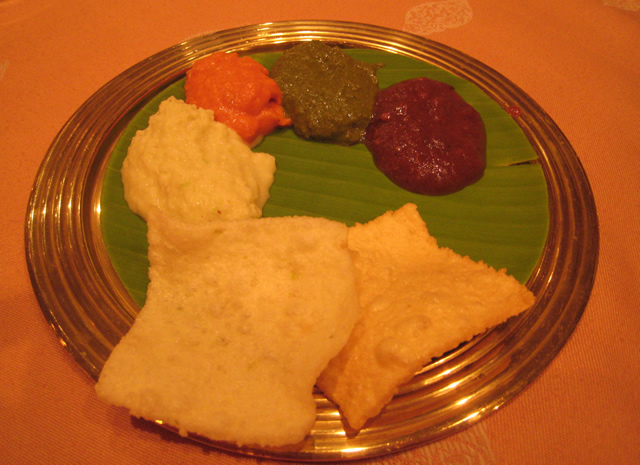
^ above: a selection of chutneys (coconut, tomato, coriander, ?) with crunchy fried things to dip in them. Delicious as these are, don’t fill up – there’s a lot more food coming!

While in Delhi I spent a morning working at Sun’s office, which is such a hive of activity that desks are at a premium! Then Ritu, a colleague, accompanied Ross and me to lunch at Dakshin, a restaurant in the Marriott Hotel in the Saket area of south Delhi.

Dakshin means “south” in Hindi, and the restaurant features premium versions of the foods of south India, in a beautiful setting with excellent service.

We ordered the vegetarian thali, a traditional Indian style of meal which works very well as a tasting menu. This began with rasam, a traditional accompaniment to every south Indian meal: a thin, spicy soup served (in this case) in gorgeous heavy brass bowls.
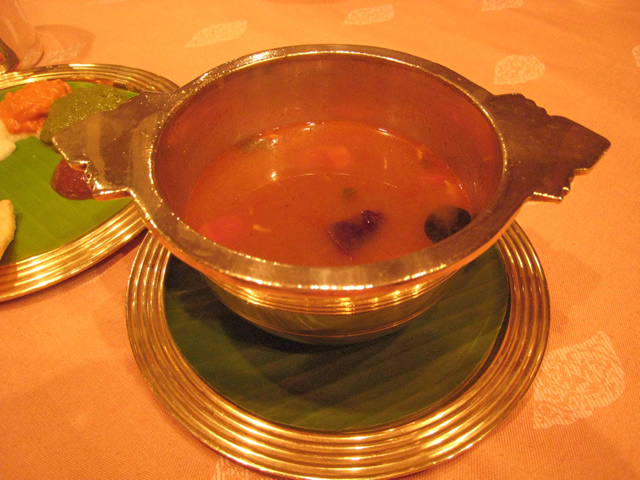
rasam

I don’t have a lot of experience with south Indian food, but this was the best rasam I’ve yet tasted – a rich, aromatic broth, probably less hot than real south Indian norms in deference to the tastes of foreigners (and, for that matter, north Indians – real southern cooking is too spicy for many north Indians).

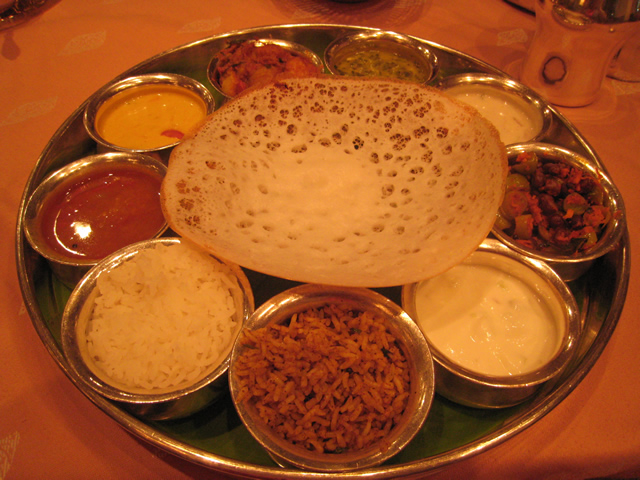
After that the main meal arrived: the thali is the large, round tray, in this case with a banana leaf perfectly cut to fit inside, with little bowls of goodies arranged around the rim.
south Indian thali

From bottom center, going clockwise: tamarind rice, plain rice, lentils, a curry made from gram flour and coconut milk, potatoes, dal (lentils) with spinach, coconut curry with vegetables, something veggie which I couldn’t identify but liked, raita (yogurt). This menu will change according to season and what the chef finds in the market that day.

In other thalis, you might leave the space at the center free for a mound of rice, so that you have room to mix it with the dal and other goodies.

In this case, the center is occupied by appam, a bread made from rice flour and coconut milk – spongy on one side, crispy on the other, light, fluffy, delicately flavored, and thoroughly yummy! South Indian cuisine features many variations on breads made from rice flour, such as dosa and idli.

All in all a very wonderful meal, even though Rs. 1000 or so per head is extravagant by local standards – prices have gone up shockingly in Delhi, especially against the weak dollar.

Oh, My Darling Clementine

The fresh fruits and vegetables section of a standard American supermarket looks much the same all year round. There is no seasonal variance in the availability of any common foodstuff: you see the same tomatoes, lettuce, broccoli etc., even when they have to be imported from someplace far away where the weather is right for growing them. This everyday "luxury" is so ingrained into American habits that, when I first moved to Italy, it never occurred to me that certain items might simply not be available at some times of year. "What do you mean, it’s not the season?"

Italian fruttivendoli (greengrocers) and their customers favor the fruits and vegetables of the season. You can certainly buy, e.g., greenhouse strawberries in winter, but they’re much more expensive, and not nearly as tasty, as the ones grown outdoors in their proper time. The most flavorful foods are grown "locally" and are bought at the peak of their season, when, due to their abundance, they’re also cheapest.

Right now it’s winter and we’re flooded with agrumi (citrus) from Sicily and other southern parts of Italy (and Spain). You can get some sort of oranges (arance [ah-RAHN-chay]) all year round, but at this time of year they’re huge and juicy, a colorful antidote to the gray weather. Blood oranges – my favorites – don’t look much different from any other kind on the outside, but inside: red red red! Squeeze them to obtain a thick, syrupy juice that looks like a vampire’s breakfast.

even the packing is gorgeous! – blood oranges

My favorite citrus, however, are clementines. I guess these are what Americans call tangerines: smaller than oranges, when ripe they are loose in their skins and easy to peel. They break apart neatly into bite-sized sections that you can pop into your mouth and enjoy a squirt of juicy sweetness, without getting it all over your hands and face. Actually, clementine [cleh-men-TEEN-ay] are usually so small that you can eat half of one in a single mouthful.

These (along with Glucose biscuits) were my favorite winter travelling food in India, and are just as handy on Italian trains: I can pop a few into my backpack, peel and eat at will. If they get a little mushed, it’s no matter – a section or two may be squished, but they don’t turn black like bananas, and the rest is perfectly edible. I also keep some on my desk for mid-morning and mid-afternoon snacks. A golden pyramid of clementine offered to guests after dinner will disappear entirely as people talk and nibble, easily downing five or six each.

There are several varieties. There are clementine con o senza semi (with or without seeds), pictured at top. There are mandarini, which are tiny, with a smooth, shiny skin that fits tightly and can be difficult to peel. There are mandaranci, which I take (from the name) to be a hybrid of oranges and mandarins. There’s a larger variety of clementine which is closer to what I remember from India – not as sweet and juicy as the standard Italian version.

I don’t buy late-season fruit: it’s always disappointing after the wonders of a fine fruit at the height of its glory. I’ll enjoy the clementine while they last. Then they will slowly disappear from the shops, and we’ll have to survive on pears and apples until the early summer fruits (cherries!) start coming in.

photos shot at Il Fruttorto, Lecco

Making Chutney

I had been saying all summer that I was going to make tomato chutney during this season, while the tomatoes are at their best – and, in Italy, that is very good indeed! My favorite fruttivendolo was selling pomodori ramati – tomatoes on the vine – at 3 euros for 3 kilos, so I bought 3 kilos (~ 10 lbs.).

I first scalded all the tomatoes, in batches, in boiling water for 15-30 seconds, lifting them out with a slotted spoon and letting them drain and cool in a colander. When they were cool enough, I peeled them (at this point, you can just strip the peels off with your fingers), chopped them, and removed most of the seeds – this is a personal thing, I just don’t like the seeds. If you don’t care, you can leave them in.

3 kilos is a lot of tomatoes, so I decided to make two different kinds of chutney, both from Madhur Jaffrey recipes. First was a Hyderabadi chutney – very peppery and garlicky, a bit yellow from turmeric. Unlike most of the chutneys I’ve made so far, this one is sauted. It is tasty, and VERY hot.

The bulk of the tomatoes (2.3 kilos) I used for my usual sweet tomato chutney, again a Madhur Jaffrey recipe. I can’t find online the exact recipe I’m using, but this one is similar – just use fresh tomatoes prepared as described above.

This recipe calls for cooking the tomatoes in vinegar and sugar, with lots of minced garlic and some spices and salt, for about an hour and a half. The recipe calls for raisins, which maybe help it densify (is that a word?) faster, but I decided to leave them out since I still have a batch of apricot chutney made a few weeks ago, with raisins. So the cooking time got longer, and it got slightly burned on the bottom before it really got dense enough. But I picked out most of the black specks, and they don’t seem to affect the flavor, which is sweet, sour, and garlicky, all at the same time.

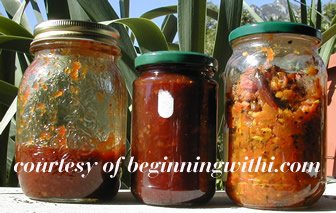
chutney jars

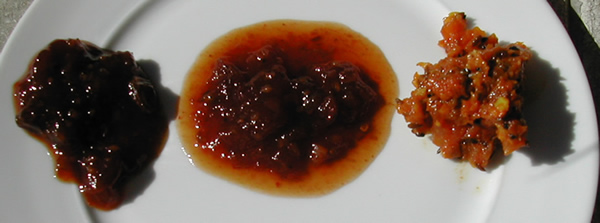
The pictures show all three chutneys – apricot, sweet tomato, and spicy tomato. Hmm. I still have some things to learn about food photography. The first two will go well with cheeses – aged and sharp cheeses such as parmigiano for sure, and probably with some kinds of pecorino (sheep’s milk) or caprino (goat’s milk) cheese as well, especially aged ones. The third one is more like a relish; I’ll have to see what it goes well with, though Ms. Jaffrey says it “could brighten up almost any meal.”