Tag Archives: Woodstock School

The Revised Woodstock School Calendar – It’s Snowing, and We Haven’t Left Mussoorie Yet!

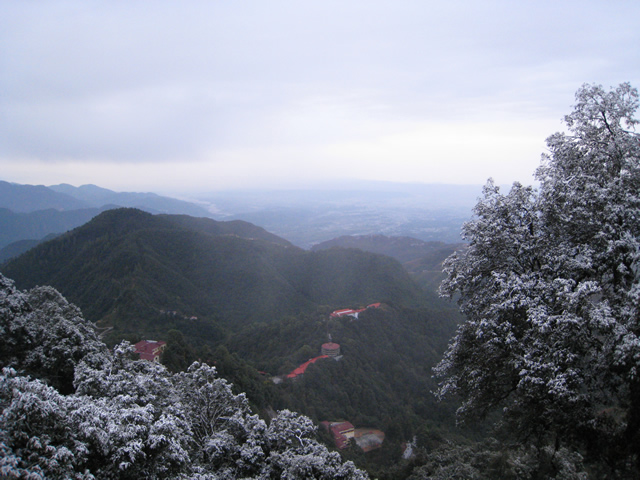
Yesterday morning I woke early to make coffee for our guest, out-of-boarding SAGE student Laura, before her 8 am exam. The sun had not yet risen when we came downstairs. I peered out the windows. “What’s that white stuff on the trees?” I wondered. “Frost? Is it that cold?”

We gazed. “It’s snow!”

We opened the door. “It’s snowING!”

We shrieked with delight. Laura, who lives in Paraguay, doesn’t usually get to see snow falling. (I, too, was raised in the tropics, and never saw snow coming out of the sky til I was 11 years old, in Pittsburgh.)

The ground was too warm for it to stick much, and the snow stopped falling after about an hour. Then the temperature plunged; last night was cold, even in Sanjay’s (unusual for Mussoorie) centrally-heated home.

This morning, the snow is back with a vengeance. Still not quite cold enough to stick, but we may be getting there…

It’s almost unheard-of for students to be around when snow begins falling in Mussoorie. Going Down Day – the end of school, when everyone heads down the hill towards home – was traditionally around December 7th, several weeks before the first snowfall was usually expected.

But this year the calendar has been experimentally changed, so school began August 8th (about two weeks later than usual), winter vacation runs December 14th to January 22nd, and the school year ends May 28th. Graduation is after that, on May 30th – ours, in 1981, was on June 25th!

The rationale for this change has not been well explained; I’ve heard that it was intended to allow more time to prepare (or less time to forget) before external exams in the spring, and/or to align better with the American school calendar.

There are historical, practical reasons for the school to have a long winter vacation. The average altitude of the campus is 7000 feet: it gets cold up here! Word on the hillside is that Mussoorie is in for a colder-than-usual winter this year, and, with a looming shortage of propane in the region, the school may have trouble heating itself. Staff usually have bukharis – woodburning stoves – in their living rooms, but in classrooms and offices these have been replaced with gas heaters. Dorm rooms are not heated at all.

Students are allowed to have electric blankets which, along with flannel or fleece sheets, can make getting into bed a far less traumatic experience than it used to be. The only problem is that, eventually, you have to get out again…

Beyond mere physical discomfort, the calendar change has upset the plans of this year’s SAGE (exchange program) families. The Winter Tour, a multi-week gallop all around India, primarily – but not only – for the benefit of SAGE students, has been compressed to 31 days. For some it will be even shorter, as students join or leave the tour at odd times so that the kids also have an opportunity to go home and see their families.

This is undoubtedly a headache for the tour organizers, especially as the tour is moving so fast that it will be hard to catch up with it along the way. Ross wanted to spend some portion of her vacation relaxing in Goa, and the only reasonable solution I could find was to have her join the tour just a week before its end, in Mumbai. It’s a pity she’s missing so much. On the other hand, after a long semester she needs some rest, and this year’s Winter Tour will emphatically not provide that.

The shortened vacation also eats into a beloved staff perk: the opportunity to travel in Asia during the dry (but still warm) season. Woodstock staff don’t get paid much, so these perks count for a lot.

All things considered, I suspect this calendar change is not going to stick, at least not in as drastic a form as we see this year. It’s a pity they had to run this experiment during my daughter’s year here; it would have been nice for her Italian relatives to see her at Christmas.


next


Bollywood Rising – Watching Hindi Movies at Woodstock

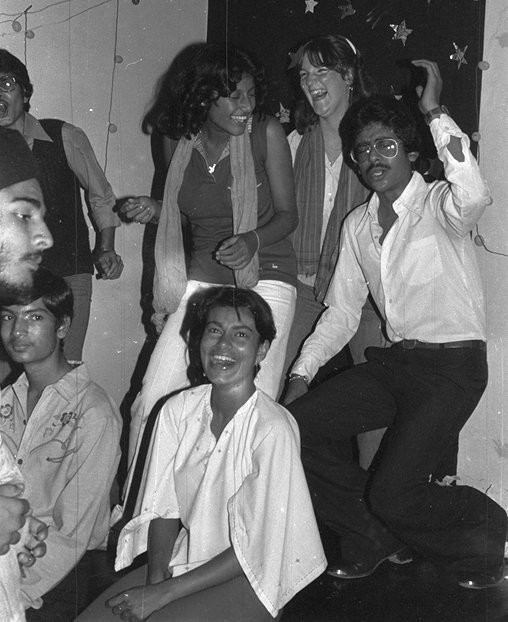
dancing to “The Beedi Song” from Omkara

When I attended Woodstock School, I never saw Hindi movies. This was partly a matter of logistics: Mussoorie’s two cinemas were available to us only on Saturdays, and a dark movie hall struck me as good mostly for getting groped by strange men – not something I was anxious to encourage; I got enough of that elsewhere in India. (I did venture once or twice, with a gang of friends, to see a rarely-offered English-language film.)

But Hindi films were such a large part of Indian culture that I couldn’t help being aware of them. We heard, and sometimes even sang, fun-silly songs with refrains like “My name is Anthony Gonzales!” or Chal, chal, chal, meri hathi, o meri sathi… (“Let’s go, my elephant, my companion.”)

During our senior year (1980-81), the original Om Shanti Om, a disco ditty, took India and the school by storm – we played it, to enthusiastic reception, at every school dance (as shown above) …but most of us (even some of the Indian students) still thought Western music and movies were cooler.

Our opportunities to see films of any kind were limited – there were no VCRs or DVD players in those days, and Indian television offered only one state-run black-and-white channel, Doordarshan. The sole television set on campus belonged to Brij Lal, our Hindi teacher, who used it mostly to watch cricket.

These days, Woodstock students have far more choices in entertainment: satellite TV and DVD players in every dorm, and of course you can watch DVDs and Video CDs (widely available in India, and cheaper than DVDs) on your laptop. Mussoorie’s cinemas have both closed down, but are not much missed (though people do happily go to the fancy multiplexes in larger cities).

At the same time, Hindi movies (now bearing the epithet “Bollywood”) have gotten better. The stories can still seem ridiculous to cynical American tastes: full of improbable coincidences, with plot points that often hinge on non-Western cultural norms. Bride & Prejudice worked as an update on Jane Austen’s classic because the “transgressions” of the sisters would seem shocking only in a relatively conservative culture like India’s.

Bollywood eye candy has also improved. Though Indian female stars have always been gorgeous, some of the male stars I observed in the 70s could get away with a bit of a paunch straining their fashionable safari suits. No longer. Nowadays they all work out with professional trainers, with results that speak for themselves.

All this, plus a larger Indian population at the school, has led to burgeoning interest in Bollywood movies among Woodstock students – not least, my daughter, whose current dream is to meet Shahrukh Khan. I was amused to have a houseful of (mostly) American exchange students enthralled by this year’s big hit, Om Shanti Om.

And I could understand why. It’s a great, goofy, fun movie. And, contrary to what some reviewers have said, you don’t have to understand all the Bollywood in-jokes to find it amusing.

So what if everyone bursts into song every ten minutes? That just adds to the fun! (And fans of western musical theater can enjoy themselves picking out the musical and scenographic borrowings from “The Phantom of the Opera” in the climactic scene.) Oh, yes – our old friend Arjun Rampal is in it, too.

If you’re new to Bollywood, I highly recommend Steve Alter‘s new book, “Fantasies of a Bollywood Love Thief” as an introduction.Among many other things, the book is a sort of production diary for Omkara, an Indianized retelling of Othello directed by Vishal Bhardwaj, who also composed the wonderful music.

As soon as I finished the book I rushed out to buy the movie, which is excellent. I can tell good acting when I see it, though I’m having trouble with the dialog: the VCD we bought has Hindi subtitles instead of the promised English, and my Hindi has not yet come back strongly enough for me to follow complex sentences in hifalutin’ semi-Shakespearean language which is at the same time in a western Uttar Pradesh dialect!

Lines of Communication: Woodstock School in the Telecoms Age

When I attended Woodstock (1977-1981), communication from and within India was fraught with difficulty. Letters to foreign countries – even in Asia – took weeks. Packages arrived damaged, or not at all. (Nowadays, Indian mail is more reliable than Italian.)

In my four years in Mussoorie I spoke with my parents by phone twice, I think, and can’t remember now what for – there must have been some kind of emergency or urgent news.

Continue reading Lines of Communication: Woodstock School in the Telecoms Age →

She’s Leaving Home

What with all the preparations, end of the school year, and various family medical traumas, I have barely had time to dwell on the fact that our daughter is about to leave home.

It’s just as well that I haven’t had that time.

Ross will be away for a full ten months (yes, I will visit). During winter vacation, the SAGE (exchange) program kids go on a one-month tour all over India, and, although it’s optional, Ross won’t want to pass that up. She will finish up at Woodstock next May 30th, presumably with enough course credits to graduate with a Woodstock diploma (equivalent to a US high school diploma).

She could theoretically then return to Italy for her fifth and final year of liceo, do the maturità (Italian school leaving exam), and go on to university in Italy – which has the advantage that it’s essentially free (we have paid for it already through our taxes). However, for reasons that I don’t feel like going into right now (because I’m so angry with the Italian school system), that is looking unlikely at present. So there’s a good chance that Ross will go straight on to college in the US, with only a vacation stopover back home in Lecco. Enrico and I are staring into the abyss of an empty nest.

Not that we thought she’d live with her parents til age 30, as so many Italian young people do – the girls do tend to get away earlier, and Ross just isn’t the type to stay home. There’s a big, wide world out there, and she can’t wait to go see it all.

Ross is also turning 18, just a few days after her school year at Woodstock begins. The 18th birthday is a big deal in Italy: it’s the voting age, the age of legal adulthood, and the age at which you can drive a car (drinking age? that was a while ago). Many kids, at least in Ross’ circles, celebrate 18 in a big way. Ross didn’t quite get her act together for a big party, but had a dinner out with a gang of friends. And we’re going to see a show in London, and will be having a few other treats along the way. Anything to keep me distracted from that moment when I have to wave goodbye to her at the airport.

Comments and shoulders to cry on welcome!

More Reasons to Send Your Child to Woodstock School

I thought of a few more answers to the question: Why send your child to Woodstock School?

The Natural Environment

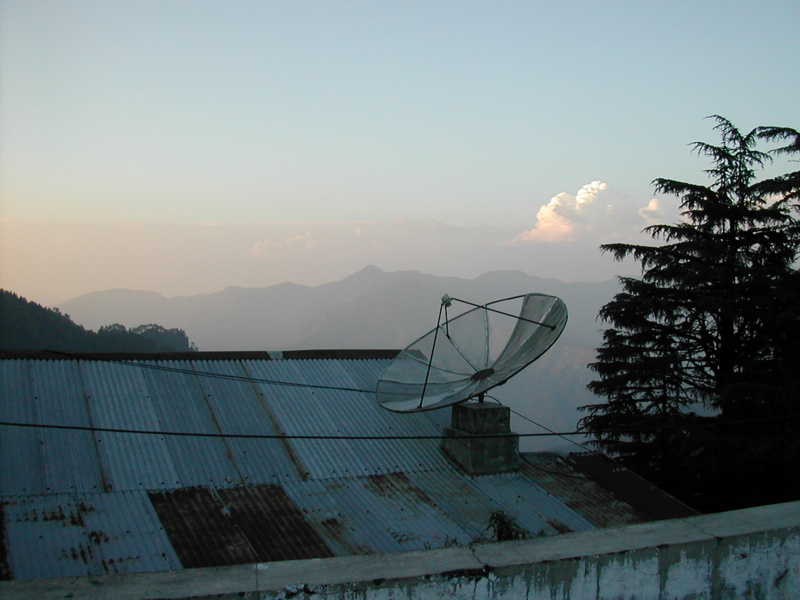
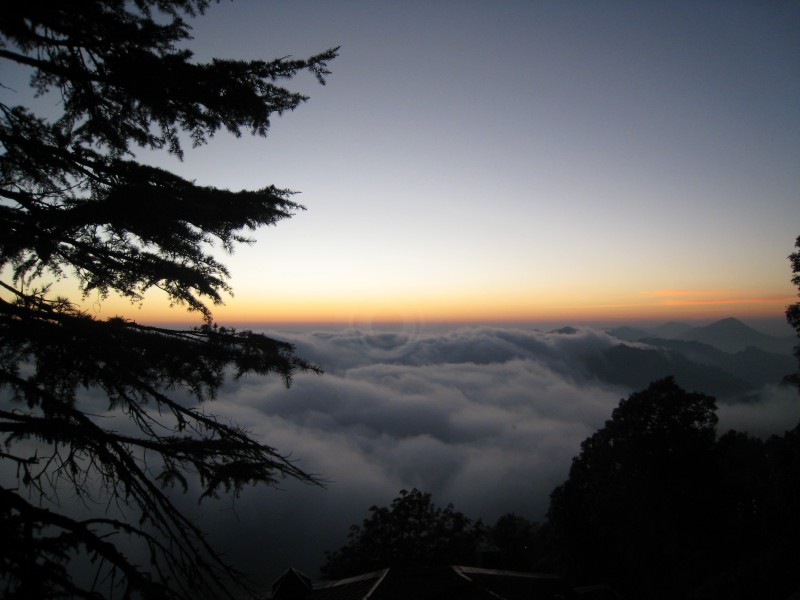
The photo above was taken from the top of the hill above school at dawn on a November morning. Need I say more? Look through the rest of the Woodstock section of this site, as well as the early part of the travel blog from my trip to India with my daughter two years ago, and you’ll see more of the extraordinary beauties of Mussoorie.

People tend to come out of Woodstock with a profound appreciation for – and desire to protect – the beauties of nature. A number have been inspired to make a career of it.

Extraordinary People

Another reason to send your child to Woodstock is that it produces some extraordinary people – and the ones on that page are just (some of) those who have an online presence that I can link to!

International Community

Though the specific demographics have shifted over the years, Woodstock has always been an international community made up of students and staff from dozens of nations, races, traditions, and religions. In such a context, you learn to get along well with everybody, to be sensitive to cultural differences, to find divergences stimulating rather than threatening.

In today’s globalized world, this is perhaps the most important kind of education any school could hope to provide.

You’re an Alum Yourself

A very strong reason to send your child to Woodstock, obviously, is that you yourself went there and loved it. I don’t have exact statistics (have asked the school), but it seems that a large proportion of alumni do send their children (and/or grandchildren, nieces, nephews, children of friends…) to share in this extraordinary experience. Some don’t quite manage to get their kids there for whatever reasons (finance, geography, lack of interest from the kids themselves), but they try, and some regret it all their lives if they don’t succeed.

The case mentioned earlier of the German boy who found Woodstock online and decided to go there is actually very unusual: people most often end up at Woodstock because of word-of-mouth recommendations from alumni and former staff. My husband accuses me, with some justice, of trying to “proselytize” Woodstock to everyone I meet. Well, that’s what I do with things I’m passionate about: I talk (and write) about them.

Now it’s your turn: if you’ve already decided to send your child to Woodstock, why did you? If your child has already gone, did the school fulfill your expectations for him/her? If you’re thinking about sending your child, what else would you like to know?