Category Archives: bio

When a Spell Checker Won’t Save You

70 million blogs, and thousands more “professional” news sources online, collectively produce billions of words every day. I rejoice that so many people are able to publish their thoughts and seek an audience, at low or no cost – information is good, freely shared information even better.

But I cringe at the abuses I see daily heaped upon the English language. Not “just” by bloggers, but also by journalists and others who should know better, working for news organizations that once upon a time had copy editors on staff.

Why should you care about excruciatingly correct grammar, spelling, and word use?

  • Anything less makes you look sloppy and amateurish, calling into question the reliability of your information. Rightly or wrongly, we are all trained to believe that information presented in polished prose is more authoritative, more likely to be accurate, than SMS-speak.
  • Poor writing is harder to understand than good, distracting the reader from the gist of your argument as she tries to tease out your meaning from a welter of poorly-chosen (or misspelled) words.

The very least you can do, as a courtesy to your readers, is to use a spelling checker – which is so easy that leaving misspelled words in your writing shows contempt for your readers and, indeed, your own work.

However, there are some kinds of mistakes that a spell check won’t catch: such as when a word is spelled correctly, but used in the wrong place. This happens most often with homonyms (words that sound the same but are spelled differently). Here are a few commonly-abused homonyms that you can easily learn to use properly:

affect effect impact

Affect

  • verb: to influence- “This product recall will adversely affect our profits.”
  • noun: an emotional state (mostly used by psychologists): “When I saw
    Mrs. Smith, she was quite depressed and had a flat affect.”

Effect

  • verb: to cause or bring about – “They managed to effect a compromise between the quarrelling parties.”
  • noun: a result – “Please don’t start drilling. That Novocaine has had no effect whatsoever.”

Impact used to be a noun: “The impact of his speech was enormous.”

Impact as a verb: Twenty years ago, the only thing that could be properly said to be impacted was a wisdom tooth or a bowel. Nowadays, everybody uses it as a verb (“That’s going to impact our bottom line”), a usage which has crept into the general language from bureaucratic Pentagon-speak. Ugh.

bated baited

bate means “1 : to reduce the force or intensity of : RESTRAIN <with bated breath>” (Webster’s online)

bait to entice or lure, as in fishing.

If you’re really waiting with “baited breath”, you just keep on waiting – ain’t nobody gonna kiss you!

flair flare

Flair is a noun, meaning a certain talent or ability: “As a child he had a flair for numbers, so he grew up to be an accountant.”

Flare is a verb, meaning to flame up: “Tempers flared on the field after the ref’s disastrous call.”

But it’s also a noun: “The soldiers broke the darkness by sending a flare into the sky.”

horde hoard

Horde, a noun, means a large group: “A horde of locusts descended upon the field.”

Hoard can be a verb, meaning to amass or hold aside something so as to accumulate a lot of it, or a noun – the mass so accumulated: “The dragon slept on his hoard of gold.”

(Confusingly, Genghis Khan’s Golden Horde refers to his army, not to any treasure they may have carried with them.)

its it’s

Any third-grade English teacher worth his or her salary should have taught you this, but it seems to be forgotten by many.

It’s true that ‘s indicates a possessive when tacked onto most nouns: “The boy’s ball was in the dog’s mouth.”

However, it’s is a special case: it’s a contraction for it is, just like he’s = he is, she’s = she is.

To indicate possession by an it, use its: “The dog had the ball in its mouth.”

lay lie

Lay is a transitive verb: you have to do it TO something: “Lay the gun down on the floor and move away slowly.”

It is often confused with lie, an intransitive verb meaning “to be or to stay at rest in a horizontal position“. Therefore, “Do you need to lay down for a nap?” is incorrect.

Don’t be confused by the children’s prayer “Now I lay me down to sleep” – lay is correct here because the child is (somewhat archaically) laying himself (his body) down. (That the child is then called upon to contemplate the possibility of his own death during the night strikes me as not likely to produce sweet dreams!)

lead lead led

NEW! (Because frequent mis-use of these is making me crazy.)

Lead, pronounced LEED, is the present tense verb, as in “to lead the pack.”

Spelled led and pronounced LED, it is the past tense of that same verb: “The old wolf led the pack until she died.”

Spelled lead and pronounced LED, it is a metal, as in “He killed Colonel Mustard with the lead pipe in the studio!”

Therefore, constructions such as “That question has lead a group of researchers to examine…” are WRONG.

peak peek pique

Peak is a noun for the top of a mountain: “Tenzing and Hilary scaled the peak of Everest.”

It can also be a verb, meaning to reach a height (from which you/it/something will then descend): “Brangelina fever peaked when…” – oh, who cares!

Peek can be a verb – to take a quick and/or clandestine look at something. In the UK, it’s synonymous with peep. “The children snuck down the stairs and peeked into the room to see what Santa had brought them.”

It can also be a noun: “Take a peek through this keyhole.”

Pique is most often used as a verb. Derived from the French piquer (to sting, prick, prod), it means to stimulate: “Her curiosity was piqued by the bartender’s odd behavior.”

But you can also have a fit of pique (irritation).

What you cannot do is to have a sneak peak (a sly mountaintop?) or to have your interest peaked (though your interest may peak of its own accord).

pore pour

Both are verbs, both can be used with “over”.

To pore over means to read or study attentively: “She pored over her notes for hours before the exam.”

To pour means to cause to flow in a stream: “He poured maple syrup over his pancakes.”

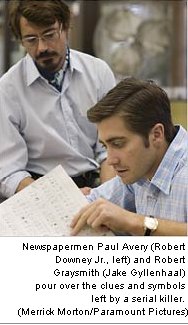
If your student is pouring over her notes, you’d better make her take a break!
pouringover

above: even the New York Times makes this mistake

prostate prostrate

The prostate is a strategically-placed male gland.

Prostrate is an adjective – (prone, lying on the ground: “They saw his prostrate form on the mountain path.”)) – or verb (to lie down on the ground, usually in front of somebody – “He prostrated himself before the golden idol.”)

Don’t confuse these two. The mental pictures conjured up are just too painful.

[free] reign or rein?

Reign is a noun meaning sovereignty or rulership: “During the reign of King Henry VIII…” Reins are what you attach to the bridle of a horse to steer by. “Free rein” means to give someone liberty to do as he likes. “Free reign” is an oxymoron.

I have not yet seen anyone offering “free rain,” and hope I never do!

tenants tenets

Tenants are the people who rent a place from you. Tenets are beliefs. You probably don’t hold core tenants, unless you need that rent money very badly.

than then

Than is a conjunction “introducing the second element in a comparison” (Webster’s New World Dictionary). “Mumbai is hotter than Miami.”

Then is an adverb, often (but not always) meaning “at that time” or “next in order of time”: ” “We’ll have dinner, then go to a movie.”

NEVER “I’m bigger then you are.”

their there they’re

Their – Possessive pronoun meaning “belonging to them”: “The kids wore their uniforms on the bus on the way to the ball game.”

There – That place: “When they got there, it was raining.”

They’re – Contraction for “they are”: “But now the sun’s out and they’re going to have a great game.”

theirs there’s

Theirs – Possessive pronoun again: “They said that no ball of theirs had ever had stitching like that.”

There’s – Contract for “there is”: “Now there’s going to be an investigation by the Little League.”

wreck havoc

The correct phrase is “wreak havoc”, wreak meaning “to cause,” “havoc” – devastation or disorder. To “wreck havoc” would presumably be a waste of time – havoc is already pretty much wrecked. To reek havoc? Let’s not even go there.

Here endeth the lesson. For today.

Feb 10 – Thanks to Jackson Day for the affect/effect grid and David Bratt-Pfotenhauer for some more pet peeves!
Il Muro di Sormano: Where Bicycle Racers Hit THE WALL

On a sunny Sunday in January, we drove up to the triangolo Lariano – the peninsula jutting into y-shaped Lake Como, whose tip is Bellagio. It’s an area famous in Italian bike racing history (there’s even a church dedicated to cycling, with relics of famous racers – including their bikes) As we drove, part of the road was stencilled with Muro di Sormano, over and over again. We had never heard of this, and thought it must refer to some ancient ruin of a Roman or medieval wall.

After lunch at the top of the hill in Colma, we noticed a tourism signpost for “Muro di Sormano – 2 km” with an estimated walking time of two hours. This seemed like a lot of time to cover two kilometers. So we started walking down the very steep slope of a newly-paved road, which was painted with altitude markers and stencils of local plants, and viewing spots where you could look out and identify the mountain peaks all around. More mysterious were the large quotations from Italian cyclists, painted on the ground so as to be read from the bottom up.

We ran into a local couple who were happy to tell us all about it. I love hearing stories from people like this, who have been in a place forever and known every inch of it for decades. Myself, I have a breadth of knowledge about many parts of the world, but I will never have the depth of knowledge that comes with being deeply, permanently rooted in your native soil. I’m not sure I would trade, but I do enjoy seeing the other side.

As they explained, the “wall” of Sormano is the road itself. It used to be part of the Giro di Lombardia (and maybe the Giro d’Italia). Because of its steep grade, the cyclists perceived it as a wall. Which doesn’t appear to have stopped them – in one part of the video you can see what are apparently the record times for covering this damn-near-vertical distance.

Immigration and Identity in Europe

(originally published in 2002)

The assassination of Pim Fortuyn, a Dutch politician, provides food for thought. Fortuyn was “a politician who rejected multiculturalism, called for an end to immigration and excoriated Islam as a ‘backward culture’ for its intolerance of homosexuals, attitude to women and more” and “argue[d] fiercely that immigrants should integrate more wholeheartedly with the host nation.” (The Economist, May 9 and April 25, 2002). Fortuyn raised valid questions about immigration and cultural identity, questions that European countries urgently need to answer.

Due to low birthrates, there is a shortage of “native” European babies, and Europe faces a demographic decline which will lead to a disproportion between the number of people being paid state pensions, and the number of people in the workforce paying the taxes to pay those pensions. Europe needs an inflow of young people to fill the demographic gap, and to do the menial jobs that native Europeans consider beneath them. There is demand for labor, and it is supplied, both legally and il-, by economic migration from poorer countries.
Yet immigration worries many Europeans. The ugly side of these fears is expressed in support for extremists like Le Pen in France. Balanced thinkers like Fortuyn, however, deserve a hearing. He posed important questions about the mutual rights and obligations of immigrants and their new home countries.

The big question is integration: How much should immigrants be expected to adopt the values and mores of their new countries? The issues are thorny when people from more repressive cultures immigrate to liberal ones (and the Netherlands’ is one of the most liberal in the world!). Which practices can or should be defended on the grounds of culture and tradition?

Some obvious lines are drawn. Clitoridectomy (“female genital mutilation“) is illegal in European countries; some women have successfully bid for political asylum to avoid being sent back to countries where they would be forced to undergo it. But other cultural conundrums run the gamut from arranged marriage, to Muslim girls covering their heads in school.

There are even culture clashes between first- and second-generation immigrants, sadly illustrated by the case of Fadime Sahindal. She moved with her Kurdish family to Sweden when she was seven, and attended Swedish schools. So she grew up between cultures, a third-culture kid, neither wholly Swedish nor wholly Kurdish. Her parents nonetheless expected that she would behave as Kurdish girls traditionally do, e.g. submit to a marriage arranged by them, with a Kurdish man. She defied them by falling in love with a Swedish man, and was murdered by her own father for “dishonoring” her family. (More)

“European populations are aging, and cannot maintain their welfare states without massive immigration; immigration from Islamic countries threatens to change European values inalterably.” (Rod Dreher, National Review Online)

Pim Fortuyn had reason to fear such changes. He was flamboyantly gay – not a problem for most Dutch, but anathema to many conservative Muslims, even those living in Holland. His murder just before the elections may already have changed the Dutch political mindset: “Mr Balkenende [expected to be the next prime minister] repudiated the country’s multicultural approach to immigration and said newcomers should assimilate with Dutch culture.” (The Economist, May 16, 2002)

Jan 28, 2007 – Revisiting this article nearly five years later, it’s hard to say that much has changed for the better. The Netherlands is having an identity crisis, spurred on the one hand by a tradition of tolerance, on the other by events like the religiously-inspired murder of director Theo van Gogh.

Italy has had its own “honor” killing. Last summer a twenty-year-old woman of Pakistani descent, raised mostly in Italy, was murdered by her father and uncle for dishonoring the family by refusing an arranged marriage and living with an Italian man. Her relatives slit her throat and buried her in the garden.

A colleague told me of a friend of hers, a north African woman in her 30s who has been in Italy for many years and lives with her Italian boyfriend. But now that her family is coming to visit from the home country (yes, I am being deliberately vague), she is going through an elaborate ruse to hide the real facts of her life, for fear that her family would literally kill her were they to find out that she is living in sin. This woman must either submit to the will of her family (marry a Muslim man of their choosing) or live in subterfuge and danger forever. Or renounce her family, but it’s possible that this would not save her life, should the family consider itself dishonored by her behavior. How is an open, tolerant society like Italy’s supposed to deal with this? What can we do to help her and others like her?

Your thoughts?

see also Integration of Muslim Students in Italian Schools

Oh, My Darling Clementine

The fresh fruits and vegetables section of a standard American supermarket looks much the same all year round. There is no seasonal variance in the availability of any common foodstuff: you see the same tomatoes, lettuce, broccoli etc., even when they have to be imported from someplace far away where the weather is right for growing them. This everyday "luxury" is so ingrained into American habits that, when I first moved to Italy, it never occurred to me that certain items might simply not be available at some times of year. "What do you mean, it’s not the season?"

Italian fruttivendoli (greengrocers) and their customers favor the fruits and vegetables of the season. You can certainly buy, e.g., greenhouse strawberries in winter, but they’re much more expensive, and not nearly as tasty, as the ones grown outdoors in their proper time. The most flavorful foods are grown "locally" and are bought at the peak of their season, when, due to their abundance, they’re also cheapest.

Right now it’s winter and we’re flooded with agrumi (citrus) from Sicily and other southern parts of Italy (and Spain). You can get some sort of oranges (arance [ah-RAHN-chay]) all year round, but at this time of year they’re huge and juicy, a colorful antidote to the gray weather. Blood oranges – my favorites – don’t look much different from any other kind on the outside, but inside: red red red! Squeeze them to obtain a thick, syrupy juice that looks like a vampire’s breakfast.

even the packing is gorgeous! – blood oranges

My favorite citrus, however, are clementines. I guess these are what Americans call tangerines: smaller than oranges, when ripe they are loose in their skins and easy to peel. They break apart neatly into bite-sized sections that you can pop into your mouth and enjoy a squirt of juicy sweetness, without getting it all over your hands and face. Actually, clementine [cleh-men-TEEN-ay] are usually so small that you can eat half of one in a single mouthful.

These (along with Glucose biscuits) were my favorite winter travelling food in India, and are just as handy on Italian trains: I can pop a few into my backpack, peel and eat at will. If they get a little mushed, it’s no matter – a section or two may be squished, but they don’t turn black like bananas, and the rest is perfectly edible. I also keep some on my desk for mid-morning and mid-afternoon snacks. A golden pyramid of clementine offered to guests after dinner will disappear entirely as people talk and nibble, easily downing five or six each.

There are several varieties. There are clementine con o senza semi (with or without seeds), pictured at top. There are mandarini, which are tiny, with a smooth, shiny skin that fits tightly and can be difficult to peel. There are mandaranci, which I take (from the name) to be a hybrid of oranges and mandarins. There’s a larger variety of clementine which is closer to what I remember from India – not as sweet and juicy as the standard Italian version.

I don’t buy late-season fruit: it’s always disappointing after the wonders of a fine fruit at the height of its glory. I’ll enjoy the clementine while they last. Then they will slowly disappear from the shops, and we’ll have to survive on pears and apples until the early summer fruits (cherries!) start coming in.

photos shot at Il Fruttorto, Lecco

The Boys of barCamp

For me, it started with a comment on Pandemia. Luca Conti (one of Italy’s most influential bloggers) reported the quizzical complaint of Marina Bellini: why were there practically no females signed up for barCamp Rome?

whodiegoluca


Luca Mascaro, Federico, Diego Bianchi, Luca Conti

I’d been reading more and more Italian blogs lately, especially since I met some Italian bloggers at a conference in Torino back in December. Luca had endeared himself to me by telling me, as soon as we met, that he had liked my piece on Bormio. And I’d gotten to know Lele Dainesi since he began doing PR consulting for TVBLOB (although, dazzled by the charms of my boss Lisa, he rather ignored me until I established my geek street cred by showing him my own site/blog).

greenshirt

The week after we hung out together in Torino, Lele, Luca, and many other Italian bloggers were at LeWeb3 in Paris (to my intense jealousy – I wanted to meet social networking researcher/goddess danah boyd – but my big boss wouldn’t pay for me to go). Amidst the controversy over how that conference was run, Lele amused himself by posting a Flickr photostream of “the women of LeWeb3.”

lele

^ Lele

So, in answer to the question “Why are women so under-represented at tech conferences?”, I commented that it might be because we hadn’t been invited, and that, fond as I am of Lele, initiatives like his LeWeb photos make us uncomfortable: “We like to feel appreciated for our brains before our tette.”

Lele jokingly replied that he simply loves beautiful women and, if they have brains as well as breasts, so much the better.

siinapasteris

^ Tony Siino, Vittorio Pasteris

(I was irritated by a similar posting of photos of The Babes of CES – really, guys, you can stop asking yourselves why women don’t come to tech conferences. As I commented on Thomas Hawk’s blog, it’s probably because we’re tired of trying to have conversations with your bald spots.)

diegob

^ Diego Bianchi aka Zoro

Another commenter pointed out that I didn’t need an invitation to come to a barCamp: anyone is welcome to attend and to speak. Then I received email from Amanda, a British woman (married to an Italian) living in Rome and working in tech (Excite), wanting to know if I was coming to barCamp, as she would like to meet me. Turns out she works with Diego, whom I knew from vlogEurope, who would also be at barCamp, along with others I knew, or wanted to meet.

redhead

^ Mystery Man C, Luca Lorenzetti, Andrea Martines, Mystery Woman 0, Mystery Man F

So I bought a train ticket on Thursday (100 euros – ouch!) and arrived Friday evening at Rome’s Stazione Termini. From there I would take the metro to the end of the line, near the home of our friends Serena and Sandro. As I looked around me in the metro station, I reflected that, the further south you go in Italy, the more good-looking the men. Not that they’re ugly up where we live, but I’m often astonished at the sheer beauty of Roman men (I admit to prejudice: my husband was born in Rome, though that doesn’t make him a Roman). But no one’s allowed to take photos in the metro, so I couldn’t document the ones who particularly caught my attention that evening. (What you see on this page are men who attended barCamp.)

redshirt

Simone Onofri

Serena picked me up at the metro station and brought me home to have dinner (and lots of wine) with the family. Sandro went over my Italian slang pages, making additions and corrections; eventually I want to get him on video demonstrating and explaining Roman slang. (I do have some video from that evening, finally edited and posted.)

whoblueconsole

Tommaso Sorchiotti

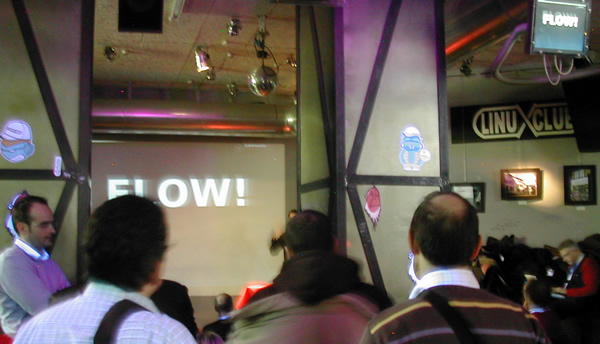
Saturday morning Serena dropped me at the bus stop to begin an hour-long odyssey across Rome. The day was beautiful and the ride fun; I had to change bus lines once and ask directions several times (I was delighted at the friendliness and helpfulness of the Romans). I found my way to the Linux Club in via Libetta by around 9:45, for an event that was scheduled to start at 10.

stefanto

This being Rome, we actually got started around 11:30, with the first speakers starting to talk while some of us were still registering for our badges and t-shirts. I stood in line with Amanda and Antonio (above), a winsome Sicilian philosopher who works for a company that makes adver-games (cool!).

barCamps are informal, and this one utterly chaotic: I had a hard time figuring out what was going on where and when, so I didn’t make it to any of the talks I thought I’d like to hear. But the ones I did end up listening to were interesting, and designed to provoke conversation rather than dispense wisdom in only one direction. Me being me, I got more than a few words in edgewise.

whotyping

^ behind: Davide Salerno, in front: Cristian Conti

blondedoor^ Federica Fabbiani, Andrea Cuius, Mystery Woman 2, Mystery Man J

During one such intervento, I pointed out that the Italian blogging community ignores the many foreigners blogging in and about Italy, whose perspective is different and potentially useful. Some people pitched in enthusiastically that they had recently discovered some of these blogs, and in the hallway afterwards several told me that they’d specifically discovered mine (thanks to a recent link from Lele), and enjoyed it – always good to hear!

dooragain^ Mystery Man K, Marco Rosella, Luca Alagna, Mystery Men N (background), O

When I wasn’t listening to “formal” presentations, there were plenty of other interesting conversations going on. Elisabetta, whom I met at vlogEurope, had come down from Milan to conduct live online interviews during dolMedia‘s coverage of the barCamp. She interviewed me about my 25 years online (a topic I had considered speaking on, but there were too many speakers already) and about TVBLOB.

A haphazard lunch was served, of Rome’s excellent casereccio bread with slices of roast pork, mortadella (aka bologna), olive paté, and various other goodies provided by San-Lorenzo.com. It was a scramble to get everybody fed, but, after years of boarding school, I am a champion at scrounging food – I didn’t go hungry (though I remained desperate for coffee for a long time).

doorhand

^ Mystery Men K, O, Luca L. (again), Diego Magnani

doorway

^ Mystery Woman 3, Leo Sorge,and Palmasco (foreground)

I realized that Robin Good, whose blog I’ve been reading for years, was present – and the photo on his site does not nearly do him justice robingood(nor does mine, unfortunately). I had not been able to locate his talk on Come pagare l’affitto con il sito (“how to pay the rent with your site”), but he was happy to give me individual advice. He, too, had followed Lele’s link to my site recently, so had some truly useful things to say. (I’m now mulling over what I’ll actually carry out.)

Robin is Italian, but writes his site in at least three languages (English, Italian, and Spanish, that I know of – and he may be adding more), and does a nice job of explaining all sorts of high tech stuff even to non-techies – I recommend it if you’re interested in understanding what we nerds are up to.

I spent a lot of the day talking with Amanda, who’s trying to set up a Girl Geeks Dinner in Italy – we need to find a woman who works at a high level in IT in Italy to be our inspirational speaker. I also talked a lot with Diego, about everything possible, and lots of other people. By the end of the day I was exhausted from talking.

table2

Mystery Man T, Stefigno, Mystery Man V, Gaspar and Fabrizio

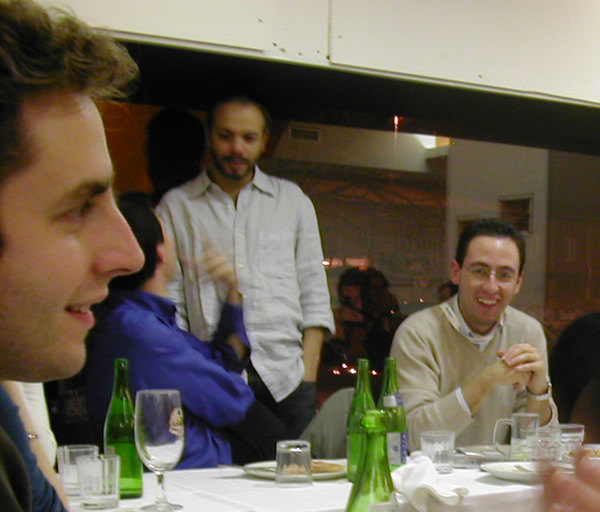
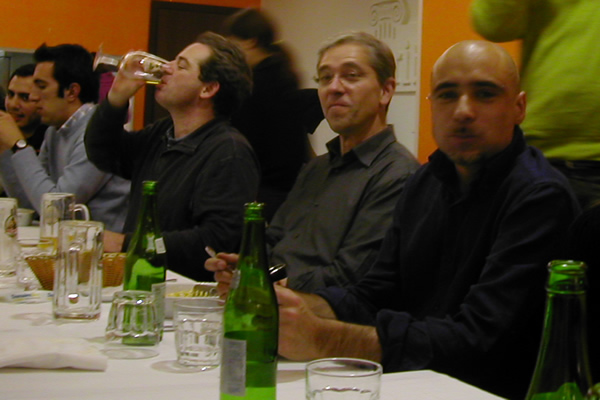
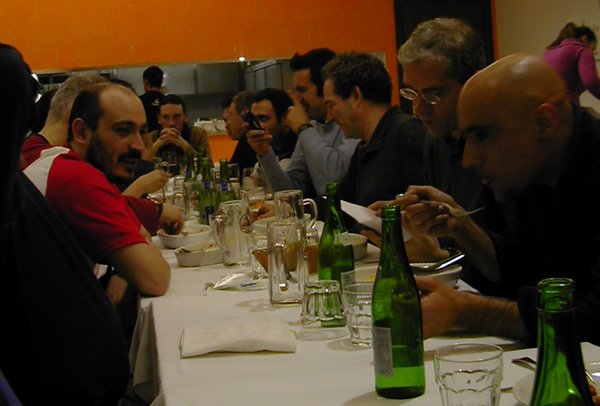
Around 8:30 pm, 40 of us moved a few blocks down to a restaurant for a group dinner. Pastarito is part of a chain in Italy, almost American in its approach and menu styling. It wouldn’t have been my first choice for a meal, but it was nearby and could seat 40 people, so probably the best we could do in the circumstances. The food was okay, though nowhere near the level of the dinner I organized for vlogEurope (said she modestly).

table1

^ Matteo Marchelli (red sleeves)

shaggy

^ waiter who looks like Shaggy from Scooby Doo, Fabrizio Ulisse

The dinner in any case was mostly about (more) conversation, though we were all running out of steam by the time we broke up at 11 pm. Diego dropped me and Luca at a metro stop, but the Roman metro closes for (ongoing) repairs every night at 9, and we couldn’t figure out where to catch the substitute bus. So we walked to a taxi stand, and finally found a taxi. Which cost a LOT less, for the distance, than it would have in Milan. I collapsed at Serena and Sandro’s around midnight.

whowhopino

^ Andrea Beggi, Mystery Man X, Pino (who shared an excellent dish of mussels at dinner)

fabio

Many thanks to Fabio Masetti (above) who organized it all, very well.

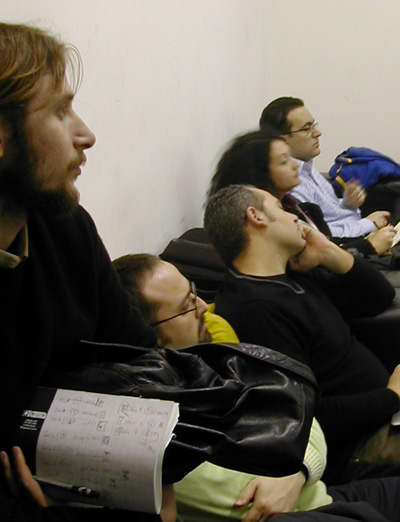
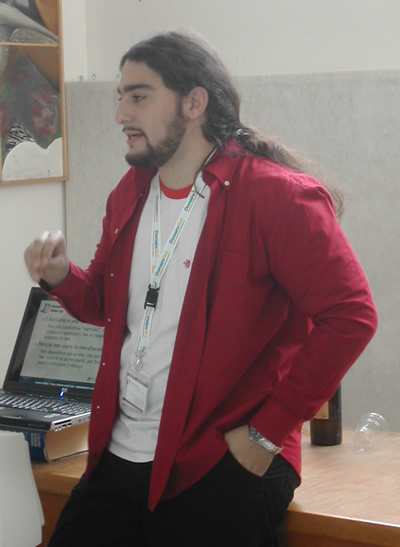
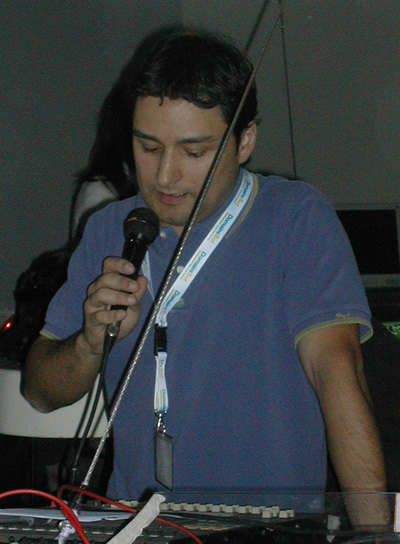
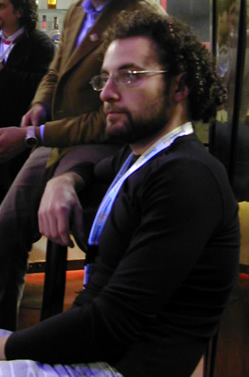
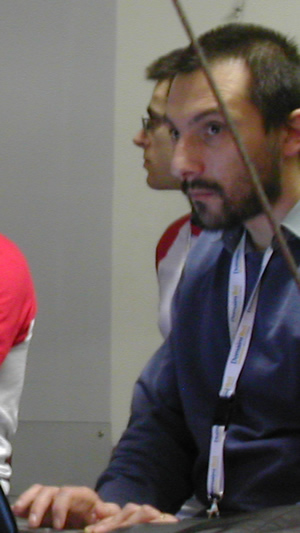
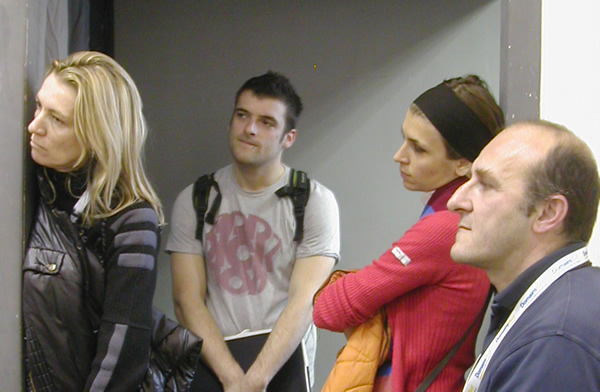
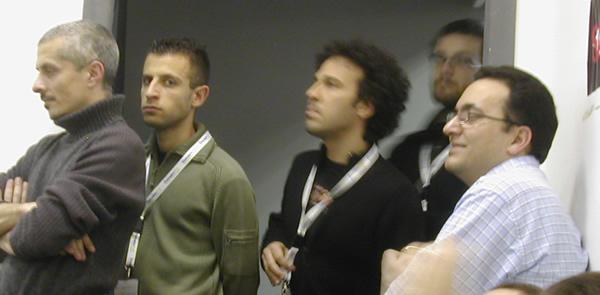
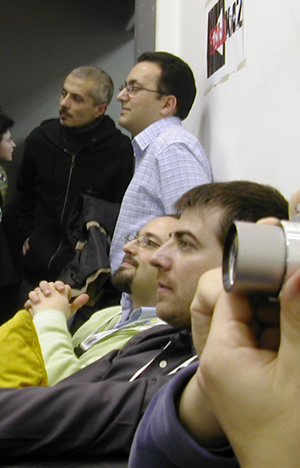
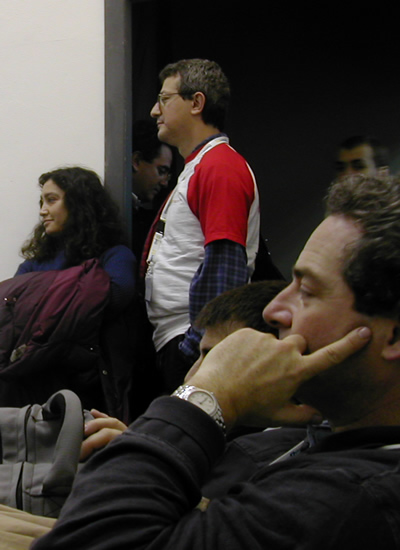
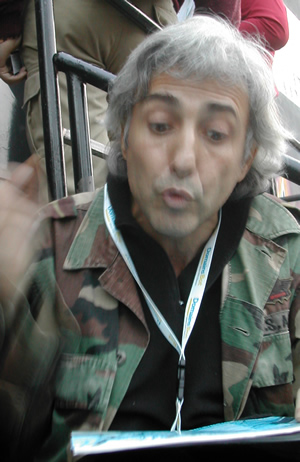
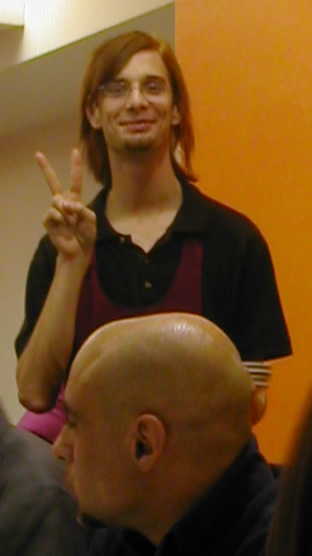
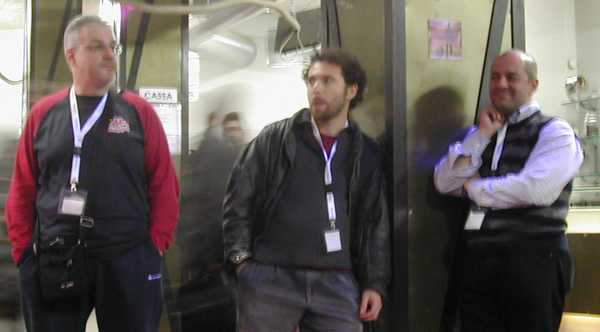
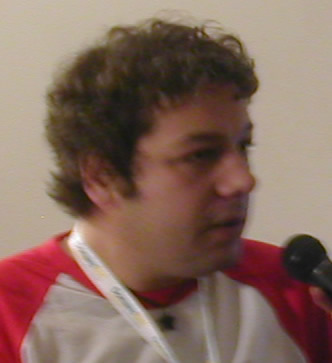
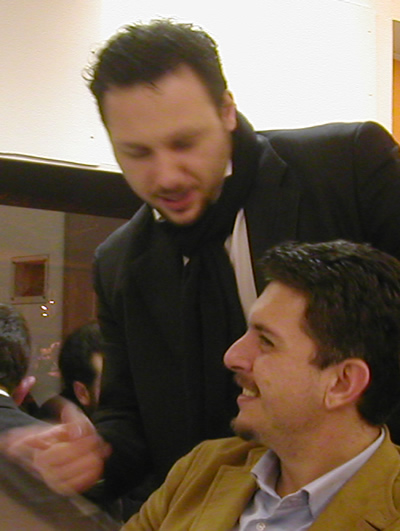
As for Les Boys: if all tech conferences were stocked with this many good-looking men, more women would probably go to them! (Sorry my photos aren’t so great – I really must get a better camera.)

I’ll leave it to the public to decide who is il piu’ figo (the hottest). If you’ve got better photos you’d like me to post or can provide links to (and names for – thanks to Luca for those already fixed), please do! Some photos I’ve already found are Luca’s.
emanuelestef

Emanuele Quintarelli and Stefano (Aghenor) Vitta