Category Archives: bio

Gender Identity Crises: Can’t They Tell I’m a Woman?

Back in August I wrote about the difficulties of being named Deirdré, which no one can spell or pronounce. An additional problem arose when I began dealing with large numbers of people online: many people don’t know whether it’s a male or female name. The default assumption was that I was male, perhaps because people “met” me in the context of technology, and assumed that a technically-capable person had to be male (that’s a rant for another time).

So I got used to being addressed in email as “Mr. Straughan;” it’s far better than some things I’ve been called online. My friend and colleague Adrian, meanwhile, had to contend with the fact that, in America, Adrian is assumed to be a female name (thanks to the “Rocky” movies). This Adrian is British, and male. On one memorable occasion, a member of a focus group of Roxio software users began (without prompting) to sing the praises of those wonderful online reps the company had, Deirdré and Adrian. Which was very nice, except that he thought that I was a man and Adrian a woman!

At least people meeting me in person usually figure out that I’m female, what with my two big attributes sticking out in front. But, when I was in Benares in 1985-86, even this certainty deserted me. I had very short hair at the time, and was a lot thinner than I am now. For most of the year, I wore salwar-kameez (traditional Indian women’s clothing, which is loose around the thighs but tight-fitting up top) and there was no question as to my sex. But in winter, to stay warm, I wore western clothing: baggy canvas trousers and a bulky sweater.

While travelling back from Kulu-Manali by bus, I was delayed in a small town where university students had blocked the road to protest something or other. I was standing outside the bus, waiting for something to happen, when a young man came bustling up, probably intent on telling me all about the noble cause, whatever it was. “Hello, Sir!” he shouted. Then, as he got a little closer, his face suddenly fell. “Oh, excuse me, Madam,” he muttered, and slunk away.

Soon afterwards, I was back in Benares, buying something in a shop. A little old Muslim man with thick glasses engaged me in conversation (in Hindi). I don’t remember what it was about, but we had been chatting for about ten minutes when he suddenly peered at me intently through his glasses. “Oh, excuse me,” he said. “If I had realized you were a woman, I would never have spoken to you.”

Italian vs. American Diet

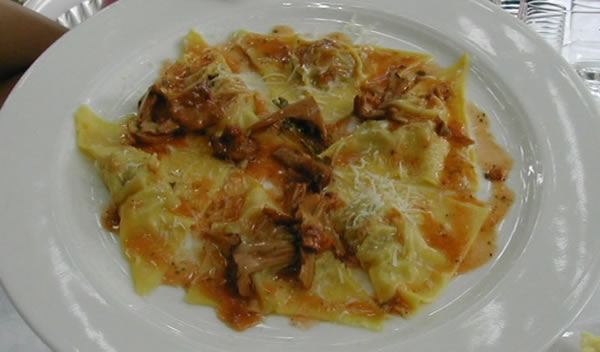
^ ravioli at Lanterna Verde – yum!

One of the most boring things in the world is listening to people talk about their diet (hearing them complain about their weight runs a close second). However, in America today there’s nothing to discuss, because everyone is on the Atkins diet (no carbohydrates, but you can eat as much of anything else as you want).

Food companies and advertisers have been swift to adapt. In the supermarket I saw “low-carbohydrate bread.” I did not read the label to learn how they accomplished this miracle; I had a feeling it would involve chemicals I’d never want to put into my body.

Magazine articles, books, and news items give alarming statistics about obesity, and offer ways to combat it, both in yourself and your children. It seems to me that maintaining a healthy weight is not rocket science, and doesn’t require a diet plan that you have to buy a whole book about, let alone pre-packaged diet meals with counted calories etc. etc. Didn’t we all learn the basics of nutrition in school, the four major food groups and all that? The major lesson I remember is that it never hurts to eat more fruit and vegetables, especially when those replace starches, fats, and sugars in your daily intake.

Perhaps what Americans really need is to revise their attitude towards food. Food seems to occupy two diametrically-opposed places in American consciousness. On the one hand, food is simply fuel – you shovel in whatever comes to hand, to keep you going. It’s this attitude that leads to families rarely eating together, as everyone is rushing off to their extra-curricular activities, grabbing whatever they can to eat along the way.

But food also has a psychological role. Cookbooks, menus, and people tout the concept of “comfort food,” which, when eaten, is supposed to make you feel secure or loved, perhaps by reminding you of your childhood. (Never mind that most of us never had this mythical comforting childhood or that kind of food with it.)

Comfort is a very dangerous role for food to play. You hear the same story over and over again: “I wasn’t overweight, but then I went through a rough patch and felt depressed. I turned to food for comfort, and became a blimp.” At the blimp stage, food is re-cast as the enemy, the secret sin, and the indulgent reward for good behavior (most often, diet-related good behavior: “I was good today, I only had salad for lunch, so I’m entitled to have a brownie now”).

The attitude towards food is one area where Italy really gets it right. This attitude is made explicit by the Slow Food movement, but I think is pervasive throughout Italian culture. In Italy, a meal is neither mere refueling nor comforting self-indulgence. It’s a time for a family to be together, to enjoy good food and each others’ company. It’s not something to be rushed through, neither in preparation nor in consumption. So dinner is eaten far later than in the US, usually around 8 pm. Meals are spread over at least two courses, which also slows you down. You have time to appreciate the food and wine, and to talk to each other. And there’s no rushing through the meal to watch TV afterwards. (I have never heard an Italian, not even a child, leave the table on that pretext.)

The Italian style of family meal has several beneficial side effects. On the nutritional side, everyone tends to eat a more balanced diet, in part because parents are at the table with their kids to ensure that they eat what’s good for them. Taking your time over a meal also ensures that you digest it better. And spending time together is good for families: you know what’s going on with each other.

Needless to say, the Atkins diet is not taking off in Italy, the home of pasta, risotto, polenta, and tasty, crusty bread. Thank god.

Winter Holidays: A Good Time to Visit Italy

While many people dream of Italy, it seems that most can’t picture it outside the summer season. I’ve seen messages on the Lonely Planet boards asking: “Is it worthwhile to even go to Italy in winter?”

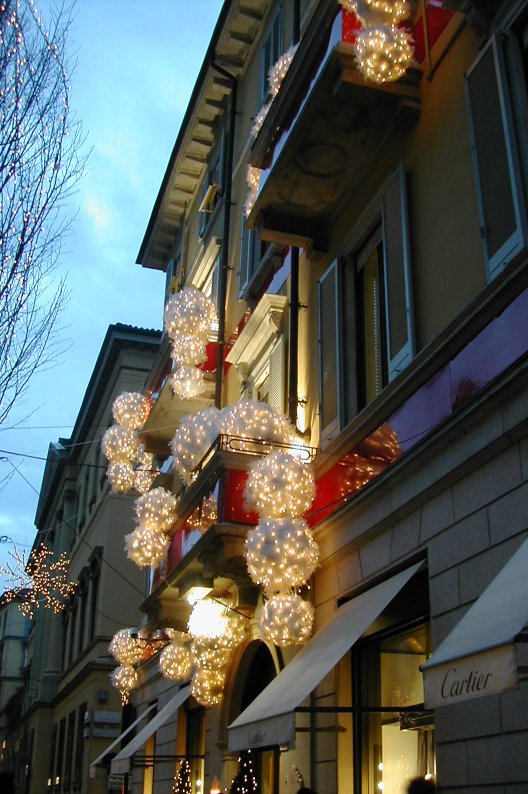
Well, yes, it is, especially around the Christmas season. As elsewhere in the Christian world, this is Italy’s biggest holiday. In the days before Christmas, shops will be open late at night, decorated in gold and silver, red and white, with lights everywhere, and the sidewalks are literally red-carpeted. There are concerts and events, street fairs and markets, and everyone is cheerful, perhaps because for once we’re all thinking about other people (i.e., what to get them for presents).

You probably don’t want to be on the road, though. Extended families travel to be together for the holiday. It’s rare for anyone to go elsewhere on vacation at Christmas; the proverb says: “Natale con i tuoi, Pasqua dove vuoi.” (“Christmas with your parents, Easter where you like.”) Millions of people travel by car (all those presents to carry!), so holiday highway traffic in Italy is horrible in the days just before Christmas and for the re-entry around the Epiphany.
Cartier - Milan
Shops are open until late on Christmas Eve, then everything shuts down for Christmas day. Except bars – you can always get coffee in Italy. Shops are also all closed on December 26th, the festa di Santo Stefano, but restaurants and at least some tourist sites are open, because that’s the day when families traditionally go on a gita (a daytrip) together. The weather usually cooperates, too. Again, lots of traffic.

From the 27th to the 31st, most shops run normal schedules. Shop windows of all kinds are suddenly full of red underwear, because wearing red underwear on New Year’s eve brings good luck for the new year. Plebeian cotton or sexy silk: doesn’t matter, as long as it’s red. I’m not sure whether it’s also required to be new, but undoubtedly the shopkeepers would tell me that it is!

New Year’s is party time, often in large gatherings of friends or, if you’ve gone off skiing or something, in paid large parties at hotels, restaurants, etc. An Italian New Year’s Eve party usually involves talking, dancing, drinking (though rarely to excess), and continuous eating, with a big feast after the stroke of midnight. This feast always includes lentils because, the more lentils you eat, the more money you will earn in the new year.

Another holiday tradition in Italy is gambling. This is about the only time of year that I see Italian families play cards or table games. The traditional games are mercante in fiera (“The merchant at the fair,” a card game about trading for goods), briscola (another card game), and tombola (bingo), all usually played for small sums of money.

For a big party one year, our friend Sandro created a quiz-show style game with questions in categories (history, sports, etc.), played in teams of four. Because he’s an ex-seminarian, one of Sandro’s categories was “religion.” Enrico and I are both unrepentant and unconverted survivors of religious schools. Much to our surprise, we won the whole game. We didn’t know anything about sports, but we were the only ones who could answer anything in the religion category (even though everyone else in the room would probably have claimed to be Catholic, if asked).

Everything is closed again on January 1st, and more or less back to normal on the 2nd. Then closed again on the 6th, the Feast of the Epiphany, the day that the magi arrived in Bethlehem bearing gifts. In Italian tradition, the Befana, a witchy-looking old crone, brings presents to the good kids and carbone (coal) to the bad ones. That is why you’ll see shops and stalls selling witches alongside Santa Clauses (an import) and lumps of black sugar “carbone.” These days, the Befana is an excuse for kids to extort yet more presents from everybody. Perhaps this is forgivable, since the Epiphany is the end of the holiday season; school starts again on the 7th.

Bible Stories

When Rossella was still in preschool and I was travelling to the US a lot for work, I brought her with me several times on extended trips, usually while Enrico was also travelling for mathematical research. So Ross experienced daycare in several different places in America, which was good for her English, and gave her exposure to American culture.

The year she was four, she was slated to spent some time with me in California. Before she arrived (accompanied by Enrico), I went to look at daycare centers with the wife of one of my Italian colleagues, who also had a young child. At one center the owner said, in a very aggressive tone: “I have all the kids recite the Pledge of Allegiance every morning.”

I had my own run-in with the Pledge when I was a kid, so you can imagine how I felt about this. “But these kids aren’t even American,” I protested.

“All the more reason for them to realize how lucky they are to be here!” she snapped. We decided against that place.

The only other option was an avowedly Christian daycare center. I was worried about what kind of indoctrination we might come up against, but the place was bright, cheerful, and clean, and I liked the staff, so I decided to risk it. I gave Ross a talk about how these people might tell her a lot of stuff about God, and she wasn’t to feel bad or strange if she didn’t agree with it; she was always free to make up her own mind.

She came home one evening and told me excitedly about the Bible stories she had heard that day: the adventures of Jonah and the whale, and Noah.

“Do you think that stuff is true?” I asked worriedly.

“Oh, no!” she said brightly. “They said they were stories!”

Nov 18, 2003

My friend Ivo wrote: “When I was in the US on my first day of high school [9th grade, in Georgia] I got the teacher yelling at me because I didn’t stand and recite the pledge! He said: “Are you Russian!? Would you prefer to be in Russia!?”

When I explained that I was Italian and had no idea of what that funny thing was, we found an agreement, and for the remaining 2 and a half years I was expected to stand up, but could avoid speaking or keeping my hand over my heart!”

My Attitude Towards Italy

I received email from someone who had visited my website, read a few articles, and concluded that I don’t like Italy much. I am confused by this, especially since the articles she cited (BabiesHomes, and one other, I forget which) didn’t strike me as negative. I see my articles as statements of fact, though written in a wryly ironic tone that might confuse some people, especially if they come looking for “Under the Tuscan Sun”-style warm fuzzies about Italy.

So, in case it needs clarifying, let me clarify: I do love Italy, and am very happy to live here. It’s probably the best place in the world for me to live, and, even if it wasn’t, my family is there, and that pretty much settles the question.

But I don’t love Italy blindly. I didn’t move here because I had always dreamed of living here*. So I don’t have particular dreams about Italy to keep alive, and can allow myself to see the bad as well as the good. And I’m not trying to make money out of writing about Italy (well, it would be nice…), so I don’t have to write the kind of sunshine-and-red-wine stuff that most people seem to want to read. The Italy I live in has much to recommend it, but it’s not the Italy you see in glossy coffee-table books. The Italian families I know are not the warm, boisterous, suffocating crowds you see in American sit-coms and movies. My family, friends, and neighbors are real, modern Italians, who rarely conform to Italian-American stereotypes.

I’m beginning to think that I should write a book about real life in Italy. Not to scare people off, but to point out that daily life in Italy has its own stresses and pains, just as daily life anywhere does. A good bottle of wine with a good meal is a lovely thing to have (even better when combined with a marvelous view), but it doesn’t cure all ills.

You know what’s really ironic? The average Italian on the street is astonished that I would rather live in Italy than America, or that anyone would (I have had this conversation with many taxi drivers). Like much of the rest of the world, Italians see America as the land of opportunity and riches, of wide open spaces and huge houses. Most of them would not willingly leave Italy permanently, yet they seem to wish that they could participate in the American dream. And they are absolutely floored to be told that many Americans dream – of living in Italy.

*If you’re wondering why I did move here… go here.