Category Archives: bio

Into the Belly of the Beast

(Part 4 of Resistance is Futile: The Oracle Acquisition)


The “change in control” from Sun to Oracle took place, in the US, on Feb 15, 2010. I visited the Oracle campus in Redwood Shores that day, invited by one of Oracle’s few sanctioned social media experts. As it happened, that was also the day that an Oracle support employee, wildly popular with customers for giving out support advice for free on Twitter and in a blog, was being shut down by the company, forbidden to provide answers outside the official – paid – support channels. It was clear that I wasn’t in Kansas anymore.

Soon thereafter, I was in Menlo Park for team meetings when I discovered that dozens of my videos had been deleted, without warning, from the BTV video hosting platform that had just been rebranded as Oracle’s. My colleagues heard my screams of anguish. I had not archived copies of those videos; that person in charge of Oracle media had not told me they would be removed (I rather thought she had implied that they would simply be rebranded). She gave no reason for the removal, and turned a deaf ear to my pleas that these were useful and perhaps irreplaceable original material, technologists talking about technology. The videos were still on a server somewhere, but I was never able to get a single one reposted. I hope there’s a special hell reserved for those who deliberately and maliciously destroy others’ work.

Her attitude was all too typical of what we experienced across Oracle, both at the corporate level and from many individuals. Oracle had been on an acquisitions spree, buying 50+ companies in five years and assimilating them with brutal efficiency. As far as I could tell, Oracle had no notion that it had once had its own corporate culture that might be worth preserving, let alone care that any of its targets did. That summer I met a former Oracle employee who had quit 18 months earlier, after 12 years with the company. “I didn’t recognize it anymore,” he said sadly. “After all the acquisitions began, it was no longer the Oracle I used to know and love.”

It was made very clear to us all that we were cogs in the machine and should not think too highly of ourselves. The only thing that mattered was profit, which was arrived at by carefully orchestrated process. Time after time we were told: “This is how it’s done here, get used to it” – sometimes in those very words. I had the impression that some victims of earlier acquisitions positively enjoyed putting us uppity Sun folk through the same miseries that they themselves had endured. Cherished ways and systems that had persisted for years at Sun – usually because they worked – were swept away with no regard for anything except The Rules.

Some particularly process-oriented former Sun people thrived in the new regime; most of us did not. For better and for worse, Sun’s creative, anarchic culture was the polar opposite of Oracle’s command-and-control style. It was soon clear that many of us, despite our best intentions to keep open minds and try to stand by the people and technologies we loved working with, would not be long for the Oracle world.

I have to hand it to Oracle: they were very canny about layoffs. Larry Ellison had claimed that “fewer than 1000” of Sun’s 30,000 employees would be laid off at acquisition. This was true – in north America. The change in control in other regions took place weeks or months later for various legal reasons, and many more layoffs happened in those areas, unnoticed by the US media. In some regions, salaries were simply cut so steeply (to match Oracle’s local salary ranges) that people left for other jobs as soon as they could find them.

I suspect that Oracle also skillfully identified the Sun employees to whom they didn’t need to offer layoff packages, because they would obviously quit anyway. In the cases of some that Oracle might have liked to keep, at least as figureheads, any desire to do so was apparently outweighed by Oracle’s structures, processes, and culture. I’ve heard that some special offers were later made to try to stem the exodus of talent, but it doesn’t seem to have worked in most cases.

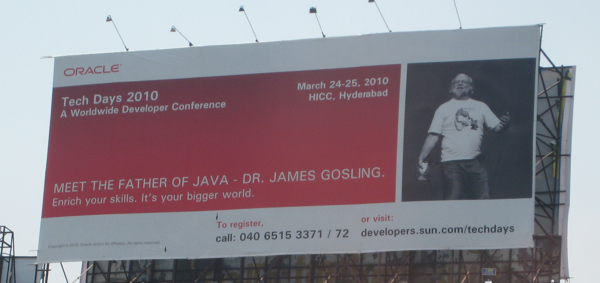
The first high-profile departure (post-Oracle) was James Gosling, the father of Java, who resigned in April, soon after headlining one of the last Sun Tech Days events, in Hyderabad, India. This also happened to be my last major trip for Sun/Oracle. I had never met Gosling (saw him once in an elevator), but was surprised at how withdrawn and standoffish he seemed in Hyderabad, spending most of his free time huddled in the hotel restaurant.

I returned to the US, finished packing my few possessions in Colorado into my Toyota Rav4, then drove to San Francisco, all within the space of five days, arriving and moving into my new home on April 3, 2010. I didn’t have official permission from Oracle to change my place of employment, but back in January I had had a major meltdown on the phone with my manager. The proximate cause was huge tensions with my Colorado roommate before the acquisition layoffs were finalized (in the event, all three of us in the household survived them). I needed to get out of that house, but it didn’t make sense to sign a lease elsewhere in Colorado when I was ready to move to California anyway. Lynn finally said: “Go ahead and go, we’ll make it official later.” She couldn’t give me a moving allowance or the cost-of-living raise that I would have got if I’d moved with Sun before the acquisition process began – Oracle doesn’t do that kind of thing. Of course.

What to Expect When You’re Expecting – to Be Acquired

(Part 2 of Resistance is Futile: The Oracle Acquisition)

I, too, received well-meaning advice from several high-profile Sun people: my job would disappear because Oracle “doesn’t do community” in the same way Sun did. This was true: we were told early on that our community work would be handed over to the small Oracle team that managed relations with the wholly independent and self-funding Oracle user groups worldwide. The OpenSolaris and Java beer and pizza parties were coming to an end. During this time, I was forcibly appointed secretary to the OpenSolaris Governing Board, a job I would not have been enthusiastic about at the best of times (having little patience for formal committee procedure) – and this was, obviously, not the best of times for that group.

I performed my various sorta-kinda-marketing activities as a non-coding member of an engineering organization. Again, there was demonstrable value in what I was doing, but the oddity of it all made me vulnerable, especially in a more traditionally-minded company. In spite of Larry Ellison’s loud proclamations that few Sun staff would be cut, I could only agree with Tim and Simon’s assessment that I would likely be one of those few.

In the midst of all this, in late August/early September of 2009, I broke up with Enrico, to whom I’d been married for 20 years. Yes, I believe in getting through all of my traumas at once. (Not to be dismissive of what was obviously a shattering event, but this is not the place to discuss it.)

Meanwhile, we in Solaris engineering had community and marketing activities already planned and paid for into early 2010, so we carried on with a “last waltz” desperation, waiting for the axe to fall. In the summer of 2009 I travelled to Brazil, New Zealand, Australia, and OSCON for Sun. In the fall, I helped run events at Usenix LISA in Baltimore and SuperComputing in Portland.

All this (and more) created so much video footage that I was paying Sun’s professional video contractors to edit my videos. I later learned that this work kept several of them afloat while Sun’s official marketing media activity was being shut down and handed over to Oracle.

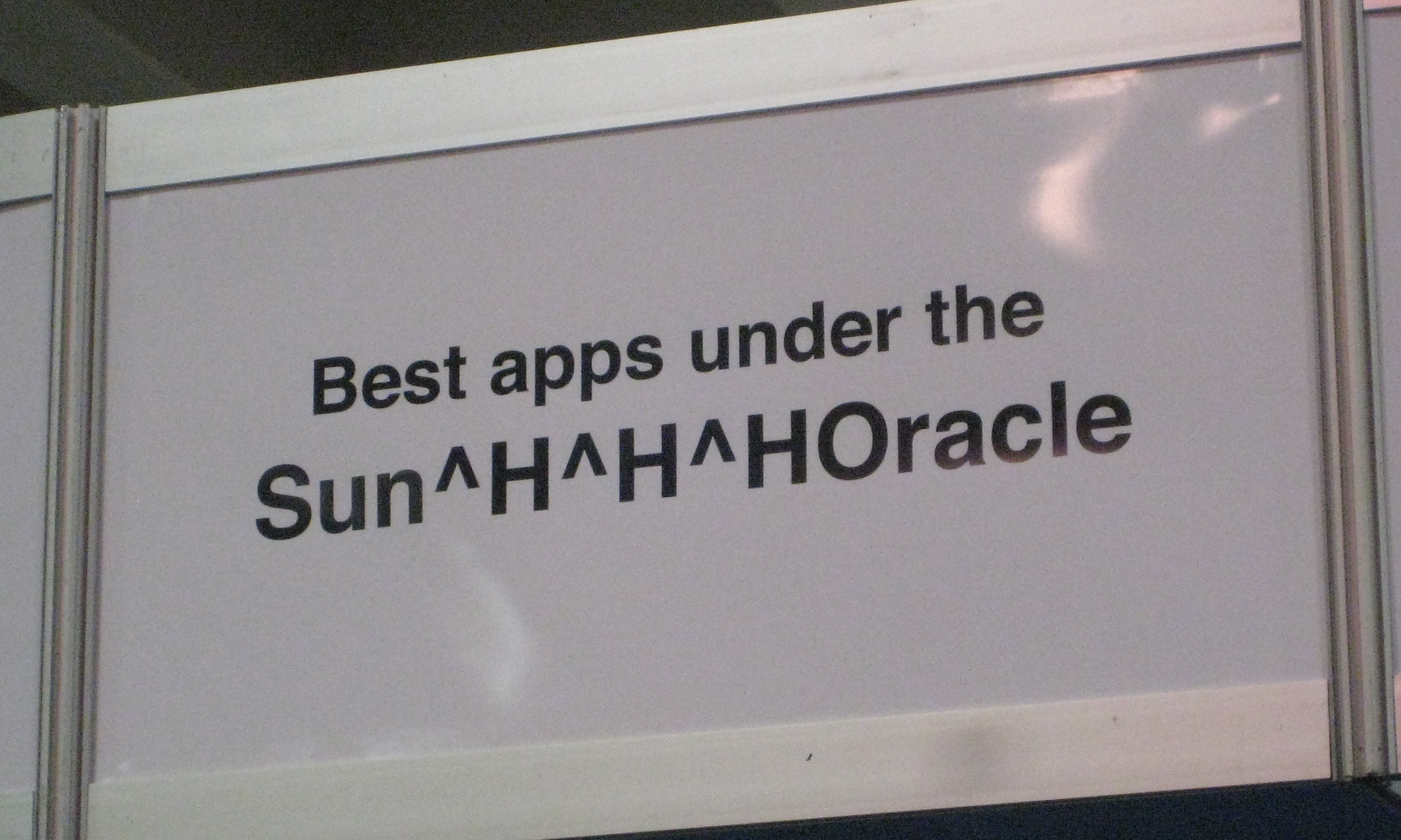
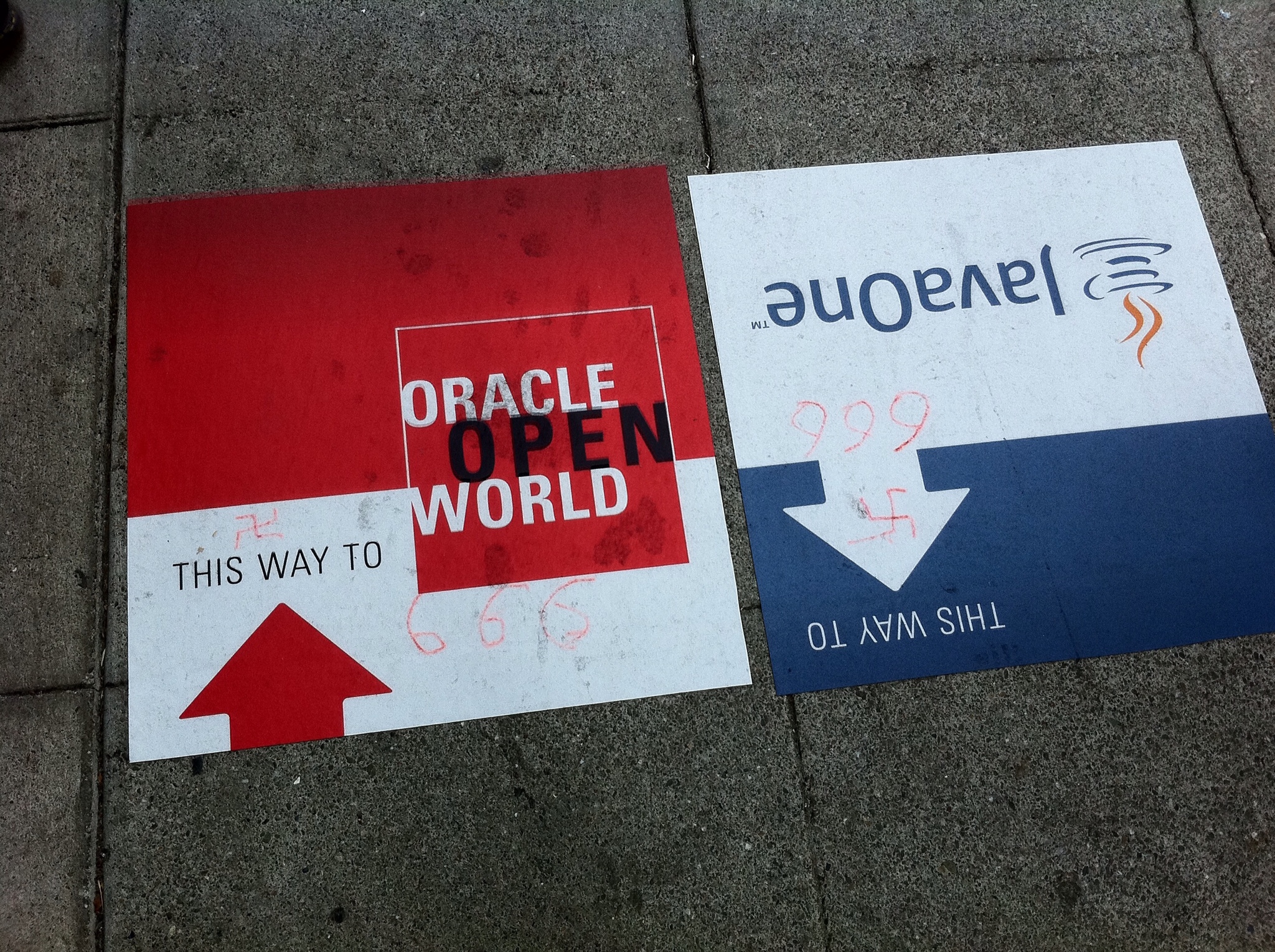
We all got a taste of Oracle media and events showmanship at Oracle Open World in October, 2009.

The opening keynote session started with Scott McNealy, Sun founder, former CEO, current Chairman of the Board, and orchestrator of the Oracle acquisition. Against a backdrop of soothing Sun blue, he gave a sweetly elegiac talk aimed at the Sun faithful: “We kicked butt, had fun, didnʼt cheat, loved our customers, changed computing forever.” All true, I supposed, but the McNealy magic failed to sway me – I had missed his heyday at Sun and didn’t really know why his former employees loved him so much.

Scott exited, stage right (or left). There was a moment of silence, then everything turned scarlet, the music changed to a pounding rhythm, and Larry came bounding out. He gave a very aggressive speech in the trademark Ellison style about how the newly combined forces of Oracle and Sun (“but mostly me“) would beat the world – especially IBM and RedHat. At the very least, we were in for a change of leadership style.

I had pinned some hopes on the fact that Oracle’s top executive team was much more diverse (read: fewer white men) than Sun’s. I was particularly prepared to be impressed by Safra Catz, the co-president/COO, who had a reputation as a shrewd, no-nonsense businesswoman. She was stiff and clearly uncomfortable on stage, which was forgivable. But then, in reference to an Oracle partner that does retail analytics or some such, she mouthed a scripted line about “Oh, I love shopping.” Safra! How could you let them do that to you? This chipped away at my hope that Oracle might be ok to work for.

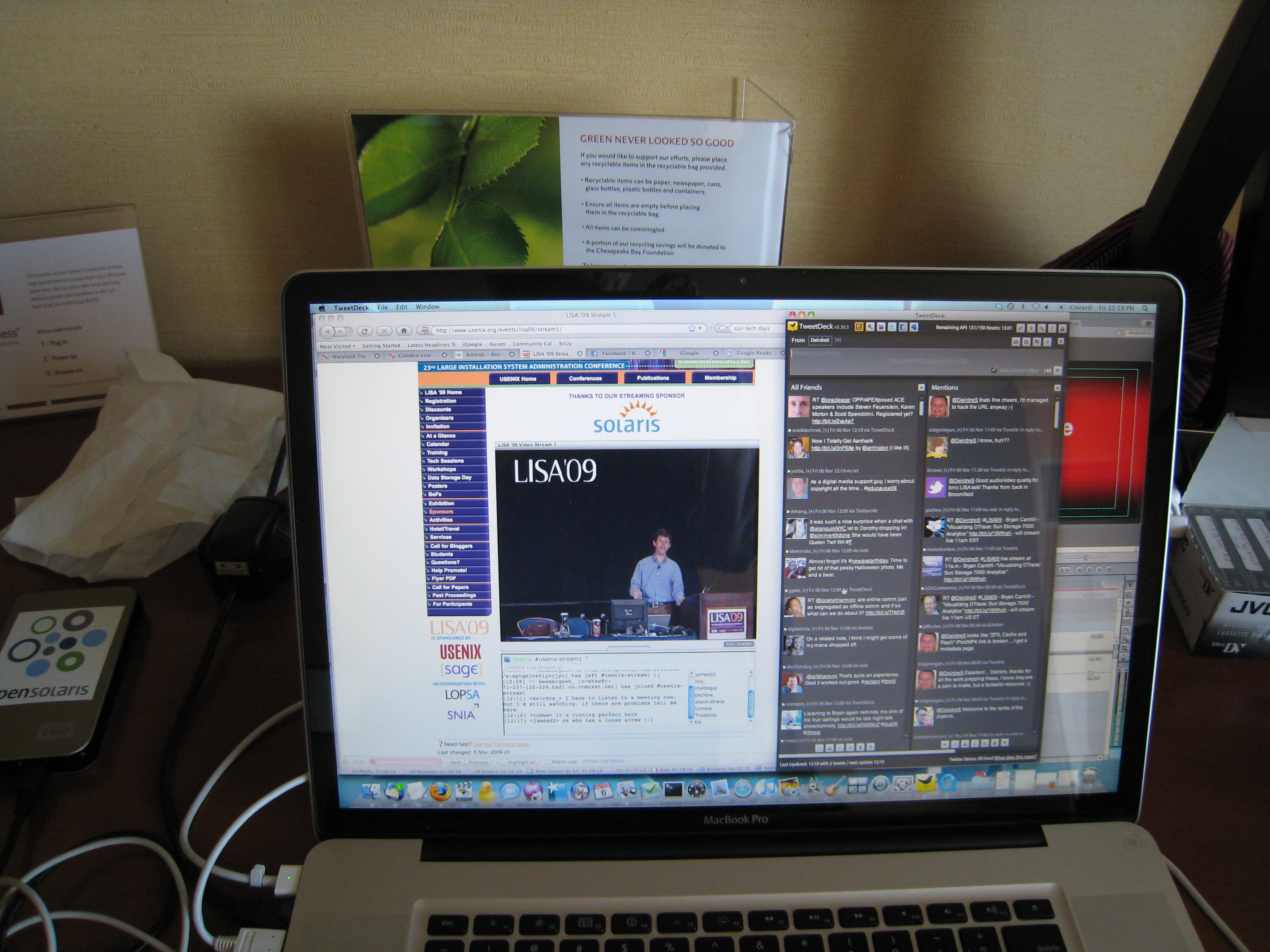
While at LISA, I got in front of the camera for once, in a conversation with Joyent’s Ben Rockwood about “conferences in general, open source communities, Solaris, OpenSolaris, Sun culture, Sun personalities, the value of video, social media…” I’m not sure I actually held out much hope by then that any of those things would be valued at Oracle.

img_9125

A day or two after this, still at LISA, I learned that our small team (me, Teresa, and our manager, Lynn) were all being moved into the Solaris marketing organization. I remember half-consciously digesting this information while haranguing a Usenix-hired cameraman (via cellphone from my hotel room) to zoom in on Bryan Cantrill’s face during his keynote talk. I had barely even met Bryan then, but I wanted his video to look good.

When I was (not very often) back “home” in Colorado, living conditions were stressful. I was renting rooms in a large house from a Sun colleague who had recently had her boyfriend, also a colleague, move in with us. Wondering which of us would survive the transition to Oracle did not aid our already-tenuous household harmony. I had never planned to stay in Colorado long-term; I’d intended it as an easier transition back into the US from my quiet life on Lake Como, before tackling the hustle and bustle of Silicon Valley, where I would logically end up for the sake of my career. By early 2009 I had started thinking about making that next move, but the acquisition announcement had put all transfers and promotions within Sun on hold, so for the moment I was stuck.

From the contact we had with Oracle (for us non-exec types, largely via “town hall” conference calls), it was becoming clear that Sun and Oracle were not well matched in corporate culture. One such call was a “we’re number one” pep talk from an Oracle sales exec. I turned to my colleagues listening alongside me in a Sun conference room and said: “When do we all line up for our testosterone injections?”

During a visit to the Bay Area in January, 2010, I met with the woman in charge of Oracle media. It was immediately clear that I would have to fight the “professional vs amateur” video battle all over again; Oracle’s attitude was that only VPs and higher in the corporate chain were worth putting on camera. Not surprisingly, two of Sun’s three video hosting services would be killed off, and the remaining one would be largely inaccessible to plebs like me. “You can put that stuff on YouTube,” she said dismissively. This would cost me a lot of work: YouTube limited me to ten-minute clips, while some of my videos were three hours long!

“What happens to all the material already published?” I asked, thinking of the many hours of Solaris history I had captured, engineers talking in depth about what they had created and why – information that might never be available again.

“We discard it all, not worth rebranding,” she said indifferently.

I pointed out that many of my videos were deeply technical and would continue to be relevant at least until the release of Solaris 11. She grudgingly agreed that I could add an Oracle video intro onto each video by way of rebranding, and keep them… somewhere. Weeks passed before I actually received the file I needed to do this. I spent many, many hours archiving videos from MediaCast and SLX, the two doomed Sun hosts, editing in the jarring Oracle intro clip, and uploading the videos to new homes on YouTube and blip.tv. The lady had told me that the dozens of my videos on the Sun BTV site (the ones the professionals had been paid to edit for me) would have the Oracle intro automatically added, so I didn’t need to do anything with them.

My new director in Solaris marketing was not much of a backer on all this. He essentially patted me on the head and said, “Yes, your little community videos are cute, now go write white papers.” As a rule, I hate, loathe, and despise white papers, but that’s a rant for another day.


continues…


Resistance is Futile: The Oracle Acquisition

The thing to understand about the illumos community is that it started out traumatized: most of us went through the baptism by fire that was the acquisition of Sun Microsystems by Oracle.

My own part in all this was very minor, but I had a ringside seat on larger events. I recount here what I saw; your own memories of this history may, of course, be very different!

Part 1: In the Gloaming

I had started working as a contractor for Sun in March, 2007. They liked me so well that, after a year, they wanted to hire me full-time into the Solaris engineering group, as a social media and community expert. When I got the offer, I called up a friend, a VC in New York who’d been trying to help me find work (not easy, as I was living in Italy at the time).

“I got a job at Sun!” I told him excitedly.

There was a long silence.

“Well,” he finally said, “it’ll look good on your resumé.”

“Huh?”

“Jonathan [Schwartz, Sun’s CEO] has been shopping the company all over Wall Street for nine months. It’s only a matter of time til it’s acquired.”

This did not give me pause. A job with a company on the auction block, back in the US, was still better than poorly-paid work or no work at all in Italy. I’d been through an acquisition before, and did pretty well out of it, though I certainly didn’t get rich. How bad could it be? More to the point: could it be any worse than the career stagnation I was suffering in Italy? I took the risk, left Italy, and went to work for Sun in Colorado. My first day in Sun’s Broomfield office was April 1st, 2008.

It was a shock, but not a surprise, when we heard in March, 2009 – from the media – that Sun might be acquired by IBM. Gloom, doom, and rumors of boom followed – and we were already reeling from round after round of layoffs. After about a month of worrying, we learned that we were, instead, to be acquired by Oracle.

At first blush, this seemed like a better fit and perhaps less overwhelming than IBM. I was cautiously optimistic. An old friend of mine used to work for Oracle and had loved the company, only leaving when she moved with her husband to a city where Oracle didn’t have an office. That had been years before, but I kept an open mind, and set about trying to understand what my life at Oracle might be like.

I was working in two areas – community and social media – where Sun was forward-looking. In employee blogging, Sun was so liberal that the hard part was encouraging employees to be as enthusiastic about it as the CEO.

My video work, though instigated by my managers in engineering, had been harder to “sell” to the official media team at Sun. They wanted all Sun video to show (expensive) professional production values, and were not keen to embrace enthusiastic amateurs like myself. There were stringent guidelines and a multi-week compliance process for the use of the Sun logo. As a result, the most successful video ever made about Sun technology contains no Sun branding at all.*

I was not deterred, and found others who thought as I did about video and podcasts. Sun being the “collection of feuding warlords” that it was, there were eventually three different media hosting platforms made available by various groups within the company, as well as YouTube and blip.tv. Over time I used them all to host my hundreds of technical videos. I knew these to be valuable, and had viewing statistics to prove it, so I was confident that my new colleagues at Oracle could be persuaded.

The acquisition took many months to complete, in part because of an anti-trust investigation by the European Commission. But Oracle was confident of eventual victory, and began dictating changes within Sun well beforehand. And, wherever we lacked concrete knowledge about our future, there were rumors, most of them frightening.

Sun.com was one of the oldest domains on the Internet (one of Sun’s slogans had been “the network is the computer”). Over time it had sprawled to 400 separate sites, a jungle that needed taming – but which also contained an enormous amount of computing industry history.

Suspecting that this status as an Internet historical place would not protect Sun.com, I offered my colleagues this advice based on painful experience.

continues…


*NB: I had nothing to do with this video, and only met its perpetrators later, though I work very closely with them now.


Second Chances

“You never get a second chance to make a first impression.”

This truism was, predictably, repeated during the WITI Summit. In my experience, it’s (fortunately) not entirely true.

When I was in college, my dad was covering my basic living expenses and my tuition was covered by scholarships. But I still needed a bit of walking-around money, so I sought flexible, part-time work, preferably something that did not involve long, late hours of being on my feet.

My major marketable skills at the time were reading, writing, and typing, so it made sense to interview with a small printing company in downtown Austin that was looking for someone to learn electronic typesetting and word processing. This was around 1983, when both of those activities involved clunky, expensive, dedicated machinery, and the rest of the printing work was done traditionally.

I interviewed with an office manager not much older than myself. I have no recollection of that interview, but it ended with a standard, noncommittal “We’ll let you know” – and then I didn’t hear from her for days. I knew I could do the job as she had described it, but I also had the uneasy feeling that I had not impressed her. Having spent my teenage years in boarding school in India, I had little experience of working, let alone interviewing.

Unsure of the etiquette of these situations, I finally called and asked her if a decision had been made.

“We’d like to look at some more candidates,” she laconically answered. It was clear that she did not have any other candidates to interview right then, but she didn’t want me even as an alternative to no one at all. At that point, I had nothing to lose.

“Look”, I said, “I’m really bad at interviewing, but I know I can do this job. Will you give me a chance?”

She did. And I was great. And they loved me. And what I learned there set me up for my later jobs in desktop publishing, then CD-R and technical documentation, and…

So, yes, first impressions are important. But a bad one doesn’t have to be your last chance, and if a hirer (or potential friend or mate) is willing to look past a less-than-optimal first impact, they might just find that that rough stone contained a diamond after all.