Brendan Gregg from Sun’s Fishworks team makes an interesting discovery about inducing disk latency. Don’t try this yourself.
also see The Making of Shouting in the Datacenter

Brendan Gregg from Sun’s Fishworks team makes an interesting discovery about inducing disk latency. Don’t try this yourself.
also see The Making of Shouting in the Datacenter
Taxi drivers the world over are usually gregarious and interested in people (it’s more or less a job requirement). I even met one, years ago in the US, who told me he was driving a taxi to gather stories for a novel he wanted to write.
I’ve just made a flying (in all senses of the word) visit to Dublin, which required four or five taxi rides between airport, hotel, and office, so I had ample opportunity to learn that Irish taxi drivers are more garrulous than most, and wise and funny with it.
The first one, who took me from the airport to the Sun offices the day I arrived, upon learning that this was my first visit to Ireland (yes, tick another “country beginning with I” off the list), told me:
“There are two things you should never do in Ireland: never touch another person’s beer at the pub – that’s sacrilege – and never call an Irishman an Englishman.”
He then reeled off a list of “stupid questions you should never ask,” attributing most of them to Texan tourists:
After giving someone else on the road a piece of his mind, this driver also explained to me that the Irish swear a lot.
“But it’s not necessarily bad. If someone tells you to fuck off, that’s bad. But if a man at the pub asks a woman ‘Do you want to fuck off with me?’, that’s a compliment.”
…
Of course everyone’s talking about the global economic crisis. Another driver told me: “The economists say it’ll be the worst off we’ve ever been. But that’s only relative. This was a very poor country 10-15 years ago.”
He grew up in a family of nine children, whose sheer number entitled the family to a “medical” card. This meant that, when their father’s weekly paycheck ran out on Thursday, the driver (the oldest boy in the family) would take his mother’s shopping trolley to the “stew house” where he was given a big pot of stew and one of rice to tide the family over until payday (Saturday). “I had two older sisters, but they were ashamed to be seen going to the stew house.”
“Now I own a four-bedroom villa in Torquay, as well as the house I live in here [in Dublin]. If I have to sell the villa because of the crisis, how badly off am I, really? I hate to say it, but maybe this crisis will teach people to tighten their belts. We’ve all become too greedy.”
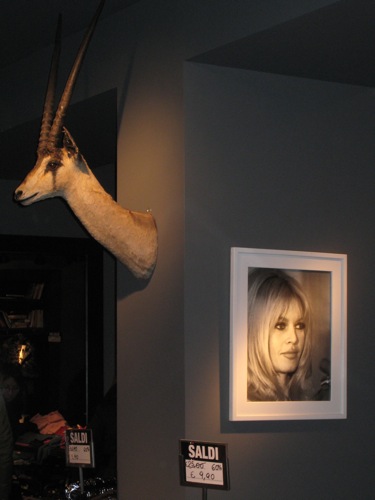
unconscious (?) irony: a shop in downtown Milan displays this antelope head next to a photo of Brigitte Bardot, who, retired from acting, is a big animal rights activist
Since I moved (back) to the US earlier this year, a number of people have asked me what I miss about living in Italy. It’s a hard question, and part of my agenda for this trip was to try to answer it. Yesterday provided me with a mini case study on the matter.
Although you can find individual items discounted year-round, Italian retailers are allowed, by law, only two big sales periods during the year, in early January and early July. The exact dates are determined by local government, and this year the Milan sales began January 3rd. After a fairly disastrous Christmas season, and in a very gloomy economy, both shop owners and customers were looking forward to this.
I wasn’t – I hate crowds and am not a big fan of shopping, so this was a nightmare scenario for me. But my business wardrobe needs updating and I wouldn’t have any other time before I leave for Dublin Monday. So I headed off to Milan, where at least I could look forward to also seeing friends.
Enrico drove me to the Lecco train station, arriving with five minutes to spare for the train I wanted to catch. Usually five minutes is plenty of time to buy a ticket, stamp it in the “obliterator”, and get on the train. But only two of the three ticket windows were open – apparently this period up to the Epiphany (Jan 6th) is a semi-holiday for the railways, so they were short-staffed. Both open windows had longish lines which would take longer because people wanted to discuss their travel plans in detail.
Usually you can buy “kilometric” (25 km, 30 km, etc.) tickets from the newsstand in the station, but they were out of the 50 km ones I needed for Milan. I poked my nose into the line at a ticket window to ask if it would be possible to buy a ticket on the train.
“Sure you can,” said the railway employee sarcastically, “if you also want to pay a 50 euro fine.”
I had to run to another newsstand down on the corner to get the !$!#@$@# ticket – all of 3.60 euros’ worth. Then run back, stamp it, and get on the train, which left the platform two minutes later. And no one ever came to check that I even had a ticket.
The train was middling clean and decent. Toilet paper in the bathroom, but no water to flush or wash my hands. Graffiti on the seats and walls. The real problem, however, was the heating. It was on, but not strong enough to cope with a very cold day. I was wearing a heavy sweater and sat with my coat over my knees, but still felt cold throughout the hour-long trip.
I arrived at Porta Garibaldi, one of Milan’s train stations, and had to take the metro to get to my friend’s place for lunch. I’d need to switch from the green line to the red, which I should logically do at Piazzale Loreto. As I was waiting on the platform, I heard a garbled announcement (in Italian only) about trains not stopping at two different stations, including Loreto, due to “works.” I couldn’t understand enough to know whether this would affect me, but thought: “This must be a pre-announcement referring to some other day. They surely wouldn’t be blocking stations today, of all days?”
They would. The train sailed through Loreto station without stopping. There were men laying tile on the platform on that side. Passengers who needed to get to Loreto had to go to the next stop and catch a train back in the other direction (the platform on the other side was open). This on one of the busiest shopping days of the year, at one of the prime stops for Corso Buenos Aires, a favorite shopping area. For work that could have been done in the middle of the night when the Milan metro is closed anyway. Probably there are rules preventing the tile guys from working after hours. Score: union rules – ten; customer service – zero.
I reached my friend’s home and had a lovely lunch with him and others. Then I finally, reluctantly, tackled my shopping. I was supposed to meet Ross downtown, which required taking the (now even more crowded) metro. Corso Vittorio Emmanuele, a large pedestrian thoroughfare in the heart of Milan, was wall-to-wall people, many of them with lit cigarettes wafting smoke into my face. I saw two well-dressed young men who had stopped in the middle of the street to enjoy a snack of freshly-roasted chestnuts, and were casually dropping the shells on the ground.
Ross and I shopped for about two hours, an activity I find exhausting under the best of circumstances. And there is nowhere to sit in Italian stores. Italian retailers don’t seem to have grasped the idea that a tired shopper, given a chance to take a load off her feet for a few minutes, might feel refreshed enough to hang around and spend more money.
As the shops began to close, we made our way to the home of another set of friends for dinner. Enrico had come from Lecco with the car, so at least we didn’t have to wait in a cold station for a train to get back.
The summary of the day is that I was glad to see friends and spend time with my family, but the rest was non-stop hassle. Which pretty much sums up my feelings about Italy at the moment: there are people here I’m glad to see (which, for me, is true of many other places). Other than that, there’s not much I miss about living in Italy.
^ sparkly crystal display in the dome of Milan’s Galleria
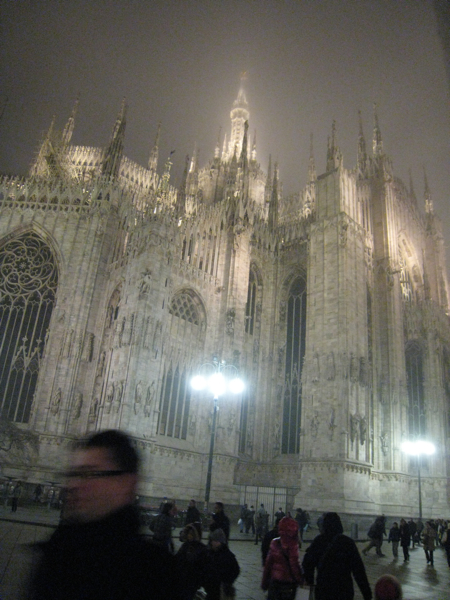
After a disastrous trip from Denver, Ross and I made it back to Italy the Saturday before Christmas, rather than the Friday as originally scheduled. Which meant I was still exhausted and jet-lagged when I made a dash into Milan to see friends that Monday. After having tea downtown with Mary Ellen, I had some time to kill before meeting Enrico, so I wandered over to the Duomo and Galleria area to enjoy the Christmas decorations. It was a foggy night (typical of Milan in winter), which lent a magical softness to the scene.
This year’s theme at La Rinascente, the fancy department store next door to the Duomo, was apparently crystal, resulting in some unusually attractive escalators:  The outside windows contained tableaux of “Swarovski-inspired” fashions which mostly looked weird, but I did like the beds of crystals the mannequins were standing in.
  Beneath the central dome in the Galleria is a mosaic floor including this representation of a bull which I believe is a symbol of the city of Torino (torino literally means “little bull”). There’s a custom in Milan to place your heel firmly on the bull’s testicles and spin, as this man was illustrating to his wife:
  …resulting in the damage you can see below (the mosaic is repaired from time to time).
  This is supposed to bring good luck, though it seems to me it might have originated as a dispetto (sign of disrespect) for the rival city.
  La Scala. I’m still not used to it being painted white. The vertical and horizontal strips of lights behind outline the new wing that was added in the recent restoration.
Yesterday we had our family holiday big meal out at Al Cenacolo (“at the Last Supper”) in Chiavenna. Having gone that far from home, it was a big decision not to go to our beloved Lanterna Verde, but, because this place had been recommended to us by Dr. Maulé, we decided to take a chance – and were not disappointed.
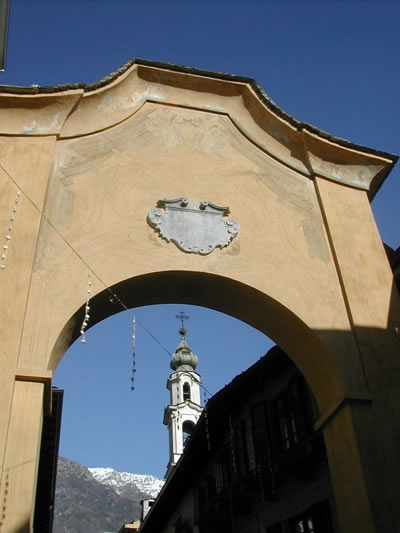
Al Cenacolo is located in central Chiavenna, very easy to find. Just go through the gate shown above, and you’ll find it a few doors down on the left.
The menu is brief (there are probably seasonal changes) and totally without fish (smoked salmon appetizer doesn’t count!).

Four of us opted for the paté di fagiano (pheasant paté). We should have stuck to the restaurant critic’s rule – everyone get something different and share – because the paté was not that interesting.

It just didn’t have much flavor, and would have been better if served a little warmer and with toast, although the restaurant’s bread was excellent.
The house wine was a very good Grumello riserva (a local wine made from Nebbiolo grapes), made especially for Al Cenacolo by the Nino Negri winery, a bargain at 9 euros per half-liter, served in a very attractive carafe – I want one of these!

Ingvild and I opted to skip the first (pasta) course. Bruno and Enrico both had the tortelli d’anatra glassati (stuffed with duck breast), which were very good (I managed to get a bite of Enrico’s).

Graziella had Al Cenacolo’s version of pizzoccheri, in which the pasta was more like gnocchi, and very tastily drowned in butter and garlic. She couldn’t possibly finish it, so we all got to clean up the serving bowl.

For secondo, I had wanted the duck breast all’amarena (sour cherries), but they would not make it for fewer than two people – very disappointing as that was not specified on the menu! I hate when I make my mind up for a particular dish and then can’t have it.
So Ingvild and I both had carré di cervo (venison) served with an insufficient portion of salsa ai mirtilli neri (berry sauce). The meat itself was luscious, rich, and tender, though the presentation was unimaginative and the polenta squares boring. Roasted potatoes would have been a better accompaniment to this wonderful meat.

Enrico had a (small) leg of pork smothered in porcini, Bruno had kidney with mushrooms, and Graziella had lamb; they all said their dishes were good, but I didn’t taste them.
The dessert menu was not particularly exciting. We had two kinds of sorbet: plum drowned in Calvados, and mandarin with “two kinds of liquor” (which kinds wasn’t specified).
The total for the five of us, including one and a half liters of wine and lots of water, was about 260 euros. Altogether a worthwhile meal, even at that price, though not quite as spectacular as I would have liked.
Ristorante Al Cenacolo, via Pedretti 16, Chiavenna – closed Tuesday evening and all Wednesday – phone 0343 32123