Category Archives: Italy

Italian Garden 2007: March

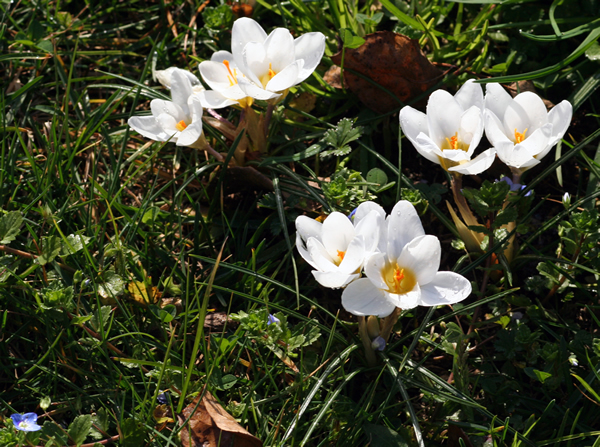
They tell us that this past winter has been the warmest in Europe for 200 years. Certainly our plants are confused. Some of the bulbs I planted in October were sprouting by December. The mimosas bloomed before la Festa della Donna, which I’ve never seen happen before. Crocuses in Italian are called bucanevi – “make holes in the snow” – but they could only make pretty white spots in the grass. And now the irises are blooming, on unusually short stalks.

I’m as confused as the plants are, but I guess there’s nothing for it but to start the orto (vegetable garden). In spite of pollen allergies (also early this year) and a lingering sinus infection, I’ve been out toiling the soil. (Actually, the sun helped to dry out my respiratory system.)

Two weekends ago I cleared part of the orto (vegetable garden) of its winter weeds, and planted basil, parsley, one kind of lettuce, and spring onions. I weeded the flowerbed by the garage wall and planted coriander, dill, and arugula there. (Now if I can only get the neighbor’s cats to quit using that area as a litter box…) And I planted various flower seeds in some of the dozens of cinder block “planters” that form our retaining wall.
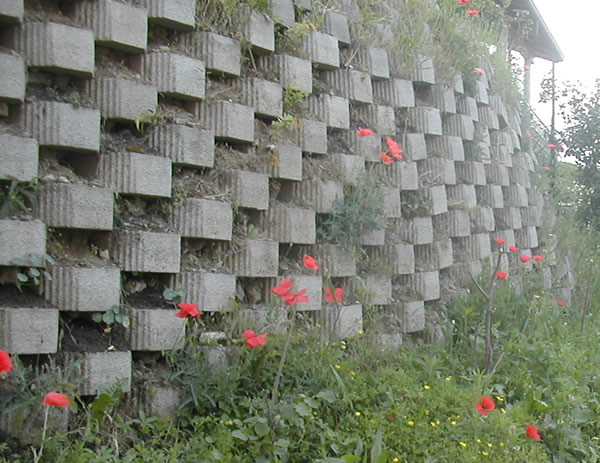
(This is what the wall looked like two years ago. I’ll take a more up to date picture when we have a prettier day for it. This picture was taken in May, when the poppies usually bloom at this altitude. It will be interesting to see how early they appear this year.)

This past Saturday I worked on the compost heap that occupies a corner of the bottom level of our terraced backyard. There’s too much wood in there – I need to break that into smaller pieces, and start mixing in more leafy stuff. But at the bottom, when I reached it, I found several buckets of decent compost.

I transplanted a mountain pine seedling that we had taken from the wild during a walk last year and planted in a pot. It lost all its needles over the winter and I thought I’d killed it, but now it’s sprouting new greenery. I planted it at the bottom of the retaining wall where it can, well, help retain.

We went to the azienda agricola (“agricultural company”) near home. I was hoping to get a jump on planting the vegetables, but they don’t have much yet – I guess the greenhouses weren’t expecting winter to be over so soon. But they did have, strangely, cranberries – not at all native to this region! 18 euros for six little pots of cranberry plants; we bought them on a whim. Checking my organic gardening book back home, I find that cranberries want to be in a boggy area with lots of sun. No such thing in our yard. Lots of sun, yes, but no bog – our soil is very clayey and dries out quickly. I enriched the soil in one corner of the garden with compost and planted them anyway; we’ll just have to water them a lot and hope for the best. It would be nice to have fresh cranberries for Thanksgiving.

We had a fairly successful orto last year, but I learned a few lessons to apply this year:

  • Plant zucchine where they will have room to spread. This year I’m going to try putting them at the top of a little slope at the bottom of the large retainin wall. This slope is usually covered in weeds – the zucchine plants can smother out the weeds for me, rather than growing down the lower retaining wall and covering plants I’d rather keep healthy.
  • Plant more eggplant. We didn’t get very many last year, and the fruit never got big, but they were very tasty – I want more of that!
  • Plant more of the tomato variety called costolute (“ribbed”) – of the various tomato varieties we have tried, these seem to do best in our environment.
  • Keep cutting back the lettuce and replanting it throughout the season. I let most of it bolt last year.
  • Can I do something to cover the strawberries so that we get to eat them, rather than the birds? Must see what I can rig up.

Enrico mutters that the roses aren’t performing as well as he had hoped when we bought them. I keep explaining that a grand garden takes time. Someday we, too, will have a wall of roses like this house in Milan:
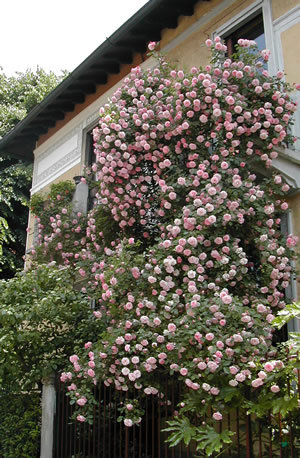
top photo by Rossella

Why Italians Drink Bottled Water

From time to time in the travel forums, I run across people complaining about the added expense of bottled water at restaurants in Italy. It is possible to drink tap water at any restaurant in Italy, and in some areas it’s the norm, but in many places the request is considered unusual.

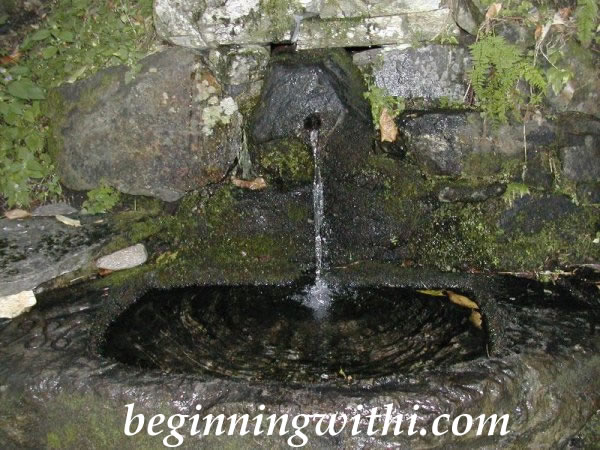
Although the water that comes out of our taps is perfectly potable, urban Italians drink almost exclusively bottled water. Not because it’s bottled, but because it comes from real mountain springs (like the one pictured above), and simply tastes better.

City tap water in most parts of Italy that I’ve experienced has a heavily chemical taste – lord knows where they get it from, or what they do to it in purifying. It is also very “hard” – full of calcium. When you see how quickly the inside of your teakettle furs up from boiling tap water, you have second thoughts about trying to process that stuff through your kidneys every day. (Although the technology is available here, very few households have installed the water softening systems that are so common in the US.)

The further you get out into the country, and particularly into the mountains, the better the tap water is: it’s often piped, unprocessed, directly from mountain springs into homes. Many town squares still feature the municipal fountains where people used to get their water before indoor plumbing became common. (In some places, water is so abundant that these can’t be turned off: they simply run, all the time, a waste which always disturbs me.) In communities that have particularly good water, restaurants will put a carafe of the local water on the table before offering you the bottled.

For home consumption, most city households buy bottled water in six packs of 1.5 liter bottles. There are dozens of brands, some local, some national. San Pellegrino is a national brand in Italy – in fact, the town and springs of San Pellegrino are not far from where we live. Most Italian bottled waters actually come from mountain springs in specific locations, and are bottled near the sources for which they’re named. Most come in fizzy and non-fizzy varieties, with the fizzy ones being artificially carbonated, but a few, such as Ferrarelle, are naturally fizzy. Some have recognizable flavors, and after a while you develop preferences (I, for example, can’t stand Ferrarelle).

There is lots of competition between brands, with ads touting their supposed health-giving properties (especially for the house brands at the terme – traditional health spas), low sodium, etc. I don’t take these claims seriously, but it is indisputable that water (bottled or not) is the healthiest thing you can drink – no calories, for starters, and one of the few health statements that most experts seem to agree on is that everyone should drink lots of it. In Italy, this is no problem: not many households keep soft drinks or beer ready in the fridge, but everyone’s always got water. The only two beverages that you see on most Italian tables are water and wine.

You don’t always have to pay for good water in Italy. Enrico and I routinely recycle plastic bottles by taking them to the mountains and refilling them with good spring water:

Aggiungi un Posto a Tavola: Concerto per Prete e Campane

Concert for Priest and Bells

Don Silvestro needs wood to build an ark so he can save the inhabitants of the village. As it happens, Clementina’s father the Mayor is also a lumber dealer and has plenty of wood, but he refuses to believe that God has spoken to Don Silvestro and demands proof – a miracle, in fact.

Don Silvestro causes all the bells in the village to ring by simply pointing at them.

Avete veduto, avete sentito, suono’ le campane col gesto di un dito. You saw, you heard, he played the bells with the gesture of a finger. 
Abbiamo veduto, abbiamo sentito, We saw, we heard 
suono’ le campane col gesto di un dito, he played the bells with the gesture of a finger. 
col gesto di un dito, col gesto di un dito, il gesto di un dito. with the gesture of a finger… 
din do do din don di di do do din don… [bell sounds] 
    
Don Silvestro:   
Ma il campanaro non sono io il campanaro é Domine Iddio But the bell-ringer isn’t me, the bell-ringer is Lord God 
che vuole farvi sapere tramite mio who wants to show you by way of me 
ch’é proprio vero quel che vi dissi io. that what I said is really true. 
    
coro: chorus [townspeople]: 
Che meraviglia, che cosa strana din don dan do do din don dan What a marvel, what a strange thing [bell sounds] 
questo concerto per prete e campana din don dan do do din don dan this concert for priest and bells 
    
il Sindaco: the Mayor: 
Ma se tutto sto scampanamento piu’ che un miracolo But what if all this ringing rather than a miracle 
fosse uno stupido scherzo – di chi? – del vento; was a stupid joke – by whom? – of the wind 
ma se tutto questo mistero piu’ che un miracolo What if all this mystery rather than a miracle 
fosse una gabola fatta, inventata – da chi? – dal clero. was a trick done, invente – by whom? – by the priest 
    
coro: Riprova un po’, riprovaci un po’, fagli vedere se é miracolo o no. chorus: Try again, try it again, show himn whether it’s a mircale or not 
Che meraviglia, che cosa strana questo concerto per prete e campana; What a marvel, what a strange thing this concert for priest and bells 
che cosa stupenda che musica strana questo concerto suona cosi’ What a stupendous thing, what strange music, this concert that sounds like this: 
din don din dan din don din dan din don din do do din dan [bell sounds] 
    
Che gran solista sono io! What a great soloist I am!

In spite of this miraculous proof that Don Silvestro is in contact with God – and heavy pressure from his family and the villagers (in the song Buttalo Via – “throw it away, it’s no good to you now”) – the mayor refuses to give up his wood for the cause. He is eventually tricked by Don Silvestro (with some help from God) into believing that all his purchasers have cancelled their contracts for the wood.

 Still smelling a rat somewhere, the mayor threatens to contact the authorities to have Don Silvestro arrested for fraud or declared insane. God has warned Don Silvestro that it is imperative that no one outside the village know of the impending flood. The villagers lock up the mayor to keep him from spreading the news.

next: Buttalo Via

Aggiungi un Posto a Tavola full song list

Aggiungi un Posto a Tavola: Sono Calmo

I’m Calm

Having sent Clementina home from the confessional, Don Silvestro returns to his evening milk. The telephone rings. The voice on the line is God, who says that he is not happy with the way things are going on Earth, and has decided to send another flood. Don Silvestro is to build an ark… At the end of conversation, after the Lord has hung up, Don Silvestro freaks out.

Calmo, mantenere la calma Calm, maintain calm
Perché se non mi calmo Because if I don’t calm myself
Mi viene il cardiopalma I’ll have a heart attack
Calmo! Calm!
Con la mente tranquilla With a tranquil mind
Adesso mi preparo Now I’ll prepare
Un po’ di camomilla* A bit of camomile [tea]
   
Eppure il telefono ha squillato And yet the telephone rang
La voce del Signore m’ha parlato The voice of the Lord spoke to me
M’ha detto, m’ha detto esattamente He said to me, he said to me exactly…
Si m’ha detto esattamente Yes, he said to me exactly…
Che m’ha detto esattamente??? What did he say to me, exactly?
Aiuto! non ricordo un accidente! Help! I don’t remember a darn thing!
   
Calmo! ipersuperstracalmo Calm! hypersuperextracalm
E per restare piu’ calmo And to stay calmer
Ora recito un salmo I’ll recite a psalm
Qui facit misericordiam …
Calmo io, é una parola I’m calm, it’s a word
Il Dio che atterra e suscita che affanna e che consola The God who strikes down and revives and causes to pant and consoles
Ha parlato con me spoke to me.
Si, vabbé lo so che prima di me, fece un discorso simile a Noé Yes, okay, I know that before me he made a similar speech to Noah
No eh? No, eh?
   
Signore, scusami Pardon me, Lord.
   
Grazie, il cuore é regolare Thank you, the heart is regular [in its beats]
Il polso? Benissimo, cammina The pulse? Just great, it goes [on]
Adesso, mi posso addormentare Now I can go to sleep
E venga ben venga domattina And tomorrow morning will be welcome
   
Calmo Calm
Calmo come una salma Calm as a corpse
Son contento e felice I’m contented and happy
Son felice e contento I’m happy and contented
Oramai m’addormento Now I’ll go to sleep
in una mare di calma in a sea of calm
Ecco, si m’addormento See, yes, I’m going to sleep
in un mare di calma in a sea of calm
Oddio! Oh, God!
Ho parlato con Dio! I talked with God!
   
* camomilla – camomile tea, frequently used as a soothing decoction to help people, particularly children, go to sleep.

next: Concerto Per Prete E Campane

Aggiungi un Posto a Tavola full song list

Learn Italian in Song: Il Ballo del Mattone

recorded by Rita Pavone
Rita Pavone - Rita Pavone: I Grande Successi Originali - Il Ballo del Mattone

Written by Verde / Canfora

Another silly song from the sixties.

Il Ballo del Mattone

The Dance of the Brick/Tile

Non essere geloso se con gli altri ballo il twist, Don’t be jealous if with the others I dance the twist
non essere furioso se con gli altri ballo il rock: Don’t be furious if with the others I dance rock
con te, con te, con te che sei la mia passione With you, with you, with you who are my passion
io ballo il ballo del mattone. I dance the dance of the tile
Non provocar la lite se con gli altri ballo il twist, Don’t provoke a fight if with the others I dance the twist
non provocar scenate se con gli altri ballo il rock: Don’t cause scenes if with the others I dance rock
con te, con te, con te che sei la mia passione With you, with you, with you who are my passion
io ballo il ballo del mattone. I dance the dance of the tile
Lentamente, guancia a guancia, Slowly, cheek to cheek
io ti dico che ti amo I say that I love you
tu mi dici che son bella You tell me that I’m beautiful
dondolando, dondolando sulla stessa mattonella! Rocking, rocking on the same tile!
(ripetere) (repeat)