Category Archives: technology

Help in Saving My Hands

Now and then I suffer from RSI (repetitive stress injury), from too much time on the keyboard: my fingers feel stiff and painful, arms and shoulders get tired, and so on. I know I should move around more, type less, etc., but when I’ve got a lot to do, it’s hard to know when to stop.

Now I have something to tell me when to stop: a piece of software called WorkRave, which I started using a few weeks ago. Wow! It really is something to rave about. It’s a well-behaved little utility that sits in the background and monitors your keyboard useage. You set it to remind you to take a break at fixed intervals; I have set “microbreaks” (60 seconds) every 15 minutes, and a ten-minute break every 45. During the longer break it even suggests helpful exercises you can do, though I’m more likely to go for coffee, talk to colleagues (or, if at home, put in a load of laundry, start dinner)…

Prior to installing WorkRave, I had pictured myself as too easily distracted – always jumping up to go to the bathroom, go for coffee, or do household chores. Now I’m surprised at how quickly those 15- and 45-minute chunks fly by. Heeding the reminders to take a break does seem to be helping my hands, too – I feel worse on days when I’ve chosen to Skip or Postpone them too often.

If you spend too much time on the keyboard and your body is letting you know it (or better, before it does), I highly recommend installing WorkRave. And the price is right: it’s open source.

2013: Two years ago I switched to the Dvorak keyboard layout, which helped far more than anything else I’ve tried in a long history with RSI.

Long-Distance Working – A Tale of Two Companies

Old Days, Old Ways: Adaptec

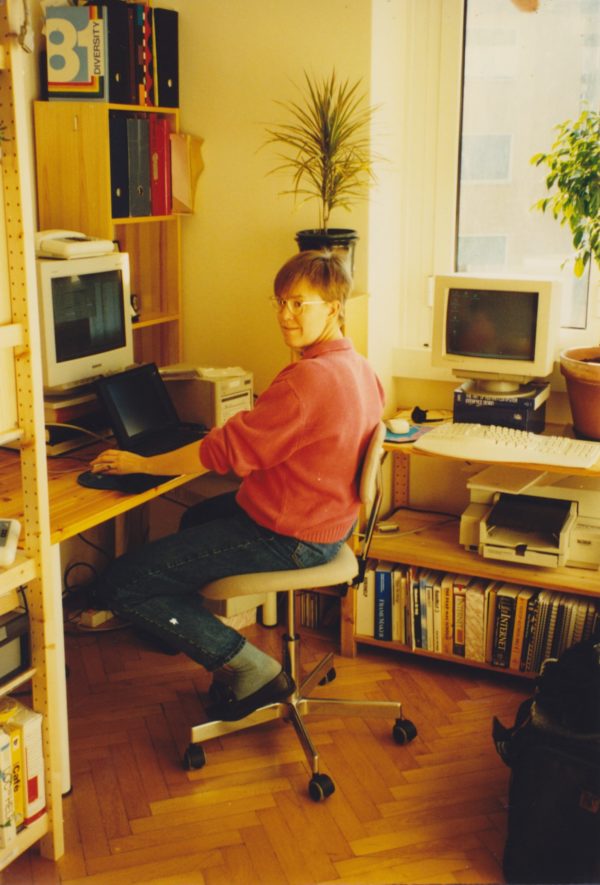
When I began working for Adaptec in 1995 (as a result of their acquisition of Incat Systems, the company which created Easy CD), I was already a remote worker. Fabrizio Caffarelli, who had founded Incat in Milan, had moved himself and the engineering staff to California in late 1993 with the goal of selling the company. In the meantime, though still living in Milan, I needed to work closely with engineering staff to document, test, and help to improve our software products. I began traveling to California regularly, but most of the time I worked from home, keeping in touch by phone and email.

Nobody at Incat had a problem with this, but the concept was foreign to Adaptec back then. In 1995, they had not even had email for very long because (so I was told) the company’s executives had resisted, fearing it would be “a distraction” (they may have had a point).

Adaptec at the time did not have any employees working permanently offsite, and they were not about to make exceptions for an unknown quantity like me so, in spite of my clearly-stated preference to become a “regular” Adaptec employee, I was taken on only as a contractor.

Adaptec’s employee benefits would not actually have been all that interesting or useful to me (e.g., I didn’t need US health insurance). However, although even the regular employees had California-standard “at will” contracts, I suspected that, as a contractor, I was more vulnerable than they to cyclical layoffs.

Some people at Adaptec even treated me as an outsider – not realizing (or perhaps resenting) that, to the CD-recording world, I was the face of Adaptec online.

On one memorable occasion, a customer reported to me that he had phoned tech support, quoting me on some technical question.

“Oh, she doesn’t know what she’s talking about,” responded the tech. “She’s just a consultant.”

I also had the uneasy feeling that, even among some of the people I worked most closely with, I wasn’t perceived as being part of the team, nor as being serious about my career. Part of the reason I started an MBA (via distance learning, of course!) was to demonstrate my seriousness – had I had to apply for the job I was already doing, the job description would have included “MBA strongly preferred.”

While I was doing one of my first MBA courses, an engineering colleague from Adaptec’s Longmont, CO office, Dan Maslowski, came up against a personal situation: he was perfectly happy in his job, but his wife had been offered the opportunity to open the European offices of the (Web) company she was working for.

Dan’s boss didn’t want to lose him, but wasn’t sure how to deal with a remote employee. So they talked to me, as an example of how it could be done, and Dan eventually moved to the Hague while still working for Adaptec. We were a mutual support society of two, commiserating on how difficult it was (and still is) to schedule phone conferences when you’re eight or nine time zones away from everyone else. I even wrote him up as a case study for my MBA course.

My own situation with Adaptec endured, but several changes of manager back at headquarters increased my sense of vulnerability, frustration, and alienation. From some perspectives, I had an ideal job: I could set my own hours (as long as those included lots of late-night phone conferences), and was largely managing my own work and that of two other contractors, all of us working from our respective homes.

But I was at a career dead-end. It was clear that, with Adaptec, I could never become a regular employee, let alone have a career path, as long as I was off-site. I was good at what I was doing, but had been doing it long enough to be getting bored. I could see things that (desperately) needed changing to make life better for Adaptec’s customers, but I would never be in a position to make those changes happen.

Hence my attempted move to California in 2000-2001, to participate in the Roxio spin-off. I wanted to help define, from the ground up, how a new company would deal with its customers, using the Internet as a tool for support, marketing, and relationship-building via customer communities.

I planned to move my family to the US for a year or two – long enough, I hoped, for me to launch a career and then find a way to move back to Italy, where my husband had his own career that he was not willing to give up.

That didn’t quite work out. The whole Roxio situation went sour for me, and I returned to Milan in March, 2001 – back to the same situation in which I had previously felt so vulnerable, alienated, and frustrated.

All those same adjectives still obtained, redoubled. The (ridiculously good) money was not enough to overcome my misery, especially when my mother-in-law was diagnosed with breast cancer. I didn’t think I could handle a major family crisis while hating my job every day. I quit in July, 2001. (My mother-in-law was successfully treated for the cancer and is still living; Roxio is no longer with us).

A New Dawn: Sun Microsystems

Corporate practice and technology have naturally moved on, and working remotely no longer seems as strange or difficult as it did ten years ago (although in Italy it’s still highly unusual). Having suffered through the early days with a resistant employer, I am now delighted to find myself working with a company that gets it.

Remember Dan? He ended up working for Sun Microsystems, where he’s currently a Senior Engineering Manager. When he realized in February that the new position he had just taken on entailed responsibilities for part of a website, he thought of me.

I knew nothing about Sun, except that Dan worked there and I liked what I could see of his management style. He had even left Sun for AMD, then gone back to Sun, and they’d kept his company blog waiting for him. This is standard practice at Sun (10% of whose ~33,000 employees have blogs open to the public), and is a subtle indicator of the company’s relationship with its people.

Obviously, Dan was asking me to join him knowing that I live in Italy and, though very willing to travel, this is where I’ll be staying. It didn’t occur to me to ask whether this would be a problem; his answer would have been: Of course not. His team was already spread across time zones from Silicon Valley to Beijing, so managing one more person in one more location wasn’t going to make much difference to him.

Arriving at Sun’s offices in Broomfield, CO for a first meet-and-greet visit in March, I astonished to learn that practically all of Sun is like this: teams seem to be formed on no geographical basis whatsoever, and many Sun employees work from home, wherever home may be. According to an official company statement I heard in an online presentation for newbies, at least 50% of Sun employees work from home at least one or two days a week.

This point was made most forcefully for me when I read the first blog post from Deb Smith, a Director in the software group I’m working for. Go read that now and you’ll see what I mean. As soon as I read it, I thought: I’m in the right place. The whole company is built for what they call OpenWork, with all the right systems – and, more importantly, attitudes – in place to make it work well both for the company and its employees.

This is probably a factor in the large proportion of women who stay with Sun – I’ve never seen so many women in an engineering organization!

And it’s not just the women: practically everyone at Sun seems to have been there for at least ten years (the company celebrates its 25th anniversary this year), with no intention of leaving. Upon getting to know Sun a little better, this does not surprise me at all. Sun demonstrates that it values its people, and understands the importance to those people of all aspects of their lives, not just their careers. That sounds like an organization I’d like to stick with.

what qualities do you look for in an employer?

Six Degrees from Disaster

Massacre at VA Tech – Malaysian Students Safe read a headline I spotted via Google News this morning. Naturally, it came from Malaysia’s Straits Times newspaper.

It’s facile to say that the global is local and the local is global. But there’s more to this particular phenomenon. When we hear about horror anywhere in the world, the natural human instinct is to want to make sure our own loved ones are safe. But we also nurture a sneaky desire, hidden even from ourselves, to have some connection to the news, to somehow feel we are participants, not just audience, in a great world drama.

Of course, no one wants to be directly affected – to be killed or wounded, or have that happen to someone we know and love. But to be able to say that we were somehow part of the larger story – it’s only human to enjoy that.

This is the bread and butter of local newspapers, as I see constantly illustrated in the posters advertising Lecco’s local and regional papers. “So-and-so disaster elsewhere in the world: no Lecchese hurt”. But sometimes they are: “Lecchese drowns swimming in Rimini” appeared a year or so ago – this would hardly be local news (Rimini is on the Adriatic coast, nowhere near Lecco) except that a local man died.

As soon as something dramatic happens anywhere in the world, we would all like to be able to say whether or not we are connected with it or hurt by it. An ideal headline would read: [disaster] strikes [someplace else], hundreds dead – but no one you know.

Hence this modest (and ironic) proposal to some entrepreneur who’s got the technical skills: find a way to combine (mash up) Google News with all my social networks, so that I can immediately know whether the horrible (or good) events of the day hit me close to home. Call it “Six Degrees from Disaster,” because, as John Guare illustrated, we are all at most six “links” away from anyone in the world – in tragedy or in triumph.

Girl Geek Dinner Italia

Some years ago Silvia, who had been one of our tech support team (of two) at Incat, paid me the enormous compliment of saying that she considered me a role model. This from a woman with a laurea in physics who holds a managerial position in a team supporting HP servers, and certainly never needed any advice from me on how to do her job!

I was extremely flattered, of course, but startled: I had never thought of myself as a role model for anybody. But it now seems that I am, and the job comes with responsibilities. Such as, um, eating free dinners and giving speeches.

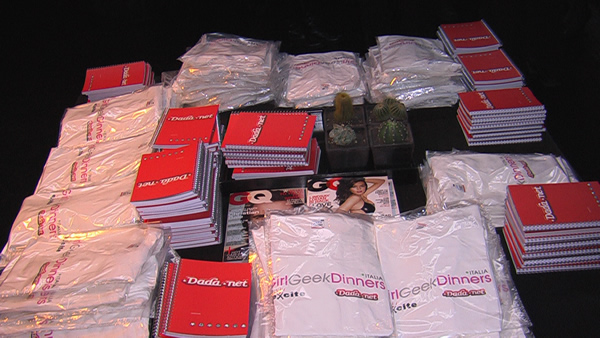
Amanda Lorenzani (whom I’d enjoyed meeting at barCamp Roma), organized Italy’s first Girl Geeks Dinner, which took place in Milan last Friday. And she pulled it off magnificently: sponsorship from Excite, Dada.net, and San Lorenzo (who contributed the bubbly) ensured a very good dinner, complete with wine (though my request for a gin & tonic was turned down on the grounds that “then we’d have to give the strong stuff to everybody”).

At least 60 people were present, most of them, indeed, women. By the rules of Girl Geeks Dinners, women couldn’t be fewer than 50% of the guests: each woman attending can, if she wishes, invite one and only one man. (My date, by his own request, was Luca Conti.) After years of attending tech conferences at which women are always a minority and often silent, I was thrilled to meet and talk with so many smart, capable women. They had plenty to say for themselves, all of it interesting. Conversation flowed easily for most; I did what I could to involve those who seemed to be shy, though I was constantly distracted by new/old friends, and my feet hurt (I’m not used to wearing heels, but Ross had insisted I should).

We didn’t have a main speaker (as Girl Geeks Dinners often do although, surprisingly, they often seem to be men), but Amanda had asked four of us to each say a few words:

My two-minute speech was neither as off-the-cuff nor as nervous as it probably sounded. I had been trying all day to decide how to translate that immortal line from Thelma & Louise: “You get what you settle for.” I finally settled on (which is different from settling for): Nella vita, ottieni quello di cui ti accontenti. And added, as my own closing line: Vi auguro di non accontentarvi mai – “I hope you never settle.”
Then I could relax and eat dinner and talk with people rather than at them. It was great fun to see in person someone I’d been following on Twitter, Svaroschi, who is heading off to grand new adventures in the Big Apple.

Almost everyone in the room had a blog, several specifically food blogs, which I will now go and read although it’s dangerous for me to do so, especially now when I have no time to cook.

Apparently I terrified at least one person in the room. Sorry about that – totally not my intention. I was a little weirded out – though extremely flattered – by people coming up to tell me they admire me, and/or like my site. Okay, it wasn’t that many, but it’s a strange experience nonetheless. Am I really somewhat famous, or just a legend in my own mind?

I was therefore a little manic, and very tired – had woken up at 4 am from jet lag, still wasn’t well (and destined to get much worse the next day), and had to get home to Lecco, with Luca in tow (as our house guest) at a not-too-unreasonable hour because we had to get up for rItaliaCamp. I hope for the next dinner I will be more relaxed and awake. There were so many topics in the air that I would have liked to hear more about.

Just one example: Beatrice came to represent TechneDonne, a project to study gender (in)equality in the world of IT. Among other things, they are asking themselves: “Is software different when women write it?” Interesting question. These are the folks who have asked me to speak at FemCamp in Bologna on May 26th; by then I hope to have had some opportunity to explore the roles of women at Sun Microsystems – in one week, I saw more women there than in any other tech company I’ve ever worked for or visited!

Another nice ego-stroke for me was that Tara (of Passpack) told me she’s loving my unfinished fantasy novel, Ivaldi. And she hadn’t even got to the good part yet! <grin>

It was altogether a fun and stimulating evening, and I would/will be delighted to see all of these people again, and hope to have time to talk with the ones I missed this time around. In fact, I’d like to do it more often – maybe we can do regional lunches or aperitivi in between dinners?

Update

April 2, 2007 – My pleasure in reminiscing on the joys of the dinner was somewhat soured by this:

(photo by fullo via Pandemia)

This group represents a new (and very laudable) initiative by Alberto D’Ottavi, Stefano Vitta, Lorenzo Viscanti, Luca Mascaro, Chiaroscuro and Emanuele Quintarelli to encourage the development of Web 2.0 in Italy. But, boys, what’s missing from this picture? That’s right… girls!

Cisco Expo 2007 Italia

It’s all Lele’s fault again. Or maybe Luca’s. They mentioned in their blogs that they would be speaking at this year’s Cisco Expo in Milan and, since that’s relatively close to home, I figured I’d go along and cheer for them. I also wanted to learn more about Cisco’s new “Telepresence” and other online video products, to see what ideas I could pick up for TVBLOB.

The venue was a hotel way out in the southern part of Milan. In addition to my usual 1.5 hours from home in Lecco to Milan, I had to take the metro almost to the end of the line, then a bus, then walk another 15 minutes to the conference registration on the back side of the hotel. But I had company: getting off the bus, I fell in with a teacher from Como and a guy in the web services business who were going my way, so I learned some things.

The teacher had come, on her own initiative, to keep up to date in her field: she teaches “systems” at a technical school in Como, training future programmers and, presumably, system admins. She told us that there are no government refresher courses for IT teachers. Some of her colleagues teach their students programming in Pascal for three years, and maybe some Delphi – this aspect of the curriculum is totally up to them, and they have no particular incentive to delve into more modern computer languages. The teacher I talked with seems to be one of the motivated ones who works hard to keep learning and teaching new things, though she admitted (with some embarrassment) that she’s behind on new media phenomena like YouTube.

Perhaps I should offer to speak on these topics in Ross’ IT class at school – if her teacher wouldn’t take such an offer as a slur on her own professional skills.

Anyway, the conference… It started with a plenary session of half-hour talks by local Cisco luminaries. From my (sparse and illegible) notes:

  • many people [in Italy?] will in coming years still be watching “general” TV, but they might see personalized ads (someone in the audience near me snorted at this – clearly he’s not watching general TV anymore).
  • Second Life is a virtual place generating real business – Adidas’ personal trainer service there has sold 21,000 [units of some sort]. (I created a Second Life persona, Deirdre Guru (!), a few months ago, but haven’t had much time to explore this virtual world, especially since it doesn’t display properly on my laptop – I have to use my daughter’s desktop computer. So far I can say that flying is fun, except for that time I got stranded high above the sea and then the whole world crashed.)
  • Cisco believes that company CIOs should be the “directors of innovation,” helping their colleagues enter the new era of the “human network.” Hmm. If you want to promote the human aspects, the CIO (Chief Information Officer) may not be the best person for this role.

While wandering around the expo and battling the crowd for a not-very-good lunch, I kept seeing faces that looked familiar. I am hugely handicapped in business by my poor memory for faces. Or rather, I recognize faces and know that I have met them before, but have no recollection of what their names are or in what context I met them. (In my defense: I have probably already met far more people worldwide than most individuals have to deal with in a lifetime…maybe my people memory is just overloaded!)

So I kept seeing people I thought I knew, but was too embarrassed to talk to them in case I was wrong, and no one acted as if they knew me. I began to wonder if I actually had met them or just thought I had, because so many looked like each other. The crowd was 95% male, most dressed in blue or gray suits with shirts and ties, similar haircuts and (for those who wore them) similar glasses. Another style among the men was wide-wale corduroy trousers in rust, red, or beige, with Clarks-style suede shoes and a sweater. Then there were a few guys in jeans with suit jackets. The women were uniformly dressed in black (as was I – but at least I had a beige sweater under my black suit jacket, and I’m pretty sure I was the only person there in cowboy boots!).

I don’t get it. We’re in Milan, one of the fashion capitals of the world, and the end result is that everyone looks the same? I longed for a real fashion statement, a Hawaiian shirt perhaps. If I’d seen one, I would have hugged its wearer, whether I knew him or not. Someone missed out on a hug.

Another thing that caught my eye was spelling errors. If I were projecting PowerPoint onto an enormous screen to an auditorium full of people (many of them potential buyers of very costly products), I would bloody well run a spell check on my presentation! I caught multiple errors in both English and Italian in the slides shown by Cisco’s top executives. That’s just embarrassing, and bad for business. If that’s how they treat me as an audience, what kind of attention to detail can I expect when I’m a client?

In the afternoon I watched a presentation about Cisco’s extremely expensive new “telepresence” system. I wonder if they even have one installed in Italy [June – they’re installing it now] – at $300,000 for a six-seat/one location configuration, I can’t imagine they will have many customers worldwide. And it was curious that they did not even show us a video of the system in action (though I had already seen such a video months ago, thanks to Robert Scoble.)

There was a video loop running during the lunch break, showing a lot of the same footage as in the ad above. Some parts of it seemed to show the telepresence system (kids talking to each other in classrooms in, apparently, Tibet, and someplace caucasian), with a note at the bottom: “Images on screen are simulated.” Uh, right. Not exactly a demo of the system’s real capabilities. And I’m pretty damned sure that there is no classroom in Tibet which enjoys the Internet bandwidth needed to support this system.

I stayed through a presentation about Cisco’s digital signage system (and, yes, got some good ideas), but left when someone started to talk in excruciating detail about the installation of high-end security systems.

Between urban transit and train connections, it took me three hours to get home to Lecco, at the end of which I was done in – still suffering with that sinus infection as well. I decided to skip the next day of the conference to work from home and rest up. I was sorry to miss Luca and Lele, but, having seen the agenda, I knew that I wasn’t really their target anyway – I am already very familiar with the stuff that they would be explaining about blogs, new media, etc., for the benefit of this Italian corporate audience – indeed, I probably could have given these talks myself.