Raising a Non-Believer

A reader has just written to me:

“One was on an essay about Religion as a Cause of Strife in the World – you can bet she went to town on that!”

this is a comment you wrote on Ross’ India Diary and i have always wanted to ask you why you believe that Ross has arrived at an independent opinion/thought/decision regarding religion when it is the exact same opinion/insight you and your husband have. maybe mistakenly, but i’ve gotten this impression that you are very prideful that her belief is identical to yours and see it as a sign of her independent, intelligent thought. how much of a stretch is that really? how different is that to the child who grows up with the gospel every week at church and every day at home? how “independent” can that child’s outlook ever be due to that home conditioning?

It’s very true and completely unsurprising that Rossella, like most kids, shares her parents’ beliefs (or lack of). The more interesting question is: did how she arrive at those beliefs?

One of Richard Dawkins’ most provocative theses is that schools and even parents should not be allowed to proselytize children into religion at young ages. He points to lifelong traumas (both physical and mental) inflicted upon people (and cultures) from infancy, in the name of religion.

One might reasonably ask (many have) how Dawkins’ desire to promote atheism is any different from a religious person’s desire to promote religion. The logic here seems to be: “Atheism is just another belief. Why is it okay for you to preach what you believe, but not for religious people to do so?”

Here’s the “fundamental” difference: most religions teach their adherents – and particularly children – to accept certain strictures, norms, behaviors, etc. because someone in “authority” said so. Believers may be allowed to question up to a point, but sooner or later every religion comes down to “faith” – a necessarily blind (because unprovable) belief that there is some “higher power” out there which has an opinion about how you should think and act.

This is emphatically NOT how we raised our daughter.

My husband is a professional mathematician. This means that he thinks long and hard to come up with new hypotheses about how things behave in his particular realm of mathematics. When he can support his ideas with mathematical proofs, and those ideas are new, and important enough to be brought to the attention of his colleagues, he submits them (in the form of articles) to professional mathematical journals. There his ideas are judged by his peers for their truth and interestingness and worthiness of publication. If he gets something wrong, either he or one of his colleagues will figure that out. He thanks the people who point out his errors, and goes back to the drawing board.

The same thing happens in every scientific field. Ideas are developed, tested, and submitted to a jury of one’s peers. Sometimes an idea is proven wrong immediately, sometimes later, as more research is carried out. A few hypotheses survive the judgement of the scientific community and the test of time to become theories: which is to say, scientifically-proven facts.

All of this is done in a spirit of cooperative enquiry and (more or less) humility. No one can claim to know more than anyone else on the basis of some externally-granted “authority” – a scientist must be able to back his or her hypotheses with solid, provable facts.

I’m not a scientist, but I use the classic scientific method in my job every day: Does this work? If not, why not? What went wrong? Test one variable at a time til you find out where the problem is, then fix it. It’s a simple logic which can be usefully applied in many areas of life.

Given our professional and personal biases (and our penchant for arguing about EVERYTHING), Enrico and I have raised our daughter to prize inquiry, and not to grant authority blindly. We would be hypocrites if we had not encouraged Ross to think for herself and ask questions – to which we always gave grown-up answers.

This isn’t a totally easy way to raise a teenager: “Why do I have to be home at midnight?” In a family like ours, “Because I’m the mom and I said so!” doesn’t cut it. In Ross’ most exhausting, argumentative moments, I have gritted my teeth and consoled myself that: “At least I know she’s not going to do something stupid just because her friends are doing it.”

And, mostly, she hasn’t. We raised her to think for herself, and she does think – and, most of the time, she comes to very sensible conclusions.

If Ross called herself an atheist simply in imitation of me and her father, I’d have no reason to boast of her independence of mind. Perhaps at 18 she hasn’t put as much thought into her beliefs as we have, but I don’t think she’s merely parroting us. She knows that she is welcome – encouraged! – to explore what others believe (Woodstock is an excellent venue for that), and decide for herself what she thinks of it all. Her father and I remain open to discussion. Ross is no fool, and very likely someday she’ll persuade me to something I hadn’t previously agreed with. It wouldn’t be the first time.

High Water (Not Hell) in Venice, part 7

Hummingbirds & Other Venetians

Sep 29, 2007

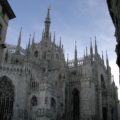
detail on St Mark's cathedral

^ detail on Saint Mark’s cathedral

^ So much for the singing gondoliers. They seemed to spend most of their time on their cellphones (like everyone else in Italy).

^ Alitalia Italian Airlines? Not for much longer…

The scene above took place on the balcony of the apartment, whose beautiful hanging garden of herbs and flowers attracted the local wildlife, including very large black bees and what appeared to be hummingbirds – which caused some debate among us. When finally convinced that they were birds, Enrico hoped that we had spotted something rare and strange (he’d never heard of hummingbirds in Italy). I asked our seemingly knowledgeable boatman later on about the surprising presence of colibri’ in Venezia, and he claimed that they were common.

Turns out everybody was wrong.

They weren’t birds.

They weren’t bees.

They were hummingbird moths. The antennae should have tipped me off. I did notice those, and thought it odd for a bird to have something like that on its head…

Venice 1, 2, 3, 4, 5, 6, 7

restaurant

High Water (Not Hell) in Venice, part 6

Venice’s Bad Karma

On Saturday morning, I learned what a macchiatone (“big spotted one”) is: it’s basically a caffé macchiato (coffee “spotted” with steamed milk), with a bit more milk – so, somewhere between a macchiato and a cappuccino, served in a cappuccino cup. I had it with a delicious little torta di riso (rice cake).

Then Enrico and I explored some more.

^ “In this antique home of the Dario family, Henri de Regnier, poet of France, Venetianly lived and wrote in 1988 and 1901.” Venetianly?

^ This was a mystery. Was the pigeon already dead when someone gored it with an umbrella?

The apartment we were staying in was owned by a Jewish family. On the wall near the kitchen was a framed edict of 1777, issued by a prince of Venice on the orders of an “Inquisitor of the Arts”, detailing horrifying restrictions on Venice’s Jewish community. Sobering reading. The Venetians invented the concept of ghetto, apparently.

Venice is indeed a beautiful city, but it has many centuries of bad karma to pay off.

Venice 1, 2, 3, 4, 5, 6, 7

restaurant

Trattoria Al Passo, Venice – Only Fish!

While we were all in Venice, Jeet’s friend and Andrew’s colleague, Umberto, wanted to take us to his favorite restaurant in the nearby village of Campalto. The restaurant’s card says Solo Pesce (only fish), and that’s all we had – lots of very, very good fish, most of it local and extremely fresh. Umberto and his friend Mauro ordered for all of us, and at the risk of a bad nautical pun, I will say that they went overboard.

Pictured above is the amuse bouche of smoked fish, which was served with Franciacorta (champagne-method wine made in Italy).

Then we had an antipasto crudo (raw antipasto). The object in front that looks like it has two big black eyes is a cavalletto di mare (sea grasshopper). These things have always looked creepy to me. The “eyes” are defensive mimicry – that’s actually the tail – and they have way too many little legs underneath. But I ate it anyway, and the flavor was divine – sweet, and the flesh slipped right down without being slimy. The plate also contained two kinds of shrimp (not raw) and some kind of fish (swordfish?).

I didn’t get a picture of the other antipasto, carpaccio di tonno (because I was too busy eating it): very thinly sliced raw red tuna, served almost Japanese style, but with olive oil. On the plate was a small mound of green stuff; I put a chunk of it in my mouth before I realized it was wasabi, which I’ve never seen served in an Italian restaurant before. Ouch!

Next we had cappesante (scallops), grilled, then served on decorative shells. Apparently this is not the season in which they are large. Didn’t matter – they were tasty!

Then razor clams, also grilled.

Then we finally got to the primi, first polenta with schie, the tiny and flavorful local shrimp. (We did wonder who peeled all these little bitty things.)

And, finally, risotto with clams. Fortunately, someone had thought to cancel the order for a pasta dish as well, and we hadn’t ordered any entrees.

All this took a long time, which we didn’t mind as we were eating and drinking fine things in good company. Pictured above are Enrico, Kiki, Hadi, and Geraldine (shown reacting to a bad joke, not asleep on the table!).

We paid about 65 euros a head for “only fish” (plus quite a lot of wine, coffee, a few desserts, and limoncello) – well worth it!

Trattoria Al Passo

via Passo 118, Campalto (VE)

phone: 041 900470, 338 347 6106

closed Mondays and Tuesdays

High Water (Not Hell) in Venice, part 5

When in Venice, Eat… Curry

In St. Mark’s Square, Jeet bought some necessary props (above).

We returned to the apartment to greet Andrew and Victoria, arrived from Paris. Jeet and Andrew set to work making a fantastic Indian meal.

Which they served in appropriate national costumes:

(Hey, I just live my life, in all its glorious weirdness – don’t ask me to explain it!)

Jeet learned his Indian cooking from Tsering and Tenzing, old friends from Woodstock. While we were enjoying the results of their lessons in Venice, our daughter, on quarter break from school, was staying with them at their home in Mussoorie. Yes, we’re all just one big happy family!

Venice 1, 2, 3, 4, 5, 6, 7 , restaurant

Deirdré Straughan on Italy, India, the Internet, the world, and now Australia