Growing up near the equator in Bangkok, I was not exposed to seasonal lengthening and shortening of days. The sun rose sometime before I woke up, and set around dinnertime (6 or 6:30 pm), with no noticeable change throughout the year.
I eventually learned that other parts of the world go through this weird annual cycle in which days get longer in summer and shorter in winter, but I was never far enough from the equator to see this in action until the summer of 1984, when I made an unexpected trip to London (from Indonesia – long story, some other time!).
I wrote my friend Barbara for help finding cheap accomodations. She got me a sub-let in a classic bed-sit flat, and offered advice appropriate for a young woman alone in London. "How late at night can I safely be out alone?" I asked. "Til around two hours after dark," she replied. I was disappointed – not that I was a party animal, but this would mean coming home awfully early, I thought.
The trip from Jakarta to London was very, very long. At the end of it, I had to get a heavy suitcase from Heathrow to Shepherd’s Bush by train and tube and on foot. Finally, having found the place, I had to drag the suitcase up four flights of stairs (or was it five?). I was finally in the flat and settled sometime in the early afternoon. Completely done in, I went to sleep.
I woke knowing that I had slept a long time. But the sun was still in the sky. I was very confused. Had I actually slept the rest of the day, through the night, and well into the next day? That didn’t seem possible. My watch was still set to Indonesia time and I was too sleepy to calculate what that must mean in London time. Finally I located a clock and found that it was around 8 pm. And there was still plenty of daylight. The sky did not darken til around 10 pm: two hours after dark wasn’t an early curfew at all!
Now I live in Italy, far enough north that the change in the length of days is noticeable, and, after fifteen years, I have yet to get used to it. When daylight savings time went off in the fall, I was plunged into gloom, literally and emotionally. At least now we’re heading in the other direction: it’s still full dark when I wake up at 7 am, but the sun is rising by the time we go to catch the bus at 7:30.
My name is Kelly, and I’m a 17-year-old girl from Adelaide, the capital city of South Australia. I’m fairly average as far as things go, I go to school and have a part time job in a department store, and live in middle class suburbia. I live with my mum and my two younger brothers, and my dad, while separated from my mum, visits often. I am doing a two year accelerated Italian course, and my exam is in less than 3 months! My school offers regular exchange programs and some of my class (there are only 10 of us) decided that over this summer (winter for all you northern hemispherers) they would do this exchange. Unfortunately, due to some complicated circumstance (I think the English teacher had a baby) my school couldn’t do the exchange with the school they normally would do it with, and so we needed to find some students to stay with us during our winter, from somewhere in Italy. Intercultura came to our rescue, as they had too many students going to Perth, Western Australia, and so they sent six boys from varying parts of Italy to stay with us. We got about two weeks notice and so my family made the snap decision to host Sergio, because we wanted to, and because there was no one else who could. Sergio is the same age as me but he’s an only child, like many Italians. He looks typically Italian, not so tall (compared with Aussie guys), olive skin, dark hair and the most amazing deep brown eyes. He found my blue ones equally fascinating. He lives just outside of Reggio Emilia, in the northern Emilia Romagna region but he has his roots in Catania in Sicily though, and so can effectively now speak three different languages, Italian, English and Sicilian.
Sergio spent two months here and we have both learnt so much from each other, and still do as we talk often. Both of us had all sorts of preconceived ideas about what the other would be like, due to stereotypes. Sergio told me that Italians thought that Australians were very much like Crocodile Dundee, and the men treated the women like they were below them. He soon learned that most Australian women are more than capable of telling someone to “Bugger off” and that unfortunately kangaroos just don’t survive in the average suburban backyard, where about 80% of Australians live.
I personally was completely unsure what to expect. Here Italians are portrayed tossing pizzas and twirling moustaches saying “Mamma mia!”, and of course the reputation Italian men have of being unfaithful and slippery lovers. You also get the fast cars, and the beautiful shoes. Of course all these things are present in Italian life, but there is so much more, as I discovered.
Culture, language, geographical differences were often very present, when Sergio came into my family and yet we both discovered that despite these things, we shared the same emotions, ideas, and liked to go out and hang with our friends, flirt (although he did this without thinking), watch movies, play sports and listen to music like most teenagers. We also discovered a mutual love for reading, and had read some of the same books but in different languages! I can’t list all of the differences but here are some I remember…
Language differences were the first to be noticed, as while his English was a lot better than my Italian (which it should be, as he has been studying it for nearly 10 years), it was far from fluent. Luckily my knowledge of Italian, my knowledge of English (the equivalent verb of ‘decompose’ is ‘decomporsi’, and so that choice of word is better than ‘rot’), his knowledge of both the languages, and a little help from the dictionary, enabled us to cross most of these boundaries. Many English words come from Latin words, despite it being a Germanic language, so there are some similarities.
Some of the things were funny, like when he discovered we used the verb ‘to pump’ to describe the action of putting air into an airbed, or to pump water. ‘Pompare’ can have sexual connotations in Italian, which I shall leave to your imagination. He and the other five boys managed to convince my friend Sarah that “Ti faccio un pompino” means, “I break your legs”, when it actually means, “I’ll give you a blowjob”. Typical teenage boy humour coming out there as they found it hilarious when she would yell it at them, thinking it was a threat. I soon learnt to take anything they said with a joking frame of mind.
Anyway, little things came up, like when he asked “Are my hairs ok?’ instead of “Is my hair ok” – because hair is plural in Italian, you ask if all your individual hairs are ok, rather than the body of hair. Makes sense to me. Also, saying, “the my shirt” (“la mia camicia”) instead of just ‘my’. He also found it weird how we Aussies inflect our last syllable, so that ‘no’ sounds like ‘noi’, and we apparently talk too fast and abbreviate everything, which I’m sure is like most languages. I retaliated by saying that at least he doesn’t have to learn at least 30 different conjugations for the verb ‘essere’ or ‘to be’ and know what context you have to use them in. In terms of pronunciation, he was horrified at our lax treatment of vowels, tried to teach me the correct way to say ‘t’ and to teach us all the difference in sound when letters are doubled, like the difference between ‘saremo’ and ‘saremmo’ the future and the conditional ‘noi’ form of ‘essere’. This distinction is important when you come to words like ‘pene’ and ‘penne’, meaning ‘penis’ and ‘pens’ (or pasta) respectively. The whole experience left me thinking about the crazy ways we say things in English and how it doesn’t make a lot of sense at all, as well as a better understanding of Italian, and left him being almost fluent in English.
Language leads into culture quite easily, as you can see from above; most English speakers could quite easily say ‘pump’ without imagining sex. I remember the first big conversation I had with Sergio was about religion. I think it was because Mum wanted to make sure he would be ok about going to church, so it wasn’t such as stupid thing to do as it sounds. Knowing that most Italians say they are Catholic, and my church is a Protestant one, I was curious to learn about the differences. Sergio told me that his family rarely goes to church and that most families are like this. He said that he thinks there is a God, but that he doesn’t agree with many of the Catholic ideals. This had occurred to me, as being a fairly smart girl I noted that most parents in Italy have only one child, and this feat usually requires some kind of contraception. Also, I was told that it is rare for an 18 year old to still be a virgin. Anyway, he was ok with going to church, but was slightly shocked when I took him to a youth group service at another church on Friday night. Think a modern building, a loud band, coloured lights, overhead projector with the song words shown, games being played to show God’s message, most of the crowd being under 30, and after one can play table tennis, drink coke and chat with friends. His words were, “This isn’t a church, this is a discoteca!” That was funny, and I explained to him that it didn’t matter how loud the band played as long as the message was getting across to the kids, very different to the quiet reverence and traditions he had seen in churches in Italy.
Another thing me and my friends who were hosting the other boys discovered was the love of politics. At a barbecue (where we all put our sausages in our bread and they didn’t) a virtual shouting match arose between the six guys, all rapid-fire Italian that none of us could understand.
I asked what it was about, and was told they were discussing politics and the differences between the north and the south of Italy. Sergio, his parents originally from Sicily, was quite fired up at Lucio, the rich boy from Parma. We were just like “Um, ok.” Australians as a whole are pretty laid back and we have very few severe political issues or debates with two major parties both of which are not extreme in any sense, and so politics rarely ever comes up in conversation unless we have a referendum or something.
We had some other different things, ways of seeing life, how important jobs are, family (I have 12 cousins, he has 1) and food. He ate so much, and yet didn’t gain a kilo. I don’t eat a lot because I feel sick if I overeat, but he told me that I would be considered to be sick in Italy because I didn’t eat. Australians are also very fat people, like Americans; and although I believe our fresh food is of good quality we have a lot of fast food alternatives, which Sergio didn’t touch. He also didn’t understand why we would put pineapple on our pizza, or marshmallows in hot chocolate or even milk in our tea.
Gosh, I’ve written so much, only one more paragraph to go. The environment, we discovered, was different here than in Italy. In Italy it is considered a big deal to drive the length of the country, which I believe is about 1000km. It is around 800km to drive to Melbourne, the nearest capital city to Adelaide, and this is a drive my family has done so many times I’ve lost count. This means we have a lot of space, and one of the first comments Sergio had was “Every house has a garden!” Italy is so squished that space saving is a way of life or so I’m told. Another comment was “Everything is so new”. This is because Europeans have only occupied Australia for a little over 200 years, hardly long enough to have ancient monuments. With such a large country we have every type of environment and climate you could want, from tropical in the north to snow in the mountains. Adelaide is fairly mild, a little like southern Italy. We get most of our rain in winter; the daytime maximum rarely ever drops below 10 degrees Celsius, and we get no snow, which Sergio found odd, when he arrived in the middle of winter and it was 13 degrees and we thought that was freezing.
Sergio’s face when he first saw a kangaroo was quite hilarious too. We took him to a nearby wildlife park, as only in the country can you see them, and we were just wandering by them, so used to them, and Sergio just stopped. He couldn’t stop looking at them; it was like he was looking at an alien. It was only then I realized what odd animals they actually are, so once again I was learning through him! We now talk via email and the phone and his parents have said that I am like a daughter to them now and would love to have me stay in the future, which I intend to do!
Probably I could write a whole book on what each of us learnt, both being curious and able to talk to each other for hours, but I won’t! I was lucky in having such a nice guy come and stay, some of my other friends had different experiences with the other guys, so I am very grateful to have had such a great time with him and learn so much.
Editor’s Note:
This has been exchange student week for me. First I heard from Kelly, asking to subscribe to my newsletter and explaining why she was interested. I suggested that she write something about her experiences, which she very quickly did.
Then I got email from a 16-year-old American girl looking for a host family so she could come to Italy on an exchange program next school year. We’re not set up for it ourselves (and are hardly a typical Italian family), but I gave her some suggestions on other places to ask, and will ask around for her as well.
I arrived in Las Vegas around 11 pm on January 3rd, expecting my colleague Pancrazio to have arrived 20 minutes earlier.In fact his flight was delayed, but this was difficult to figure out, as nothing was being posted about Delta flights on the arrivals board, for reasons mysterious to me (and to the airport information staff). Las Vegas McCarran airport was in absolute chaos, with people arriving for CES, and for the Adult Entertainment Expo being held on exactly the same days. My flight from Austin had also carried a number of University of Texas football fans, on their way to Pasadena for the Rose Bowl (college football championship). I’m such an inattentive alumna (of UT) that I didn’t even have a burnt-orange shirt to wear.
While waiting for my luggage, I got an SMS from Pan that his flight had just landed, 40 minutes late. I stationed myself between Delta’s two baggage carousels, where I waited another hour, bombarded by the soundtracks of video ads for Las Vegas attractions, playing on large screens all over the airport. Pan and his luggage finally arrived, and we went out to stand in line for a taxi – another half hour. All told, I spent over two hours in that airport that night.We finally checked into the Luxor hotel (the world’s 4th largest hotel, it claims) sometime after 1 am. Having made our CES arrangements late, we only had two rooms between the three of us. Fabrizio already occupied one, and I had suggested that Pan share with me so he didn’t have to endure Fabrizio’s smoking. When we entered our room, it was already imbued with a familiar stench: Fabrizio had been assigned the room adjoining ours, with a connecting door – the smoke of his horrible Toscani cigars had already made its way under and around the door frame. I tried wadding a wet towel under the door, but this was only marginally effective.
We got about four hours’ sleep that night, what with our varying conditions of jet lag. In the morning, we began trying to locate the DHL shipment of the equipment we needed to set up for the show. Our best-laid plans to get everything to Las Vegas in good time had been set at naught by a shipping screwup (just like last year), so we were awaiting our boxes on the same day as hundreds of other people. The hotel business center said they wouldn’t guarantee delivery for up to two hours after the boxes actually arrived at the hotel. DHL said the boxes were already in a truck somewhere and couldn’t be intercepted. Calls throughout the day produced no new information; we later learned that the scanner on board the truck was broken, so the driver had been unable to log information about what had been delivered when.
everything in Vegas is an “experience”
We decided to walk to the Sands Convention Center to meet our hosts from VWeb (a company that makes video codec chips), who had our conference badges. This walk turned out longer than we expected: maps of Las Vegas are deceiving, because each of the hotel/casinos covers several city blocks. It took us nearly an hour to reach the Venetian hotel at the other end of the Strip.
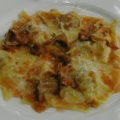
We met the VWeb folks for lunch, and actually took the risk of eating pasta at the Valentino Cafe’. The “appetizer” portions which the waiter thoughtfully offered us were exactly the size of our usual dinner portions back home, and the sauces were actually quite good, though my plate with shrimp and bell pepper sauce was rather short on shrimp: only five or six little shrimps in total – our Neapolitan restaurateur back in Milan would have been horrified had his chef been so stingy! (And would still have charged less for the dish.)
We went to the Sands Convention center (a long indoor walk from the Venetian) to get registered; security was tight, with names being checked against passports.
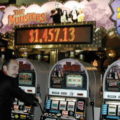
Then, having nothing better to do til our equipment arrived, we went off to Fry’s Electronics to buy a few necessaries – and just for fun: Fry’s is absolute heaven for geeks. It’s a franchise, but each store is “themed,” e.g., in San Jose, one is an Egyptian temple. In Las Vegas, of course, the building is decorated to look like a giant slot machine. Vegas flavor leaks inside as well: I saw a guy in the aisles with a live cockatoo on his shoulder, and one who, judging by his hairstyle and sideburns, must work as an Elvis impersonator.
While at Fry’s, I got on the phone again and learned that our boxes had finally arrived at the Luxor, so we dashed back to pick them up, then on to the convention center to set up one of our two stands. Murphy’s law always rules in these situations; set-up took a while. We then had to detach all the portable stuff and stow it in a locked cabinet, so it wouldn’t walk away during the night. We finally got back to the hotel around 8, had dinner at the Luxor’s fancy steak restaurant (good, though slow), and collapsed.
The next morning I was up bright and early: I had to be back at the VWeb booth to set everything up again by the show’s 8:30 opening. Shuttle buses were supposed to start running at 7:30, but the first did not actually arrive til 7:45. This became a problem the other three days, when the show floor was supposed to open at 8 am.
When I arrived at the booth alone to reconnect and restart everything, nothing seemed to be working – we were demoing on new machines that I had never actually laid hands on before, with quirks not yet familiar to me. After a half hour or so of panic and a phone call to Pan, I finally got it all running just in time for the first show attendees.
The actual show is a blur to me now. We weren’t even in the main convention halls over by the Hilton, but in the “Innovations” area at a separate, much smaller, convention center. Nonetheless, CES hosted 140,000 people this year, and I feel as if I personally saw most of them. I don’t think the human brain is meant to process so many faces in such a short time. After a while, everyone started to look familiar – and some actually were.
The first morning, a man stopped by the booth to rest for a moment; I had noticed that he was carrying professional sound-recording equipment. The name on his badge was familiar: Andrew McCaskey, author of the Slashdot Review, one of the few podcasts I’ve ever actually listened to. We chatted a bit about podcasting and videoblogging, and I showed him what we’re up to at TVBLOB.
Soon after that, I spotted a very familiar face, though I had to grab his badge to remember the name (I remember faces well, but am terrible at remembering where I know them from). It was an old Adaptec colleague, Andy. It seemed that he had to look at my badge as well, which made me feel a little better about my memory. <grin> He now works for Logitech: Lord of the Mice! Which, as I said to him, are an important part of the user experience.
More people passed. I demoed software, answered questions, and sometimes argued. Some people couldn’t see the point of a set-top box which can transmit as well as receive video. A guy from Fox News sneered at the idea of consumers communicating via video over their television sets. “We’re making it possible for your viewers to compete with you,” I pointed out. “Yeah, right,” he said sarcastically. “We need it,” murmured his colleague from Fox Radio News.
Other visitors, including some who may turn out to be important to the company, were more impressed. Which was a relief – it’s nice to know that at least some people “get it,” and believe that we’re on the right track.
Manning (womaning?) the stand was intellectually demanding work. Because VWeb makes video compression chips, many of the stand’s scheduled visitors were far more technical than I, so I was talking over my own head a lot of the time. I suppose it helped that I am rarely embarassed to admit when I don’t know something – though sometimes this earned me a long lecture from an enthusiastic geek who was only too glad to tell me! (NB: Geek is not a pejorative term from me – I’m a geek myself, and have the profoundest respect for geeks, as well as finding them amusing.)
I made some observations about working a show like this: You can get almost anyone to stop for a demo if you smile, ask how they’re doing, and ask if they’d like to see it. Americans are so polite that they rarely turn down a direct offer. So I tried, most of the time, to radiate friendliness and availability – which meant that I was damned busy doing demos most of the time, to a huge range of people. Not all were potentially profitable customers, but I learned something from most. Just listening to the questions people ask is a good way to spot market trends.
Out of Context
Mid-morning on the third day of the show, I was brain-dead, and asked someone from VWeb to keep an eye on my station while I went for coffee. As I walked out, I passed a short, bald guy who looked familiar; I had a strong sensation of knowing and liking him very much. Since we were at CES, I figured he must be a former colleague from somewhere, but just couldn’t place him. This was embarassing, but I quickly decided that I would feel even worse if I later remembered who he was and regretted not having said hello. I tapped him on the shoulder and said “This will sound rude, but I think I know you.” He stopped willingly, looked me full in the face, and said “I’m Evan.” He looked at me expectantly. I read his badge: Evan Handler, Palm, Inc. The name meant nothing to me, and I couldn’t remember knowing anyone who then or now worked for Palm. I was so flustered and shy that I simply walked away. (Yes, shy – even though I had just spent three days accosting total strangers, I get shy at moments like this.)
A few steps out of the hall, I realized why his face looked familiar. Nah, couldn’t be. What would he be doing here? Working for Palm? Was he doing ads for them? The whole thing made no sense.
I got my coffee and went back to the booth, tormented with doubt. I asked Peggy, the LA actress/model who was doing presentations for VWeb: “Are you a Sex & the City fan?” “I saw him, too!” she said excitedly. “And I yelled, ‘Hey, Charlotte’s husband!'”
Yup. Evan Handler is the actor who played Charlotte’s second husband, Harry, in the series – a character I loved, and one of the few male characters to come out of that series with any dignity. And I had blown the chance to get an autograph for my daughter. Argh! I looked around a bit, but there was no hope of finding him again in the crowd.
I hope I didn’t hurt his feelings by walking away like that. Probably he just thought I was completely insane.
(Ross was both amused and furious, but she got even madder at me when Evan turned up on Lost.)
Adult Entertainment
Speaking of sex, the Adult Entertainment Expo (“It’s sexy, it’s powerful, it’s business”) was held concurrently with CES, on the lower level of the same Sands Convention Center where I was stationed.
I didn’t see any of it. The two levels were connected by a mezzanine where the bathrooms are located, and on the first day Fabrizio managed to wander from one to the other (“by accident,” he claimed). He was one of the few who got away with it: by the second day of the show, there were security guards watching the exits from the bathroom level – every time I was down there I heard them saying: “Sir, sir – you can’t go down there with that badge. Sir?”
To legally enter the expo, you either had to be an exhibitor or pay a $50 entrance fee. Mere curiosity wasn’t worth that much to me, though it must have been to quite a few people: the juxtaposition of the two events was clearly intentional. I didn’t have much contact with the “pornies” except when standing in line for coffee. The women working those booths looked exactly as tired as I felt; they were just dressed a little differently.
Leaving Las Vegas
My return home became yet another customer service saga. Many people attempted to leave Las Vegas on Sunday when CES closed – we heard it was taking two and a half hours to get through the airport with the crowds, and hoped that the next morning would be better.
For Pancrazio, it was. He woke up (and so did I) at 3:30 am, so as to arrive at the airport at 4:30 am for a 6:40 flight. He was sitting at his gate well before I arrived in the airport at 6 am for my 8:40 flight. I found the American Airlines line stretching halfway down the terminal, and congratulated myself on my paranoia and foresight in arriving so early.
I started out fairly relaxed about the long wait, though I wondered if I might not have done better to arrive just barely in time so I could get pulled out of the line and rushed off to my flight as so many were doing – I was amused and annoyed at the people who had blithely imagined they could make a 7 am flight arriving at the airport at 6:15.
I fell into conversation with a retired super-geek, also going to Chicago, who said confidently, displaying his Treo cellphone/palm computer: “If anything changes on the status of this flight, I’ll get a page about it.” The woman just ahead of us was crouched on the ground, listening on her cellphone and writing things down. When she finished, she said: “The Chicago flight is delayed until 10, and will likely be cancelled, due to mechanical trouble.” Uh oh.
I tried to call American Airlines myself, but they were evidently bombarded – I got cut off as soon as I went into the hold queue. “Try Advantage [American’s frequent-flier program],” suggested the woman (her name was Lee). “I got right through to them.” I tried, got cut off again. Maybe there was something about my cellphone? Lee very kindly dialled the number on her phone and was able to get through; I spent the next 20 minutes on her phone, mostly on hold, as the Advantage agent had to speak to Alitalia, and got put on hold in turn.
The agent finally came back on and said she couldn’t do anything over the phone due to the way the ticket was booked. I would have to get through the line to the desk and have the local American Airlines agent rebook me. If the flight did actually take off by 10, Alitalia would try to hold their connecting flight in Chicago long enough for me to run for it – though, realistically, half an hour would never have been enough.
We were in line for over two hours, crawling along (me with two large bags to haul plus a heavy backpack). American Airlines had a lady walking down the line periodically giving updates and helping where she could – which wasn’t much. She gave out a special emergency number to call about this specific problem, but the people on the other end proved to know nothing about our situation. I suggested to the line lady that customer relations would be much improved by a distribution of coffee (none of us had had breakfast that morning), but she said they couldn’t do that. <sigh> Hell, go to Starbucks and buy it if you have to – that simple gesture might have helped American Airlines gain customers for life, instead of losing them.
When I finally reached the desk, it took the agent about half an hour to find a solution: he rerouted me Chicago-Brussels-Milan. I then had to go stand in line at America West to get a boarding card for the Las Vegas-Chicago leg. When I saw the long line there I could have cried – I was already exhausted, and cranky from lack of caffeine. I asked an agent standing there if I could just go through the first class line (where there was no one waiting). She was very nasty in saying no: “That wouldn’t be fair to our PAYING customers. You’ve only been rerouted from another airline.” As if that was my fault. I didn’t think to say that I had actually arrived from Austin on an America West flight a few days before, and had certainly paid for that one.
“What if I just sit here and cry?” I asked. “I don’t have any tissues,” was her reply. Snide bitch. She probably thought the same of me, but… customers are allowed to act bitchy, especially under duress. For service staff to do so is a HUGE mistake (a mistake the American Airlines staff did NOT make in a far more difficult situation, kudos to them). The customer may not always be right, but you’ve still always got to be nice to her. And I was treating this agent as politely as I could, considering that steam was coming out of my ears.
She did me a further disservice, I later realized, by not pointing out that there were two America West lines. I got into the wrong one, of course – Murphy reigning supreme that day – but fortunately I figured this out before it made much difference to my wait time.
Along came a gorgeous young Polish woman in the same fix, who worried that we wouldn’t make it through this line and security fast enough to make the flight – two years before, she had missed a flight due to Las Vegas’ legendarily slow security. After 30 or 40 minutes, growing increasingly nervous, we asked another agent if we could be pulled out of the line and sent ahead. He refused, and claimed that the 25 minutes remaining before the flight would be sufficient to get through the rest of the line AND security.
On the suggestion of two guys waiting ahead of us for a later flight, we cut to the front of the line, asking permission as we went. Most people were kind enough to agree, though some attempted to ignore us. One man sniped: “You should have gotten here earlier.” I explained, with far less heat than I might have, that we had gotten there in plenty of time – 6 am for a 10 am flight?!? – and vowed to myself never again to leap to conclusions about others’ travel planning.
Having checked in and put our suitcases through the scanners, of course we were both singled out for special security treatment – in a separate line, shoes off, everything out of our hand luggage, then pass through a monstrous machine which puffed jets of air at us. I think it sucks up the debris and checks it for bomb-making chemicals; in my case, all it got was dandruff.
I don’t know if the Polish woman made the flight in the end; we got separated at security. I arrived at the gate as the flight was boarding, and still hadn’t had any coffee. The gate agents promised me there would be some on the flight and, mercifully, there was.
I was cramped up in a middle seat for the 3 1/2 hours to Chicago, often inadvertently elbowing (and irritating) the woman to my left, who was reading a book about “Toxic Bachelors.” At least the flight staff were pleasant, though the only food available was a $5 “snack pack”: tortilla chips and salsa (that’s a vegetable, right?), breadsticks (“authentic from Torino!”) and processed cheese, a fruit cup, candy, and a packet of raisins.
During the Chicago layover I had time for a nice spinach salad, and even nicer gin and tonic, at Wolfgang Puck’s. My trans-Atlantic flight was now with American Airlines, whose staff were very kind, making up for some of the day’s woes. My seatmate was pleasant, an Oracle employee on her first trip to Europe, for a business meeting. She asked my advice on how to get over jet lag (I wish I knew). We were in an emergency row seat, which didn’t have the legroom I’d anticipated as it was at a bulkhead – and I could have used it, because after all the standing around, my knees were aching, and my right leg hurt all the way up to the hip (yes, I have inherited my dad’s arthritis, and it gets pretty bad sometimes even though I’m only 43).
Emergency exit seats are cold, I suppose because there’s less insulation around the emergency doors. The stewardess brought us little bottles of cognac, so I made a toddy with hot water, lemon, and sugar – worked a treat. I fell asleep listening to “Harry Potter and the Half-Blood Prince” on my iPod.
Brussels airport was quiet. I had coffee and a pastry, got on my flight to Milan, and fell asleep, waking only as the descent into Malpensa began to hurt my ears. My buddy Antonello the taxi driver was there to meet me (Enrico was teaching), for which I was very thankful. I finally reached home at 1:30 pm local time – just about 24 hours since I’d woken up in Las Vegas.
Full Suitcases
Jan 17, 2006
In response to my travelogue, Faisal made some excellent suggestions, including “travel light!” Words to live by, truly. But there was a reason for my carrying so much: I needed clothes. Even before the dollar nosedived against the euro, clothing was cheaper in the US than Europe. I could expect to pay 300-350 euros for a new (much-needed) winter coat of decent quality. A coat as good or better could be got from Lands’ End in the US for $150. By having it shipped to my friend in Tulsa and picking it up from her, I also saved myself international shipping costs and 35% customs duty. Ironically, I did not need this coat at all during my stay in the US: everywhere I went was unseasonably warm, so much so that in Austin I ended up buying and borrowing t-shirts.
It’s also easier to find clothing to fit me in the US: as I’ve said before, I don’t seem to have the standard Italian body shape, so have a hard time finding clothing in Italy that fits me well. And it’s difficult to find colors that I like. Naturally, Italian shops carry colors (orange, lime and olive green, yellow) that suit Italian skin tones. No blue or purple, little pink or bright red. Colors that look good on me don’t look good on Italians, and vice-versa. So I end up buying black, white, beige, and grey – boring!
My new coat is “orchid” pink. It certainly stands out in the crowd of dull colors in Milan. And I certainly need it – we’re due for snow again today.
I instinctively dislike chain restaurants: when someone says “Let’s eat at a [name of chain restaurant],” I wince. And it’s getting harder and harder to find a restaurant in the US that isn’t part of a chain. However, my instincts may be out of date: chain restaurant food seems to be improving. During this recent trip I ate at TeKei’s (Chinese/Thai), Razzoo’s (Cajun), Sarovar (north and south Indian), and something else with a southern (American) theme. I think they’re all chain franchises, but they were also all good. I still prefer to support local and personal cooking creativity where possible, but… sometimes you gotta make do.
What puzzles me is the concept of waiting to get a seat at a restaurant. In 15 years in Italy, I have almost never waited for a restaurant. I’m sure it must have happened once or twice, but I can’t actually remember a single instance. The handful of times I can remember arriving somewhere and finding it full, there was always someplace just as good nearby to go to instead.
But, in the US, no matter how saturated with restaurants an area may be, it’s not uncommon to arrive at a restaurant and find you have to wait half an hour for a table – even though American restaurants are usually HUGE compared with Italian ones, and manage several seatings per table per night, as Americans rarely linger over their meals. I can’t figure it out. Maybe Americans simply eat out more often than Italians (with today’s prices at Italian restaurants, that wouldn’t be surprising).
Restaurant congestion is so bad that, throughout my recent trip, everyone I had lunch with wanted to eat at 11:30 am to avoid the rush. If I hadn’t had jet lag, I would never have got used to this, but it was good preparation for CES, where, if you don’t eat early, you don’t eat at all.
America seems to be obsessed with eating. You can’t go anywhere without being bombarded by advertising for food. It’s effective, too: hearing or reading adjective-stuffed descriptions and seeing perfectly-staged food photographs (there’s an art to it), I always get hungry.
I can’t remember ever hearing food advertised on Italian radio (not that I listen to it regularly). Nor are restaurants advertised on TV in Italy, except McDonald’s. I guess that’s because there aren’t any non-fast-food restaurant chains in Italy (well, there is one, Pastarito – I don’t recommend it), and it doesn’t make economic sense for a single restaurant to advertise nationally.
In America, the marketing doesn’t stop once they’ve got you in the restaurant. The typical American menu is larded with sensual adjectives: “creamy this, delicately folded into tangy that, with a hint of zesty the other…” Some menus include photos, though the food on your plate rarely comes out quite as beautifully. All of this – words, pictures, page layout, fonts – is designed to encourage you to buy the items on which the restaurant makes the biggest profit margin. The waiter may also, asked or unasked, recommend those high-margin items.
There’s no art of selling in Italian menus: they generally only give the name of the dish and a price. In most Italian restaurants, this is all that’s necessary, because most stick to well-known classics with maybe one “house specialty” dish. In the rare cases that you don’t know what a dish’s name means, you ask the waiter, who gives you a bare description: “pasta with sauteed eggplant and salted ricotta.”
The fancier restaurants do tend to be more creative and therefore need to explain their dishes, but the explanations are usually simple statements of fact: “sauteed local trout with diced vegetables” – which hardly does justice to one of Lanterna Verde‘s amazing dishes. But then, the food at Lanterna Verde is so good that you need not be seduced into eating it, and you will certainly not be disappointed, whatever you choose.
I left home early on the morning of Dec 26th (with Enrico driving, bless him) to go to Milan’s Malpensa airport – unfortunately, Milan’s only hub for trans-Atlantic flights is the airport furthest away from Lecco, it takes us nearly two hours to get there.
I was flying Alitalia, an airline of dubious quality – the standard joke is that “Alitalia” stands for “Always Late in Takeoff and Late in Arriving.” At least check-in was efficient. Other US-bound flights I’ve taken from Malpensa have checked in with extra security at a cordoned-off area at the end of the airport, but Alitalia doesn’t do this, even though the flight was direct to Chicago. Which puzzles me. Do we assume that United, Delta, and British Airways are more likely to be targeted for nastiness, even when flying to the same destinations?
Enrico and I had a second coffee together and said goodbye, and I proceeded to security. It was fortunate that I was ahead of schedule, because it took about 20 minutes to get through – everybody in Italy seemed to be anxious to leave, now that the obligatory “Natale con i tuoi” (Christmas with your family) was over.
We boarded on time, then sat on the runway for about an hour, for no reason that was made clear to us passengers. I heard one finally ask a stewardess about it, who said: “Oh, the pilot announced that, when he said we were third for takeoff. Each takeoff slot is half an hour.” (I may be misquoting her numbers, but that was the gist.)
Since all flight schedules include at least half an hour of padding, we were pretty much on time arriving in Chicago, so I had a comfortable margin to get through immigration, retrieve my luggage, and recheck it to my final destination. At immigration, as usual, I was asked what I had been doing in Italy, and got the usual blank look when I replied that I live there. I don’t know why this is always a shock to immigration agents. Some even say rather aggressively: “Well, welcomehome.” As if I should repent of ever having left. I guess they are so accustomed to dealing with people desperate to get into the United States that they can’t conceive of anyone voluntarily leaving.
I was directed to the red channel for customs, for no reason that I could determine. The reason was even less clear when they did not open my luggage at all. The guy typed on his computer for a while, then said I was free to go. ???
I checked my bag with American Airlines and took the train to their terminal, where I had about two hours to kill before my connection to Little Rock. First, of course, I had to go through security again. This meant taking my laptop and videocamera out of my backpack, and putting them in separate bins along with my jacket and my boots. Then having to put it all back together again at the other end. <groan>
I had a neck and back massage – a truly useful airport service after hauling heavy luggage around and then sitting for ten hours. I ate half a bagel (we don’t get bagels in Italy), and got on the little bitty plane to Little Rock.
My college roommate Stephanie and her mom were there to meet me. We ate, then drove to Russellville where Steph’s parents live. I met their very exuberant pair of Scotty dogs, had a shower, and collapsed.
The next afternoon we hit the road for Tulsa, Oklahoma, where Stephanie lives. I didn’t mind the ride, because Steph is good company, and the scenery was different from what I’m used to, though not intrinsically fascinating. The sunset was so vivid that we suspected something had been burning. We later learned that brush fires were raging in northern Texas and Oklahoma. The area is suffering a drought and “burn bans” are in effect in both states, meaning, I suppose, that you can’t burn your trash or light a campfire. New year’s fireworks were still on sale, although reportedly at least one of the brush fires was started by kids playing with fireworks. Apparently the states cannot interfere with trade by banning the sale of fireworks, no matter how sensible it would be to do so in conditions of severe dryness and high winds.
We spent a couple of days in Tulsa, I did some errands, including buying a cellphone. The nice man from Tracfone with whom I exchanged emails hadn’t been able to help with a fast enough alternative payment method for me to buy a phone from their website, but I found a cheap one ($20) at Wal-Mart, and bought a 150-minute/one-year card (for $90) so that the number will not expire, and this phone will work immediately on any of my family’s future visits to the US.
I should mention that Tracfone’s online activation process was smooth and easy – a pleasing contrast to so many websites which are just too damned hard to use!
Thursday we left for Texas, staying overnight in Dallas with a Woodstock alumnus and his family. I hadn’t actually met Steve (class of ’68) before, but I know several of his classmates (e.g., Tom Alter), and Woodstockers always find plenty to talk about – sometimes to the sheer boredom of those around them! (Steph bore up heroically, and Steve’s family was clearly used to it.)
Friday we made our leisurely way to Austin, stopping to shop at an “outlet mall” along the way to buy clothing, mostly for Ross. I tried to get a picture of the highway sign for “Italy, Texas”, but somehow, throughout the trip, almost everything I wanted to film was backlit.
That evening we met my brother Ian for dinner at the Iron Works barbecuerestaurant downtown – a classic Texas BBQ joint where you order at a window and carry your own food and drink to your table. I had a combo plate of beef brisket, sausage, and beef ribs, with the standard sides (potato salad, pinto beans, white bread). Heaven on a sectioned paper plate.
Saturday we had to do still more shopping, as I realized that I had left behind somewhere one of the two pairs of jeans I’d packed. I found that a regular Gap store can have better sales than a Gap outlet store. Hmm. Post-Christmas sales are a wonderful thing – practically everything I’ve bought this trip has been half price, sometimes when I wasn’t even expecting it and was already happy with the marked price.
We also went to the downtown branch of Whole Foods Market, Austin’s celebrated home of health-conscious food (and other eco-friendly products), recently moved to a huge new building with underground parking. It was very busy, and we were sardonically amused to note that at least half the cars in the crowded garage were enormous SUVs. Not what I would have expected from the Whole Foods crowd…
New Year’s Eve saw the event I had come to Austin for: a party at Spankyville, the place made famous (as far as my readers are concerned) by my video last February. Julia and Dani celebrated the completion of their new kitchen by roasting an entire pig and inviting all of Julia’s family, and dozens of other friends from all over the world. Their goddaughter brought along her boyfriend and his band, The Four, so we had good live music, tons of excellent food, and very fine company. Someday I will have to do video interviews with Julia’s amazing extended family.
On New Year’s day Steph had to return to Tulsa. My brother Ian and I drove to Aunt Rosie’s farm outside of Coupland,Texas, and had a New Year’s meal of black-eyed peas, along with ham, corn bread, and sweet potatoes. I had not known that, in the American south, you eat black-eyed peas on New Year’s for the same reason that Italians eat lentils: to ensure prosperity in the coming year. My aunt refused to let me do a load of laundry at her house, and made me promise not to do it elsewhere: doing laundry on New Year’s day means washing a member of the family out of your life. I hadn’t known that, either.
Monday I spent quietly, mostly in the hotel, resting up in anticipation of the extreme busy-ness to start the next day.
Tuesday I had to check out of my hotel by noon, but my flight wasn’t til 10 pm. I dropped my luggage at Julia and Dani’s, then went to an Indian restaurant in north Austin to lunch with two Woodstock alumni: one member of the class of ’45, one of the class of ’95. Both were great company, and agreed that it was time to restart Woodstock “curry club” lunches in the Austin area. Ruth (’45) then very kindly drove me back to Spankyville, where I wrote, read, and relaxed until Julia and her family came home from an outing, and we all pitched in to help with dinner (video of which will be forthcoming).
Ian drove me to the airport, and I was off to my next adventure. More to come…