Jes’ Plumb Iggerant

American Companies Demonstrate Lack of Global Vision

One thing that makes me insane about trying to do business with many American companies is their sheer ignorance about the rest of the world. You might be surprised at the big names that fall into this trap. Examples:

A bank sent a letter that I needed to call them, and helpfully provided a number for me to do so. 866 area code? Where’s that? Oh, it’s a new toll-free number. Well… let’s try anyway. “The toll-free number you have dialled is not toll-free if dialled from outside the United States.”

Now, mind you, the letter they sent me had my address printed at the top, you know, the address that includes ITALY. And there was no other number printed anywhere in the letter or letterhead that I could call. Fortunately, I have some normal numbers scribbled down from a similar occasion a few years ago.

Later – When I finally found the right person, I mentioned the toll-free number problem. He apologized and said that the error had been spotted after the letters were printed, and some were reprinted with a more useful number, but mine slipped through the cracks. At least they knew a mistake had been made. Most American businesses, even those who do plentiful business overseas, have no clue that their toll-free numbers are NOT international.

NB: I used SkypeOut to make the phone calls, which saved me a bunch of money. They had a few glitches at the beginning, but it seems to be working fine now. Now I just have to get back in the habit of calling people.

Last summer I was in the US, and decided to pop down from Boston to DC to visit friends. I looked on one of the travel sites, Expedia or Travelocity, I forget which, and found a flight at the right time and price. Got through the booking process all the way to billing – which meant I had already typed in a lot of information – before I slammed up against a screen that wanted me to enter a US address for my credit card. My credit card is billed in Italy. The site had no provision for that. Nor did its rival, my next try.

I then went to United Airlines’ site, to see if they would give me the same price on the same flight. Yes, they would. Cool. Got through screens and screens of required information, and – boom! – this site doesn’t accept a non-US credit card. NB: This card is issued by an American bank and paid from an American bank account, they only send the statements to Italy. But there’s simply no way to enter a non-US address on the forms on many websites.

So I called United to see if I could purchase by phone. Half an hour later, the second agent I had been passed to finally concluded, in some frustration himself, that there was NO WAY I could use my credit card. Hello? United? Are you an international airline? Do you EVER have customers from outside the United States? Find a travel agent, you say? How can I – they’ve all been driven out of business by Expedia, Travelocity, and the airline websites! I finally had to use my friend’s credit card and pay her back with a personal check – imagine how humiliating this would have been in a business situation.

Ross wanted an iPod for her birthday this year. Okay, these are bound to be more expensive in Europe (I’ve never even seen one here) so, since she was in the States herself at the time, I figured I’d order it directly from Apple, where I could have it engraved with her name and a message: “15 GB for 15 years” – ain’t I the coolest mom ever?

Guess what? Apple wouldn’t take my credit card.

Well, when all else fails, there’s Amazon, who never turn up their noses at my money (although some of their “partner sites”, such as Drugstore.com, do). They even went the extra mile on customer service. This particular model of iPod was discontinued two days after I ordered it, resulting in an immediate $50 price drop at Amazon. They credited the discount back to my credit card, AND say they’ll give me a $50 gift certificate. Thank god somebody knows how to treat customers.

Now, of course, the iPod is having problems, I can’t get it recognized by my Windows machine all of a sudden. And Apple tech support appears to be non-existent. But that’s a gripe for another time.

Italian Recipes: Scrippelle

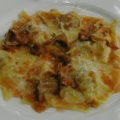
Saturday night we had scrippelle, a traditional treat from Abruzzo. You can think of them as crepes made without milk, or very, very thin omelettes. These had been home-made for us by family friends, Enrico brought them back carefully wrapped in layers of plastic with a wet dishtowel, storing them in fridges when he stopped along the way. They freeze very well, but we decided to eat them right away.

The simplest way to prepare scrippelle is to roll them up with lots of freshly-grated parmigiano inside, place three in a shallow bowl, and pour fresh, hot chicken broth over them. Sprinkle with some more parmigiano if you like, and dig in.

Italian Recipes: Panzanella

Today’s lunch was panzanella, another good thing to eat while tomatoes are in season. I more or less follow the recipe from The New Basics Cookbook, except that I didn’t have any of the herbs. Basically, you make home-made croutons by frying chunks of dry, old bread.

…which is a great way to use up dry, old bread, BTW. We always end up with a lot, partly because we overbuy and undereat, and Italian fresh bread goes stale very quickly, sometimes within the day. Whatever I can’t use up making croutons, or bread cake (recipe another day), or crumbs, goes to the horses – horses love dry bread.

Where was I? Bread: chop into 1-inch cubes (roughly), sauté in butter and olive oil with minced garlic, fresh herbs if you have them. Pepper. Remove from pan into a large bowl, toss with fresh-ground cheese. The recipe says parmigiano, my grater currently contains odds and ends of sharp aged cheeses, I don’t even know what all.

Then chop ripe tomatoes, thinly slice red onions, toss with oil, red vinegar, salt, and pepper. When ready to eat, add the croutons.

Making Chutney

I had been saying all summer that I was going to make tomato chutney during this season, while the tomatoes are at their best – and, in Italy, that is very good indeed! My favorite fruttivendolo was selling pomodori ramati – tomatoes on the vine – at 3 euros for 3 kilos, so I bought 3 kilos (~ 10 lbs.).

I first scalded all the tomatoes, in batches, in boiling water for 15-30 seconds, lifting them out with a slotted spoon and letting them drain and cool in a colander. When they were cool enough, I peeled them (at this point, you can just strip the peels off with your fingers), chopped them, and removed most of the seeds – this is a personal thing, I just don’t like the seeds. If you don’t care, you can leave them in.

3 kilos is a lot of tomatoes, so I decided to make two different kinds of chutney, both from Madhur Jaffrey recipes. First was a Hyderabadi chutney – very peppery and garlicky, a bit yellow from turmeric. Unlike most of the chutneys I’ve made so far, this one is sauted. It is tasty, and VERY hot.

The bulk of the tomatoes (2.3 kilos) I used for my usual sweet tomato chutney, again a Madhur Jaffrey recipe. I can’t find online the exact recipe I’m using, but this one is similar – just use fresh tomatoes prepared as described above.

This recipe calls for cooking the tomatoes in vinegar and sugar, with lots of minced garlic and some spices and salt, for about an hour and a half. The recipe calls for raisins, which maybe help it densify (is that a word?) faster, but I decided to leave them out since I still have a batch of apricot chutney made a few weeks ago, with raisins. So the cooking time got longer, and it got slightly burned on the bottom before it really got dense enough. But I picked out most of the black specks, and they don’t seem to affect the flavor, which is sweet, sour, and garlicky, all at the same time.

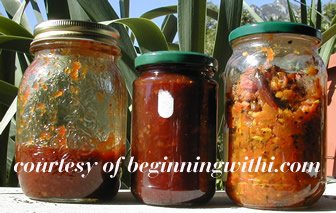
chutney jars

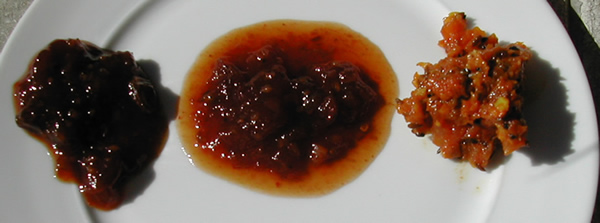
The pictures show all three chutneys – apricot, sweet tomato, and spicy tomato. Hmm. I still have some things to learn about food photography. The first two will go well with cheeses – aged and sharp cheeses such as parmigiano for sure, and probably with some kinds of pecorino (sheep’s milk) or caprino (goat’s milk) cheese as well, especially aged ones. The third one is more like a relish; I’ll have to see what it goes well with, though Ms. Jaffrey says it “could brighten up almost any meal.”

The Family That Eats (and Drinks, and Talks) Together

News sources reported recently on a survey of American teens which shows scary correlations between the habits of the people kids spend time with, and the likelihood that they themselves will do various things (drugs, alcohol, sex). It seems that hanging out with the proverbial “wrong crowd” really can lead to trouble.

The New York Times goes on to say: “The survey suggested a simple way for parents to reduce the likelihood that their teenage children would smoke, drink or use drugs: have dinner with them. Teenagers who reported having fewer than two family dinners a week were one and a half times likelier to abuse these substances than those who had five or more dinners a week with their parents. They were also more likely to have sexually active friends or spend more than 25 hours with a significant other. But as teenagers grow older they are less likely to have family dinners, the survey found; older teenagers are also more likely to be substance abusers or engage in sexual activity.”

I have written before about the central role of family meals in Italian culture, and how they help Italian teenagers to grow up civilized. Eating together isn’t a panacea; drug and alcohol abuse do exist in Italy, and alcohol abuse seem to be on the rise particularly among young people.

But Italy has a long way to go to “catch up” on that front, and there is hope that it won’t go that far. After all, many Americans are attracted to Italy’s more leisurely, family-oriented lifestyle – there’s even a book about how to live an Italian lifestyle in the US. (NB: I have not read it, nor am I likely to.)

A New York Times opinion piece today on curbing teenage drinking says: “This summer, we’re celebrating the 20th anniversary of the minimum drinking age of 21, signed into law by President Ronald Reagan in 1984. That legislation has saved an estimated 20,000 lives.” The author calls for more funding for enforcement to prevent underage drinking.

At 18, Americans are old enough to vote, and to make life-or-death decisions such as joining the military. They’ve been driving since they were 16, unlike European teens (driving age is 18 here), and most are leaving home to go to college or enter the work force – they are legally independent of their parents. Yet they’re NOT old enough to drink. Huh?

As usual, American culture focuses on the wrong things. You don’t stop teenagers doing stupid things by telling them not to – which is simply hypocritical when most of their parents did the same, or worse, when they themselves were teenagers. Teenagers can spot hypocrisy miles away, and rightly despise it.

You also don’t stop kids doing “bad” things by “shielding” them. In spite of the censorship of American television, most kids are very familiar with the word “fuck” by third grade or so.

And you don’t stop teenagers having sex by pretending it doesn’t exist, or that it only exists within marriage. I’ve recently been told by a friend, who works in pregnancy prevention in the US, about studies showing that, in households where sex is freely and openly discussed, kids tend to start having sex later.

Adults drink, and swear, and have sex, and it’s useless to pretend that we don’t. Teenagers are growing up, they want to feel adult, and want to do these “grown up” things themselves. You can’t stop them doing things; you can only try to prevent them from hurting others or getting hurt themselves. (Morally and emotionally, as well as physically.)

The solution is honesty, openness, and responsibility. Let kids learn to drink responsibly, by starting at home, at family meals. Teach them to have safe sex, by talking with them about it, answering any and all questions, and getting them to a clinic for birth control. As for swearing, I learned about swearing responsibly from my dad long ago, when I was about 10 years old:

“When you drop a hammer on your toe, it’s okay to swear,” he said. “But you don’t sit at the dinner table and say: ‘Pass the fucking salt.’ “

Deirdré Straughan on Italy, India, the Internet, the world, and now Australia