Tag Archives: what I do

The Evolution of a Technical Writer – Bringing Documentation Into the Web 2.0 Age

How has technical writing evolved in the age of the Internet? How have tech writers’ jobs changed, and how should they continue to change, in response to new technologies now available for sharing knowledge with our customers?

Prologue: The Dead Tree Society

My technical writing career began twenty years ago, with the design and writing of software training courses for desktop publishing. These were delivered as printed sheets in a binder used in face-to-face classroom training.

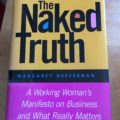
The first manual I wrote was for an optical-character recognition software. Soon after that, I co-authored a very technical book (Publish Yourself on CD-ROM, Random House, 1993), which included a manual for Easy CD 1.0 (later named by PC World one of the 50 Best Tech Products of All Time).

The book was one of the first in the world to include a CD, for which I produced a screen-readable, hypertext-rich version of the text (the CD also contained a demo version of the software). This early experience demonstrated the power and flexibility of electronic texts, but we still had to deliver them on physical media.

Moving It Online

Between 1992 and 1995, I wrote manuals and software-based help for several versions of Easy CD and other CD recording software. Paper manuals were (and are) expensive to produce, print, and distribute. Even “online” help, when it’s deeply hooked into the software (e.g., context-sensitive help for each dialog box) could not be rev’d any more frequently than the software.

As we entered the Web 1.0 age, customers’ expectations of company responsiveness increased, and these old, familiar processes were no longer fast enough. We needed a way to provide customers with updated and expanded information about our software, on demand (in response to FAQs and newly-discovered bugs as they arose), and at low cost.

The worldwide web came to the rescue. When the small software company I worked for was bought by Adaptec, I had pages ready to post on Adaptec’s new website. I soon found myself responsible for the busiest (though not the largest) section of the Adaptec site, which eventually brought in up to 70% of overall traffic – clearly, we were providing information that customers wanted.

Usability

Meanwhile, a separate but converging trend in the industry aimed to improve software usability. After years of slaving over manuals, I realized that, for most users, RTFM is a last-ditch solution. At least where consumer software is concerned, most of us just dive in and start using it, and only look to documentation when we can’t figure out something from the UI (user interface). Users increasingly expected that they should NOT need to open a book or help file, except maybe when using advanced features – a reasonable expectation, I think.

I further observed that, when a software process or feature is difficult (as opposed to complex) to document, this usually means that something’s wrong in the software design. I began working closely with the engineers, initially during beta testing, then earlier in the design phase so that I could try to head off UI problems from the start, rather than be told later: “We won’t have time to fix that til the next release.”

And I worked directly on the UI, writing and editing text strings for dialog boxes, etc. This was obviously a job for a tech writer: the clearer the messages onscreen, the less I would have to explain in the manual.

Collaborating with the Community

Around 1993, I had begun to interact daily with customers online, and soon learned to value their knowledge. No QA (quality assurance) or tech writing team can spend as many hours with a product as a large pool of users will collectively spend with it, nor can an internal team hope to duplicate all the diverse situations in which customers will use it. When we tap into what customers know about our products, both sides benefit.

In the mid-90s, I was an active participant on Usenet forums, answering questions where I could, keeping an eye on hot issues, and conveying customers’ knowledge and issues back to the company. (NB: By late ’95/early ’96 I had handed off my manual-writing job.)

In 1996, I launched a moderated, email-based discussion list which fulfilled the same functions, but in a more controlled and congenial atmosphere. The same concept is seen today in discussion forums run by companies on company sites (which may not be moderated or even monitored).

My role as a tech writer in these virtual meeting places was to work with users to find answers to problems, then to “pretty up” and post that information to the website and, in the longer term, write it into the documentation and/or take note of it in future product design.

I did not originate all this new material (that wouldn’t have been humanly possible!), but my deep knowledge of the technology and ability to write about it in layman’s terms made me ideally suited to fit this new “outside” information into the bigger picture – I was now more a knowledge editor and manager than a writer.

Where I did create original material, it was usually in response to customer FAQs and other expressed or observed customer needs. By staying close to customers and interacting with them daily, I kept a finger on the pulse and knew what they needed/wanted, sometimes before they knew themselves. I considered myself a conduit for information between customers and the company, translating from user-speak to engineer-speak (or boss-speak) where necessary.

New Tools

In the six years since I quit my job with Roxio, the technologies available for online communication and collaboration have, of course, moved on. We now have two very powerful new tools: blogs and wikis. How should we use them, and other new tools that will doubtless show up in the future? That’s a topic for another article.

Your thoughts? If you’re a tech writer, how have you seen your role evolving, and what do you anticipate for the future?

40 Years Online: Communicating on the Internet Since 1982

Note: This is a heavily revised version of an article that I originally wrote around 2001, now updated for this year’s “significant” anniversary. 25 years online seems like a milestone worth marking!

I can say without hubris that I have a talent for communicating online. Which shouldn’t be surprising: I’ve been doing it for over 25 years.

Continue reading 40 Years Online: Communicating on the Internet Since 1982

Communicating with Your Customers

Someone anonymous claiming to be an Apple employee launched a blog (now vanished) to discuss his/her thoughts on Apple’s communications with its customers. This was big news in the blogosphere, because Apple is notoriously secretive and uncommunicative.

The only Apple product I own is an iPod (I had a Mac SE 15 years ago, my first and last Macintosh), but I have read the few entries on this new blog, and the accompanying reader comments.

Many of the commenters decry the blogger’s anonymity, saying that it proves that the blog is a fake perpetrated by Apple itself as a publicity stunt. Some blogs have recently come to light claiming to be produced by individuals who “just happen” to love a company or its products so much that they would dedicate time to blogging about it, but these blogs turned out to be funded by the companies in question (e.g., Wal-Mart). Such subterfuge cannot long remain hidden in the teeming online world: when thousands of minds attack a puzzle such as “who’s really behind this blog?”, it gets solved very quickly.

The Apple blogger him/herself points out, reasonably enough, that to be identified by the company could cause her to lose her job (most of the commenters seem to assume the “Masked Blogger” is a man, while I, for no particular reason, think she’s a woman).

The Masked Blogger’s avowed purpose is to start a conversation about what Apple could be doing to communicate better with its customers. She’s asking the right questions, and some of the answers are useful. It therefore doesn’t matter whether the blog is genuine, because Apple is reading it. Whether they read it to see how their PR experiment works out, or to try to identify their rogue employee, the conversation about conversation is taking place – and Apple, volente o nolente*, is listening.

Whether they will learn anything is another question. It surprises me that this conversation is still needed. All the “new wisdom” floating around the blogosphere about how companies should communicate with their customers (the current vogue, of course, is that they should use blogs) follows principles that I invented for myself over ten years ago, starting in CompuServe forums (yes, I am a geek antique).

You want to communicate with your customers online? It’s not rocket science.

The basic principles are:

  1. Be honest. This doesn’t mean that you need to spill your guts and tell every company secret, but everything you do say must be absolutely true. And, when you know there’s a problem that affects customers, say so, especially if asked point-blank. Don’t imagine that you can pretend ignorance, or hide behind spin and subterfuge – you can’t.
  2. Be real. Not every problem is going to get fixed quickly and not every customer is going to be happy. If you explain what steps are being taken and how soon you (reasonably) expect them to take effect, customers are surprisingly forgiving. Most will love you just for showing that you’re listening and trying to help. Sometimes you can’t fix a problem; not everything customers say they want is even possible. When I worked for Adaptec/Roxio, I frequently used the line: “Fast, cheap, or perfect – pick two.” Most customers understand that businesses cannot supply everything for nothing. If you can give a reasonable explanation for why you can’t do what they’re demanding, or can’t do it as fast as they would like, they get it. And they appreciate being spoken to like capable adults. Weasel-speak only shows contempt for your listener; no one likes that.
  3. Be yourself. Perhaps because I started out “talking” to people personally in forums (and never wrote marketing copy for a living), it always came naturally to write in my own voice. I was surprised at how well people responded to this, telling me: “we, as customers, like the feeling that we are dealing with a real person, not a machine producing corporate ‘happytalk’.” NB: This did not mean that they wanted to hear about my vacations or what I ate for lunch or my views on politics, nor did it mean that I could tell someone he was an idiot even when I thought so – I represented the company and, when you do that, you ALWAYS have to be polite. And careful: sarcasm usually backfires online, and even mild irony gets over-interpreted.
  4. Be strong. It’s a hard job, representing a company online. You’re highly visible: when the shit hits the fan, you’re the first to get spattered. Because people are accustomed to being treated badly by every other company, their default assumption is that you, too, are out to screw them, that your niceness is just a ploy, it’s all a PR stunt, etc.NB: OF COURSE it’s a PR stunt – everything that you do in the name of your company where a customer can “see” you is marketing and PR (whether you – or your company – realize it). Every employee in any company who ever has contact with a customer has a chance to make or break the company’s reputation – maybe just with that one customer, maybe with many who will hear by word of mouth about that customer’s experience. What is that if not PR?

    Be prepared for suspicion and abuse. Just keep smiling, and nice them to death. Trolls get bored quickly, and they are a small minority, no matter how loud. The silent majority will respect your patience, good manners, and tolerance. In fact, if you hold out long enough, they will start leaping to defend you!

  5. Believe. Being nice under duress does take a psychic toll, so you’d better be doing it for a company, product, or cause that you believe in. And it’s fine to defend your belief passionately: people respond to passion, even if they don’t necessarily agree with you on its target.

Okay, I’ve told you everything you need to know. Now get out there and talk to your customers!

Similar thoughts from the Scobleizer

My Technical Writing

WinOnCD Documentation

User comment from CNet on WinOnCD 5 (US release, November 2002): “I definitely am not a techy and I had no problems. The reason is because I carefully read the manual. The manual is detailed. It took a number of hours to digest. There is a learning curve, but after some practice everything worked as described.”

“…Roxio’s excellent online help is friendly and logical…” – Review of WinOnCD 6 in PC World (UK), February, 2003.

Kudos from Long Ago

Manual for Easy-CD Pro, reviewed in InfoWorld, June 6, 1994:

“We generally don’t expect documentation to be better than the program it describes, but in the case of Easy-CD Pro, it is. Even though the product design is inconsistent, the 100-page manual does a great job of explaining the product from a functional point of view. It is cleanly printed, well indexed, and conceptually informative… On-line help is beautifully organized and cross-indexed, and context sensitive almost everywhere.”

How I Became an Italian Journalist

Soon after we moved to Italy in December, 1990, I read an article in Italia Publishers, a magazine about desktop publishing, in which the writer described his difficulties in finding a font for Hindi. Although he had never been to India, he had been studying the language in Milan for fun, and wanted to write the world’s first Hindi-Italian dictionary. “Well,” I thought, “I’m one of the few people in the world qualified to help him: I speak Hindi and Italian, and I know a lot about desktop publishing.” So I wrote him a letter, care of the magazine, proposing to collaborate on the project.

After a few weeks, the writer called me. The dictionary project had never taken off; he couldn’t find a publisher. “But the magazine editor wants to speak with you,” he said. There was a shortage of journalists who could write about computers, and they were willing to try me out. My first piece was a small review of a piece of Macintosh software, I don’t remember the name, it was an organizer/calendar with “personalities” that would talk to you. The editor of Applicando, then the leading Italian Mac magazine, liked this piece, and more work flowed in from him and other magazines in the same publishing stable.

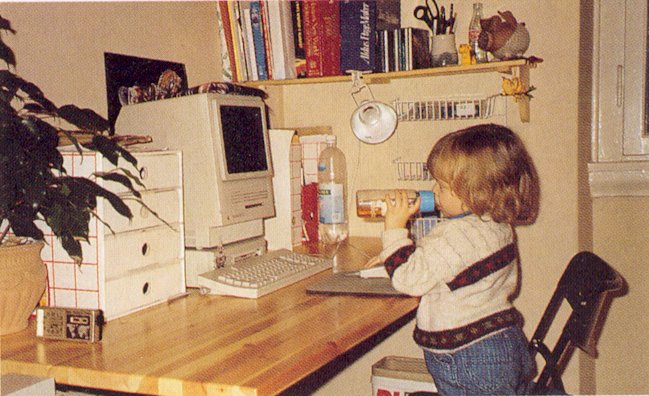
Another early piece was about “The Manhole,” kids’ software for the Macintosh which was more a world to explore than a game. We tested it on Rossella, then only two years old, who had no trouble picking up the concepts of the mouse and pointer. The review included a photo of her in front of the Mac, intent on the screen, with the mouse in one hand and her bottle in the other. NB: The guys who did “The Manhole” later on went on to do Myst.

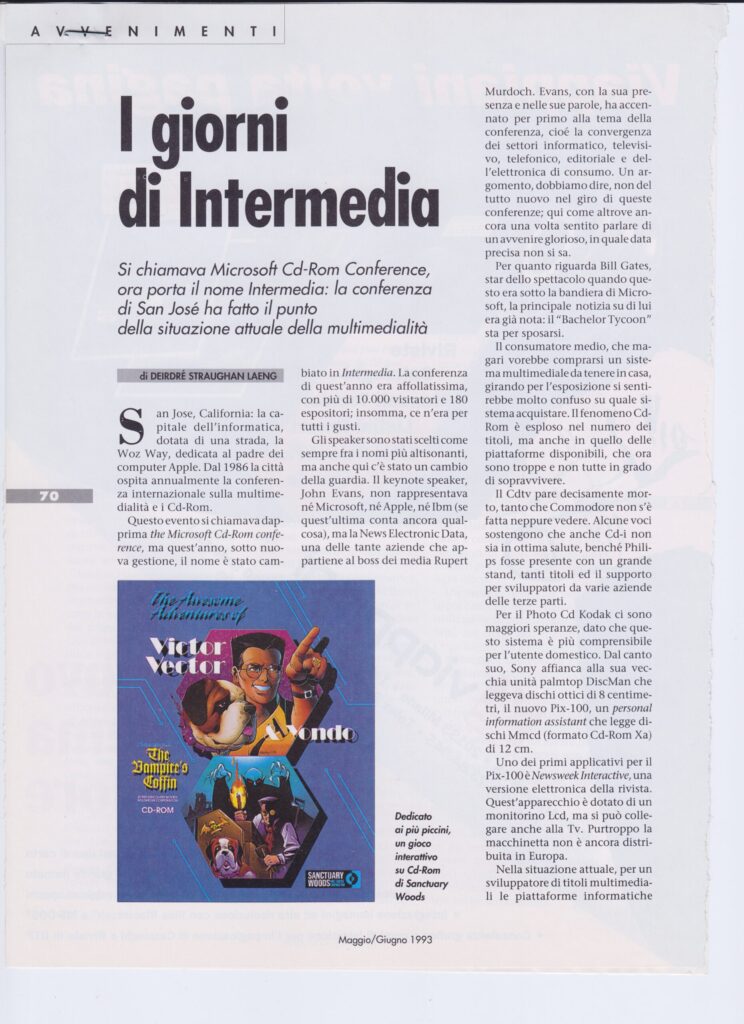
The writing didn’t pay well, but there were perks. I got to go to Edinburgh on a junket paid by Aldus (the company that created PageMaker desktop publishing software). All I had to do was write an article about their new product announcements. I helped pay a couple of trips to Boston by writing articles about the Seybold Conference, to which I got free entrance as an accredited journalist (though I was badly snubbed by a “real” computer journalist I had idolized, Denise Caruso). And I got into the Microsoft CD-ROM Conference in San Jose the same way; by then, Fabrizio and I were going to the conference for other reasons as well.

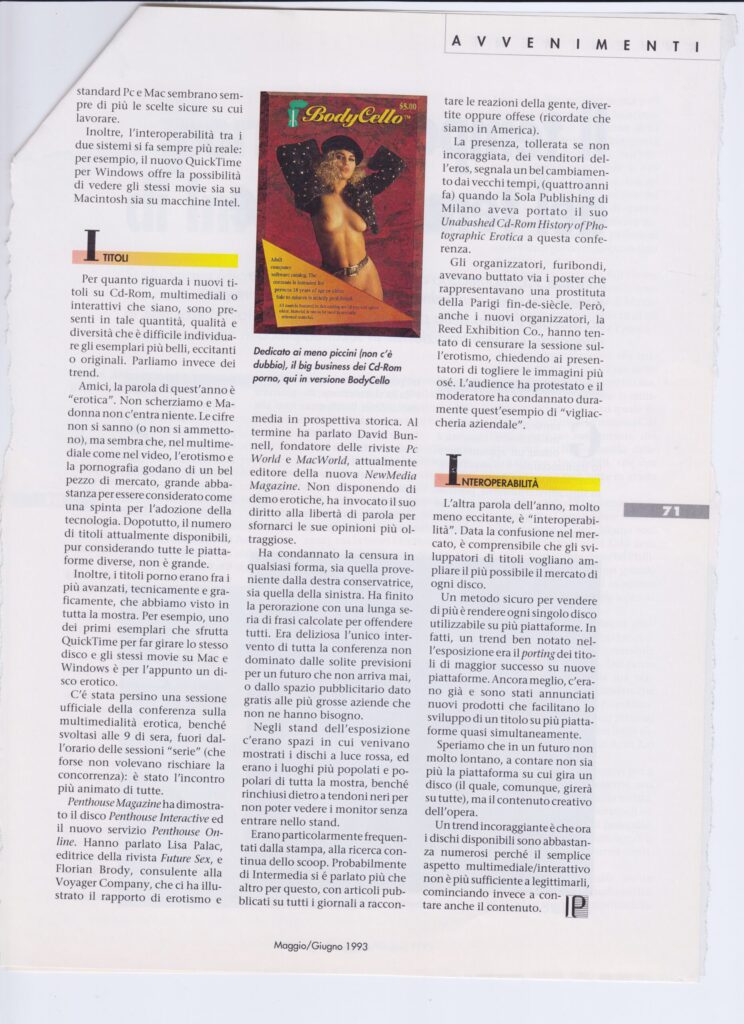
One of the CD-ROM conferences I attended took place in the “porno year.” This was when conference organizers in the US finally decided to admit that pornography was a driving force in software and CD-ROM publishing (as it would later be for the Internet), and to allow the porn merchants to attend on almost the same footing as other publishers. There was a whole floor devoted to porn at the big Comdex show in Las Vegas, but I didn’t go to that. The situation at the CD-ROM conference was funny. The pornies had a section of the floor to themselves, carefully draped off with black curtains. There was also a conference session on pornography, held at 9:00 in the evening, well apart from every other session.

Fabrizio was amused by all this. His first big foray into CD-ROM publishing had been “The CD-ROM Unabashed History of Photographic Erotica,” co-edited with a photo archive in Milan, which he had tried to advertise at the conference several years before. He’d been forced to take down his posters, but word got around anyway – back in Milan, Microsoft ordered two copies for somebody high up in the company.

I looked at some of the porno stuff at the conference, brought back lots of samples, and wrote a wry, amused piece about the American reaction to it all. Nino, the magazine editor, was thrilled to include pictures of the products: “Finally, we have tits – just like Panorama and L’Espresso!” (Two Italian news weeklies which often find ways to work naked women into their covers.)

My article also reported on the results of a “test” I had run at the office, where I got the engineering staff and my husband to watch a porn movie on CD with me. The engineers were intrigued by the fact that the disc was “hybrid” – it would run on both Macintosh and PC systems, a technological trick which the porn publishers pioneered. Everyone commented wisely on the jerkiness of the video, although, given the subject matter, perhaps some jerkiness was to be expected.

The American press had noticed the sudden “legitimization” of digital porn, and had a lot to say about it. Stephen Levy, author of “Hackers,” published in MacWorld an interview with a young porn CD publisher, which I happened to read while on a visit to the US.

Levy asked the publisher what his parents thought of his business. “My dad’s okay with it, but my mom’s not too thrilled,” was the reply. “Well, so-and-so,” concluded Levy sententiously, “you should have listened to your mother.” I was infuriated by Levy’s condescending tone towards his interviewee, especially in light of “Hackers,” where he notes that many computer geeks are lonely young men unable to get dates. It seems to me that digital porn is a sevice to those guys.

Not having a computer available, I scrawled off a furious note in my terrible handwriting, and sent it to MacWorld. Months later, at the SMAU computer show in Milan, I ran into a magazine editor I knew. “Hey, I saw your piece in MacWorld!” he said excitedly. They had published the letter, but since I was not a regular reader of MacWorld I hadn’t noticed. I’ll have to go dig that up someday to remember what exactly I wrote to Stephen Levy. I don’t know whether he ever replied.