Category Archives: bio

More Reasons to Send Your Child to Woodstock School

I thought of a few more answers to the question: Why send your child to Woodstock School?

The Natural Environment

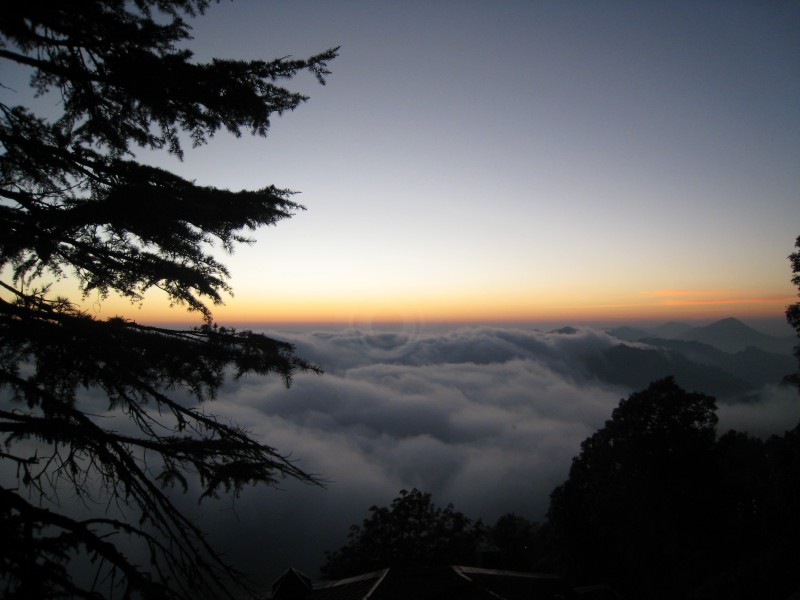
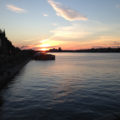
The photo above was taken from the top of the hill above school at dawn on a November morning. Need I say more? Look through the rest of the Woodstock section of this site, as well as the early part of the travel blog from my trip to India with my daughter two years ago, and you’ll see more of the extraordinary beauties of Mussoorie.

People tend to come out of Woodstock with a profound appreciation for – and desire to protect – the beauties of nature. A number have been inspired to make a career of it.

Extraordinary People

Another reason to send your child to Woodstock is that it produces some extraordinary people – and the ones on that page are just (some of) those who have an online presence that I can link to!

International Community

Though the specific demographics have shifted over the years, Woodstock has always been an international community made up of students and staff from dozens of nations, races, traditions, and religions. In such a context, you learn to get along well with everybody, to be sensitive to cultural differences, to find divergences stimulating rather than threatening.

In today’s globalized world, this is perhaps the most important kind of education any school could hope to provide.

You’re an Alum Yourself

A very strong reason to send your child to Woodstock, obviously, is that you yourself went there and loved it. I don’t have exact statistics (have asked the school), but it seems that a large proportion of alumni do send their children (and/or grandchildren, nieces, nephews, children of friends…) to share in this extraordinary experience. Some don’t quite manage to get their kids there for whatever reasons (finance, geography, lack of interest from the kids themselves), but they try, and some regret it all their lives if they don’t succeed.

The case mentioned earlier of the German boy who found Woodstock online and decided to go there is actually very unusual: people most often end up at Woodstock because of word-of-mouth recommendations from alumni and former staff. My husband accuses me, with some justice, of trying to “proselytize” Woodstock to everyone I meet. Well, that’s what I do with things I’m passionate about: I talk (and write) about them.

Now it’s your turn: if you’ve already decided to send your child to Woodstock, why did you? If your child has already gone, did the school fulfill your expectations for him/her? If you’re thinking about sending your child, what else would you like to know?

Where Italians Go on Vacation

Someone asked on Frommer’s: “Where do Italians go on vacation?”

The majority go to the beach. For at least a century, a seaside vacation has been considered healthful: during the Fascist period, ocean front “colonies” were built, where urban children could be sent to escape the grime of the cities.

The month-long summer vacation is still a reality for many Italians, who transfer their families (often including one or more grandparents) to a seaside hotel, apartment, or a trailer and tent in a campground. Even if Dad’s working, Mom and the kids will be there, with Dad perhaps driving down at weekends. Many families own second homes at or near the seaside, so take their vacations in the same place, year after year. It seems to be part of Italian culture to crave the comfort of familiarity and routine, even when you’re away from home.

Italy is a long peninsula, and also owns a lot of islands in a range of sizes, so there are plenty of beaches to go to, depending on your tastes and the size of your wallet. Choices range from the upscale, such as Portofino, Sardegna’s “Emerald Coast”, and Capri to… places that normal people can afford.

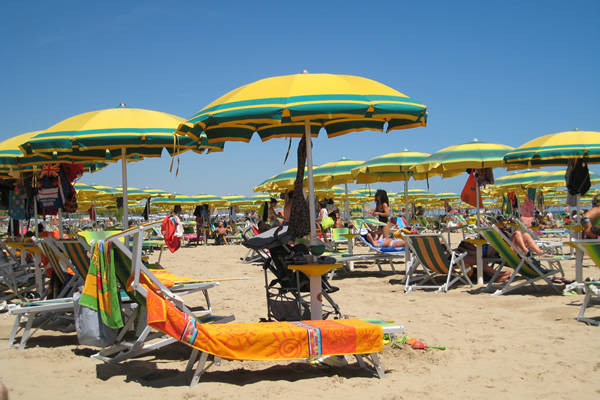
For family reasons, most of my Italian beach experiences to date have been very much in the affordable category, in Abruzzo on Italy’s central Adriatic coast. Having grown up in Thailand when it was still an unspoiled tropical paradise, I was astonished the first time I saw the Italian idea of a holiday beach: row after row of umbrellas, so close together that you could barely see the sand between them. I never have learned to see the charm of this.

(^ The photo at top shows a relatively roomy beach, by some Italian standards!)

Far from being relaxing, Italian resort towns are usually buzzing with activity: from early morning until late at night, you see (and hear) everyone (old and young) out and about, swimming, sunning (yes, tanning is still considered healthy here), strolling, chatting, eating gelato, being “animated“, until late at night. At least the afternoon siesta is held sacred!

Death by Waiting

Thanks to those who have written words of encouragement and kept me in your thoughts and prayers. Yes, even as an atheist I can appreciate prayers – if you care enough to intercede with your god for me, I take it as a sign of affection, and affection never hurts. Besides, I have so many different denominations praying for me that one of them’s bound to take, right? <wry grin>

I also had a bunch of phone calls yesterday wanting to know the news. Unfortunately, there hasn’t been any yet. Some people have said this may be a good sign: if there was bad news, the hospital would be in more of a hurry to inform me about it!

All this helps, but basically I’m going through hell. I cope better with unhappy certainties – god knows I’ve had enough practice at that – than I deal with any kind of uncertainty. I’ve slept very poorly for a week (staying at a noisy campground at the beach last weekend didn’t help), and there aren’t enough distractions in the world to keep my mind off this. (Though Ross is certainly providing a full repertoire of teenage moments – I begin to suspect she’s trying to make me glad that she’s going away to boarding school!)

The fear and anxiety I’m experiencing are very normal – even the American Cancer Society says so. I now know that a number of my friends and relatives have already been here and done this. So why didn’t I hear about it before? It seems that people have different reactions: some keep it to themselves; some share, but only with their closest. And I suspect that, when the results come back negative, many feel a bit foolish for having put themselves through so much misery: “What right do I have to complain? I’m one of the lucky ones: turns out I don’t have cancer.” And they put it out of their minds until the next time.

Make no mistake, there will be a next time – after all, I have difficult breasts. And I have heard from and about other women who have gone through this multiple times for various reasons. There’s got to be some way to make this waiting period less horrible for all of us.

update at 10:30 am: Finally got hold of the doctor (“But she called you yesterday!” – oh?) – all is well, nothing to worry about.

Difficult Breasts

I had my first mammogram about ten years ago, around age 35. I was surprised when the gynecologist I was seeing suggested it; I thought routine mammogram screening didn’t start til age 40 or 45. He said: Lei ha un seno difficile – “You have difficult breasts.” By which he meant that they were naturally lumpy (fibrocystic), making it hard to tell by palpation whether there was anything suspicious in there or not.

So I went for my first mammogram at one of Milan’s big hospitals. I stood a torso nudo (stripped to the waist), staring round-eyed at the machine. I’d been told mammograms were (at best) uncomfortable, and I didn’t know what to expect.

The technician, seeing my expression, asked: E’ la prima volta? (“Is it your first time?”). I nodded. She kept up a steady stream of chatter, to which I replied in monosyllables until she finally burst out: “I’m trying to distract you!”

I appreciated the effort, but…

So, for those who have yet to experience it (or never will), here’s how a mammogram goes:

You stand in front of the machine and the technician raises the platform (about a foot square) to a height just slightly uncomfortable to fit under your breast. You arrange your arm around the corner of the platform, and hold onto a handle at the back of the machine – that keeps your arm stretched out of the way. If the corner digs into your armpit, you know you’re doing it right.

The technician lifts the breast onto the platform and pulls it out to an extent you would not have imagined your breast could stretch. Then she lowers a flat, clear plastic cover that squashes it down to a minimum possible thickness (in my case, about two centimeters). This is indeed uncomfortable, verging on painful, depending on how sensitive your breasts are (which, in my case, depends partly on the time of month – never schedule a mammogram just before your period is due).

The technician retreats behind a safety screen and throws the switch; there’s an x-ray buzz, then the plastic thing squashing your breast lifts by itself and you can breathe again.

Repeat for the other breast.

Then it’s time to do the laterals. The platform is tilted to a 45-degree angle and your breast squashed sideways onto it, again held flat by the plastic cover. Lather, rinse, repeat. Ow, ow, ow.

I was advised to do this every two years until further notice. The second or third time I had a mammogram, the clinic insisted on also doing a sonogram (ecografia), because the internal geography of my breasts is so difficult that a mammogram alone isn’t enough to spot potential trouble.

This revealed large cysts – very common, nothing to worry about, they show up as huge black bubbles on the sonogram. They are benign and totally unrelated with cancer.

During a trip to California in 1999 or so, I was going to sleep in my hotel one night when I suddenly noticed something sticking out of my breast – the inside of my upper arm brushed against it. It was about the size of a walnut, and seemed to have come out of nowhere. I lay awake much of the night, until it was late enough that I could call my doctor back in Milan.

“It’s probably one of your cysts that has suddenly enlarged,” she said soothingly (possible cause: I had just gone off the pill after trying it for 2-3 months and finding myself constantly depressed).

I was flying back to Milan within days, so the doctor told me to come immediately to her office when I got home, and she would give me a n emergency form entitling me to see a specialist within 48 hours. I duly did so, and had 100 cc’s of a nasty black fluid drained out of one of the cysts (through a large needle). Nothing to worry about.

You can’t keep a cyst down for long, however, and having these large sacs full of fluid in my breasts just makes me front-heavier. Within a few years I was trying to convince another doctor to drain them, but she refused, saying that would cause them to fill with hard stuff instead. The only solution short of surgery was to find better bras.

The cysts and I have been relatively at peace for a while. Until a couple of weeks ago, when my breasts began to ache, apparently with the strain of bearing increasingly large amounts of fluid. I wasn’t worried about this, but wondered if something could be done. Went to the family doctor on Wednesday. She gave me a Fascia A (A Category – urgent) prescription for a mammogram, which meant that they slipped me into the schedule the next morning at the hospital’s mammogram center.

The mammogram this time was, unsurprisingly, very painful – my breasts were already sore, after all. I whimpered, causing the technician to ask: “Does it really hurt that much?” I tried to concentrate on the many colorful posters hung on the walls around the room, presumably to distract suffering patients.

While waiting in the dressing cubicle, I overheard the doctor saying to another woman (an older one, I think): “There’s just something here under the nipple… can you come in Monday at 11 for a prelievo?” (“withdrawal” – in most medical contexts this refers to a blood sample, but in this case I assume she meant tissue). I wondered idly what medical adventure this woman might be embarking on, and thought of my mother-in-law, who had breast cancer six years ago.

When my x-rays were developed, the doctor – a reassuring lady with masses of curly black hair – called me in for my sonogram. She squirted a lot of chilly gel all over my breasts and slid the instrument around in it while staring intently at the TV screen.

“How long does it take to learn to understand what you’re seeing there?” I asked.

“Oh, you never stop learning!” she said cheerfully.

It was greek to me, but I could make out the cysts: big black gaps in the picture. They swam in and out of sight as the doctor moved the probe.

Then she went back to looking at the mammograms.

“I want you to do one more mammogram of this right side. The picture on this one is superimposed, it’s not clear enough.”

I wiped all the gel off with wads of the paper sheet, and returned to the x-ray room. (Did I mention that it was chilly in all these rooms and I had been topless for nearly an hour?)

This time I was in for special torture. An extra piece was added to the x-ray platform to raise it up, then instead of a big square piece of plastic, a small round one was squashed down on my breast (which hurt even more) and the technician drew a curve around it on my breast with a blue marker pen, I suppose to define the precise point of squashing.

Then I sat in the cubicle some more until the doctor called me back in.

“There’s an area here that’s…” she trailed off without ever finding the word. “It’s probably just the mastopatia [benign fibrocystic “pathology”], but… can you come in Tuesday for a prelievo?”

next

FemCamp Bologna 2007: Sessions & Reflections

In the afternoon I attended some sessions, though I missed the most popular presentation of the day, Iocelopiulunghismo (“Mine’s-the-biggest-ism”), by Elena and Feba, a funny and ironic look at (male) bloggers’ obsession with their (blog) statistics.

I poked my head into Andrea Beggi‘s unfortunately-titled presentation on “Blogging for Ladies,” but the room was so crowded I couldn’t stay. I hope and assume that he intended the title to be tongue-in-cheek, but it was risky, and evidently a number of people did not take it as ironic. After what was apparently a useful bunch of technical how-to’s on getting more traffic to one’s blog, he came in for some flak about “what makes you so sure women want more traffic to their blogs?”

If this comment was really made, it was more than a bit silly. There are indeed private blogs intended for specific, closed audiences (e.g. one’s family), and hopefully the people who write them are smart enough to make them accessible only to the desired readers. But anyone else who’s blogging probably does want to be found and read – if you blog and nobody reads you, have you truly blogged at all?

I attended a session on women in the open source community, basically a report of statistics which, while I had not heard them before, did not surprise me in the least. I knew instinctively that women are a small percentage of the people working on open source software (I can remember seeing only one on my particular beat – storage – in the OpenSolaris.org forums). The interesting question is: why are there so few? One possible answer (given) is that people tend to do open source work in their free time, which women have less of than men (this is not fair, but that’s a topic for another time).

Something was said about technologies designed by and for women, a concept that wasn’t clear to me. In that context, we certainly weren’t talking about recipe organizers. Marzia responded with an example, Cercatrice di Rete (“Web Searcher”, the word searcher being in the feminine in this case), which she explained in more detail the next day at the E-Wit conference. It’s a search engine tuned to highlight women’s issues, e.g. searching on violenza returns results related to violence against women.

I suppose it’s one more example of a vertical search engine. I may be missing the point but, if I wanted to research “violence against women”, wouldn’t I just type that in? And if I needed immediate resources to protect me against an abusive spouse (the example Marzia seemed to have in mind), I would probably search on something more to the point, like: “how to murder your husband and get away with it.”

When it was my turn to present, I was disappointed that few of the younger women I’d seen at the camp were in the room. I was aiming mostly at them in my talk Fuori dagli Schemi – Aneddoti e Lezioni di Una Carriera Insolita (“Outside the Box: Anecdotes and Lessons from an Unusual Career”). I was afraid that what I had to share would be obvious to career women closer to my own age (well, okay, in their 30s), who seemed to be the bulk of my audience.

But several friends were present to cheer me on, and everyone seemed enthusiastic in spite of my quavering delivery in unusually shaky Italian (a result of nerves plus jet lag). If you want to hear it, go to this page and look for my name (towards the bottom), and click video at the end of that line (actually, it doesn’t sound as shaky as I had feared, though the grammar is not perfect).

Afterwards one woman told me she had needed to hear my admonition to “make sure the people who count know about the work you’re doing”, because she, too, had suffered from accomplishments that went unnoticed.

There wasn’t time for discussion, unfortunately, so I missed the opportunity to raise the question of what next steps the group could take for us women to help each other in our professional IT careers. I do have some ideas, though, which I’ll be discussing shortly in these pages.

Lele then got up to introduce a group of “cheerleaders.” I was about to rip his head off – the idea that my “go get ’em girls” talk should be immediately followed by sexist, male-pleasing bullshit was just too much. Then I realized that he had been asked to introduce a presentation I’d been curious about, “Save the Cheerleader, Save the World,” on gender in the fan communities of Heroes. Lele had gotten the wrong end of the stick in introducing the three young women doing the presentation as cheerleaders – the cheerleader referred to is character Claire Bennett.

One of the three did a good job of presenting the research carried out by a (mixed gender) group of students at the University of Urbino, but we didn’t actually hear any conclusions: those will be presented in a video to be posted on YouTube. It’s a pity her two colleagues didn’t get to speak, and I wasn’t sure of any of their names as Lele made a joke of them. But I appreciated that they had stood in the audience and smiled at me through my own presentation – I hope they gained something from it (e.g., don’t let someone else do all the talking for you, even if she’s female). later – I know at least one of them did: she left a very nice comment.

Amanda then gave a well-researched presentation on women in IT in Europe. That ties in well with what I heard the next day at the E-Wit conference, so I will talk about it in that context, in a future article.

Organization

There’s been a lot of bitching about how hot and crowded the venue was. In fact there would have been a lovely and capacious alternative venue, the one used for E-Wit the next day, in quarters shared between the Women’s Library of Bologna and the University of Bologna’s Department of Visual Arts.

However, as Federica (one of the organizers) explained to me, Internet access there was so hemmed about with firewalls that it would have been impossible to stream the video which allowed people from all over Italy (and the world) to follow the event live. Many of us present had also attended RitaliaCamp, hosted at a branch of the University of Milan which turned out to be very grudging in allowing attendees network access, to everyone’s frustration. (Hyper-bloggers gasp like fish out of water if cut off from Internet access for more than 15 minutes.)

The organizers of FemCamp opted instead for via San Felice, and, thanks to a sponsor, were able to provide the best wireless coverage anybody has yet seen at a camp in Italy – lack of which would surely have been cause for complaint at the other venue (note to conference organizers: you can never please everybody).