Category Archives: bio

Baby-Friendly

The NYT reports on the phenomenon of daytime movie screenings at which parents are welcome to bring babies – presumably the entire audience understands and tolerates baby noise. If people were a bit more tolerant in general, this kind of thing wouldn’t be necessary. Bringing a baby to a usually baby-less venue doesn’t have to mean that everyone around the child suffers, as long as the parents behave with common politeness, and expect the same from their child (within the limits of his/her age and abilities).

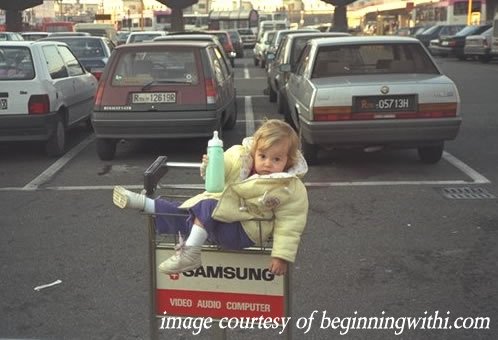
We took Rossella to movies practically from birth (lots before birth, too). We love movies, and she was a tranquil infant, if a breast was readily available. As soon as she made the tiniest noise, I put her on the breast, she fed herself to sleep, and we went on enjoying the movie. (She could sleep through any kind of movie, no matter how loud.)

No one ever objected at the many Yale film society screenings we attended during her first months. One of the societies was at Yale med school, where we were objects of delighted attention from young med students, eager to display their new knowledge: “Look! There’s the fontanel!”

When I visited my aunt in Texas, we went to see a Woody Allen movie. We got there well ahead of schedule and settled into good seats. I left Ross with Rosie for a minute to go to the bathroom before the film started. While I was away, Ross started to fuss. A lady sitting nearby frowned at Rosie. “Don’t you think you should take that baby out of here?” “No,” replied Rosie calmly. The lady got up in a huff and changed seats. By the time the film started I was back in my seat, and Ross was quietly feeding.

I suppose the lady thought that we were going to allow the baby to disrupt her movie. Certainly not. If Ross had a problem that couldn’t be cured by a breast, I quickly took her outside. This, to me, was simply polite, and anyway I couldn’t concentrate on a movie with a fussing baby nearby, any more than anyone else could. We finally gave up going to movies with her around six months, when she was sleeping less and more active, and we could no longer keep her happy and quiet for the length of a film.

What everyone most dreads is babies on airplanes. Get onto a plane with a baby in your arms, or toddler by the hand, and see the pained winces, furtive looks, and muttered prayers: “Oh, please, don’t let it sit by me!” I got so tired of being on the receiving end of this that now, when I see a family with children coming to sit near me, I make a point of welcoming them with a smile, no matter how much I’m cringeing internally.

Ross and I travelled a lot when she was small. The trips were exhausting for me, because I worked very hard so that she would NOT annoy fellow-passengers. Several times, as I sat limp and drained (literally) at the end of a flight, exiting passengers would compliment me, with some relief, on how well my baby had behaved. “You have no idea how hard that was,” I would think to myself.

Ross was by and large cooperative, wanting only to be entertained. The one really bad flight we took was when she had just become extremely mobile (crawling). The plane was a double-decker 747, and our seat was on the aisle near the stairs to the upper deck. Ross was entranced with those stairs, and I spent the entire flight (Rome to NYC) chasing her. I didn’t mind her moving around, as long as she wasn’t about to trip somebody, but every time I let her go, she bolted immediately for those fascinating steps.

Ross was maybe a year when an older woman, seeing my struggles to keep her occupied during a flight, suggested: “Give her paper and a pen.” This hadn’t occurred to me; I assumed she was still too young. But she went right to it, happily scrawling away, and thereafter I made sure to have markers and an ample supply of paper for every flight. Perhaps the artistic ability Ross has now owes something to that kind lady.

Celebrity

I don’t watch TV, because the amount of trash on it strongly outweighs anything actually worth watching. Especially if you consider that a lot of what’s shown is sports, none of which I will watch unless it involves horses (except for the occasional Olympic event).

Of course we had a television in our hotel room in Vienna, so Ross wanted to catch up on her MTV (which we don’t get at home in Lecco). Unfortunately, they were running a full weekend of The Osbournes. I had read about this show a while ago in a New York Times article, and, as with many, er, cultural trends, glancing at the headlines on Google News has been sufficient to keep me up to date (if that were needed). Actually seeing the show, I found that ten minutes of Ozzy’s extremely limited vocabulary was more than enough; the man is apparently unable to form a single sentence that doesn’t involve the word “fuck.”

That, plus some other stuff on MTV about Justin and Britney and Christina, made me wonder: who are these “experts” who get interviewed about celebritys’ lives, how did they get to be so “expert,” and aren’t they embarassed to be considered such? Would you want your obituary to read: “Was frequently interviewed about Britney Spears’ love life” ?

I don’t understand the celebrity cult in the first place. We seem to believe that by seeing or touching someone famous, or getting their autograph, or owning something they once owned or touched, some sort of magic is passed to us, making us a little less ordinary, a little more special, like them. This is very similar to the cults of saints and holy people in some religions. Surely there’s an anthropology dissertation in that somewhere…

Dancing Horses: The Lipizzaner Stallions

For Easter vacation we went to Vienna. There’s so much to do there that we barely got started; we’ll definitely have to go again.

The highlight of the trip, fulfilling a 30-year dream for me, was seeing the Lipizzaner stallions perform at the Spanische Hofreitschule. The event fully lived up to my hopes and expectations.

For my non-horsey readers: the Lipizzaners are the famous “dancing” white stallions who perform highly skilled and specialized dressage, in a tradition dating back 400 years.

They generally perform only twice a week, and there aren’t very many places for spectators, so you need to book well in advance – I wandered onto their website in mid-February and snapped up the last three tickets for the Saturday before Easter. The site is confusing; had I realized at the time how much those seats were going to cost, I might not have booked. But then the email confirmation arrived saying that the reservation could not be canceled, so we decided, what the hell – once in a lifetime, it’s bound to be worth it. And it was.

It’s a beautiful show of acrobatics and athletics, but it’s also about the relationship between man and horse. At the Lipizzaner museum and in the show program notes, we learned that riders begin at age 16, first learning to ride on an experienced stallion. After four years or so, when and if he’s judged ready, a rider is given his own young horse to train, which will take another four years. Later still, he will be expected to train other riders and help them train their horses; part of the selection process includes an assessment of the rider’s ability to pass on what he knows. Throughout his career, a rider will be responsible for the same small group of horses ­ ideally, a horse is always ridden by the same rider, for up to 20 years.

So what you see is the result of a long-term partnership in which man and horse know each other very well. So well that the horses appear to perform their magic entirely of their own will ­ the rider’s signals are so subtle that you don’t see him move from his ramrod-straight position in the saddle. The most we observed was a twitch of the heel here and there.

The riders also keep very straight faces, almost never displaying any emotion or even a well-deserved sense of accomplishment. At the end of each exercise, the only sign that anyone’s been working hard (and they have been!) is that the horses are foaming at the mouth and the riders are red in the face.

There was one exception to the poker-face rule, one of the senior riders, who didn’t quite smile, but nonetheless looked kind. And Ross swears that, when his young horse was acting up (slightly) during the show, she saw him giggle. We agreed that he looks like someone you’d want to take riding lessons with.

Unfortunately, that’s a dream that Ross could never live, without a revolution: the Hofreitschule is totally a guy thing. The horses are all stallions, and the riders all men. As far as we could discover, there has never been a female rider. I’ll have to dig a little deeper and see whether the notion has ever crossed anyone’s mind.*

* Aug, 2006 – A reader wrote to point me to an article showing that women do indeed ride Lipizzaners – but in South Africa, not Vienna.

photo above: the performance hall, rightly called the world’s most beautiful manege

Born into It: Why You Can’t Become Italian

Most of the world’s major religions proselytize (for some, it’s a major facet of the faith), and eagerly accept converts. Except Hinduism. Hare Krishnas notwithstanding, you really can’t convert to Hinduism, because it is much more than a set of beliefs and practices. Hinduism is a system that you are born into, a fixed hierarchy of families and castes. You are who you are because of your birth, and nothing can change that. Therefore, logically, anyone born outside the system must forever remain outside.

A non-Hindu can’t become a Hindu.By analogy, I’ve been wondering: can a foreigner become an Italian?

I don’t think so. Not in the same way that an immigrant to America becomes American. I think this has to do with the Italian concept of paese (hometown). You’re born into a paese, you grow up in it, absorbing its cultural and linguistic nuances, its history and traditions. “Italian” isn’t enough to define you; you’ve got to have a paese (and, often, a dialect) as well.

The attachment to paese begins early. Rossella has had trouble finding kids to hang out with after school, because most of her classmates commute to Lecco from smaller towns, where they already have firmly established social circles with whom they spend any leisure time left over from school and family. The frightening part (to me and Ross, anyway) is that, at age 14, they already consider themselves set for life, and will not move outside of their established places and groups unless forced.

They don’t get out, and no outsider (estraneo) gets in. This goes for other Italians as well. Italians who leave their paese to live elsewhere in Italy don’t fit in – they are not part of their new paese of residence, and never will be. One exception is Milan. I recently met an Italian who told me that, when he wanted to return to Italy after years abroad, he deliberately chose Milan as the most welcoming city in Italy, both to foreigners and Italian strangers.

Which is not to say that people in smaller towns are cold, far from it. My experience of the Lecchesi is that they are warm and welcoming and happy to have us here. But we’ll never be Lecchesi.

That’s okay with me. As a third-culture kid, I long ago resigned myself to never fitting in anywhere (except Woodstock). We have friends in Lecco whose company I enjoy, but these days I am expanding my social circles among expatriates. Interestingly, some Italians also seek out opportunities to socialize with expats, because they have themselves lived overseas and, as often happens to travellers from any country, find that they no longer quite fit in when they return “home.”

Apr 27, 2004

This article was widely read and responded to. One interesting thread came up on eGullet (I posted the article there at the invitation of one of the moderators), where some very knowledgeable people discussed the phenomenon in terms of Italian and European history.

You Want Me to Put that Where?!?

Cultural Differences in Medication Methods, US and Italy

There are cultural differences between Italy and the US even in seemingly small things, such as how medicines are administered. I got through a childhood of many, many medicines without ever using a suppository – except once. That once is still imprinted on my mind as one of the more humiliating, not to mention uncomfortable, experiences of my life. So I was unpleasantly surprised to find that suppositories were routinely prescribed for Rossella‘s childhood fevers. I guess the logic is that it’s easier to ensure that a small child gets the correct dosage that way, but it wasn’t fun for anybody.There are even adult-sized suppositories, though I’ve never heard of anyone actually using them. But then I don’t suppose that’s something you’d discuss in casual conversation…

The favored medicine format for adults is the bustina (little envelope), of a powder which is mixed with water, forming a fizzy and more or less palatable decoction. Beyond that, it’s plain old pills – none of these wimpy American capsules or gel caps, just swallow it down and quit complaining.

Then there’s my once new, now old, friend – the aerosol. This is a machine with a noisy little motor that compresses air. You attach a rubber tube to it, then a glass “nebulizer” into which you put liquid medicine. The final glass piece, connected by a rubber joining ring, can be a nasal “fork” (in two sizes), a mouthpiece, or a soft plastic mask that covers nose and mouth. The compressed air is forced through the nebulizer, where it mixes with the medicine to create an aerosol which you then breathe in – excellent for getting the medicine to where it’s actually needed for respiratory problems. A beneficial side effect, for people like me who often won’t sit still long enough to rest even when we need it, is that you are tethered to the machine for the half-hour that it takes to inhale all the medicine. But that’s a drawback when you have to treat a small child.

Because I am often clumsy and drop things, I was initially nervous of handling all that delicate-looking glass, but it turns out to be not as delicate as it looks, and in any case you can buy replacement parts at the pharmacy.

Another area of cultural difference in medicine is how you obtain it. It pays to make friends with your local pharmacist, because, once she learns to know and trust you, she will often let you have things that technically are supposed to be available only by prescription – very handy when you know exactly what you’ve got and how to treat it, but can’t get hold of your doctor to write the prescription.

You do eventually want to get the prescription so that you can get some money back. Most pharmacies will sell you something on an emergency basis, then refund your money when you come back with the official prescription form which allows them to charge it (in whole or in part) to the national health service.

Apr 27, 2004

Mike Looijmans says re. suppositories: “The Dutch words for those are many, and translate into things like “ass grenade”, “plug-in” and “stick-up”. I cannot even recall the official word for them…”

He and others rightly pointed out that they’re often used for children (and sometimes adults) when they might be expected to throw up any medicine taken orally.