Category Archives: bio

Shopping for a Sari in Bombay

Though some articles on this site might lead you to believe otherwise, I am not usually an enthusiastic shopper. Shopping, for me, is not an end in itself; “retail therapy” has never worked for me. I don’t go out just to see what’s there – I like to have a specific mission.

Ross is good at providing me with shopping goals (one of her life’s missions seems to be to spend all my money!). Right now, we are on the hunt for a sari for her to wear for her Woodstock School graduation in May. (Mussoorie offers very limited choices, and she won’t have other opportunities to look elsewhere before school ends.)

So my classmate Deepu has been gamely escorting us all over Bombay, on the hunt for the perfect sari. This has turned out to be an endurance event, though the shops strive to make it pleasant.

A sari shop usually features a soft surface covered in taut, spotless white cloth. In the first place we visited, this was a counter that the salesman stood behind, and we had comfy chairs to sit on – refreshments were offered as well.

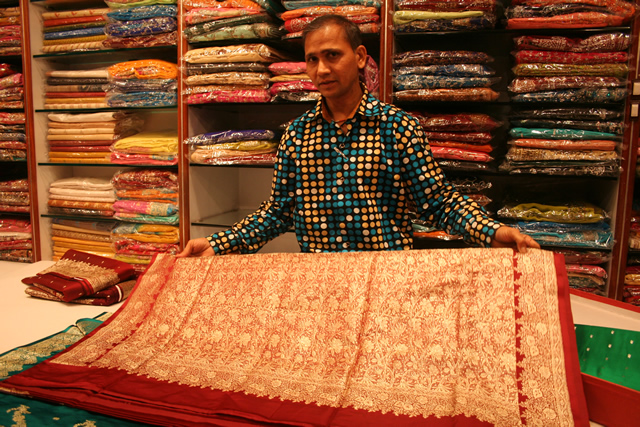
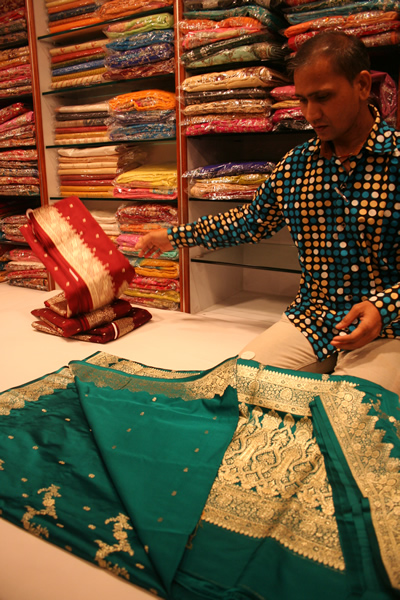
In the next shop (pictured above), the surface was a low platform, wide enough for the salesman to sit on, while we sat on cushioned benches.

In the third and most traditional, we sat on the cloth-covered floor (shoes off at the door) and reclined on bolsters, while the salesman sat cross-legged in front of us. This was very hard on the knees after a while – I’m too creaky to sit that way for long.

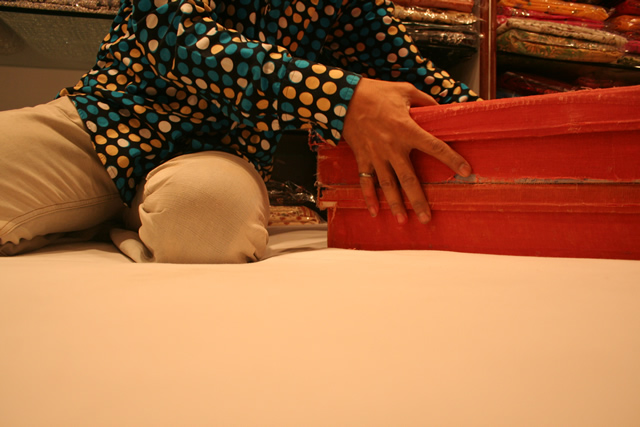
Once you’re settled and have established a range of what you’re looking for, the salesman begins to pull out long cardboard boxes…
IMG_7424

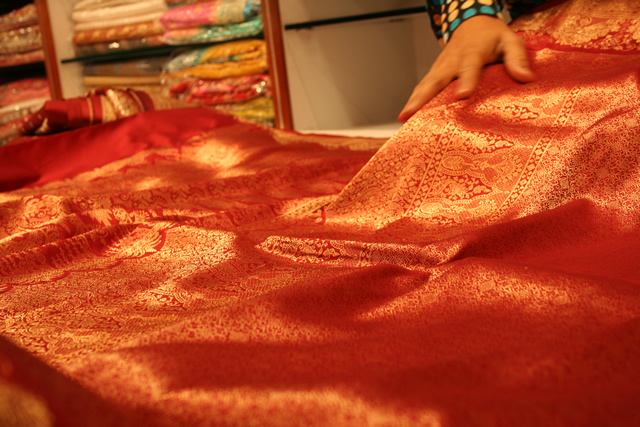
…from which he unfolds meter after meter of textile miracles.
IMG_7430

These are Benares brocades, an ancient art that may be dying out because it’s not in sync with modern tastes.

I love this material so much that I’m tempted to buy practically everything in sight, though I have no idea what I’d do with it, having no particular occasion, nor the necessary skill, to wear a sari myself. (I don’t even know enough to buy one without help, there are so many styles and origins and other factors…)

As the mind begins to boggle with colors, borders, and styles, saris to be kept for further consideration are tossed aside rather casually:
IMG_7422
…while the rejects are folded back into their boxes. Like every other organization in India, sari shops swarm with employees – assistants stand ready to do the folding.

Prices range from Rs. 2000 into the stratosphere, depending on the quality of the material, whether the gold is real, and how much of it is woven into the material. A very fancy wedding sari can be heavy to wear from the sheer weight of precious metal in it. Though they can be expensive, a good sari lasts practically forever, always fits (you can have new blouses made to wear underneath), and can be handed on to your daughters.

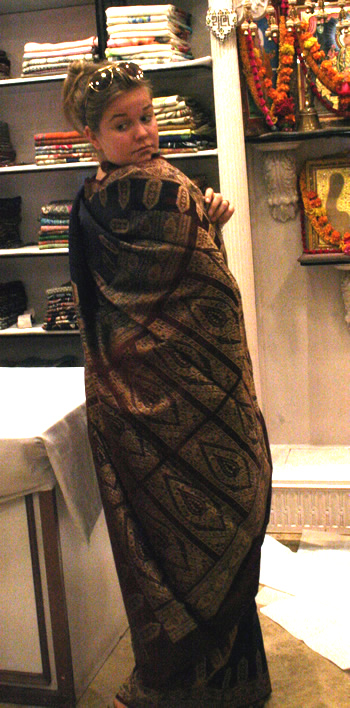
When you find something you really like, someone will help drape it around you (over your clothes – no need for a changing room) so you can judge the effect in the mirror:
7409

later – It took us until this evening – and an hour at a fourth store – to actually buy anything. But I won’t describe it, so as not to spoil the surprise. Suffice to say that Ross will look stunning!

photo top: At a large sari shop in Santa Cruz. The gentleman got nervous after a while and asked me to stop taking photos.


next


Delhi Sunday Morning

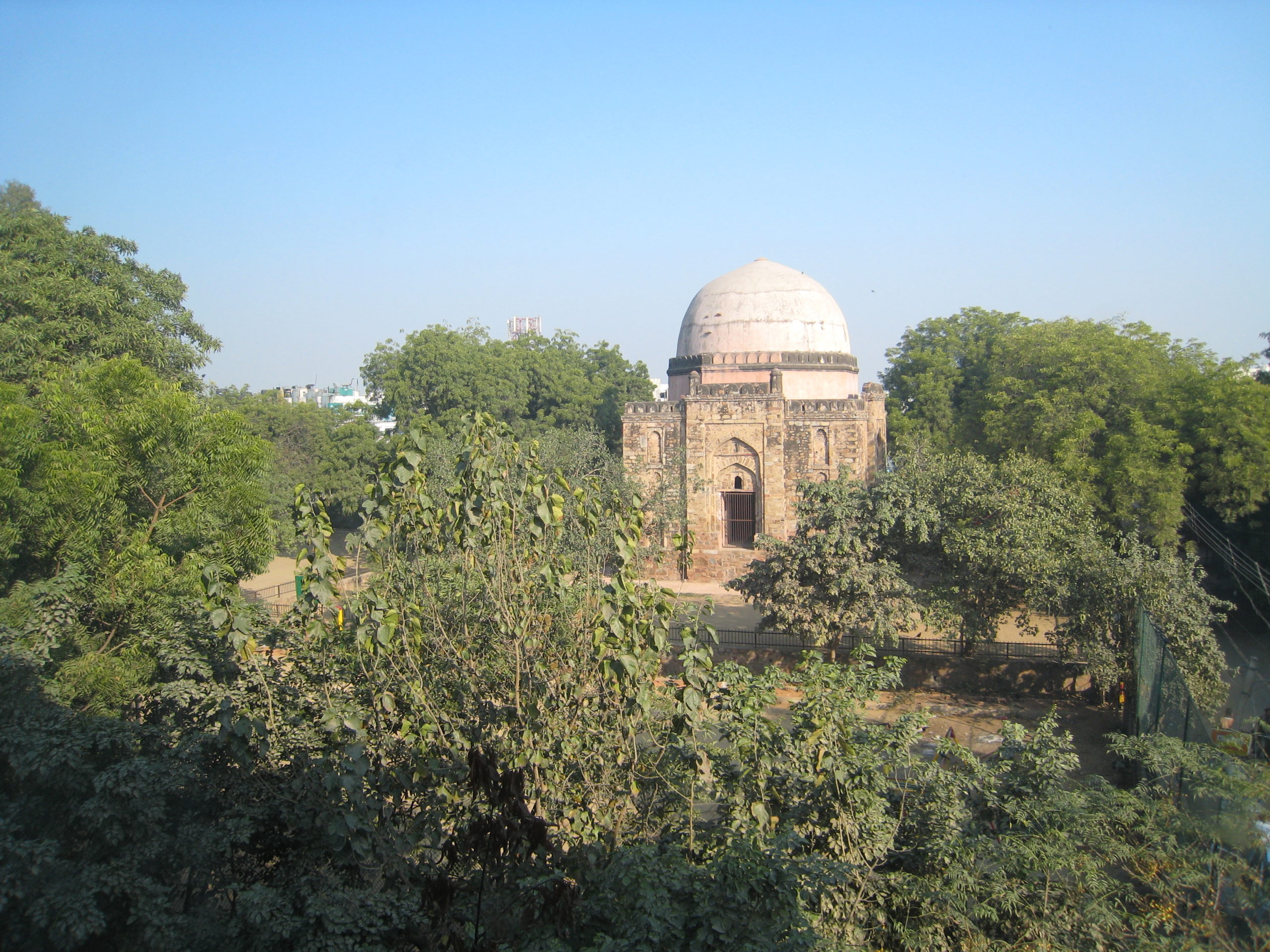
I’m sitting on a rattan footstool in order to be close to the modem – the wifi doesn’t seem to be working, but there’s an Ethernet cable, and the ADSL connection is good. Outside the window is a small, presumably ancient tomb, I have no idea whose, another of Delhi’s many semi-abandoned Mughal relics.

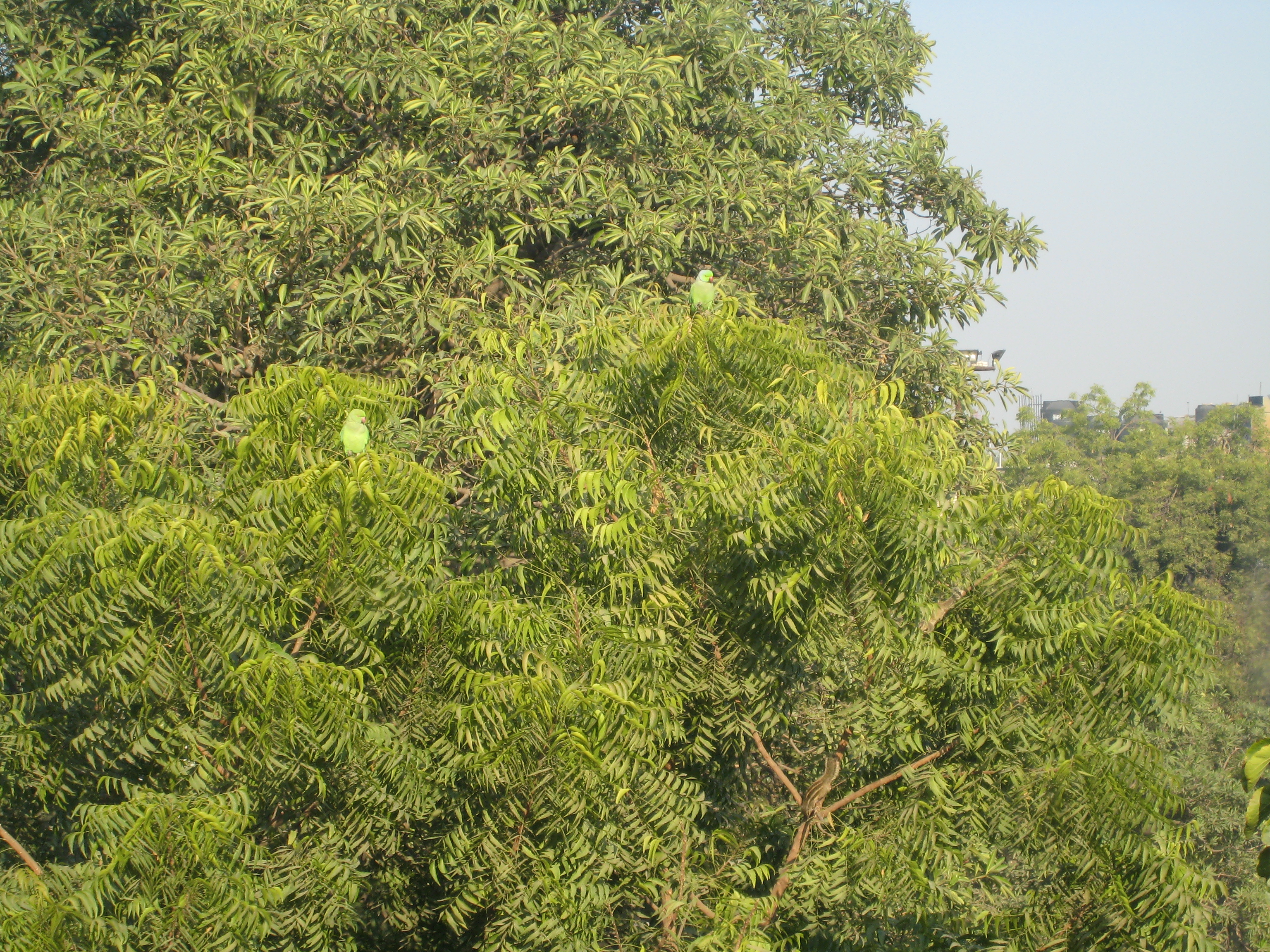
But the patch of land it sits on seems to be protected: there are trees enough to attract bright green, long-tailed parrots, and the little chipmunks whose backs are said to be striped because Lord Ram stroked them in thanks for helping build the bridge to Lanka.

We arrived in Delhi late Friday night on the Shatabdi Express from Dehra Dun, along with about 200 Woodstock students “Going Down” to return to their far-flung homes, and 14 staff members who were responsible for getting them onto myriad flights. A Woodstock staffer’s job emphatically does not end with the end of the semester! Some will have been on duty for 24 hours before they saw off the last of their charges yesterday afternoon – even longer if departures were delayed, as they so often are in Delhi’s foggy winter.

Fortunately for us, we only had to go across town to Green Park, where we are staying in a guest house/apartment belonging to a Woodstock alumna. It took us a while to find the place – our hired driver, being from Rajasthan, doesn’t know every corner of Delhi. But, then, I’m not sure anyone does.

The apartment is a third-floor walkup, nicely, if simply, furnished. The location is fairly quiet at night, though I suspect that we are due for some disturbance as the neighbors have had a huge awning put up for some sort of celebration. This morning I was awakened around 7:30 by steady drumming. Seems an odd time for a wedding rite (and also the wrong time of year for weddings), so I wonder what this is about.

As the city wakes up, more sounds impinge. A man on a bicycle pedals through the neighborhood crying: Kabadi kabadi kabadi (“second-hand goods” – he’s looking to buy them, including scrap clothing and paper). Another shouts Koel – I don’t know what that means. Cars make strange chirps and whistles to alert us that they are backing up. But mostly right now I hear parrots, mynahs, and pigeons against a muted rumble of traffic (relatively less – today is Sunday).
img_1837

Delhi wildlife: can you spot two green parrots and a stripey squirrel?

I’m breakfasting on fresh papaya, bought from a well-stocked fruit stall around the corner, and Nescafé. Yes, this latter is a terrible comedown for a long-term resident of Italy, but India’s coffee culture is still developing. When I go out I’ll find a Barista or Café Coffee Day and have a decent espresso – Barista was recently bought by Italy’s coffee giant, Lavazza, a brand we drink at home.

I would be happy to sit around and work and listen to the morning symphony, but I’m cramped and chilly. Delhi is much colder than I expected at this time of year, but everything here is built for the fiercely hot weather of summer. Rooms which are doubtless delightfully cool and airy then are shivering cold now, with no possibility of heating. The shops, on the other hand, tend to be too warm without their habitual air conditioning. I’m going shopping!

Fashion Statement

Swatch watch "Eve"This Swatch was my major fashion statement for several years, until (as you can see) I wore it out. The design isn’t easy to understand at a casual glance, so people would ask me about it: “Is that a mermaid?”

“No,” I would explain: “It’s Eve, gathering apples.” (As for the snake, take a close look at the strap…)

It goes with my theme song, by Cole Porter from his show, Nymph Errant.

Experiment

Before you leave these portals

To meet less fortunate mortals,

There’s just one final message

I would give to you.

You all have learned reliance

On the sacred teachings of science,

So I hope through life you never will decline,

In spite of philistine defiance,

To do what all good scientists do:


Experiment!

Make it your motto day and night.

Experiment!

And it will lead you to the light.

The apple on the top of the tree

Is never too high to achieve,

So take an example from Eve –

Experiment!


Be curious,

Though interfering friends may frown.

Get furious

At each attempt to hold you down.

If this advice you always employ,

The future can offer you infinite joy

And merriment,

Experiment!

And you’ll see…

The Revised Woodstock School Calendar – It’s Snowing, and We Haven’t Left Mussoorie Yet!

It’s Snowing, and We Haven’t Left Mussoorie Yet!

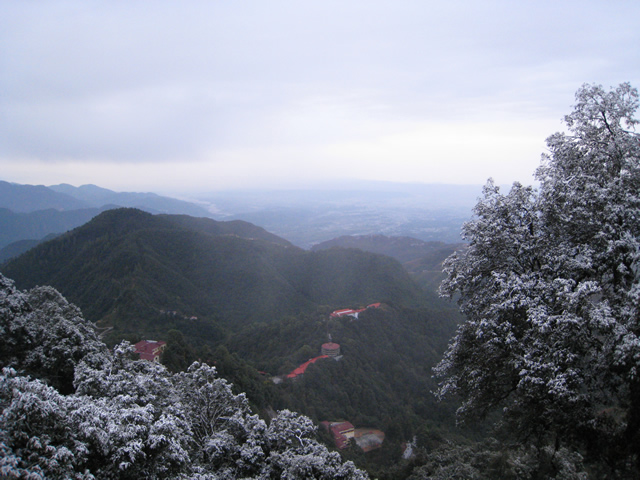
Yesterday morning I woke early to make coffee for our guest, out-of-boardingSAGE student Laura, before her 8 am exam. The sun had not yet risen when we came downstairs. I peered out the windows. “What’s that white stuff on the trees?” I wondered. “Frost? Is it that cold?”

We gazed. “It’s snow!”

We opened the door. “It’s snowING!”

We shrieked with delight. Laura, who lives in Paraguay, doesn’t usually get to see snow falling. (I, too, was raised in the tropics, and never saw snow coming out of the sky til I was 11 years old, in Pittsburgh.)

The ground was too warm for it to stick much, and the snow stopped falling after about an hour. Then the temperature plunged; last night was cold, even in Sanjay’s (unusual for Mussoorie) centrally-heated home.

This morning, the snow is back with a vengeance. Still not quite cold enough to stick, but we may be getting there…

It’s almost unheard-of for students to be around when snow begins falling in Mussoorie. Going Down Day – the end of school, when everyone heads down the hill towards home – was traditionally around December 7th, several weeks before the first snowfall was usually expected.

But this year the calendar has been experimentally changed, so school began August 8th (about two weeks later than usual), winter vacation runs December 14th to January 22nd, and the school year ends May 28th. Graduation is after that, on May 30th – ours, in 1981, was on June 25th!

The rationale for this change has not been well explained; I’ve heard that it was intended to allow more time to prepare (or less time to forget) before external exams in the spring, and/or to align better with the American school calendar.

There are historical, practical reasons for the school to have a long winter vacation. The average altitude of the campus is 7000 feet: it gets cold up here! Word on the hillside is that Mussoorie is in for a colder-than-usual winter this year, and, with a looming shortage of propane in the region, the school may have trouble heating itself. Staff usually have bukharis – woodburning stoves – in their living rooms, but in classrooms and offices these have been replaced with gas heaters. Dorm rooms are not heated at all.

Students are allowed to have electric blankets which, along with flannel or fleece sheets, can make getting into bed a far less traumatic experience than it used to be. The only problem is that, eventually, you have to get out again…

Beyond mere physical discomfort, the calendar change has upset the plans of this year’s SAGE (exchange program) families. The Winter Tour, a multi-week gallop all around India, primarily – but not only – for the benefit of SAGE students, has been compressed to 31 days. For some it will be even shorter, as students join or leave the tour at odd times so that the kids also have an opportunity to go home and see their families.

This is undoubtedly a headache for the tour organizers, especially as the tour is moving so fast that it will be hard to catch up with it along the way. Ross wanted to spend some portion of her vacation relaxing in Goa, and the only reasonable solution I could find was to have her join the tour just a week before its end, in Mumbai. It’s a pity she’s missing so much. On the other hand, after a long semester she needs some rest, and this year’s Winter Tour will emphatically not provide that.

The shortened vacation also eats into a beloved staff perk: the opportunity to travel in Asia during the dry (but still warm) season. Woodstock staff don’t get paid much, so these perks count for a lot.

All things considered, I suspect this calendar change is not going to stick, at least not in as drastic a form as we see this year. It’s a pity they had to run this experiment during my daughter’s year here; it would have been nice for her Italian relatives to see her at Christmas.

next


Bollywood Rising – Watching Hindi Movies at Woodstock

dancing to “The Beedi Song” from Omkara

When I attended Woodstock School, I never saw Hindi movies. This was partly a matter of logistics: Mussoorie’s two cinemas were available to us only on Saturdays, and a dark movie hall struck me as good mostly for getting groped by strange men – not something I was anxious to encourage; I got enough of that elsewhere in India. (I did venture once or twice, with a gang of friends, to see a rarely-offered English-language film.)

But Hindi films were such a large part of Indian culture that I couldn’t help being aware of them. We heard, and sometimes even sang, fun-silly songs with refrains like “My name is Anthony Gonzales!” or Chal, chal, chal, meri hathi, o meri sathi… (“Let’s go, my elephant, my companion.”)

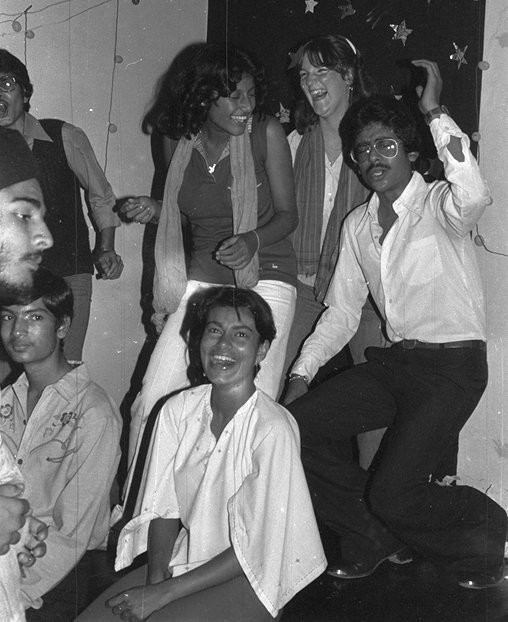
During our senior year (1980-81), the original Om Shanti Om, a disco ditty, took India and the school by storm – we played it, to enthusiastic reception, at every school dance (as shown above) …but most of us (even some of the Indian students) still thought Western music and movies were cooler.

Our opportunities to see films of any kind were limited – there were no VCRs or DVD players in those days, and Indian television offered only one state-run black-and-white channel, Doordarshan. The sole television set on campus belonged to Brij Lal, our Hindi teacher, who used it mostly to watch cricket.

These days, Woodstock students have far more choices in entertainment: satellite TV and DVD players in every dorm, and of course you can watch DVDs and Video CDs (widely available in India, and cheaper than DVDs) on your laptop. Mussoorie’s cinemas have both closed down, but are not much missed (though people do happily go to the fancy multiplexes in larger cities).

At the same time, Hindi movies (now bearing the epithet “Bollywood”) have gotten better. The stories can still seem ridiculous to cynical American tastes: full of improbable coincidences, with plot points that often hinge on non-Western cultural norms. Bride & Prejudice worked as an update on Jane Austen’s classic because the “transgressions” of the sisters would seem shocking only in a relatively conservative culture like India’s.

Bollywood eye candy has also improved. Though Indian female stars have always been gorgeous, some of the male stars I observed in the 70s could get away with a bit of a paunch straining their fashionable safari suits. No longer. Nowadays they all work out with professional trainers, with results that speak for themselves.

All this, plus a larger Indian population at the school, has led to burgeoning interest in Bollywood movies among Woodstock students – not least, my daughter, whose current dream is to meet Shahrukh Khan. I was amused to have a houseful of (mostly) American exchange students enthralled by this year’s big hit, Om Shanti Om.

And I could understand why. It’s a great, goofy, fun movie. And, contrary to what some reviewers have said, you don’t have to understand all the Bollywood in-jokes to find it amusing.

So what if everyone bursts into song every ten minutes? That just adds to the fun! (And fans of western musical theater can enjoy themselves picking out the musical and scenographic borrowings from “The Phantom of the Opera” in the climactic scene.) Oh, yes – our old friend Arjun Rampal is in it, too.

If you’re new to Bollywood, I highly recommend Steve Alter‘s new book, “Fantasies of a Bollywood Love Thief” as an introduction.Among many other things, the book is a sort of production diary for Omkara, an Indianized retelling of Othello directed by Vishal Bhardwaj, who also composed the wonderful music.

As soon as I finished the book I rushed out to buy the movie, which is excellent. I can tell good acting when I see it, though I’m having trouble with the dialog: the VCD we bought has Hindi subtitles instead of the promised English, and my Hindi has not yet come back strongly enough for me to follow complex sentences in hifalutin’ semi-Shakespearean language which is at the same time in a western Uttar Pradesh dialect!