NB: The links on this page are mostly to video, of course! There are also lots of photos. Be aware that some of the language in the videos is Not Safe for Work.
What did I do at vlogEurope? I barely participated in the conference, and didn’t film a thing – some videoblogger! But I organized, organized, and organized some more. Here’s a mini-diary:
Monday or Tuesday: Found out there would be a national transport strike on Friday, when we were expecting the bulk of our foreign guests to arrive. Had no way of knowing how airports would be affected. Public transport in Milan was expected to strike from 6 to 10 pm – right when many would be arriving from other countries. I scrambled to let everyone know and make suggestions on how they could get where they were going.
Tuesday evening, while my daughter was in theater class in Milan, met with the Nodehouse landlord to make another payment and get keys.
Wednesday: Andreas and Anders arrived on the same flight from Copenhagen and came to meet me at my office. We had lunch together, then they wandered Milan while I kept working and organizing. Questions, questions: Did we need to set up anything at the conference venue? If so, when would we do it, given the transport strike Friday evening – the only time the place would be available to us? (We decided we wouldn’t need that much setup, just go give the place a look-over and be prepared for whatever we would have to do to make it ready early Saturday.)
I called Taverna ai Poggi, the restaurant in Lecco, to confirm probable numbers for the Sunday night dinner – 26 people, as it then seemed. I also told them we’d be wanting to revise the wine list – we had had a substantial donation earmarked specifically for wine!
I worried about the weather – would it be good for our outing on Lake Como Sunday? Not that I had any control over that…
Alberto and Schlomo also arrived. They spent the night at the Nodehouse while Andreas and Anders came back to Lecco with me on the train, and had dinner with my family.
Thursday: Up at dawn to go back to Milan at my usual work time, on the 8:17 train. Everyone who was already in Milan met up at TVBLOB again and had an informal demo of (and debate about) what we’re doing, then we all ate lunch at my boss’ usual lunch place, before they all took off to drink and eat and talk all over Milan – I stayed at the office, working and organizing (more).
In the evening, Andreas and I met Arianna of TheBlogTV and Maria Giovanna of Digital Magics, our hardworking co-organizers,at IED, the conference venue. Roberta of IED showed us the spaces we’d be using and we agreed on how to set them up, including projectors for laptops, mics, etc. Being Italy, this all took a great deal more discussion than Andreas and I thought strictly necessary, especially as we were tired and hungry and wanted to meet up with the gang.
When we got out, we planned to take a taxi to the Nodehouse, but there were none to be found (as we learned later, this was because of the big motorcycle show going on elsewhere in town – attendees of the big business shows all take taxis, being unable or unwilling to figure out the local transport system).
It was getting so late that we hopped on a tram heading downtown, and got off as soon as I saw a restaurant I was familiar with. We told Anders to eat with the others and then meet us at the Porta Garibaldi train station in time for a 9:40 train, but he went there a good deal earlier, so we finished up our meal and got there ourselves by 9, then we all sat on the train and waited for it to depart. Poor Anders only had a vending machine sandwich for dinner. Enrico picked us up at the station in Lecco and drove us home. I think. It’s all rather blurry in my mind by now.
People kept piling into the Nodehouse, being willing to sleep on (hard, cold, marble) floors rather than give up the camaraderie – some nostalgia for college dorm life, I guess. (For some, that willingness only lasted one night on that floor!)
Friday: Groups of videobloggers roamed randomly in and out of my office and all over Milan. I kept in touch by phone, SMS, and email, trying to herd the cats to their respective destinations.
Alberto got up before everybody in the Nodehouse and called saying he had something to discuss with me in person. He sounded so anxious that I was afraid something dreadful had happened, some horrible cultural misunderstanding or breach of manners that I would be called upon to resolve. I couldn’t begin to imagine what it could be, or how I would fix it.
He came to the office and told me his dilemma: he had found out on Monday that he had won an award (with a nice cash prize) from the Tuscany regional government, for a short documentary he had made. He was the first-place winner, so the organizers insisted that he show up in Carrara to be feted on Saturday – the very day of the vlogEurope conference he had been so looking forward to. He was devastated, but I assured him over and over that the conference was only a small part of the experience (which was true), and he should definitely go to collect his prize!
Aske Dam arrived at TVBLOB’s offices after lunch and we were pleased to give him a long demo – he was gratifyingly excited about what we’re doing. In fact, he arrived excited (having heard about it from Andreas), which is an unusual treat for us: a lot of people don’t get it until they’ve seen it in action (and some not even then).
Duncan also arrived in the afternoon. I fed him my last banana because he hadn’t eaten all day, then sent him to join the others.
I had suggested that everyone meet at the Duomo before six, and reserved a restaurant within walking distance so that the transport strike would not keep us from our dinner. I ended up staying in the office til 7 pm myself, to help my colleague Pancrazio script and shoot the new TVBLOB demo video.
Assuming the strike had started, I walked from my office to the Duomo, in the rain, exchanging rapid-fire SMS with Jeffrey to keep updated on the status of Steve, Mark, Richard, and Miguel.
I was the first to arrive at Ristorante da Bruno, a family favorite of ours for years (most of the waiters have been there forever and remember my daughter at age three). I gossiped a bit with the owner (son of the founder, I guess), who now has two young daughters of his own.
Eventually people began arriving in clumps, some very late as they were waiting for a taxi. I felt incredibly stupid when I found out that the local transport strike had been called off at the last minute and they could have taken the metro! (Which explained why I saw people going down into the metro stations on Corso Buenos Aires – I had wondered at that, then figured that they were using the metro to cross under the street rather than wait for a light to change – that’s something I would do…)
We had a great dinner at da Bruno, though I winced at the prices, which had gone up since I was last there. I had been aiming for something less expensive; I knew some of the visitors were on tight budgets. But everyone tucked in happily – I moved back and forth between our two long tables, sorting out dietary needs and preferences. The waiter worked hard that night, and I tipped him 30 euros when we left (by American standards, this would have been low given the size of the final bill, but it was very high for Italy – he was delighted). I had some budget leeway for things like this thanks to some other donations.
Because I had anticipated trouble getting from the restaurant to the railway station Friday (due to the now-cancelled strike), I had asked my friend Antonello to come pick us up in his big van – splitting the cost between 6 or 7 people, Milan to Lecco in a taxi is almost reasonable (150 to 170 euros total, depending where in Milan). A bunch of people came back to Lecco that night; our family room began to resemble a men’s barracks. It’s a good thing I had the whole house wired for Internet a year ago – they plugged in a switch so everyone had their own wired access (our wireless doesn’t get that far from the router on the 2nd floor), and many stayed up late using it – among other things, video and text chatting with the group back at the Nodehouse.
Saturday: We all (Andreas, Anders, Bicycle Mark, Richard Hall) got up even earlier than the previous days so we could catch the bus down the hill and an earlier train into Milan, to prepare for the actual conference before it started at 10.
At the office, we packed up three TVBLOB boxes, a switch, cables, cameras, etc., then called a taxi to take us to IED. I specified a large car with room for five, but that’s not what arrived. So Mark and Richard volunteered to find their own way to the venue (and eventually did).
At IED, I set up the boxes, testing them with a small portable TV monitor while waiting for the kind folks from TheBlogTV to arrive from Rome with three TVs they were lending me for the occasion (which didn’t really make sense – I could have brought them from the office, but when IED was unable to supply them, TheBlogTV folks offered, and it saved me having to haul them back and forth across Milan).
Attendees ambled in. Some on the list never turned up, but we got some walk-ins to replace them – about 50 total attendees in the end. There were several Italian journalists, students of journalism, and bloggers, including my (now) new friend Lele.
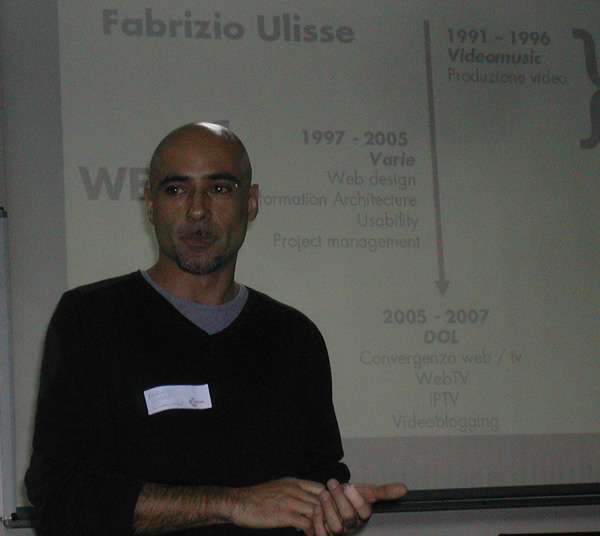
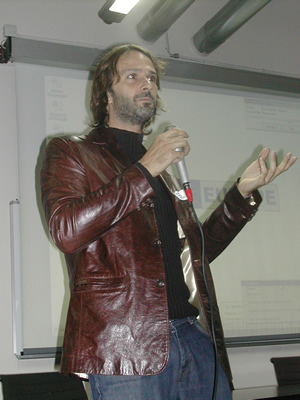
We finally started around 10:30 with a brief introduction by Andreas before the “vortex” sessions began. There were two in Italian: a Node 101-style introduction and how-to by Fabrizio Ulisse
and one on vlogging and TV by Bruno Pellegrini of TheBlogTV.
The Italians mostly attended those, with only a few – Beatrice of Weblogart, Saverio of TheBlogTV, and Diego Bianchi (who had also come from Rome) really making the effort to mix with the international crowd (Alberto also would have, had he not gone off to Carrara to collect his prize). There had been some efforts to overcome language barriers.
Miguel, Joel, Saverio
Another Italian who mixed was Elisabetta, not (yet) a videoblogger herself, but a grad student at Milan’s Catholic university, doing research on new media for her thesis. She had heard about the conference somehow and asked Andreas and me (wholly unnecessary) permission to come gather thesis material.
above – front: Beatrice, Miguel, Anders P, Schlomo, Anders C
back: Joel, Daniel
Diego and Elisabetta
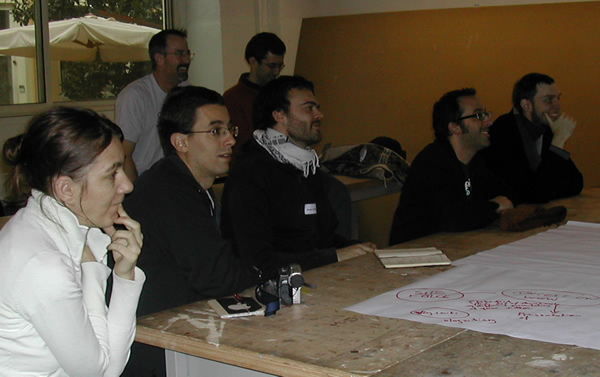
The international gang, reasonably enough not expecting to get much out of presentations in Italian, had small and very lively sessions on working under constraints, vlogging and politics, vlogging in context (more here), making money from vlogging (top secret! no filming allowed!), and Aske’s talk looked fascinating.
Richard addresses the camera
I myself didn’t get to see or hear much of any of this – there was always something else to be done, including demoing TVBLOB stuff (keeping recalcitrant beta software alive) to all and sundry. I hadn’t demoed so much since CES in January. It was mostly fun, and the demo-ees were excited by the possibilities.
The audience grew and then shrank over the day, at the end mostly the foreigners were left. We closed with a quick recap from each group of what had been accomplished, bagged up our equipment, and headed out. A few kind volunteers came back to the office with me to help carry stuff, then we went to meet the others at the Nodehouse to see what to do about dinner (Andreas and I, as usual, were very hungry – we’d been working hard all day!).
We found a place near the Nodehouse, Pizzando Grigliando (which, I now realize – and unusually for Italy – appears to be part of a chain). It had a wide enough variety of menu to satisfy everybody, at semi-reasonable prices. Alberto joined us, back from Carrara, as did Diego, to my delight, though I didn’t get to talk to him as he was at the other end of a very long table.
After dinner we went back to the Nodehouse, where Antonello met us at 11 pm with the van. Several more people decided to make the move to Lecco, including Richard Bluestein, who was delighted to take a “lesbian” bath with scented salts, foams, and candles in our master bathroom.
As Enrico and I went to bed, I remarked: “I bet all those guys downstairs are still on their computers.” As confirmed the next day, I was right.
Sunday: We took it easy in the morning. I had provided train and boat schedules so that everyone could make their own way up to Lake Como as and when they pleased. Those of us already in Lecco didn’t need to rush – it was everybody else’s turn to do the commuting (yes, I planned it that way). The weather cooperated: Sunday was partly cloudy and completely gorgeous on the lake.
While still at home, Andreas and I were interviewed by Miguel on the balcony. Eventually we rounded up the gang and walked down to town and caught the train to Varenna.
On the train ride, Mark and I talked about being TCKs, growing up “between worlds”. There are many points of common experience, even when the worlds (New Jersey and Portugal, India and Pittsburgh) are very different. He had had the classic TCK conversation the day before with Arianna:
“Where are you from?”
“Uh…”
“Don’t worry, I get it. Me, too!” (Arianna is an Italian citizen raised in the US and France.)
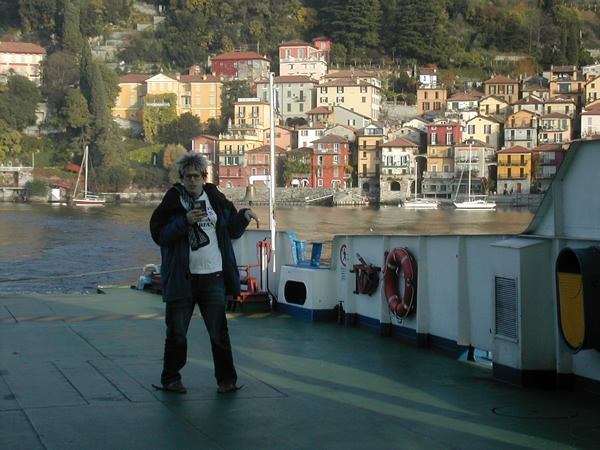
Elisabetta and her boyfriend Gabriele met us in Varenna, and she began interviewing everyone in sight. We all took the ferry across to Bellagio, with commentary by Madge.
One group had reached Bellagio before us; we found them lazing around drinking coffee at an outdoor table in the sun. As soon as Madge appeared, all cameras were on her– to the great confusion of everyone else in Bellagio. I overheard the following:
Wife: Ma chi e’? (“Who is that?”)
Husband: Che cazzo ne so? (“What the fuck do I know?”)
Those of us arriving from Lecco hadn’t had lunch and were hungry. We sat inside the cafe (no tables left outside) and had coffee, pastries, and sandwiches. Somebody shot footage of the locals’ reactions to Madge, but I haven’t seen that appear online yet.
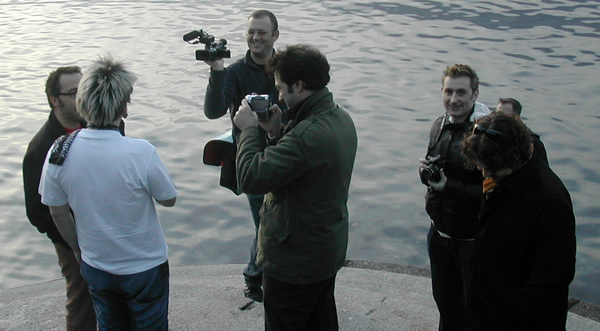
We wandered around in constantly-changing groups, eventually all congregating on the lakeside spot where Madge was interviewing Schlomo.
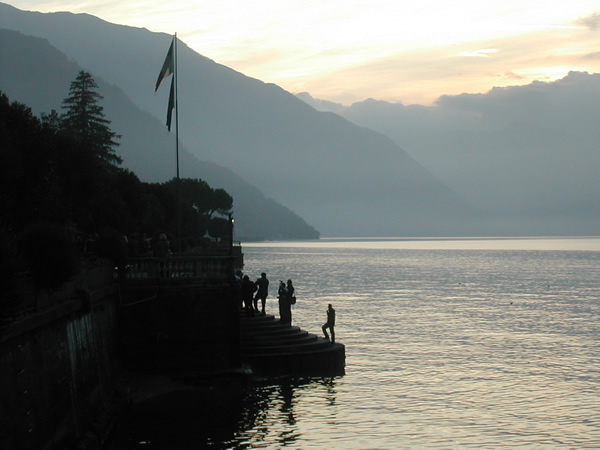
vlogging off into the sunset
There were so many cameras pointing at each other that the other tourists and residents thought there must be somebody famous around, and gathered to watch.
This is probably what saved Steve’s camera bag. He had put it down somewhere and forgot about it when he moved on, til someone came hurrying along asking who had lost a bag. No one had touched it – when he got there, he found a large group of people gathered around staring at it, each making sure that no one else would steal it!
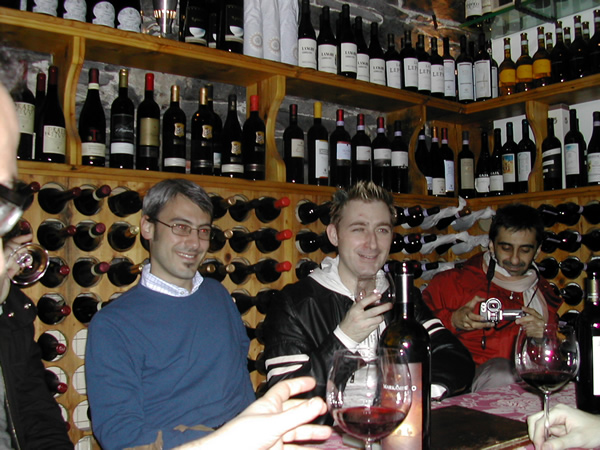
The light was gone, so we gathered in a small wine bar, near the photography shop with photos of famous people on a board outside, for (of course) wine.
Gabriele, Steve, Alberto
It was getting cold and dark. We all piled onto the boat back to Varenna and then the train to Lecco. At the station, I spotted two friends of my daughter – perfect subjects for a Madge interview.
As scheduled, Antonello was there with his van to run people up to the restaurant. I went in the first group so I could give last-minute instructions on food and wine, and be there to direct traffic as people arrived. After some last-minute defections (Lisa’s ride flaked on her), 21 people sat down to eat:
antipasti:
brisaola della Valchiavenna (dried salted beef, typical of this
region), coppa brianza (pork), prosciutto
first course:
- pizzoccheri – the local specialty, buckwheat pasta boiled with
potatoes and greens, then baked with cheese, butter, garlic, and sage
- risotto al Sassella e luganega – rice cooked with a local wine and sausage
- (for the vegetarians) bigoli di pasta fresca alla crema di taleggio – ravioli-type pasta, home-made, with sauce from a local soft cheese
second course: roast suckling pig, with side dishes of polenta and zucchine. There was a veg option but I don’t remember what it was.
dessert: choice of mostly home-made cakes – chocolate with pears, chocolate with strawberry sauce…
water,
coffee, and lots of wine!
Taverna ai Poggi did very well by us. All the food was abundant, the pig tender and sweet, and in the end they charged us only 35 euros a person, including the upgraded wines. And we got a tour of the wine cellar.
When all was eaten and done, Antonello and another driver were waiting with two vans to carry back to Milan all who were going there. Our family room in Lecco was full again, with a slightly different mix of people – all of them, again, were up late playing with their computers.
Monday: We slept late, lazed around the house, and played with the turtles. Except for Raymond and Schlomo, who took off even before I woke up – Raymond had never gone to sleep at all, so he ended up spending the day sleeping in the Nodehouse.
I was interviewed by Madge (with Mark on the camera and Andreas on lighting), we had lunch, then Richard and Bicycle Mark headed back to Milan.
Tuesday: I had to go to work. Andreas and Anders rode in with me, met up with Mark and Richard, and were naughty at the museum of La Scala (filming!). In the evening I dropped Rossella at her theater class and met Andreas and Anders and Enrico at a nearby bar for an aperitivo (the kind that comes with lots of food, though not terribly good in this case). A&A brought me a thank-you gift from Richard and Mark: “lesbian” bath goodies from the Body Shop. Ross finished theater class early, we all went home in the car listening to a strange mix CD I had made years ago.
Wednesday: A&A, our first and last houseguests for vlogEurope, accompanied me to Milan for the last time, and flew out in the evening. Anders had reached the conclusion that, at some point in his life, he needs to live in Italy. Either or both of them can certainly come back here as guests any time – they were great to have around.
Regrets
I didn’t get to talk as much as I’d have liked with a bunch of people. Hopefully next year’s event, which Joel has masochistically volunteered to organize, will give me more opportunities to interact.
There were few women at the conference, and none among the foreign contingent.
Lack of mixing between the Italian and non-Italian crowds, with a few important exceptions.
Raves
I enormously enjoyed all the people I did get to spend time with – it’s not every day I get to hang out with such an intelligent, interesting, motivated group – all at once!
Reviews
“I cannot wait for next year as this was THE new media conference of the year for me.” – Schlomo
my photos
^ top: my daily commutes were far more entertaining than usual!