A very indicative Italian saying:
A pensare male si fa peccato, ma si indovina [quasi] sempre.
This translates roughly as: “To think badly [of others] is a sin – but you’re nearly always right.”

A very indicative Italian saying:
A pensare male si fa peccato, ma si indovina [quasi] sempre.
This translates roughly as: “To think badly [of others] is a sin – but you’re nearly always right.”
Italian, like English and many others, accretes words from other languages. Often these are modern terms which have no easy equivalent in antique Latin or Greek roots.
For example: Ten years ago, Italians didn’t know how to refer to the process of scanning (a page, a photograph) using a scanner.
The correct word – digitalizzare (“digitalize”) – is unwieldy. An Italian speaker might instinctively invent a verb based on the foreign noun. But scannare already has a meaning in Italian: to slaughter! Which seems rather overkill for some poor, innocent document.
The compromise has been to use scannerizzare – “to scannerize”. Or else to say scannare with a wink, to acknowledge that the speaker knows that the usage is not correct.
There are lots of perfectly good words that one could use in Italian (associazione, circolo) for a group of people who gather to share a common interest, but for some reason the English “club” is also used.
However, for reasons which completely elude me, a short English u often ends up pronounced as eh by Italian speakers. Furthermore, English plurals are often abused by Italian speakers, being added or removed (with or without a superfluous apostrophe) without any consideration for real English usage. Hence the satirical music group Squallor could produce a song entitled Ti ho conosciuto in un clubs, where the final word is singular and is pronounced “clebs”.
There is no good Italian equivalent for the modern use of “stress” in English. You could say sotto tensione to mean “under stress,” but stress is so commonly used that most people would now say sotto stress or stressato/a (stressed) and stressare (to make stressed, to cause stress).
Usually pronounced without the initial h (there is no h in Italian) and, apparently, there is no native word for handicapped.
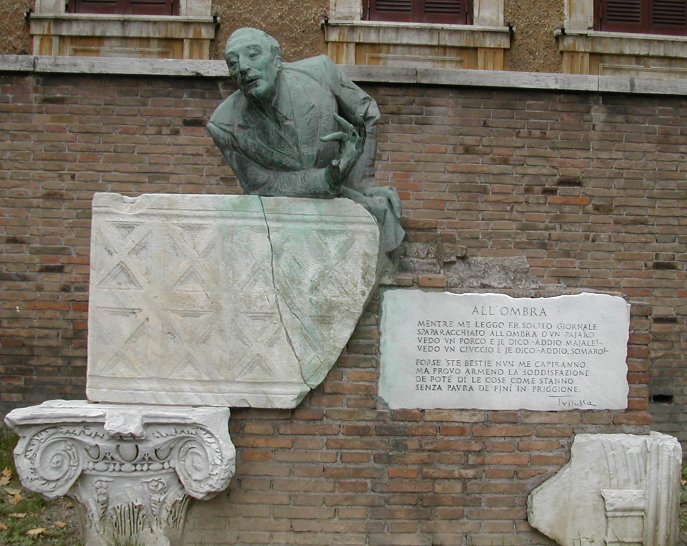
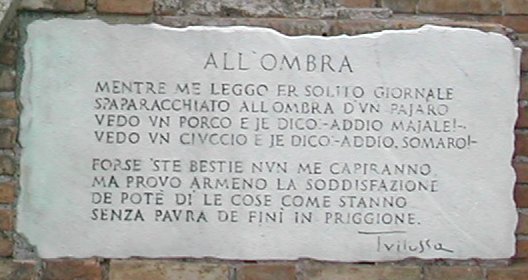
Monument to the poet Trilusso, in Roman dialect. Piazza Trilusso, Rome
For some fun political puns, look here
While I read my usual paper,
Sprawled in the shade of a [tree]
I see a pig and I say to him: “Goodbye, swine!”
I see a donkey and I say to him: “Goodbye, ass!”
Perhaps these beasts won’t understand me
But at least I have the satisfaction
Of saying things as they stand
Without fear of ending up in prison.
|
|
||||||
| Recorded by Neri per Caso. | ||||||
Donne |
Women |
|||||
| Donne in cerca di guai | Women in search of trouble(s) | |||||
| Donne a un telefono che non suona mai | Women at a telephone that never rings | |||||
| Donne in mezzo a una via | Women in the middle of a street | |||||
| Donne allo sbando senza compagnia | Women out of control without company | |||||
| Negli occhi hanno dei consigli | In their eyes they have advice | |||||
| E tanta voglia di avventure | And much desire for adventure | |||||
| Se hanno fatto molti sbagli | If they have made many mistakes | |||||
| Sono piene di paura | They’re full of fears | |||||
| Le vedi camminare insieme | You see them walking together | |||||
| Nella pioggia o sotto il sole | In the rain or under the sun | |||||
| Dentro pomeriggi opachi | Within opaque afternoons | |||||
| Senza gioia né dolore | Without either joy or pain | |||||
| Donne pianeti dispersi | Women, dispersed [lost] planets | |||||
| Per tutti gli uomini cosi’ diversi | For all men so different | |||||
| Donne amiche di sempre | Women, friends forever | |||||
| Donne alla moda | Fashionable women | |||||
| Donne contro corrente | Women [who go] against the current | |||||
| Negli occhi hanno gli aereoplani | In their eyes they have airplanes | |||||
| Per volare ad alta quota | To fly high | |||||
| Dove si respira l’aria | Where [you can] breathe the air | |||||
| E la vita non vuota | And life is not empty | |||||
| Le vedi camminare insieme… | You see them walking together… | |||||