Garden of the Gods, Colorado

Garden of the Gods, Colorado
Disclaimers:
For whatever human physiological reason, it seems that, at least for online video, sound quality is more important than video quality.
The first videos I did for Sun had, um, highly variable sound quality. I knew that the built-in mic on a consumer camcorder was not likely to be very good so, at a conference where room sound was being run from a professional sound board, I tried attaching an XLR cable to the videocamera’s microphone jack with an RCA-to-1/8″ mini adapter. This was very unstable and prone to come unplugged, and, even when it worked, didn’t provide great sound quality. Comments on my earliest videos included complaints about the poor sound.
After a few upgrades, I currently have the following:
Beachtek mixer: essentially a miniature sound board that fits between the camera and the tripod. It has an output cable that plugs into the mic jack on a consumer camcorder, while the inputs are two female XLR jacks and one 1/8″ minijack (you can use any two, not all three). You can control input levels independently for each channel via volume control knobs on the back of the unit.
Sennheiser Evolution G2 100 series wireless mics – two lapel mics and one handheld, with wireless transmitters and receivers.
Rode VideoMic – a camera-mounted shotgun mic. Designed for use with consumer-grade camcorders, this gets much better sound than the camera’s built-in mic, and eliminates a lot of background noise. For example, this video of Mike Shapiro and Steve O’Grady was shot on a street in San Francisco with city buses rumbling by and lots of chatter from the bar we were standing outside of. The Rode did a good (if not stellar) job of focusing in on the conversation I was trying to capture, and I think the fact that we were able to do this on the street made for more engaging video than talking heads in a studio would have been.
Most of my filming is of engineers making formal presentations, e.g. at conferences. I am often a last-minute adjunct to the event and don’t have much control over the setup. Because I don’t have a huge professional camera with an enormous zoom lens, I try to get a seat near the front (but not so near that the speaker disappears behind the podium), and I beg the A/V staff on hand to give me an output from their big sound board. (These folks are invariably helpful even when they weren’t expecting me – no one has turned me down yet.)
The best sound solution is to run an XLR cable from the sound board to the Beachtek. I have a bunch of XLR cables, but have given up carrying them around because they’re heavy in my luggage, and the local A/V crew have plenty of cable and (usually) the male-female or whatever adapters we always end up needing (note to self: must buy some adapters, at least).
If the camera is too far away from the sound board to run a cable (some of these conference rooms are HUGE), I use the Sennheiser wireless transmitter and receiver: hook the transmitter into the sound board and the receiver into one of the Beachtek’s inputs (the Sennheiser kits included both XLR and mini-jack cables for the transmitter/receiver – very cool). This also gets good sound quality, but you have to keep an eye on the batteries on both units.
If the presentation I’m filming is likely to generate audience discussion, I put the Rode videomic on top of the camera and aim it at the audience. Even when the room is provided with a floor mic for Q&A, people don’t always use it, nor can the speaker be relied upon to repeat the question, so it’s essential to have a way to capture what the audience says (I have at times been reduced to scribbling down the questions myself and putting them in later as subtitles).
I’ve also filmed a bunch of interviews, usually with engineers, such as these examples in Sun’s Grenoble and Eagan offices. At the time I only had one lapel mic, so I had the subjects share the handheld, passing it back and forth between them. The problem with this is that people hold the mic differently, and the sound level you get depends on how close the mic is to the speaker’s mouth. That, plus the fact that people have different natural speaking levels, makes it very hard to get consistent sound (I can’t always react fast enough to twiddle the volume control on the Beachtek appropriately).
I would now be inclined to use two lapel mics, or have one person use the lapel and one the handheld, adjusting the input levels separately to each speaker’s voice before filming begins.
Lapel mics, at least the ones I have, are sensitive to how far the speaker’s mouth is from the mic. The mic is usually attached to the front middle of the speaker’s shirt. When he turns his head sharply sideways to look at his projected slide, the sound gets softer because he’s no longer speaking at the mic. I don’t have a solution for this yet, unless I can train speakers to turn their whole bodies towards the screen instead of just their heads. (There’s probably an audio leveling feature in Final Cut Express that would improve this in post-production, but I’m still learning to use that software…)
Nowadays, my setup often looks like this:

^ front view: XLR cable from sound board hooked into Beachtek adapter; the 1/8″ minijack from the Rode Videomicgoes into the jack at the back of the Beachtek

^ back view. Yes, it does get a little crowded back here. And this doesn’t even show the camera’s power cord attached!
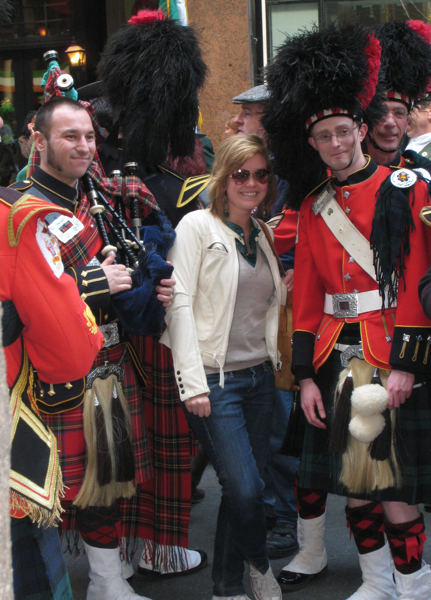
Ross and I arrived in New York the morning of St. Patrick’s Day – a mistake I will never make again. Our taxi had to drop us two blocks from the Roosevelt hotel because the streets were already blocked off. We then had to fight our way through the crowds (with our suitcases) to reach the hotel, only to find that it was too early to check in. So we left our suitcases with the bell desk and, despite exhaustion (we had woken up at 4:30 am to get our flight from Austin), went out to take pictures.

It’s spring again (although, as you can see, it’s been snowing) and that means baby owls on the BRM campus.
What’s a TCK? Read here.
A much more complete list than mine can be found here (thanks, Sezin!).
Barack Obama: The world’s most famous TCK right now, and maybe that’s a good sign (perhaps it’s fortunate that few American voters recognized the term).
Santiago Cabrera – actor
Julie Christie, actress
Richard Dawkins, evolutionary biologist and author
Elizabeth Edwards – late wife of John Edwards, US vice-presidential candidate – “Edwards is the daughter of a Navy pilot and lived in a dozen places by the time she was 18. ‘There is no better experience’ in preparing someone for the madness of a presidential campaign, she says.” New York Times, July 17, 2004. She wrote: Saving Graces: Finding Solace and Strength from Friends and Strangers
Scott Foley, actor
Michel Gondry
Katharine Gun, whistle-blower:
“Her decision to follow her conscience sounds almost unthinking – I didn’t want to step back and think, ‘But, hey, what happens if I do this, and then this happens and then that happens?'” she says. But she has clearly thought in detail about what made her that way… “One of the things the research says is that third-culture kids tend to be extremely empathetic, and because they’ve usually lived in at least one other foreign country, they somehow feel a global alliance… ” Guardian
Mohsin Hamid
“So where does Hamid belong? Does he feel a Pakistani Muslim, or an American?
“I’m fully neither,” he said, adding that he believed it was unwarranted to expect individuals to sign up for allegiance to the nation-state.
“What I feel like depends on the context you put me in,” he said. “In the Pakistani context, my attitudes toward religion, to the state, to gender relations are perceptibly American. That makes me American.” Yet when he is in the United States, he can feel quite Pakistani, he said.” International Herald Tribune
Teresa Heinz – John Kerry’s wife, born in Mozambique.
John Kerry, US politician – Attended boarding school in Switzerland while his father was a US diplomat in Germany.
Robin McKinley, author
Viggo Mortensen, actor: “I remember coming to the U.S. and not only having to learn the accent but the slang,” Mortensen says, adding that being forced to adapt quickly helped him later on. “Out of habit you assume that you have something in common with people no matter how different they seem.” Washington Post
Mervyn Peake, author
John Rhys-Davies, actor – “Rhys-Davies spent his formative years in Wales and East Africa, returning to the UK when he was nine.”
Alexander McCall Smith – novelist – his books
Cordwainer Smith – A science fiction writer who spent many of his formative years in China and was bilingual in Chinese and English. I suspect that this is the reason for the unusual, even poetic, style of his writing. Cordwainer Smith’s books
W. Richard Stevens, UNIX guru
Kathleen Turner, actor – diplomatic “brat”
Dominique de Villepin, former Prime Minister of France
Joss Whedon, screenwriter and creator of Buffy the Vampire Slayer – partly schooled in the UK
Hugo Weaving, actor – born in Nigeria, has lived in Australia, South Africa, England.
let me know of any other famous TCKs you are aware of!