Category Archives: what I do

How I Got My (First) Job in Italy

I don’t claim to be a comprehensive resource on any aspect of living in Italy; my reasons for being here are different from some others’: I married into it, which made getting a visa (permesso di soggiorno) and permission to work relatively easy. And that was years ago, so what little I remember about the process is probably out of date. There are sites with expertise to offer about the law and other technicalities; you’ll find some listed here.

When I first arrived here, I had been a mostly stay-at-home mom (in New Haven) since Rossella’s birth, and I was ready to go back to work. I had very little experience in job hunting anywhere, let alone in Italy. One of my major saleable skills was desktop publishing, which in those days was still an arcane art that could be sold as a third-party service. The closest thing I could find in the Milan Yellow Pages was “editoria elettronica”. Neither Enrico nor I was sure what that meant, but I sent off a resumé and cover letter to each of the four or five companies listed. Deafening silence ensued.

I pounded the pavements, taking my resumé to computer firms that might need someone who knew how to put systems together and train people to use them. Showing up with a resumé at an office where no one knows you is not the done thing in Italy; people stared at me uncomprehendingly, and at one place they literally laughed in my face.

I didn’t know what else to do to find computer work. Contacts are all-important in Italy, and I had none in the high-tech field. I did get a few translation jobs, thanks to my father-in-law. This was also the period in which I accidentally became a computer journalist. I could have taught English, but the idea didn’t attract me, and I didn’t want to fall into teaching as a career when I had other skills that ought to be far more valuable.

In June (1991), Enrico had a chance to return to Yale for an academic visit, and Alitalia happened to be offering two-for-one tickets. I figured that, if I couldn’t find work, I might as well go on vacation. So we left Rossella with her grandparents and prepared to take off for a week. This was on a Sunday morning. We were putting luggage into the elevator when the phone rang. I answered it, and the conversation went more or less like this:

“My name is Caffarelli. I received your resumé a while ago. Could you write a software manual?”

“Uh, yes, I guess so.”

I had never actually written a manual, but I had designed and written course materials to train people in using desktop publishing software, and had worked with a friend on a manual he had written for a deep-ocean exploration and recovery apparatus. I didn’t think I’d make a fool of myself in the attempt, at any rate.

When I returned from the trip, I went to meet Fabrizio Caffarelli, who had founded a software company in Milan a few years before. The software in question was for optical character recognition, which I actually knew something about – I had beta-tested some scanners and software, back when a 100 dpi black-and-white scanner cost $10,000. So I wrote the manual, in English, and it was “simultaneously” translated into Italian by Fabrizio’s niece Cristina. We had a great time doing it.

At the end of the six weeks or so that the project took, Fabrizio said to me: “I like the way you work but, unfortunately, I don’t have any more work for you right now.” We parted on good terms, and I recommenced the job hunt (well, not until September — no one does anything in Italy in August). I wrote a few more articles for computer magazines, and began to wonder whether I could write a book about something computer-related, perhaps in Italian. I was casting about for a topic when Fabrizio called, sometime in November. “Would you like to write a book with me?” he asked.

So we wrote Publish Yourself on CD-ROM, published (in English) by Random House. It was one of the first books in the world to include a CD. We didn’t get paid much for writing it (and Fabrizio took the lion’s share of what little there was), but I made some extra money on the deal by desktop-publishing it myself, using FrameMaker software. I also used FrameMaker to create a hypertext version of the book to go on the disc, a skill which was to come in handy later on. The disc mainly contained a demo version of Easy CD 1.0; Fabrizio’s reason for writing a book was to publicize the software by showing how easy it could be to make your own CDs – if you had our software, of course.

By the time the book was published (January, 1993), I was working full-time for Fabrizio, writing software manuals and other materials, and doing just about anything else that came up. (The small-company environment suits me precisely because I get to wear a lot of different hats, and people aren’t so territorial about their jobs.)

Fabrizio moved the engineering team to California in late 1993, and, having conquered the 75% of the worldwide Windows market for CD recording software, sold the company to Adaptec in August, 1995. I was hired by Adaptec and had a very good run with them, and later with the Roxio spin-off, until I quit in 2001. Along the way I helped a few other people find work (hired some myself), in Italy and elsewhere. Most of the freelance work I’ve had since has come through friends: good karma pays off, I guess.

In sum, it’s hard to advise anybody on how to find work in Italy, except in these very general terms: be flexible and patient, meet a lot of people, and when opportunity knocks, be ready to leap on it.


Multitasking

Feb 4, 2004

I said, “I developed a new skill with Fabrizio: simultaneous translation and transcription. If he wanted something written in English, he would dictate it to me in Italian, and I would type it straight out in English. I’m not sure I could do simultaneous translation if I had to speak, but I can do it typing, as fast as he can talk.”

Mike L. responded: “According to recent studies, this is something that (almost) only women can do. The explanation behind this is that the female brain is better capable of handling multiple tasks simultaneously, such as translating and writing. The experiments were quite funny to watch. One person would read a series of words, while the test person was asked to repeat after him. Most of the females managed to speak just a single syllable (sometimes even less) behind, while most of the males had to wait longer. My explanation is that males are equally well capable of multitasking, but one task is constantly allocated to thinking about sex – sex – sex…

About the Newsletter

[My] newsletter began shortly after I resigned from Roxio, the software company, in July, 2001. At the time I was the editor of two email newsletters (one for Windows, one for Macintosh) with a combined list of 180,000 subscribers, intended to help people to get the most out of their software. I used to write all the material myself (except for the Macintosh software, which I didn’t know well enough); later, when I got busier with the many other parts of my job, I hired outside writers for the feature articles. But there was something from me in every edition, and my signature was at the bottom every time. The return address was my personal email, so when people replied, they immediately reached a real person. This was an important feature, which Roxio has abandoned since my departure.

Because I took this personal approach, I knew that I couldn’t leave without saying goodbye to the subscribers. I included a farewell message in my final newsletter, giving my new website address and private email.

Within two days, I got about 400 messages of thanks, condolence, and farewell (one woman assumed that Roxio had fired me, and furiously offered to complain to the company’s president). A few dozen of those messages included lines like: “Whatever you write in future, I want to read it.” This was a great morale-booster, at a time when I badly needed one. Someone specifically suggested that I start a new newsletter. So I did, and invited all those kind people who had written me to join it. And they did. So the original group of subscribers were mostly people I had never met, who knew me only through my software newsletters. I have since pestered friends and relatives to sign up, and they have graciously done so.

I originally expected to keep writing about technology, something I knew my original subscribers enjoyed reading from me. But I found that I was too burned out to think that hard, and instead began writing about what I was up to, and what was on my mind. So far, most of you have done me the honor of enjoying whatever I throw at you. (I have been writing about technology, as paying freelance work: software manuals for Roxio Germany).

I’m also enjoying the freedom of not representing a company. Admittedly, a lot of my personality was detectable in what I wrote for Roxio (this seems to be part of what made it so effective), but I avoided potentially contentious topics; public relations means making people feel good, smoothing them down rather than stirring them up. In this new venue, I’m free to be myself, and, as those who know me personally can attest, “sweetness and light” is not me!

This issue is a new departure: I’m including a guest column from my dad. We were talking about the war, he said some things that struck me, and I asked him to write about them. I know that my subscribers have a wide range of experiences and opinions, and not all may agree with him; do feel free to respond! I hope to have more guest columns in future, not because I can’t write plenty myself, but because this group is made up of interesting people with interesting thoughts and stories, which you sometimes generously share with me. I find these stories fascinating, and believe the rest of you will as well.

A few practical notes:

  • I send out newsletters no more than twice a week, usually much less. Lately it’s been more frequent because I’ve had more time and more to say; when I get busy with paying work, things get very quiet around here. I usually keep each issue to 4 or 5 pages.
  • All the newsletters are archived, so if you want to catch up on back issues in the order and format they originally appeared, go there.
  • Almost everything I publish in the newsletters I also put on this site, often adding pictures and links. For books and movies, I provide buy links to Amazon, both US and UK. If you buy via any of these links, I get a commission. So far this hasn’t made me rich, but it’s fun to see what people click through to, and a few people have actually bought (thank you!).
  • The site also contains a resume section with pages about various facets of my work, and what people have thought of it (only the good opinions, of course <grin>). I need more freelance work, so if you know someone who might have a use for any of my skills, I’d be very grateful for leads.
  • A fantasy novel I’ve been working on for 15 years is available for download, though it’s not quite finished.

Questions, comments, and suggestions are always welcome!

Online Marketing

… if that’s the right term. I’ve been doing something online for about years now, but I’m not sure what to call it. Is it marketing? Customer service? Tech support? It’s hard to define because it partakes of all of these – and that’s a clue to what makes it effective. My resumé lists the details of what I’ve been doing; more explanations and thoughts are here, and on the other pages in this section (links on the left).

The Making of an Online Career

Riding the Cluetrain

I first heard about the Cluetrain Manifesto from a customer who thought my style a good example of how a company could put the manifesto into practice. Which is a great compliment, since I had evolved this style based on what I felt was right for the company and comfortable for me personally. But, from a corporate point of view, what’s the ROI in riding the Cluetrain? The Cluetrain site doesn’t provide any case studies.

What the Gurus Are Saying

Brand New Branding: “Forget what you knew about branding. The Web changes everything. Four experts explain how and why” – Darwin magazine, July 2001

scott bedbury: “The Web has increased the consuming public’s ability to rant or rave about a company or service. Smart companies now recognize the necessity of being responsive to the criticisms, in real-time, and of making sure the brand is consistent€”and is as good as it can be€”wherever it shows up, and even after the sale has been made. The tools the salespeople use to sell it, public relations efforts and follow-up customer service all must reflect brand values and impart a consistent brand image. ”

regis mckenna: “The Internet is not a broadcast medium like television. It is much more of a service medium in which you allow people to interact and exchange information with you. ”

john hagel: “…they’d think, ‘No product is perfect. You mean my customers are going to talk with each other about my product’s flaws?’ Then I would say, ‘I’ll go on the Web and find at least five discussion forums where people are actively discussing your products and services.’ The point is, this is not a choice. It is going to happen. The only choice you have is how to participate in that discussion.”

© 2001 Darwin magazine

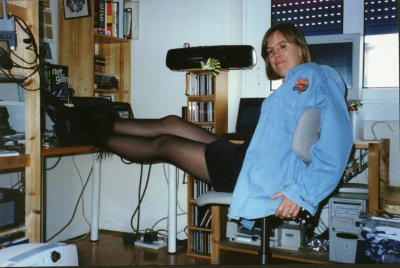
The Infamous Miniskirt Photo: Give the Customers What They Want!

The photo above first appeared on the Adaptec website in April, 1998.

Over the years some of my colleagues griped that having a picture like this on a corporate website was “unprofessional,” and I suppose it was. But (a) why does “corporate” have to mean “boring”? and (b) there’s a story behind it.

It all started with a (rare) vent of my own to the Adaptec discussion list, titled “How NOT to Obtain Customer Service.”

Which I later followed up with “How Not to Obtain Customer Service – a Final Peeve”, which included this throw-away comment: “I used to wear miniskirts to conferences, precisely because this made everyone assume that I was a purely decorative booth bimbo. I then enjoyed the shock on people’s faces when I proved to have a brain or two in my little head after all!”

I wasn’t surprised when this resulted in several requests like: “How about a couple of mini skirt photographs to prove your point regarding Deirdre being a female name?” I laughed them off, until I received this plaintive note: “I’ve had a really tough week. I could really stand to see you in a miniskirt.” So I dutifully put on my miniskirt and had my husband take the picture, and posted it on the site for the benefit of our list subscribers.

Time marches on… I still adore the denim “Born 2 Burn” shirt and the cowboy boots, but, sadly, don’t  fit into the miniskirt quite as well as I did…

Website Content & Management

Some of my work on the Adaptec/Roxio sites can still be seen, courtesy of the Wayback Machine (not quite in their original form – graphics may be missing – but you can get the gist). I personally wrote most of the material for these sites, except for the marketing brochure-type pages (product datasheets, etc.).

The CD-R section of the Adaptec site (which in those days got about 70% of total traffic to the Adaptec site) included technical and support information, and included applications such as:

  • The CD-R database, to help users choose a CD recorder with specific capabilities, and find out which version(s) and features of our software were supported with specific recorders.
  • The CD-R Media Bargains board, an ante-literam Web 2.0 application. This was a custom-designed database where anyone could post information about where to buy CD-R media – deals they themselves were offering, or had found elsewhere.
  • The Disc Reading Troubleshooter, a wizard-style web application that helped users determine why a disc they had recorded could not be read/played (there were many possible reasons) .

CD-R Central was a separate community/marketing site used to support various marketing campaigns, with a different look and feel from the main Adaptec site.

I led the design and development of the first Roxio site – pre-spinoff (January, 2001) – which included a user community area, and other features that would now be classifed as “Web 2.0.”

Comments on Adaptec/Roxio Sites

9/21/98 – Found every solution for my CD-RW. Keep it up.

7/26/99  – As CD-R/CDR-W’s grow in popularity, so does the need for information. The Adaptec Web-site has become a one-stop invaluable resource for novice, as well as expert PC users. Its extensive wealth of information is not only comprehensive and up to date, but well designed.

8 Jan 2000 – I operate a professional recording/mastering and CD design/manufacturing company. I am completely amazed with your website. Particularly the fact that you have links with full details of blank CDR media with prices etc. This is VERY cool… we found blank inkjet printable CDRs at a fraction of what we have been paying which means we can pass the savings on to our customers… and we have you to thank for this.

3 June 2000 – I’m new to digitizing audio, so I found your web site very informing and useful. I went through most of the articles listed on the music page. Very easy reading.

Your troubleshooting section is easy to navigate and very helpful.  What a refreshing change from a lot of others!

Thanks very much for an excellent Website.  The article “Capturing and Encoding for VideoCDs” provided me with all the information that I needed for capturing from an NTSC video source. Your Web Authors and Content Providers have produced a very informative and user friendly site.