Category Archives: women in technology

Men, Women, and Salary Negotiation

“To get ahead in business, women need to speak up, blow their own horns, and always negotiate their salary offers. In other words: act like men.”

Women hear this sort of thing often. I’ve said it myself as well-meaning advice to other, especially younger, women. We heard it from many speakers at the WITI summit, successful women who were presumably giving this advice because it had worked for them. Research shows that it can be effective in getting that raise, VC meeting, promotion, or next job.

There are two problems with women emulating men in this way:

  1. The social rules are different for men and women. A man who is assertive and self-promoting is considered, well, manly. A woman who does the same is more often considered a bitch. Both men and women react negatively to “pushy” women.
  2. Because of Point 1 or for socialized reasons, most women feel uncomfortable behaving this way. As a male friend pointed out, telling women to behave more like men is similar to telling introverts they should behave like extroverts. It implies a judgement that the extroverted or “male” way is the “best” mode of human interaction, and we should all strive to emulate it. For some, this may be harrowingly uncomfortable – for some, it’s downright impossible.

There are reams of advice given on doing business in other cultures: how to fit in, how not to offend, how to negotiate with someone who may see things very differently than you do and may not give the cultural cues that you expect. Such advice stresses understanding and compromise, and we all agree that it would be unproductive and gauche to expect our counterparts from other cultures to adapt entirely to our ways.

So why is it acceptable to demand that women take on the modes of interaction more native to men (or introverts to extroverts)?

I have read articles about how even hirers are frustrated at the way women “leave money on the table”. To paraphrase a piece written by an anonymous hiring manager: “I’m authorized to give a higher starting salary, but only if they ask for it. The women never ask, the men always do.”

The women in these situations say, if asked, that they felt the offer was fair – i.e., they assumed the employer would treat them fairly – and/or they didn’t feel comfortable making a counter request and being perceived as pushy broads before even starting a new job. But if they later learned or guessed that they were paid less than a man (or another woman) for the same job, you can bet they resented the hell out of it, and felt betrayed by their employer.

Avoiding “politics” of this kind is a big motivator for many women to found their own businesses: when you’re the boss, you can ensure that your employees are treated fairly.

My own feeling is: if you (my employer) think my job is worth $n, that’s what you should pay me; I should not have to ask. (If you don’t know what the job is worth, I may not either – why don’t we figure it out together?)

Telling women that we’re leaving money on the table by not asking is blaming the victim. Paying higher salaries to those who merely ask rewards negotiating skills, not professional merit or hard work in a particular role which may have nothing to do with the ability to be an aggressive bargainer.

The same applies to introverts – which, by the way, often describes some of your most valuable staff: programmers. Many male engineers are naive, young, introverted, and/or socially awkward, which puts them in a similar position to women at the bargaining table. They may accept your first offer and not subsequently question their salaries, as long as they can pay the rent.

But, in a hot job market, you’re taking a risk when you pay people less than you can afford and know they’re worth. Your best and brightest (men or women, outgoing or introverted) get job offers every week, and if you’re paying them at the low end of the scale, it’s easy for someone else to make a better offer. Company rules may “discourage” your employees from discussing their salaries with each other*, but a recruiter may be happy to say: “Oh, we pay a lot better for that position.”

If you value an employee and want to keep them, it’s in your best interest to deal with them transparently, honestly, fairly, and in a way that accommodates their individual character and style. If that’s not already part of your company culture and policy, perhaps it’s time to revisit those things and think about what kind of company you want to be, in order to keep your best and brightest, and attract more like them.


* In California, it is no longer legal for companies to prevent or penalize employees discussing their salaries. Furthermore, “California’s newly effective (January 1, 2017) pay equity law indicates that reliance on an individual’s salary history does not justify a pay disparity, but the law does not specifically prohibit employers from soliciting the information on applications.”

Especially in light of a recent (April, 2017) court ruling which seems to undermine that law, the best advice is never to give recruiters any previous salary history. However, it can be difficult to avoid doing so. When I interviewed for a job at Google, before I could go there I had to fill out a web form that required me to fill in a “previous salary” field, along with a statement that falsifying any part of the form would end forever my chances of employment with them. That was only the first of several red flags around that interview, I didn’t get the job and that was probably for the best.


GHC09: Becoming a Person of Influence

Still trying to catch up with my notes from the talks I attended at the Grace Hopper Celebration of Women in Computing in October…

Jo Miller was a very popular presenter at GHC08, so was invited back this year to speak on Becoming a Person of Influence. Jo, an Aussie with a somewhat confused accent after years in California, does Women’s Leadership Coaching for a living, and I suspect from this experience of her that she’s good at it.

This talk had the particular merit of being useful to everyone attending, at whatever stage of their tech career.

I was amused that she started the session saying: “Anyone caught blogging or tweeting during the session will absolutely be invited back next year!”

From my notes:

The emerging leader’s quandary: you can’t get to the higher level job without leadership experience, but you can’t get the experience without the job.

How can you establish yourself as a leader while doing your current job?

Question: Are you the best-kept secret in your organization?

“In my company, influencing skills are the single most important success factor after knowing your job.” JoAnna Sohovich, Honeywell

Are power and influence good or bad? “Power is like manure: it really stinks if you keep it to yourself, but it’s good if you spread it around.”

Wanting to be an influencer means wanting to be a person who can make a greater difference than one person alone can.

An influencer arrives at the meeting early to greet everyone, and doesn’t wait for permission to speak when it’s her area of expertise. If you walk into a room with confidence and authority, people are predisposed to hear what you say.

Don’t think about influencing a specific situation but “how do I become a person of influence?”

First impressions count, but the cumulative impact of all impressions is more important.

The dog whisperer doesn’t train the dog – he/she actually trains the owner to exude an air of calm authority.

Our behavior teaches people how to treat us.

You can influence others in every conversation you have.

Jo asked people in the room to mention what they think of as leadership qualities. Responses included:

  • know the people you’re working with, and care about them. People are not a means to an end, they ARE the end.
  • be consistent and principled, good at engaging people in interesting conversations
  • a leader makes you want to be a better leader

Countdown: The Six Sources of influence Available to Women Leaders

6. Positional influence: the influence inherent in your job title/role

For example, a woman was reorged into a situation where no one knew what she did, but her boss made a point of having her meet people.

“How are you introducing yourself?” You need an elevator pitch.

Building on positional influence:

you have an important job and people need to know about it
take every opportunity to educate others about the importance of your role and how you can help them

create a 30-second commercial:
1. name
2. title
3. I am responsible for…
4. come directly to me when you need…

You may need multiples “ads” to cover various aspects of your job.

Mine might include:

I’m Deirdré Straughan. I am responsible for helping people communicate about technology. Come directly to me when you need help/advice/training with social media, especially videoblogging and video streaming.

Or:

I am responsible for building and nurturing tech communities. Come directly to me when you need help with community strategy and execution.

One pitfall with positional influence is to over-rely on it and to imagine that, if you are higher up, influence comes naturally.

5. Expertise influence: background, qualifications, experience and expertise

Make sure you don’t let someone else take credit for your work!

Ways to build expertise influence:

  • don’t wait for an invitation to speak up about your area of expertise
  • promote your accomplishments
  • present in meetings etc.
  • write
  • speak on panels, conferences

Pitfalls: “Are men smarter than women? No, but they sure think they are.” Women underestimate their own candlepower while men overestimate theirs (2008, Newsweek). Male job candidates are not shy to claim expertise they may not necessarily have! It’s not about paper qualifications, it’s about owning and making visible the achievements you already have.

4. Resources Influence:– the ability to attract and deploy resources you need to do your job well.

e.g. budget

Ways to increase resources influence:

  • become a strong negotiator – know how to ask for and get what you need
  • learn matrixed management
  • cross-train others in your area
  • gain visibility for the importance of your work and the effort it takes
  • suggest special projects as developmental opportunities for others

3. Informational influence: being an informational powerhouse, who keeps finger on the pulse on business, personnel and organizational issues

Know the above, know who the other informational powerhouses are. Walk around and gossip, but filter useful info from noise. Seek out info about changes before they occur, e.g. new projects, opportunities, resource allocations, budget, long-range plans.

2. Direct influence aka coercive

Being firm,professional and direct when someone’s behavior is detrimental to team or org (1% rule) – when something really important is at stake. But also share a vision of what would be possible for them if they changed their behavior – show that you care.

Tips: be firm, fair, professional, direct and concise with tough news
explain what was unacceptable and why
focus on a positive vision for the future

1. Relationships influence: that which comes when you know who the key people are in your organization (and other areas of life), when you reach out to them and build authentic, trusting relationships and an influential network.

The most importnat thing you will build in your career is your network, aka your sphere of influence.

McKinsey leadership project – What drives and sustains successful female leaders? Connecting.

Think about:

Which sources of influence are you most strong in?
Which do you intend to strengthen?

GHC09: Women in the Flat Connected World

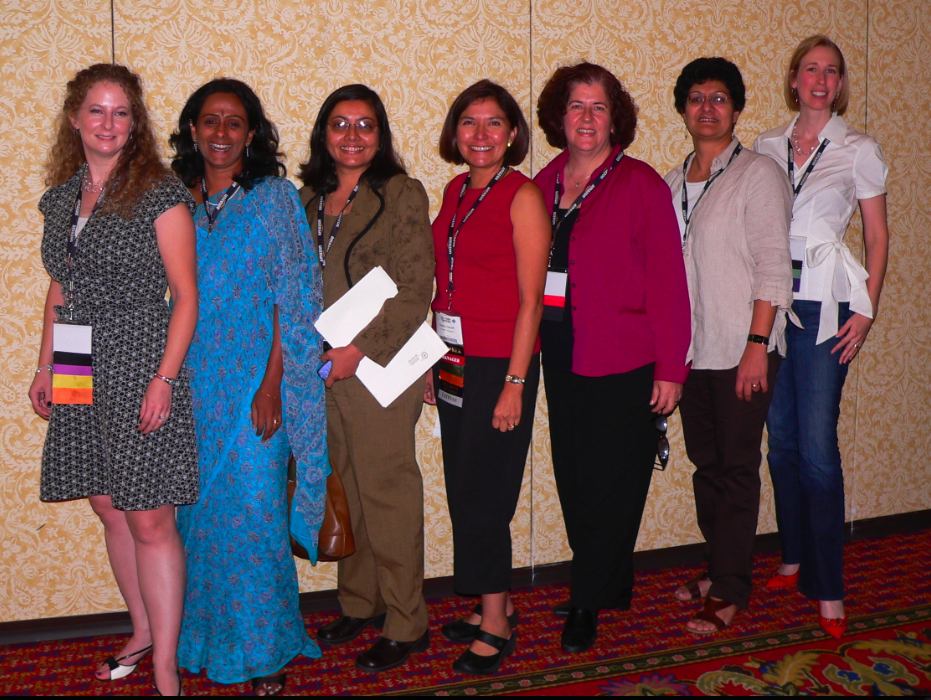
^ Panelists (L->R): Kristin Rozier (NASA); Sumitha Prashanth (Sun Microsystems-India); Radha Ratnaparkhi (IBM); Claudia Galvan (Microsoft); Bev Crair (Quantum, formerly Sun); Meenakshi Kaul-Basu (Sun Microsystems); Lydia Ash (Google) – photo from Meena

Globalization has forced companies to create new processes to empower distributed teams to collaborate. It could mean that individuals have to travel for longer periods of time across the globe, work at odd hours, and work from home or make other adjustments to accommodate a new working lifestyle.

Panelists will discuss and give their perspective on the topic, impact on women, and the technologies and strategies they use to maintain balance.”

This panel at the Grace Hopper Celebration of Women in Computing 2009, run by my colleague Meena, was one of the few sessions at GHC09 that I felt addressed the  practical needs of women currently in technology management: all of the panelists manage geographically-dispersed teams (which are increasingly the norm in high tech).

One theme that came up over and over was the importance of face-to-face interaction, especially for the managers, who therefore end up traveling a lot. Phone conferences, email, and instant messaging simply can’t build relationships in the same way. As Bev Crair said, even for teams that know each other and have worked together for a long time, “Trust breaks down after six weeks of not seeing someone.” I’ve seen this in my own experience of working remotely.

Bev added that relationships can be supported by video conferencing: “We use WebEx a lot.”

But she and others also felt strongly enough about the importance of in-person interaction that (during her time at Sun) she created a rotation program for Sun’s engineering office in China. US-based test engineers visited for three weeks at a time (the company had rented four apartments) and did their regular jobs from Beijing while also mentoring/training Chinese colleagues.

This taught the local engineers Sun standards for engineering, but it also helped the US-based engineers understand local problems so they could better represent their Chinese counterparts when they got back to US.

Kristin Rozier, NASA: “We put a lot of emphasis on face to face” within her small US reearch group. They host an annual symposium where everyone can get together.

Lydia Ash, Google: “As a manager I had to realize that bad news travels much faster than good news.” Solution: over-commuicate rather than under-.

Claudia Galvan, Microsoft: “You need to let go of driving everything from HQ and let the remote sites drive, too.”

Work-Life Balance

Bev Crair: “Working globally means there’s not a hard line between work and home life. I take time for myself and my daughter n the middle of the day. I have to set aside that time.”

Women are about connectedness, so why try to separate work from life?

Sumitha lives with her in-laws (a traditional arrangement in India), who are very supportive of her family and career. She says: “There’s no such thing as work-life balance. You figure it out as you go along. There’s no perfect situation. You have to prioritize. And don’t feel guilty about anything.”

Radha agrees that work-life balance is a myth. But there can be harmony if you have control and a support system (family, friends, community).

Two of the panelists’ daughters wouldn’t want their mothers’ jobs: “Too many phone calls.” One thinks that being an engineer is cool because you get to go to all these exotic places.

Women often end up taking care of family stuff (babies, aging parents), which leads to breaks in their career histories. Being able to “integrate” the personal with the professional is critical. Remote work allows people to deal with things e.g. cultural observations (such as the rituals around a death in the family) while still working. We need to have the tools and processes in place for this to happen.

Question from the audience: All this flexibility needs company support. How real is that?

Answer: Even the [US] federal government offers time off for family situations, e.g. up to 12 weeks to help a parent after surgery.

Tools and Pitfalls

It was mentioned that video conferencing can feel weird because of lag times (at long distance) and the fact that it doesn’t provide a sense of eye contact, because the webcam lens is not where you direct your eyes when you’re looking at the video you’re receiving. “Everyone looks stupid in a videoconference.”

Bev said they have extra monitors which display video streams from other offices, to maintain a sense of presence even when not actively participating in video conferences.

Lacking funding or tools for any of this, one manager said that her group put up photographs of their remote colleagues to enhance a feeling of connectedness. Every little thing can help.

Virtual environments (such as Google Lively and Second Life) can become informal and unprofessional very quickly. It’s important to remember that professional presence matters even in these virtual worlds. In video conferencing, watch out for bedhead and undone laundry in the background; what is the message you are sending by your video presence?

Use tool such as Writely to collaborate in real time on documents.

On the whole, a very useful panel, and I’m grateful to have had the opportunity to learn from these women.

Who’s a Guy?

One session I (and many others) attended at the Community Leadership Summit was on women in technology/communities. Frankly, I lost patience very quickly. As I said then, we all have horror stories; I’m more interested in discussing fixes. (Which, with Sara Ford to get the ball rolling, we did.)

One meme that came up repeatedly during this session was the sexism – or otherwise – of using the term “guys” to refer to a mixed group of men and women. In other words, is it offensive to walk into a room containing both sexes and say: “Hi, guys” ?

Some felt that it was sexist, though probably unconsciously so, others felt that anyone who thought so was being over-sensitive. Impasse.

A few days later during OSCON, I found myself in a Moscone Center women’s bathroom at the same time as one of the women whose job during the conference was to make sure that no unbadged person got into a session. We were the only people in the room. She said to me: “You guys are really rare at things like this.”

It took me more than a few milliseconds to parse this. She meant: “Women at technical conferences are rare.” And used the term “guys” to refer to me and women like me.

Case closed. “Guys” no longer refers to men only, so we can stop arguing about whether it’s sexist.

The First Colorado Front Range Girl Geeks Dinner: Jai Ho!

The first Colorado Front Range Girl Geek Dinner was held on Thursday, March 5th, on Sun’s Broomfield campus. More than 80 people attended, only one of whom was (a very brave) male.

Sun sponsored this first one with food, drink, and venue. There was plenty of interest from other individuals and businesses in helping with the next (contact me to be put in touch with the now-being-formed committee). Thanks to the many who helped spread the news (including Jeremy Tanner, who helped get the word out to startups and other smaller businesses). We had at least 80 attendees (probably more – I don’t think we caught quite everybody at the registration desk), and were in touch with several dozen more who couldn’t attend on this particular date but definitely want to participate.

With this kind of momentum, I think the next CO FR GGD can take place in about two months (but I’ll be leaving it up to others to organize that one as I expect to travel heavily from now through July).

The atmosphere in the room was electric and inspiring, and I hope was encouraging for those who had recently lost their jobs (or fear they might soon). Women helping women can be a powerful resource in the workplace, and that’s what Girl Geek Dinners are about.

Colorado GGD

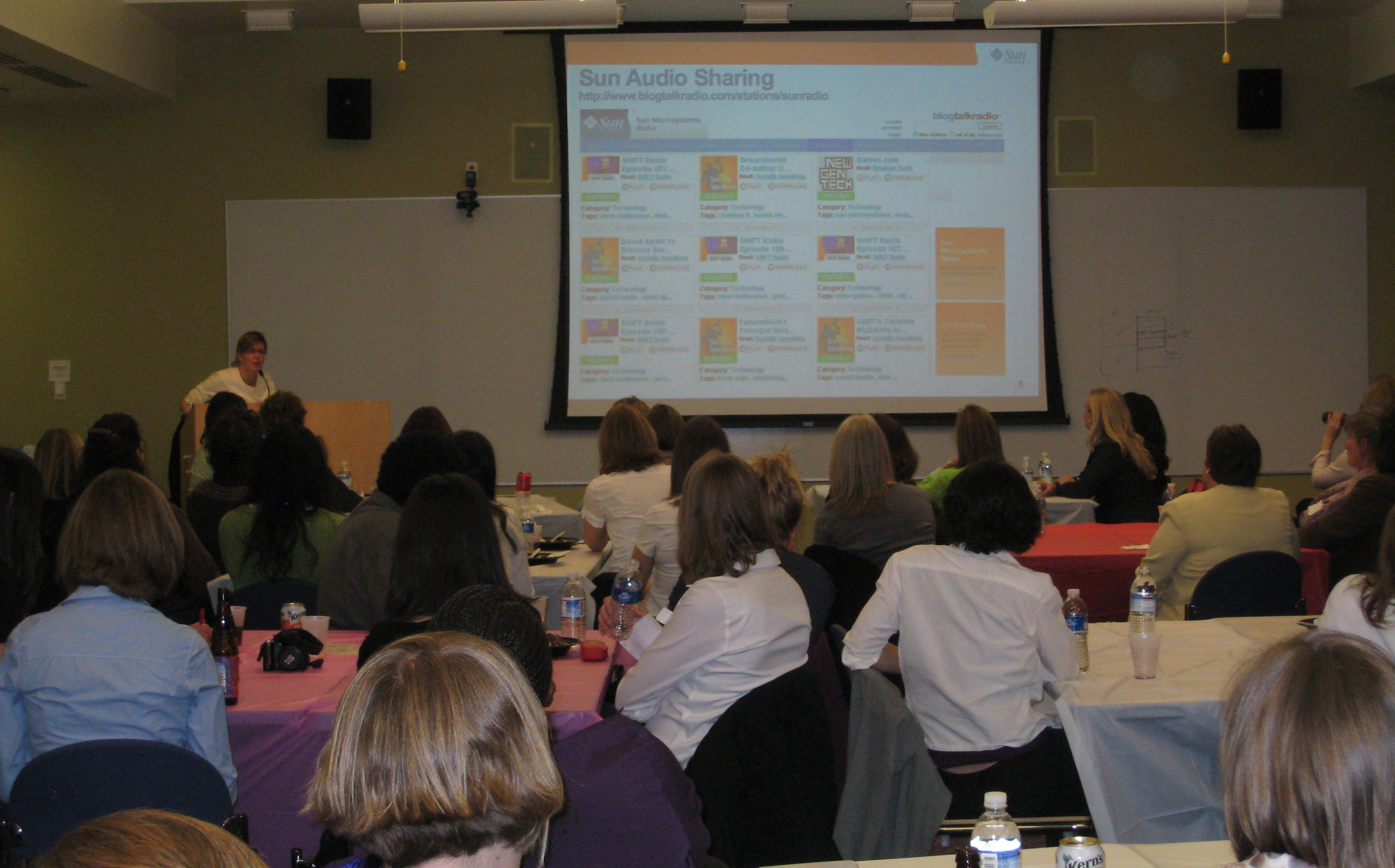
^ listening to Linda, the “voice from on high”

Linda Skrocki put together a presentation which I ended up delivering (with her participating by phone) because she was home with a flu and didn’t want to infect the rest of us.

Our aim was to showcase Sun’s many activities in social media, in order to illustrate how other companies and individuals can use social media to enhance their own brands, win friends and clients, and influence people. Social media is important in just about any job these days, so I hope the information was useful to other women wanting to add to their work skills.


I noted a lot of interest in the room at the idea of managing one’s personal brand and identity online; that might be a topic for a future talk. One attendee wanted to talk more with us about Sun’s “radical transparency” in relation to a project she’s working on. And it seems that people want to hear more about videoblogging, which of course I’m happy to discuss anytime.

Colorado GGD

My only (personal) disappointment was that I was so busy running the show, I had very little time to talk with anybody – and there was a roomful of fascinating women I’d love to know more about. I look forward to making up for that next time!

Thanks to Kristin Tulp of Level3, we had TV coverage, with a segment by Jodi Brooks of CBS4 news (Denver) on Friday night. As part of a series on “Beating the Recession,” the piece talked about how we “Geek Girls” are rallying together to help ourselves and each other in a hard job market. I don’t know whether the segment will be posted on their site. Perhaps if enough of us ask them…? Here’s the transcript: ‘Geek Girls’ Gather In Broomfield For Networking

other coverage:

In case you’re wondering about the title: Jai Ho is the Oscar-winning song from the end titles of  Slumdog Millionaire. The song’s composer, A.R. Rahman, says that Jai Ho translates as “May victory be yours.” Which seems to me a fitting benediction for my fellow girl geeks.