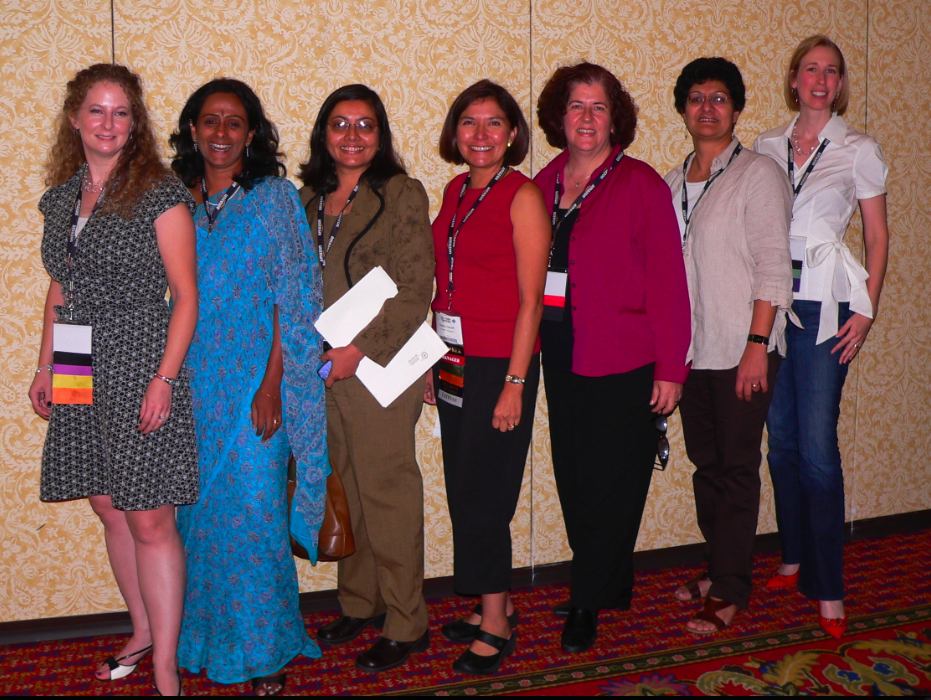
^ Panelists (L->R): Kristin Rozier (NASA); Sumitha Prashanth (Sun Microsystems-India); Radha Ratnaparkhi (IBM); Claudia Galvan (Microsoft); Bev Crair (Quantum, formerly Sun); Meenakshi Kaul-Basu (Sun Microsystems); Lydia Ash (Google) – photo from Meena
“Globalization has forced companies to create new processes to empower distributed teams to collaborate. It could mean that individuals have to travel for longer periods of time across the globe, work at odd hours, and work from home or make other adjustments to accommodate a new working lifestyle.
Panelists will discuss and give their perspective on the topic, impact on women, and the technologies and strategies they use to maintain balance.”
This panel at the Grace Hopper Celebration of Women in Computing 2009, run by my colleague Meena, was one of the few sessions at GHC09 that I felt addressed the practical needs of women currently in technology management: all of the panelists manage geographically-dispersed teams (which are increasingly the norm in high tech).
One theme that came up over and over was the importance of face-to-face interaction, especially for the managers, who therefore end up traveling a lot. Phone conferences, email, and instant messaging simply can’t build relationships in the same way. As Bev Crair said, even for teams that know each other and have worked together for a long time, “Trust breaks down after six weeks of not seeing someone.” I’ve seen this in my own experience of working remotely.
Bev added that relationships can be supported by video conferencing: “We use WebEx a lot.”
But she and others also felt strongly enough about the importance of in-person interaction that (during her time at Sun) she created a rotation program for Sun’s engineering office in China. US-based test engineers visited for three weeks at a time (the company had rented four apartments) and did their regular jobs from Beijing while also mentoring/training Chinese colleagues.
This taught the local engineers Sun standards for engineering, but it also helped the US-based engineers understand local problems so they could better represent their Chinese counterparts when they got back to US.
Kristin Rozier, NASA: “We put a lot of emphasis on face to face” within her small US reearch group. They host an annual symposium where everyone can get together.
Lydia Ash, Google: “As a manager I had to realize that bad news travels much faster than good news.” Solution: over-commuicate rather than under-.
Claudia Galvan, Microsoft: “You need to let go of driving everything from HQ and let the remote sites drive, too.”
Work-Life Balance
Bev Crair: “Working globally means there’s not a hard line between work and home life. I take time for myself and my daughter n the middle of the day. I have to set aside that time.”
Women are about connectedness, so why try to separate work from life?
Sumitha lives with her in-laws (a traditional arrangement in India), who are very supportive of her family and career. She says: “There’s no such thing as work-life balance. You figure it out as you go along. There’s no perfect situation. You have to prioritize. And don’t feel guilty about anything.”
Radha agrees that work-life balance is a myth. But there can be harmony if you have control and a support system (family, friends, community).
Two of the panelists’ daughters wouldn’t want their mothers’ jobs: “Too many phone calls.” One thinks that being an engineer is cool because you get to go to all these exotic places.
Women often end up taking care of family stuff (babies, aging parents), which leads to breaks in their career histories. Being able to “integrate” the personal with the professional is critical. Remote work allows people to deal with things e.g. cultural observations (such as the rituals around a death in the family) while still working. We need to have the tools and processes in place for this to happen.
Question from the audience: All this flexibility needs company support. How real is that?
Answer: Even the [US] federal government offers time off for family situations, e.g. up to 12 weeks to help a parent after surgery.
Tools and Pitfalls
It was mentioned that video conferencing can feel weird because of lag times (at long distance) and the fact that it doesn’t provide a sense of eye contact, because the webcam lens is not where you direct your eyes when you’re looking at the video you’re receiving. “Everyone looks stupid in a videoconference.”
Bev said they have extra monitors which display video streams from other offices, to maintain a sense of presence even when not actively participating in video conferences.
Lacking funding or tools for any of this, one manager said that her group put up photographs of their remote colleagues to enhance a feeling of connectedness. Every little thing can help.
Virtual environments (such as Google Lively and Second Life) can become informal and unprofessional very quickly. It’s important to remember that professional presence matters even in these virtual worlds. In video conferencing, watch out for bedhead and undone laundry in the background; what is the message you are sending by your video presence?
Use tool such as Writely to collaborate in real time on documents.
On the whole, a very useful panel, and I’m grateful to have had the opportunity to learn from these women.