Tag Archives: social media

SxSWi Report – Social Media: Connecting with Customers

Note: This was listed in the catalog as “Social Media: If You Liked it, Then You Should Have Put a Digg on It…”, which I wouldn’t have bothered to attend, but when I walked by the room the title had changed to “Social Media: Connecting with Customers”, which was a lot more obviously interesting to me. This was also one of the few panels that didn’t seem to treat large corporations (and those of us who work for them) as the enemy.

Panel:

  • Chris Bowler – VP Social Media Lead, Razorfish (moderator)
  • Jordan Corredera -  Director of Online Marketing, Carnival Cruise Lines
  • Paula Drum – VP Digital Marketing, H&R Block
  • Malini Ratnam – Digital Media Mgr, Avenue A/Razorfish/JCPenney

First, each panelist gave an overview on what their company is doing in social media (comments on the companies themselves are partly my own, for the benefit of non-US readers who may not be familiar with these companies):

H&R Block

Well-known in the US as a tax preparation service, H&R Block’s problem is that their business is extremely seasonal, running from January (they kick off their advertising season with the SuperBowl) through Tax Day on April 15th. They are trying to use social media to stay in the public consciousness year-round. The overall theme is customer connections to build lifelong relationships.

Tactics include:

  • a tax news widget for tax professionals
  • YouTube contests
  • online community
  • tax-themed content related to other times of year, e.g. back to school, company benefits enrollment periods
  • provide customer service via Twitter and Yahoo Answers
  • helping tax professionals participate in these programs as well
  • along with the Social Media Club, have organized/participated in Tweetups in 10 cities

JC Penney

Penney is a very old retail company, and is trying to overcome a rather musty reputation with younger shoppers: “Trying not to be ‘your mother’s store’.” They have chosen to actively participate in women’s online communities.

Their first big project is the extremely funny “doghouse” video (which I had seen long before this conference, though I had probably forgotten that it was done by JC Penney):

At the time it had had 4.1 million views with a 60% completion rate, resulting in 600 (new) Twitter followers and 1100 tweets/retweets. It was initially seeded from a Penney microsite using Facebook Connect. Traffic crashed the server and led to higher fees. Offloaded the traffic to YouTube.

They’ve also set up a Facebook group targeted to women, after finding that segmentation by Penney sub-brands did not work. And they’ve got a customer service Twitter account.

Someone asked what was the ROI on the doghouse video campaign. The answer was that brand awareness, not ROI, was the objective; a hard sell would not have been as successful.

Carnival Cruise Lines

In 2005, Carnival set up a group planning tool built on Community Server. The Cruise Talk forum there grew to 500 posts/day, and was followed by a “scrapblog” and a Twitter account with 1300 followers.

Then came a blog by John Heald, a cruise director, which has become immensely popular, as measured by 100 comments a day [visitor stats were not given].This has grown into a multimedia extravaganza including live chats, videos (quality was an issue), etc. Cruising is inherently social, so this has worked well.

[D here: This is an example of how effective social media marketing can be when tied to a real personality. You can also build community around that person: Heald fans want to talk to each other, there are now even Heald-themed fan cruises.]

Then the moderator asked questions:

How do you set up your organization to participate in social media?

H&R Block: You have to figure out where does this fit. Customer service, communications, marketing, field coordination…? The company isn’t yet on board, we’re still in a skunkworks phase. We’re trading off media dollars with human capital – we have only one person for Twitter, which is a 24/7 job. [But she said later that some resources are being shifted to social media.]

Also, the Federal Trade Commission is changing the legislation about blogging [as relates to professional tax preparers]. We’re still figuring out how to train people, what legal disclosures are needed. Ideally, we’d like tax preparers to be blogging. Education and support are difficult. People need to understand that it’s okay to have your own personality.

JC Penney: Similar situation, we have no dedicated social media team. [Some problem of] brick and mortar stores vs. jcpenney.com. Facebook took off for us when it became a two-way conversation, but that takes dedicated staff.

Carnival: We have an online community manager with two moderators and a social media strategist. Not seeing any particular efficiences from online yet.

How can we measure the results of social media?

Page views, links to transactions.

How does this tie back to brand? How do we make the brand relevant to the new generation?

Word of mouth as brand tracker, but it moves over multiple years.

ROI = Risk of Ignoring

creating spheres of influence, measuring awareness

Traditional ROI isn’t the be-all and end-all – Twitter is free! [except for staff time]

Use Radiant6 to monitor buzz.

Facebook charges $300k for a brand page – Carnival elected not to spend this. Buying a YouTube channel can cost $500k plus media costs.

But you can get started for free.

If you’re going to lead social media [teams], you have to be doing it yourself.

Content creation is expensive.

How might employee culture affect the use of social media in older companies?

An interesting question, but, frustratingly, I didn’t note the answers. Maybe there weren’t any.

D’s Conclusions

A good and useful session, one of the few at SxSWi to address the needs of large companies and their employees.

I was very frustrated that Sun was not speaking on this panel, as we have one hell of a story to tell in this space.

And, even absent Sun’s support infrastructure for blogs, wikis, and video, I could have told them that there are cheaper ways to do this stuff than what Facebook and YouTube are charging for branded offerings.

The First Colorado Front Range Girl Geeks Dinner: Jai Ho!

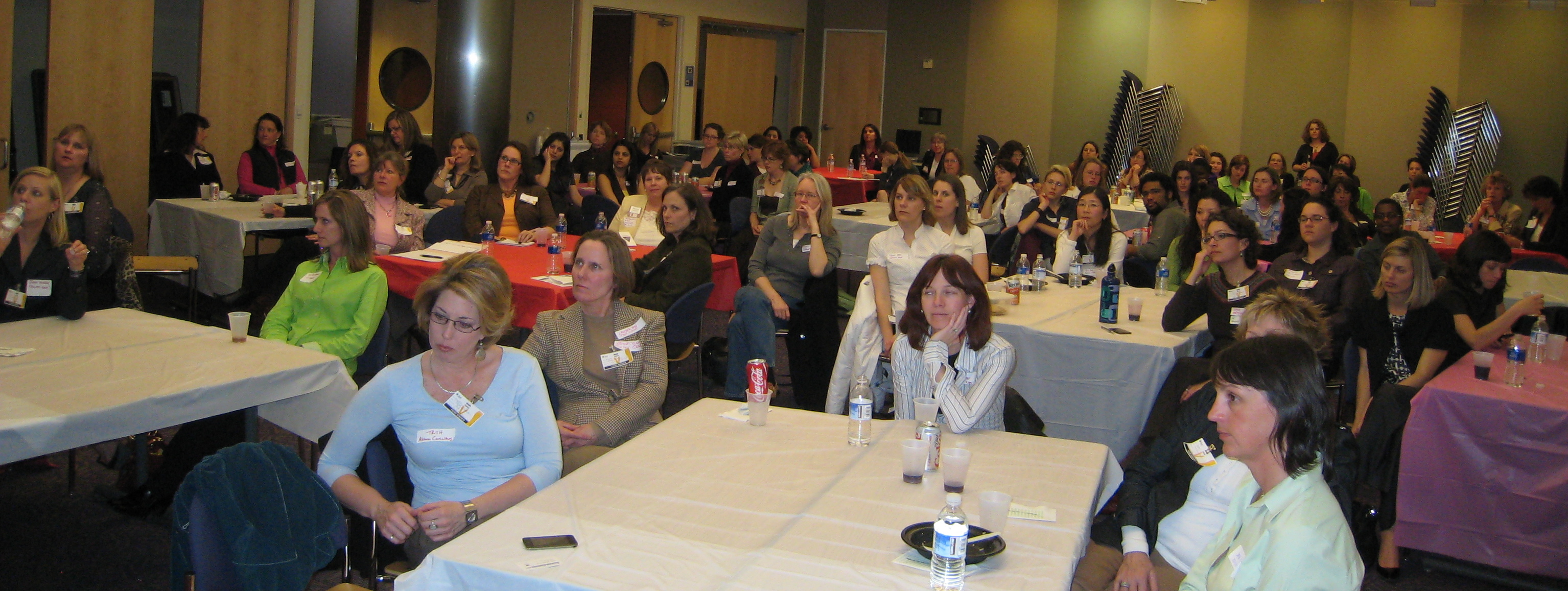
The first Colorado Front Range Girl Geek Dinner was held on Thursday, March 5th, on Sun’s Broomfield campus. More than 80 people attended, only one of whom was (a very brave) male.

Sun sponsored this first one with food, drink, and venue. There was plenty of interest from other individuals and businesses in helping with the next (contact me to be put in touch with the now-being-formed committee). Thanks to the many who helped spread the news (including Jeremy Tanner, who helped get the word out to startups and other smaller businesses). We had at least 80 attendees (probably more – I don’t think we caught quite everybody at the registration desk), and were in touch with several dozen more who couldn’t attend on this particular date but definitely want to participate.

With this kind of momentum, I think the next CO FR GGD can take place in about two months (but I’ll be leaving it up to others to organize that one as I expect to travel heavily from now through July).

The atmosphere in the room was electric and inspiring, and I hope was encouraging for those who had recently lost their jobs (or fear they might soon). Women helping women can be a powerful resource in the workplace, and that’s what Girl Geek Dinners are about.
Colorado GGD

^ listening to Linda, the “voice from on high”

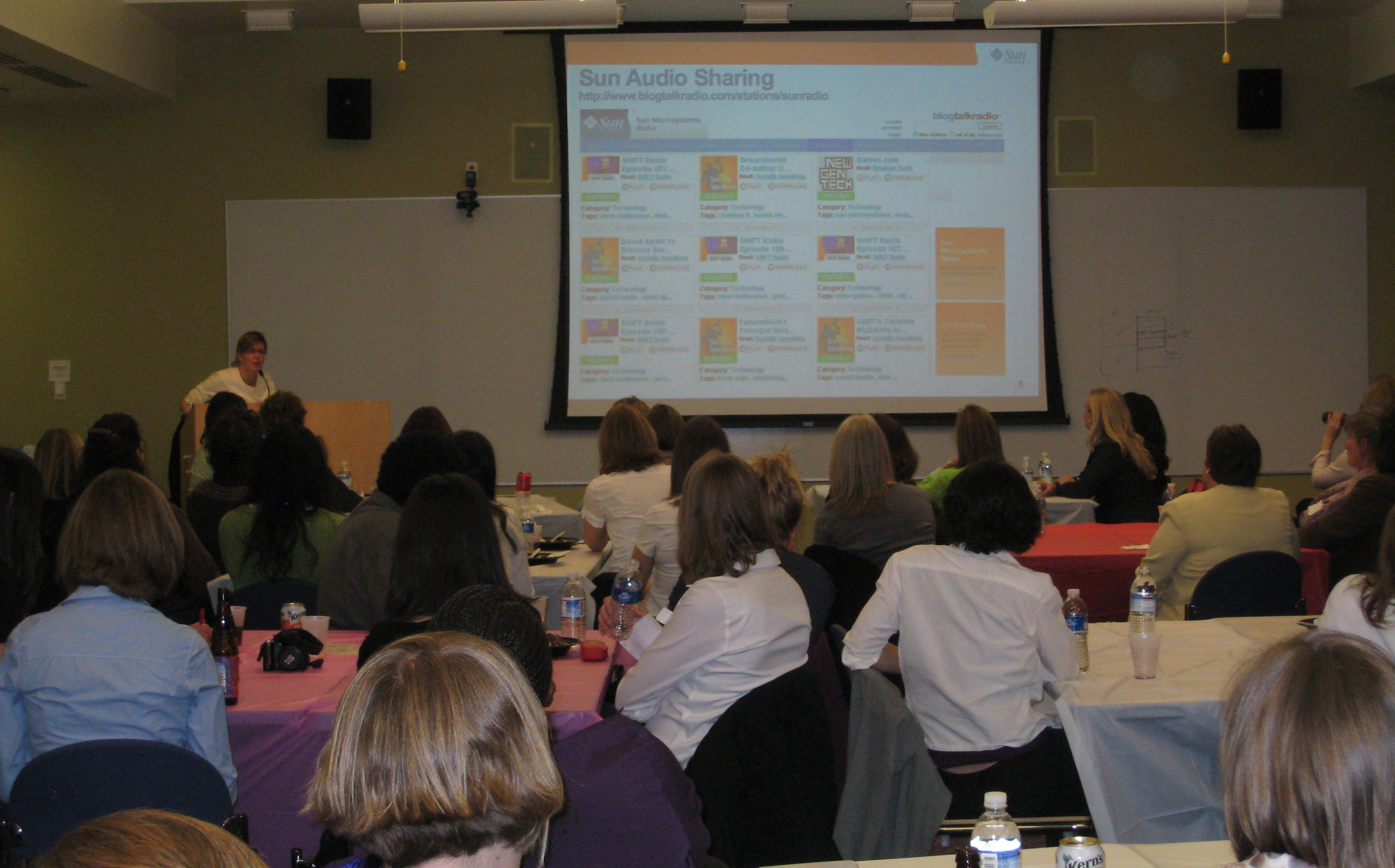
Linda Skrocki put together a presentation which I ended up delivering (with her participating by phone) because she was home with a flu and didn’t want to infect the rest of us.

Our aim was to showcase Sun’s many activities in social media, in order to illustrate how other companies and individuals can use social media to enhance their own brands, win friends and clients, and influence people. Social media is important in just about any job these days, so I hope the information was useful to other women wanting to add to their work skills.


I noted a lot of interest in the room at the idea of managing one’s personal brand and identity online; that might be a topic for a future talk. One attendee wanted to talk more with us about Sun’s “radical transparency” in relation to a project she’s working on. And it seems that people want to hear more about videoblogging, which of course I’m happy to discuss anytime.
Colorado GGD

My only (personal) disappointment was that I was so busy running the show, I had very little time to talk with anybody – and there was a roomful of fascinating women I’d love to know more about. I look forward to making up for that next time!

Thanks to Kristin Tulp of Level3, we had TV coverage, with a segment by Jodi Brooks of CBS4 news (Denver) on Friday night. As part of a series on “Beating the Recession,” the piece talked about how we “Geek Girls” are rallying together to help ourselves and each other in a hard job market. I don’t know whether the segment will be posted on their site. Perhaps if enough of us ask them…? Here’s the transcript: ‘Geek Girls’ Gather In Broomfield For Networking

other coverage:

In case you’re wondering about the title: Jai Ho is the Oscar-winning song from the end titles of  Slumdog Millionaire. The song’s composer, A.R. Rahman, says that Jai Ho translates as “May victory be yours.” Which seems to me a fitting benediction for my fellow girl geeks.


Seth Godin at TED: Tribe and Community

A very cool perk of working for Sun recently was that we had live streams of TED into the three major US campuses. It has long been a dream of mine to attend TED, though for the moment it’s well out of my price range.

I couldn’t break free of meetings to watch during the day, but I was mesmerized by the evening sessions. The first major speaker Wednesday evening was Seth Godin, whose blog I follow from time to time. Not surprisingly, his talk was based on his new book, Tribes, which I probably don’t need to read now (for the record, I haven’t read any of his other books, either).

I took away some ideas that might be useful for those of us at Sun (and elsewhere) who are doing this mysterious and fashionable thing called community building.

Seth started out by asking: “What do we [TED attendees, presumably] do for a living?”

His answer: “We try to change everything.”

In order to foster change, Godin offers the idea of tribes, which “can align large numbers of people” behind a goal or cause. He recommends this cycle:

tell a story -> connect a tribe -> head a movement -> make change -> repeat

He notes that a product that “tells a story” lets its user/consumer tell the story again and perpetuate it.

Godin says that tribes need leaders, most often self-appointed. Leaders should:

  • Challenge the status quo
  • build Culture
  • have Curiosity
  • Connect people to each other (“people want to know they’ll be missed if they go away”)
  • have Charisma (but you don’t need to be born with it; being a leader automatically endows you with charisma)
  • Commit to the cause/tribe/people

So how does this apply to Sun’s efforts to create community around our open-sourced software? Clearly, we had to be the leaders who started this (but that doesn’t mean we’ll always be the leaders of these communities).

You can’t force a community into existence; people have to want to be part of it. But you can make it fun and easy for them to participate, mostly by making it easy for them to connect with each other.

Important Note: Once they’re connected, you don’t get to control what they say to each other! Oh, you can try, but it’s a bad idea because it always backfires. Even when you’re the leader, you’re still only one member of the tribe, and the tribe insists on functioning as a democracy no matter who’s supplying the facilities.

What we can, should, and do do, however, is act as leaders.

Whose Story is It, Anyway?

When I wrote about leaving Italy (but not my husband), a long-time reader expressed concern about my marriage, saying that it was clear that my primary relationship is with my daughter Rossella, whereas my husband Enrico is “merely a footnote.”

I appreciate this reader’s concern, but was quick to correct (I hope) his misconception. It’s true that I have written more about Ross, and in more detail, than I do about Enrico. But that doesn’t necessarily reflect the importance of each in my life.

It’s a generational thing. Ross, having grown up with the Internet, shares her life online in a way that is completely normal for her generation, but which leaves her father shaking his head in bemusement: “When I was young, I would never have dreamed of making public some of the things she does, even if I’d had the technology.”

So it’s simply out of respect for his privacy that I don’t write much about Enrico.

This brings up a larger question that has been on my mind for some time: we all have stories to tell, and much of what I share online is, one way or another, stories. But the most interesting stories involve other people, who don’t necessarily want those stories told about them. And I can’t be sure about others’ sensitivity level. While I have rarely or never told a story with deliberate intent to cast anyone I know in an unflattering light, on a few occasions people have been unhappy about what I wrote about them. And there are lots of stories I haven’t yet told out of respect for others’ privacy. Still, I wonder: whose story is it, anyway? What legal or moral right do I have to tell my own tales when they happen to involve other people?

Translating Blogs and Finding New Friends – Worldwide!

Note: The images in this post were originally on a Sun site, and were lost in the Oracle transition.

About a year ago, Dan Maslowski had a simple-but-brilliant idea to increase the reach of some of Sun’s Open Solaris Storage blogs: translate them! Sun’s globalization team was initially cautious: they already had their hands full translating interfaces and documentation, and weren’t sure where this blogging thing fit into their scope of work. But they agreed to give it a shot.

We started with Bob Porras’ blog. Based on attendance at Sun Tech Days worldwide, he opted to have it translated into Chinese (first post July 9th), quickly followed by Spanish (first post August 17th) and Russian (August 20th). We’ve recently added Japanese (April 30th) and Brazilian Portugese (May 22nd).

The results were good, though not surprising: traffic increased.

What’s more interesting than the simple increase in page views is the range of countries now represented in Bob’s readership. Here’s a breakdown of traffic by (roughly calculated) language areas:

New entrants Japanese and Brazilian Portugese are already making a noticeable contribution – clearly, there was demand for material in these languages. (Note that “all others” refers to all other countries that have sent traffic to Bob’s blog – folks from these countries are obviously reading one of the six languages so far represented.)

Our geographic reach increased. For example, look at the number of Spanish-speaking countries from which people are reading Bob’s blog each month:

Jun Jul Aug Sep Oct Nov Dec Jan Feb Mar Apr May
3 6 8 8 9 13 8 10 10 12 11 11

The list varies a bit from month to month, altogether 15 Spanish-speaking countries are represented so far:

Andorra
Argentina
Bolivia
Chile
Colombia
Costa Rica
Dominican Republic
Ecuador
El Salvador
Guatemala
Honduras
Mexico
Peru
Puerto Rico
Saint Lucia
Spain
Venezuela

Some of these are tiny countries bringing us only one or two visitors a month – but that’s one or two more people we’re talking to that we weren’t before.

Now let’s look at Storage Stop, a very different kind of blog which we began translating into Chinese in November, but have neglected to since March. Umm, we’ll just claim that was a web traffic experiment, not an oversight, right?

I wonder whether translating Storage Stop is useful, because it’s primarily an aggregator, pointing at material on other blogs (so far mostly in English), and a venue for videos which are so far entirely in English. (We’re looking into ways to translate videos.) For that or whatever reason, Storage Stop never got a lot of traction in Chinese, and I may abandon that experiment to spend translation resources more productively.

Since December we’ve also been translating Scott Tracy’s blog and Lynn Rohrer’s blogs into Chinese.

But it was clear from the overall trends of traffic to Sun storage blogs that our most-valued material is mostly highly technical. So over the last few months we’ve been translating selected posts into various languages. Examples include:

These translations are mostly too recent to draw conclusions; I’ll report back after we’ve got some numbers to analyze.

We also translated one important post by Jim Grisanzio on Building OpenSolaris Communities, into multiple languages. Early returns show that this is having an effect on traffic and, more importantly, as Jim had hoped, it’s opening up new conversations.

Sun’s globalization team are now enthusiastically and ably taking over more of the blog translation process: all I have to do is identify the posts to translate, and they do the rest. With their help, more blogs are being translated all over Sun, in other technology areas such as Sun Cluster.

We’re opening up to the global conversation, and the world is talking back. Sometimes the simplest ideas have the profoundest effects.