the family ambigram
Category Archives: bio
Toys of Empire – Teaching Young Bengalis to be Bureaucrats of the Raj
While I was in New Mexico last weekend, Sharon and I drove to Santa Fe. The town has many museums, but we visited only one: the Museum of International Folk Art. It’s not big, but offers plenty to keep the attention. One room has drawers full of decorative panels from Bangladeshi rickshaws, and molé cloth work.
Most fascinating to me was the Girard Wing, created from the personal collection of a bi-cultural globetrotter whose taste in funky objects I completely concur with. It’s an enormous room crammed to bursting with toys, figurines, masks, and tapestries, arranged according to some interior logic of the donor, which doesn’t always make sense to the outside observer. Girard didn’t believe in labels, and I can see his point: I get distracted reading the text instead of observing the object it describes. So he put discreet little numbers on the cases, corresponding to a catalog with one terse paragraph of description per case. This was very frustrating at times – you’re left wondering: “Where is that thing from? What does it mean? Why does this mask show a person with pursed-out lips with a lizard climbing down his nose?”
And: “Why does this 18th-century Bengali story-teller’s scroll illustrating the life of Krishna feature (Indian) people and gods dressed for the French royal court in knee pants, hose, and big wigs?”
We weren’t sure if we were allowed to take photos (though there weren’t any signs saying otherwise), but I couldn’t resist snatching some shots of these.
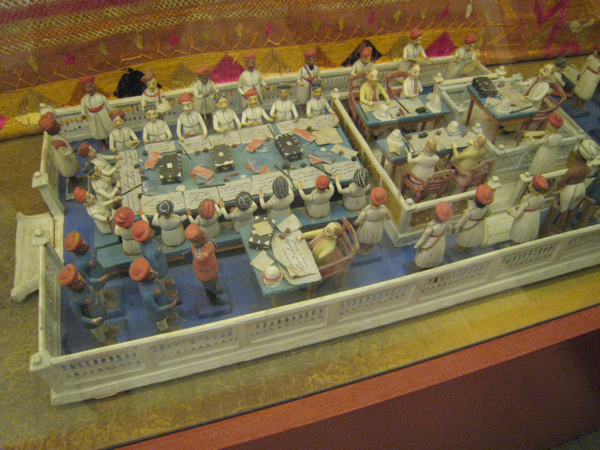
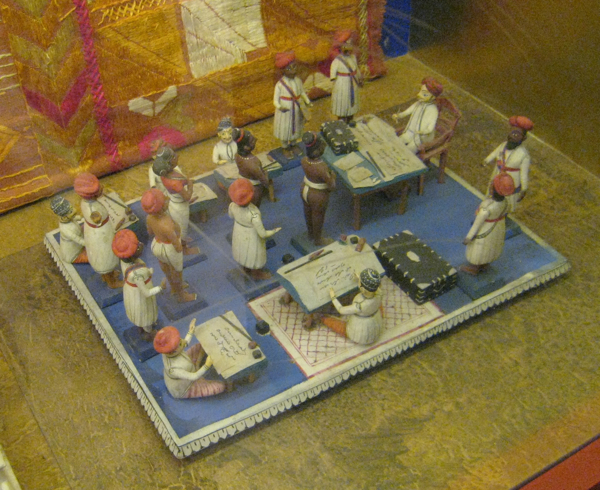
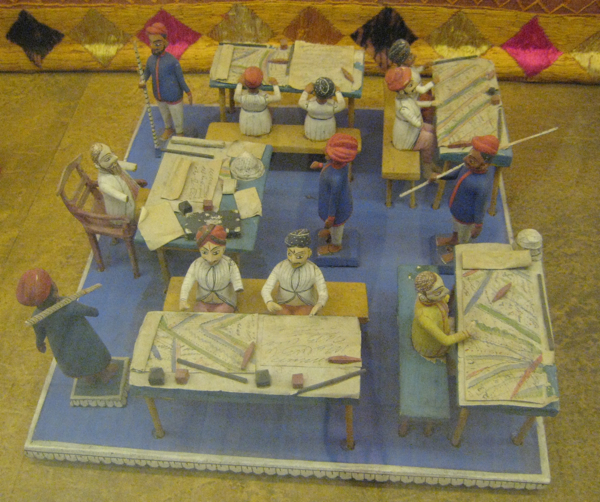
The catalog inadequately explained that they are from Bengal, and represent scenes of the workings of the British empire – intended as educational toys, perhaps to show Bengali children the (limited) jobs that would be available to them in the British bureaucracy.
At the top of the page you can see a higher court in full session. Aren’t these guys wonderful? Look at the detail of their moustaches and beards, and the little white pith helmets on the table.
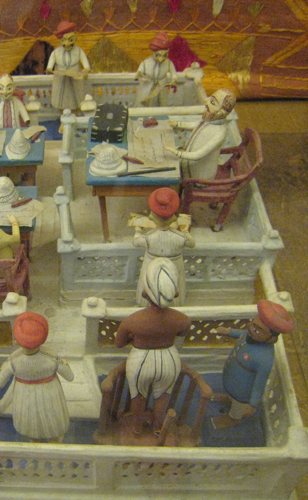
Below is a detail showing the British judge in his white jacket, with the plaintiff in the white dhoti and turban in the foreground, under the watchful gaze of a guard in blue.
Below, I think, is a low-level magistrate’s office with a “native” judge. I’m guessing from their loincloths and hairstyle that the plaintiffs are tribal people.
^ Here’s a surveyor’s office, everyone busily drawing maps – except their British supervisor (who appears to be a close relative of the judge). There’s even a guy with a rod, ready to go out and take more measurements.
A New Kind of Education
By 4:10, my brain hurts, literally.
Lessons here are divided into periods of 40 minutes each, but usually (except for subjects like religion) there are two consecutive periods per lesson, so 80 minutes.
Today, 80 minutes of Hindi with a test (I didn’t remember the word for “pocket” but I think everything else went okay); then 80 minutes of AP English: that is, a university-level English course – they say.
We’re reading and analyzing a book, that one about the insane asylum and the guy who flew over the cuckoo’s nest and I don’t remember the Italian title.
THEN: 80 minutes of math – no comment! And to end in beauty: 80 minutes of Government and Politics, during which I had to do research to write a “paper”, as they call it here, on the positive or negative influence of non-governmental organizations in the world. I chose to write about female genital mutilation in Africa, so I spent a good hour reading delectable discourses about clitorises torn off with pieces of glass and such.
School started in August, vacation was far too brief (Jesolo, every now and then I close my eyes and I’m there!), and yet I’m not complaining. I have to say that I have landed in my natural habitat, scholastically speaking.
I was allowed to choose my own courses. Aside from some minimum requirements and so on, I decided for myself what to study! And this is fantastic. Then the teaching here is completely different. Very discursive lessons, and you have to participate – and those who have had the honor to have me as a classmate know that I love to participate actively in class, even too much so.
Every hour I have to remember new phonetic sounds, and new writing. I don’t have to read a book, but go on the Internet and find for myself the information I need to put together my research.
It’s hard. It’s tiring. It’s not passive learning. It’s too wonderful!
The courses I’m taking are: Hindi, English, Government and Politics, acting, arts and religions of Indian origin (Suor Maria, don’t hate me!).
It’s strange: geographically I’m in India, but the school is a place unto itself. Once you’re here, it’s a total melting pot. Everything varies, from skin color to accent to eye shape. I’m very embarrassed when I can’t pronounce someone’s name or, worse, I’ve never heard of the country they come from!
I’d also say that a white pseudo-blonde feels banal in a place like this.
Ever since the school began to work with this cultural exchange agency [the SAGE program], it’s traditional that the new kids and the “old” ones take some time before they start socializing and form a united class group.
This depressed me, and I still feel uncomfortable about it. It seems as if the high school is divided into two clans of – ugly to say it – white and black! No one makes an effort to approach the other except, obviously, the undersigned. I feel like an imbecile every time when, with a stupid question, I interrupt the silence, or raise my hand to state my opinion and make myself heard. And yet, I can’t stop. I hate segregation!
I was reaching the limits of my tolerance and was about to resign myself to the life of an asocial little American when today a girl the color of milk chocolate whom I’ve never seen, I swear NEVER seen her face, turned around and said “Hi Rosela! How are you? Are you getting used to India?”
My expression must have shown that I didn’t know who the hell she was, but it was a mix of confusion and stupor: my eyebrows curved high, a half smile, a knot in my throat. “A person I’ve never seen in my life has noticed me, knows my name – more or less – and asks how I am in a friendly tone? And she’s neither white nor a new student!”
Every day is a discovery, every day is laughter mixed with a pinch of melancholy and regret that I can’t be in two places at once, that in a year many things change, and I don’t want to be unknown to the people who have been part of my life before India.
I feel guilty, it seems almost a betrayal to laugh, joke, and show affection to new friends.
That Giulia known as Manzo advised me to find at once the people best suited to degeneracy. Ironically, I’ve met a certain Julia who’s completely out of her head…

The Silent Screams of Dying Trees
Last Sunday Tin Tin and I went to Rocky Mountain National Park. It was a beautiful drive from Boulder, through Estes Park (which is a town, not a park) and on up – and up, and up. At its highest point, the Trail Ridge Road is something over 12,000 feet in altitude (and, obviously, closed by snow for much of the year). On this particular day, the last Sunday before school starts in this area, it was also very crowded – we gave up on the Alpine information center because the parking lot was full.

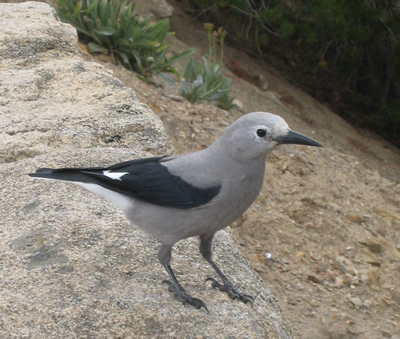
< This cheeky fellow came very close, hoping for a handout of trail mix – not likely to happen, given all the dire warnings posted about feeding the animals and the presence of a park ranger six feet away!
We continued down the other side of the Continental Divide to Grand Lake, then doubled back into the park to take a walk which, according to the guidebook, was supposed to be “easy.” (More on that later.)
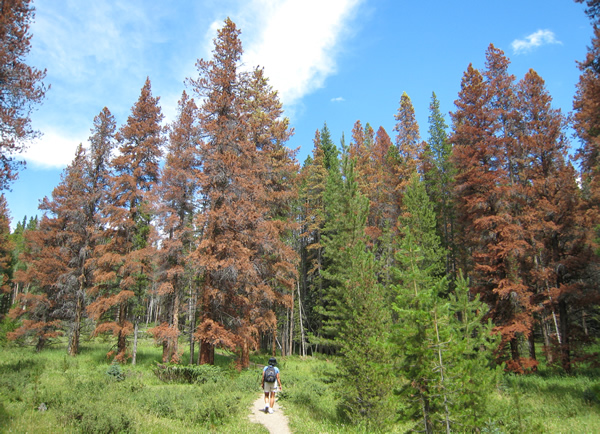
I’d just heard about the havoc being wreaked by mountain pine beetles: my friend Sharon, with whom I had dinner in Boulder a few days ago, had seen huge swathes of destruction on her drive up from New Mexico (and had overheard a tourist ask a park ranger: “Where can I get one of those pretty red trees?”).
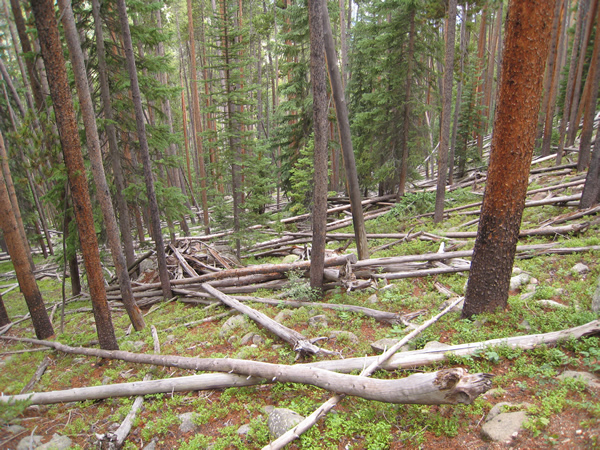
We saw some evidence of damage on the eastern side of the range, but far, far more on the western side:


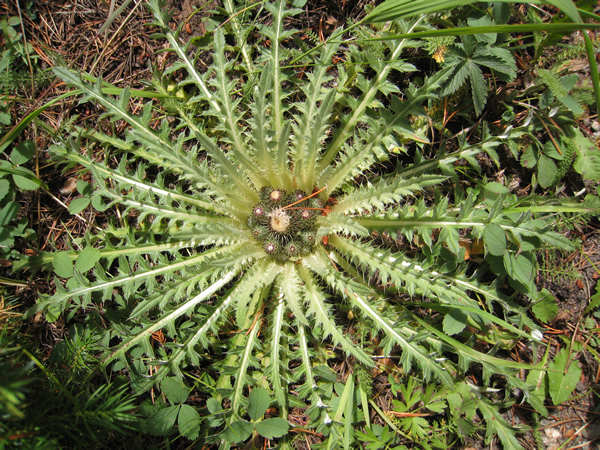
Shorter forms of life, meanwhile, are thriving:
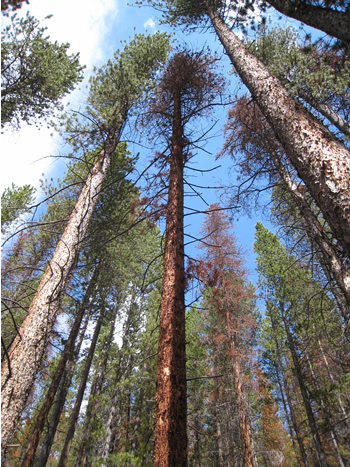
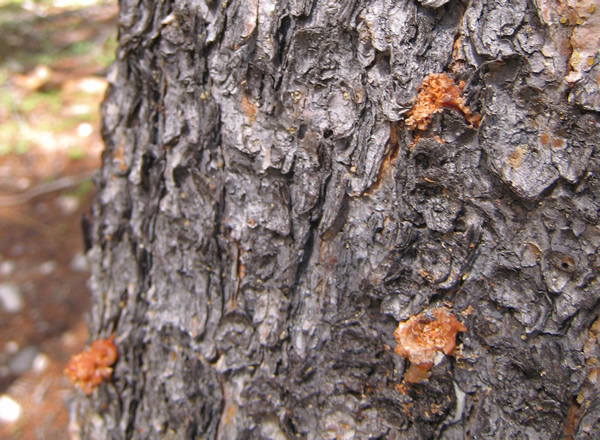
The tree above has been recently attacked by beetles: the blobs of sap show where they tunneled in to lay their eggs. Healthy trees can produce enough sap to overwhelm a few beetles and drive them off, but these trees are weakened by prolonged drought, and in the last few years the region has not seen the sustained bitter winter temperatures needed to kill eggs and larvae already inside the trees.

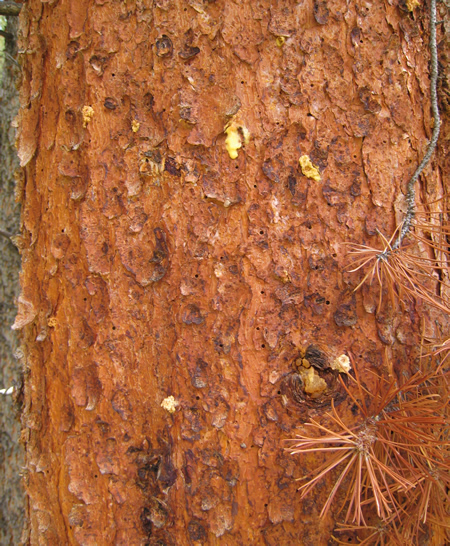
^ This tree is much closer to death, hence the red color (and many, many holes).

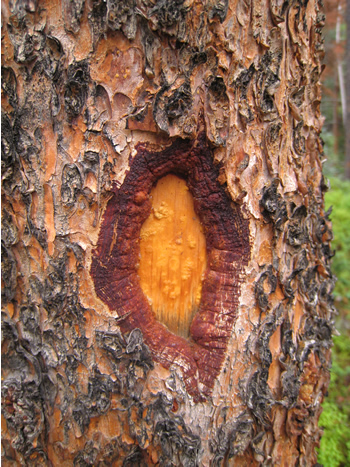
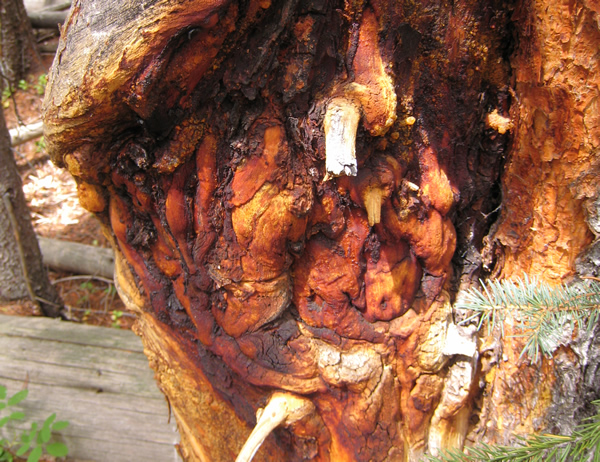
^ I don’t know what caused this, but it’s sort of pretty, though probably a bad sign for the tree.

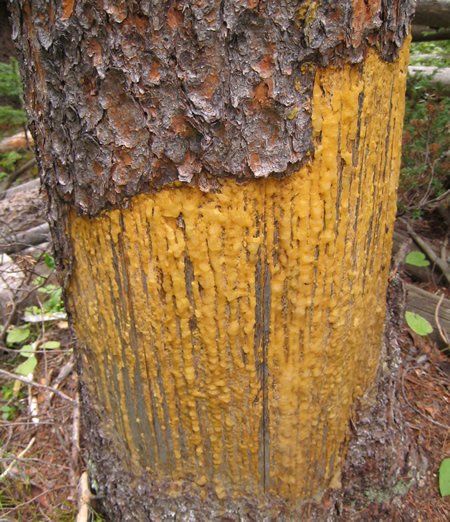
< Dunno what caused this, either. Possibly the bark was stripped off by rangers investigating the infestation.

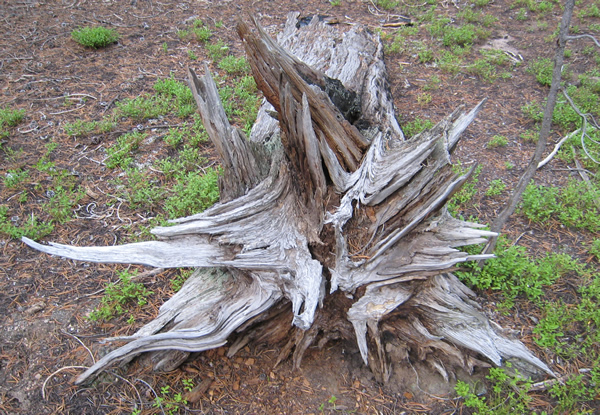
^ …and this one’s not beetle-related, but just plain scary!

This beetle attack has been going on for years, and many trees have fallen. By some estimates, 90% of Colorado’s lodgepole pines will be lost before this is over.
- Denver Post: Pine-beetle battle turns desperate
- High Country News: Global Warming’s Unlikely Harbingers

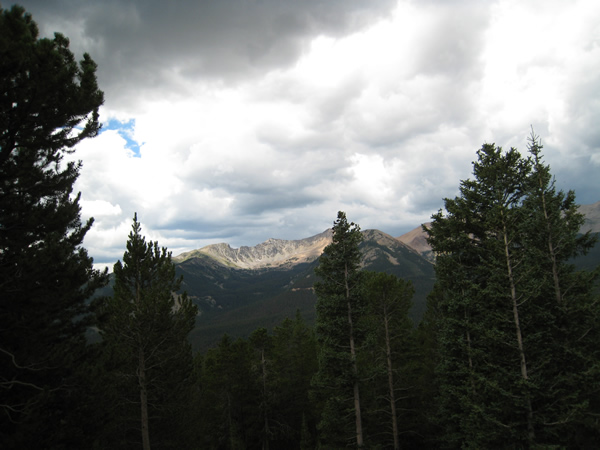
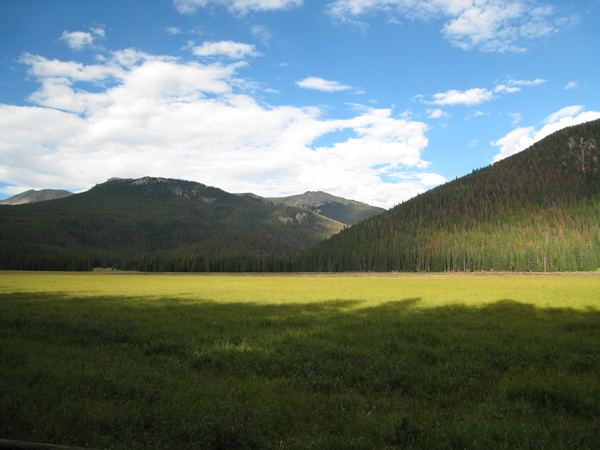
Of course there is still great beauty in the park, and always will be. Some areas are relatively untouched for now.

^ But reminders of tree death are everywhere.

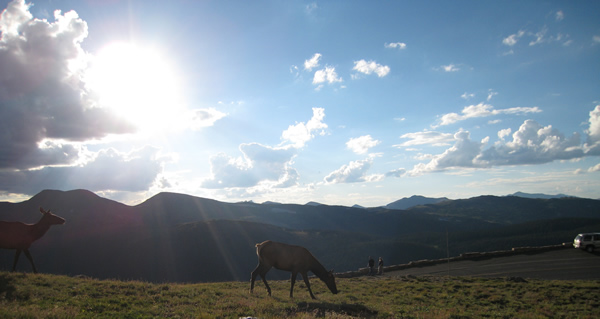
Apparently the increased sunlight to the forest floor improves the forage for elk, who certainly seem to be thriving – and completely unafraid of all the humans stopping to take pictures of them.

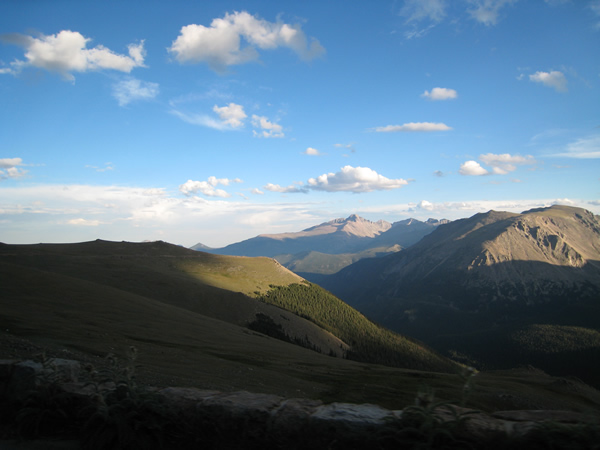
^ This was taken back on Trail Ridge Road, above the tree line, as we returned home in the evening. Very reminiscent of the high Alpine terrain in many parts of Italy – but this is higher.As for our hike… it took us three and a half hours to cover six and a half miles – not “easy” by any definition of mine! My knees and hips were screaming, although, fortunately, the steeper path was on the way up.On the way home we stopped in Estes Park for dinner. I had buffalo burger – bison is ranched for meat in this area, and widely available, even in the Sun cafeteria. It’s a flavorful meat, and supposedly healthier than cow beef. We also had a couple of excellent local wheat beer micro-brews.
San Lorenzo Dinner at the Symposium Quattro Stagioni: Arrival
I was one of a lucky group of people to win a dinner offered by San-Lorenzo.com as part of its marketing initiative Il Vino Lo Portiamo Noi (“we’ll bring the wine”). So what if the dinner took place halfway across Italy in le Marche? The Symposium Quattro Stagioni is one of Italy’s top restaurants, and the company at table seemed likely to be as enjoyable as the food.
My friend Susan was one of the group, so we travelled down together in the train from Milan Friday afternoon. Our friend Sara Piperita, the event organizer, was on a train that was supposed to leave earlier, but ended up leaving later. This did not bode well, as we were supposed to meet her in Fano to catch a ride to Cartoceto, the village where the restaurant is located.
We ended up waiting two hours outside the station in Fano, as Antonio Tombolini, head of web marketing for San Lorenzo, got stuck in traffic coming to get us. Travelling in Italy in summer can be absolutely miserable, no matter what means of transport you choose.
We reached the village with just enough time to check into our B&B and take showers, and change before we caught a ride to the restaurant with Roberto and Ludovica. The establishment proved to include lodgings, and a pool with a marvellous view.

As we waited for the group to assemble (18 people in all), chef/owner Lucio Pompili led tours of the wine cellar.

He explained that the bottles are wrapped in plastic to preserve the labels: a 1000-euro bottle of wine can lose 30% of its value if the label is ruined, and still more if it has suffered evaporation loss. (If the wine was 1000 euros good to begin with, I personally would not give a damn about the label.)
Sara’s husband Patrice, who recently qualified as a sommelier (in addition to his day job as a chemist), was in his element.