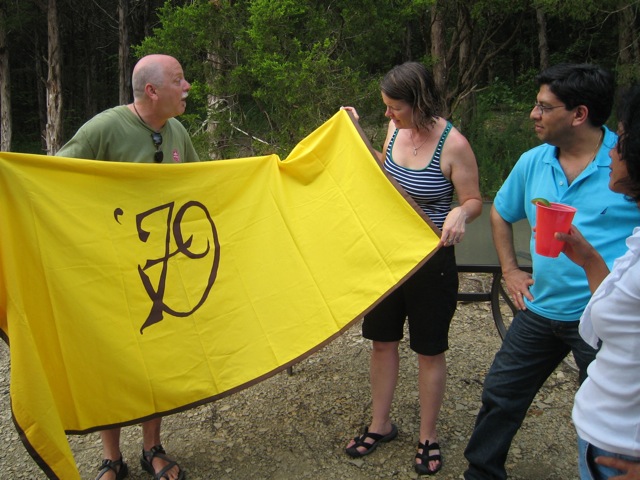
I just spent a fantastic weekend with a bunch of fellow Woodstockers (and their families) on houseboats on a lake in Tennessee.
Before my own classmates raise a protest: I am not actually a member of the class of ’79 – I graduated in 1981. Like most Woodstockers, I am fiercely loyal to my graduating class. But we all have friends in other classes, both older and younger.
I should also note that Woodstock School has nothing to do with Tennessee; it’s an international boarding school in the foothills of India’s Himalayas. This lake in Tennessee just happened to be a good place to gather a lot of people.
I was invited to the class of 79’s 30th anniversary reunion by James, one of the organizers, who had been my partner in crime for the “young people” portion of the WOSA-NA 2006 reunion in North Carolina. We so enjoyed working on that together that he extended an invitation to this one, for which I am very grateful – it was the perfect ending to the insane trip I have just completed (in the previous five weeks I had been to Brazil, New Zealand, Australia, and California, with the excuse of work).
The ’79ers extended their reunion to include former (and current) staff and other classes, as well as families of course. The result was a very lively group of about 85 attendees, ages ranging from infancy to retirement.
Thursday night, after filming for Sun at OSCON until 9 pm, I took a red-eye flight (no sleep!) which left SFO over an hour late, so I had to run for my connection in Houston. But I made it to Nashville on time to meet Hugh S., who would be driving me, Heather, and Heather’s son Sean to Dale Hollow lake.
Hugh had emailed a photo of himself, which was a good idea because I would not have remembered him (wish I had my old pictures of “A Midsummer Night’s Dream” handy). Heather, on the other hand, was instantly recognizable. It seems that, on average, the men have changed more than the women since leaving school.
We passed the two-hour drive in amiable conversation (with me nodding off here and there). Heather is in theatre in Toronto, and had recently done a piece at the FringeKids! Festival, a one-woman presentation of three of Kipling’s “Just So” stories, with accompaniment on tabla and digeridoo. Sean is a well-spoken young man, not at all shy of his elders, though I find his wearing black sneakers and black socks with shorts disconcerting – maybe it’s a Canadian thing?
Hugh, after teaching at Woodstock and elsewhere in the course of his career, now has a big long title at the University of Nebraska College of Medicine that includes “Assistant Dean”. ; ) He spends too much time at a desk, but wakes up at 4 am every day to go running. So we didn’t feel sorry for him having woken up early to catch a flight and then doing all the driving.
Upon arrival at the lake, we met some of our cohorts at one of several lakeside cabins that had been rented for the occasion. I was deeply grateful to Anita S. for lending her towel so I could take a shower – if I’m short on sleep, a shower helps me reset the day. I was so tired I was having trouble absorbing all the new faces and names (after this latest trip, my internal face database is way overloaded).
Out on the cabin deck, I talked with Rajeev Malhotra, whom I’d never met before, but whose name had recently come up in conversation… in Brisbane. Whoa. My world gets smaller all the time.
Though some were staying in cabins on shore, most of the group would be lodged on five houseboats, which had to be moved four miles down the lake. James, Kevin, Rick, and others had set out hours before to fetch them. The first to arrive was the non-air conditioned one that I’d be staying on along with Sharon, Steve, and their son Robin; Ken P. and three of his four kids; and Carol, her husband Dale, and their two teenage daughters.
Dale was instructed on how to pilot the boat, and many other pointers were given on how to live in it (which tap is drinking water, what you can’t put into the chemical toilet, how to swap the batteries…). I wasn’t absorbing much by this time. I crashed in my bunk (a double, which I’d be sharing with Sharon), but didn’t sleep much thanks to some excitable children running up and down the roof, demanding shrilly to know why they weren’t allowed to dive off it while the boat was in motion. I later got it sorted that two of these were Deanne and Benno’s Christopher and Vandana, the other their cousin (Stan’s daughter) Eva. (Yes, we had a boatload of Lehmans.)
We moored our boat in a cove and awaited the others, which eventually arrived in majestic array, complete with police escort (Wayne in his speedboat).
They all tied up side by side, so we had a little village of houseboats parked at a forested shore.
We all spent most of our time on and off these boats. For the land-bound folks in the cabins, there were hourly shuttles back and forth across the lake to join us. Kevin and Marty had brought their pontoon boat, and Rajeev and Wayne Carpini had driven 44 hours from L.A. so they could bring Wayne’s speedboat, which was kept busy with water skiing, float towing, and wave-making. The group also rented two jet skis and another pontoon boat. All this and plenty of lake to swim in kept grownups and kids alike as busy as they wanted to be.
James’ instructions to bring games and cards were almost superfluous, though they were useful at night – the teenagers played cards with M&M chips. Some of the kids knew each other from earlier class reunions, but in any case they all seemed to find plenty to do and talk about together. I suspect that being Woodstock kids gives them something in common, even if they haven’t (yet) been to Woodstock themselves (NB: there’s a tuition discount for children of alumni). I was only sorry that my own Rossella wasn’t along, but she was seeing her friends and father in Italy, and she’ll be attending plenty of reunions now that she’s an alumna in her own right.
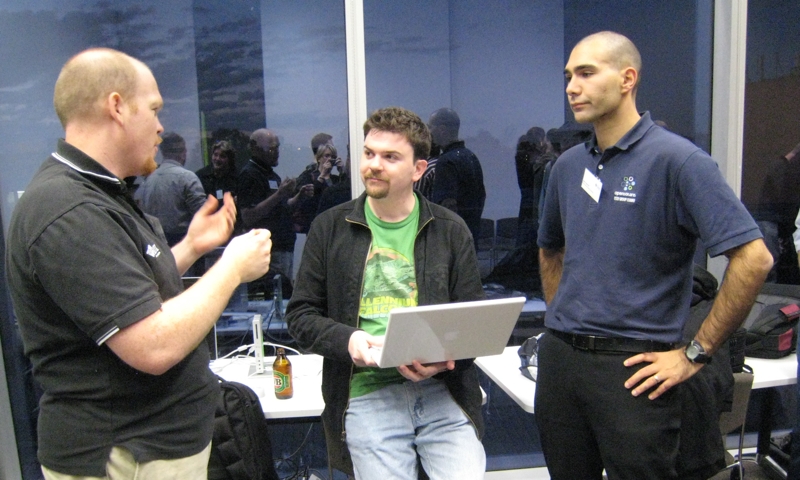
There was no need for scheduled activities. In or out of the water, we were all usually deep in conversation. Groups formed and reformed seemingly at random, but always found plenty to talk about. Pankaj had brought a guitar: part of one evening was spent singing old favorites. Firebugs Stan and David ensured that we had a good bonfire every night (the last night’s fire popped a cinder in my face – very lucky that I wear glasses).
Photos were shared… and shot (Tajchai had the biggest equipment):

At some point “Shadows” did get sung, but we didn’t make a big deal of it.
Conversations
There’s never enough time at reunions to talk with everyone you’d like to, but I find that anyone I talk to is interesting. Since I wasn’t a member of the predominant class and didn’t know or remember all of them well, I was equally happy to talk with their spouses. Kathleen (Stan’s wife) and I had a deep heart-to-heart in front of the campfire the first night. A superb chiropractor, she later adjusted me and many others.
Benno, Deanne’s husband, seemed usually to be looking for “the right room for an argument”, which I enjoyed. Among other topics, he didn’t agree with me and another Woodstocker (who was that?) that people deep down are fundamentally the same, with very similar needs and values. Maybe that’s a Woodstock thing; when you grow up living 24 hours a day with people of all stripes and persuasions, it seems natural to conclude that there simply aren’t many differences that really matter.
I caught up on as much news as I could, though there were many I missed (and I apologize in advance if I garble something).
Joe Pilaar’s Himalayan expeditions business continues to do well, and was recently featured in Anne is blogging about it – I have been remiss in not reading that. Other staff alumni present were Bud Skillman, and Peter and Peggy Jenks (and Sharon and Steve). Steve Alter
Anita L. is another geek like me, working as an IT consultant and supporting three college-age kids!
I finally got to meet Sadhana (Rick’s wife) who is a fellow member of the SAGE board. With Nathan and Sharon also present, we had a quorum for a meeting, but never quite got around to that. Talked a bit with Rick about ideas for Woodstock’s website, I need to dust off the Woodstock web strategy I started two years ago…
I’m sure I talked to many others, but can’t at the moment remember everything.
Reflections
One of many articles I have not yet got around to writing would be about the passion and intensity which Woodstockers bring to their lives and careers. Most of us are doing interesting things, with burning enthusiasm and a desire to make the world a better place. This doesn’t necessarily mean we’re doing what the school’s missionary founders would have called “service work”, though it often does. But most of us bring a service angle to whatever we’re doing. Can’t imagine where we got that from.
Most of us are storytellers, and all have amazing stories to tell. And, as Paul Hackney says, “Some of them are even true.”
The furthest-traveled for this reunion were Pankaj (who came from Melbourne with son Kartik) and Nathan T., who teaches in Saudi Arabia but is building a home in Lebanon with his Lebanese wife (and four kids).
Pros and Cons
Having a reunion on a lake was a fantastic idea (kudos Kevin, Marty and James) – the water was plenty of entertainment, the houseboats and campfire (and the famous “island”) provided natural “conversation pits” that people could move in and out of as they wished. Each boat had a slightly different flavor (the Lehman boat was famous for its mojitos, which I somehow missed out on, but I found the Maker’s Mark down the other end).
The lake also meant that people could stay more or less clean, so there wasn’t overwhelming traffic to the showers every morning. Quarters were a bit rough and certainly close (it’s been a long time since I shared a room with 7 other people), but that was fine for a weekend.
James took care of the food: he’d been buying, cooking and freezing for two months in advance. He, Paul, and Anita L. convoyed dozens of coolers from North Carolina, then the food was parceled out among the boats and cabins, with different groups taking turns at grilling, salad preparation, etc., so every meal got us circulating among the boats. There were ribs and hamburgers, but only some of them in traditional style: there were kebab burgers, katha-mitta (sour-sweet) ribs, satay burgers… Everything I got to try was delicious.
Having the event at a “wet” (in all senses) site was a big plus. A reunion is an occasion for reminiscing, drinking, and reminiscing some more; the habit of having the wider alumni association reunions at alcohol-free sites is counter-productive. In reality, very few of us belonged to non-drinking missions or would be offended by alcohol today. And it is possible to find reasonably-priced non-Christian sites. The general reunions are also an occasion to ask for donations, and organizers should keep in mind that people who are gently inebriated and misty-eyed with nostalgia have deeper wallets to donate from. ; )
Cons? There really weren’t any. I’d do this again in a heartbeat.