Note: This was listed in the catalog as “Social Media: If You Liked it, Then You Should Have Put a Digg on It…”, which I wouldn’t have bothered to attend, but when I walked by the room the title had changed to “Social Media: Connecting with Customers”, which was a lot more obviously interesting to me. This was also one of the few panels that didn’t seem to treat large corporations (and those of us who work for them) as the enemy.
Panel:
Chris Bowler – VP Social Media Lead, Razorfish (moderator)
Jordan Corredera -Â Director of Online Marketing, Carnival Cruise Lines
Paula Drum – VP Digital Marketing, H&R Block
Malini Ratnam – Digital Media Mgr, Avenue A/Razorfish/JCPenney
First, each panelist gave an overview on what their company is doing in social media (comments on the companies themselves are partly my own, for the benefit of non-US readers who may not be familiar with these companies):
H&R Block
Well-known in the US as a tax preparation service, H&R Block’s problem is that their business is extremely seasonal, running from January (they kick off their advertising season with the SuperBowl) through Tax Day on April 15th. They are trying to use social media to stay in the public consciousness year-round. The overall theme is customer connections to build lifelong relationships.
Tactics include:
a tax news widget for tax professionals
YouTube contests
online community
tax-themed content related to other times of year, e.g. back to school, company benefits enrollment periods
provide customer service via Twitter and Yahoo Answers
helping tax professionals participate in these programs as well
along with the Social Media Club, have organized/participated in Tweetups in 10 cities
JC Penney
Penney is a very old retail company, and is trying to overcome a rather musty reputation with younger shoppers: “Trying not to be ‘your mother’s store’.” They have chosen to actively participate in women’s online communities.
Their first big project is the extremely funny “doghouse” video (which I had seen long before this conference, though I had probably forgotten that it was done by JC Penney):
At the time it had had 4.1 million views with a 60% completion rate, resulting in 600 (new) Twitter followers and 1100 tweets/retweets. It was initially seeded from a Penney microsite using Facebook Connect. Traffic crashed the server and led to higher fees. Offloaded the traffic to YouTube.
They’ve also set up a Facebook group targeted to women, after finding that segmentation by Penney sub-brands did not work. And they’ve got a customer service Twitter account.
Someone asked what was the ROI on the doghouse video campaign. The answer was that brand awareness, not ROI, was the objective; a hard sell would not have been as successful.
Carnival Cruise Lines
In 2005, Carnival set up a group planning tool built on Community Server. The Cruise Talk forum there grew to 500 posts/day, and was followed by a “scrapblog” and a Twitter account with 1300 followers.
Then came a blog by John Heald, a cruise director, which has become immensely popular, as measured by 100 comments a day [visitor stats were not given].This has grown into a multimedia extravaganza including live chats, videos (quality was an issue), etc. Cruising is inherently social, so this has worked well.
[D here: This is an example of how effective social media marketing can be when tied to a real personality. You can also build community around that person: Heald fans want to talk to each other, there are now even Heald-themed fan cruises.]
Then the moderator asked questions:
How do you set up your organization to participate in social media?
H&R Block: You have to figure out where does this fit. Customer service, communications, marketing, field coordination…? The company isn’t yet on board, we’re still in a skunkworks phase. We’re trading off media dollars with human capital – we have only one person for Twitter, which is a 24/7 job. [But she said later that some resources are being shifted to social media.]
Also, the Federal Trade Commission is changing the legislation about blogging [as relates to professional tax preparers]. We’re still figuring out how to train people, what legal disclosures are needed. Ideally, we’d like tax preparers to be blogging. Education and support are difficult. People need to understand that it’s okay to have your own personality.
JC Penney: Similar situation, we have no dedicated social media team. [Some problem of] brick and mortar stores vs. jcpenney.com. Facebook took off for us when it became a two-way conversation, but that takes dedicated staff.
Carnival: We have an online community manager with two moderators and a social media strategist. Not seeing any particular efficiences from online yet.
How can we measure the results of social media?
Page views, links to transactions.
How does this tie back to brand? How do we make the brand relevant to the new generation?
Word of mouth as brand tracker, but it moves over multiple years.
ROI = Risk of Ignoring
creating spheres of influence, measuring awareness
Traditional ROI isn’t the be-all and end-all – Twitter is free! [except for staff time]
Use Radiant6 to monitor buzz.
Facebook charges $300k for a brand page – Carnival elected not to spend this. Buying a YouTube channel can cost $500k plus media costs.
But you can get started for free.
If you’re going to lead social media [teams], you have to be doing it yourself.
Content creation is expensive.
How might employee culture affect the use of social media in older companies?
An interesting question, but, frustratingly, I didn’t note the answers. Maybe there weren’t any.
D’s Conclusions
A good and useful session, one of the few at SxSWi to address the needs of large companies and their employees.
I was very frustrated that Sun was not speaking on this panel, as we have one hell of a story to tell in this space.
And, even absent Sun’s support infrastructure for blogs, wikis, and video, I could have told them that there are cheaper ways to do this stuff than what Facebook and YouTube are charging for branded offerings.
NB: I have long wanted to attend SxSwi – where the cool geeks go to party – and this year had my first opportunity to do so, thanks to Sun. This conference is great bang for the buck: registration cost only $450, for four days of good, solid talks. I’ve been meaning for some time to write about sessions I attended and what I learned from them, but time keeps getting away from me. Here’s the first in a series. I hope the next will follow in reasonably short order – but I don’t guarantee that!
Why I attended this session: I work with communities, both online and off. And Powazek is a well-known name in web design, which has been part of my career, so this confluence of topics was irresistible to me.
From my notes:
Surowiecki’s premise is that the aggregate wisdom of “the crowd” can be greater than the wisdom of a single individual (no matter how expert).
According to Surowiecki, the elements of wise crowds are:
diversity
independence
decentralization
aggregation
Powazek gave suggestions on how to make the wisdom of the crowd work online:
give small, simple tasks (e.g., one-click vote on Hot or Not) – This works best when there is a definite outcome, e.g. a Threadless shirt design is chosen. A grass-roots news site gave a list of desired interviewees, participants then conducted the interview(s) of their choice via email
try to have a large, diverse group of participants – This is a sticky point. The Internet is inherently a place where it’s easy for people of all kinds to congregate (absent language barriers), but we still clump with people who mostly think like us. It takes effort to create a truly diverse crowd.
design for selfishness: participants have to get something out of it for themselves, even just a chance to win. The “greater good” is not sufficient motivation. (But personal glory can be.)
aggregate results so that individual behavior (e.g., tagging) leads to collective wisdom
(However, there’s the Heisenberg Problem: scoring creates a game, and therefore an incentive to cheat.)
Popularity does not have to rule. Amazon’s reviews/ratings are displayed with a histogram of results, and readers can rate each review (“was this helpful? yes/no”), giving feedback on the feedback.
Consider both implicit and explicit feedback.
Implicit:
page views
searches
rate of change
interestingness
Explicit = voting and rating, but never ask people to do more thinking than they have to, e.g. use a simple yes/no or thumbs up/thumbs down wherever possible.
Note, however, that you get better data when you don’t ask the question.
Design Matters
Kvetch.com -Â The mood of responses became happier when the color scheme changed from dark to light.
Red vs. blue – In testing, people shown blue backgrounds responded with more imagination, while red backgrounds led to better attention to detail. This may occur because red is a danger sign, so people are primed to be more cautious when they see red, whereas blue is calming, so they feel freer to be creative.
(Sun’s corporate theme color is blue, Oracle’s is red. Uh oh.)
This is relevant online because we have much less input than in real-life social situations. Virtual communications like email, blog comments, and instant messages come without the associated social data our brains are used to. In the absence of context, our brains fill in the rest. What we fill it in with is a byproduct of our own insecurities.
My own thoughts on this:
If you’ve spent much time interacting with people online in email, forums, blogs and comments, you know how easy it is misunderstand someone’s character or intentions when you only know them through text.
Misunderstandings can occur because of differences in language, culture and writing skills, as well as the above-mentioned human propensity to fill in our mental gaps with worst-case assumptions. We are especially negative in our assumptions when we don’t feel in control in our own lives – and, these days, who does? The result is flame wars and other online unpleasantness that simply doesn’t happen in real life.
In my first distance-working experience, I also learned that it’s hard for human beings to work with someone they’ve never seen. I suspect that we don’t quite believe someone is real until we’ve seen them face-to-face. In my six years working from Italy for a Silicon Valley company, I noticed that colleagues were poor at responding to me until they’d met me once (I traveled to California four times a year), then their attitude would change radically. It wasn’t that I did anything particular on my visits to inspire cooperation; it was simply that they now could put a face to the emails and the voice on the phone. I guess that’s human.
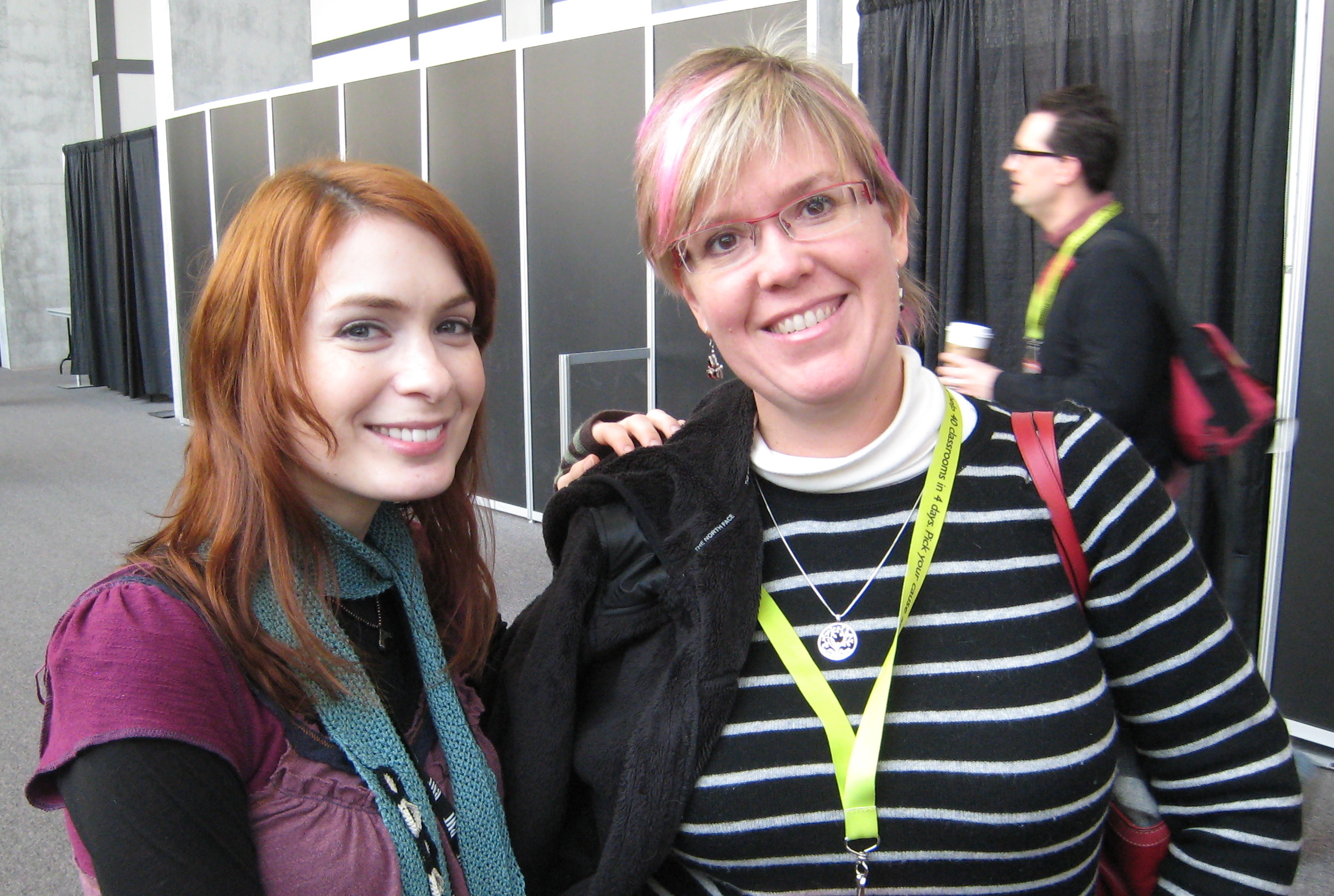
Conversely, we can have warm feelings for people we’ve only seen on screens. I have twice now embarrassed myself meeting actors in unexpected contexts, the first at CES, and, more recently, at SxSWi itself: I was wandering the halls when I saw a familiar face. This wasn’t unexpected at SxSWi; videoblogging buds and other folks I know were there. So my brain registered “someone I know and like,” and I rushed up to greet her with an enthusiastic “Hi!” before my memory kicked in with: “You know her from Buffy and Dr. Horrible.” She was completely unfazed; I’m sure this happens a lot to actors.
All this is why I’ve encouraged the Sun teams I’ve filmed to shoot brief introductions of themselves to share online: if you’ve seen their faces and heard their voices in video, you’re more likely to treat them kindly when responding to their text (e.g. in an online forum). And it’s easier to feel a sense of community, kinship, and cooperation with people you’ve seen and heard, even if only via recorded video.
The next step is to get video from non-Sun members of our developer communities. Working on it!
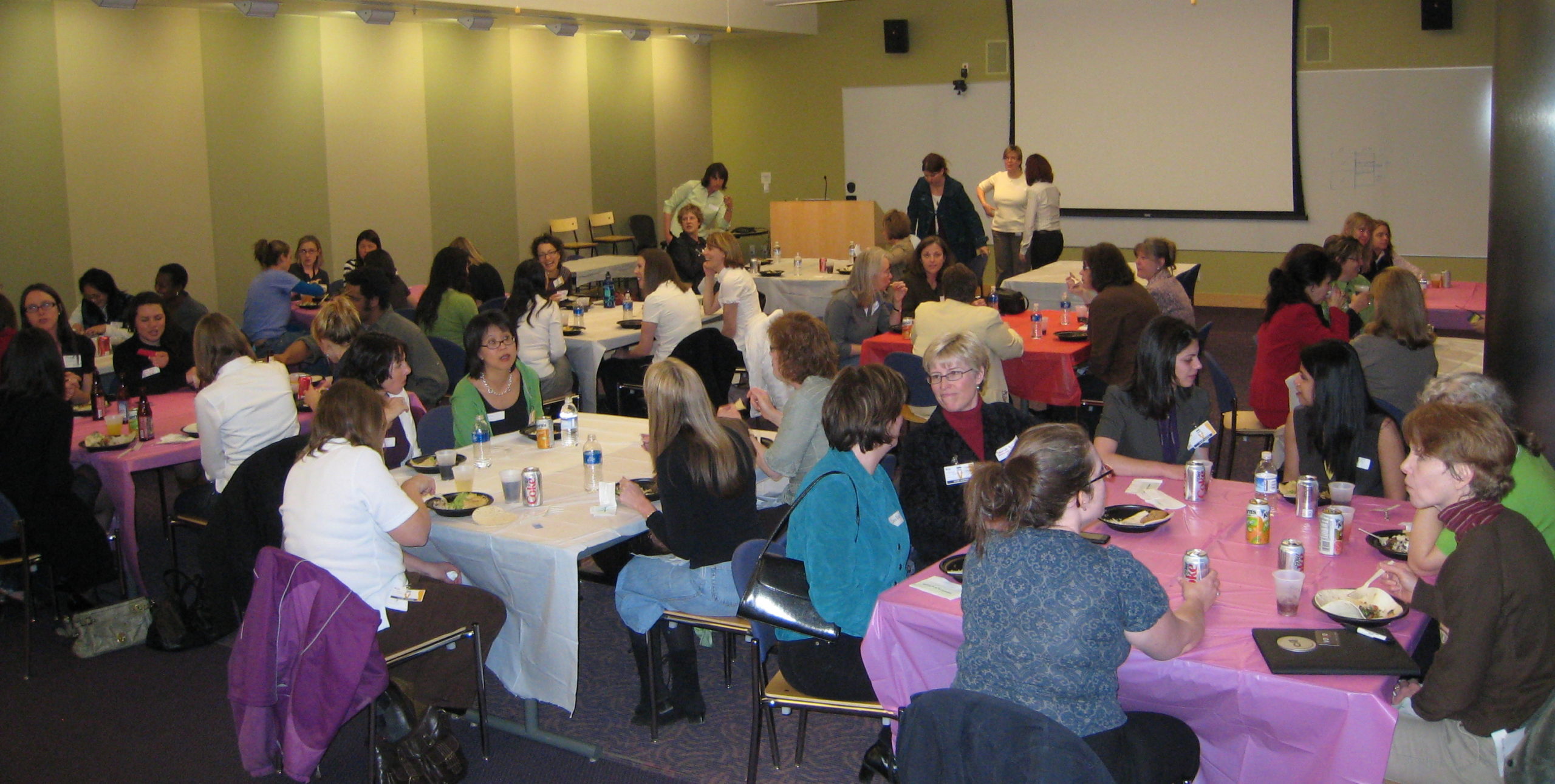
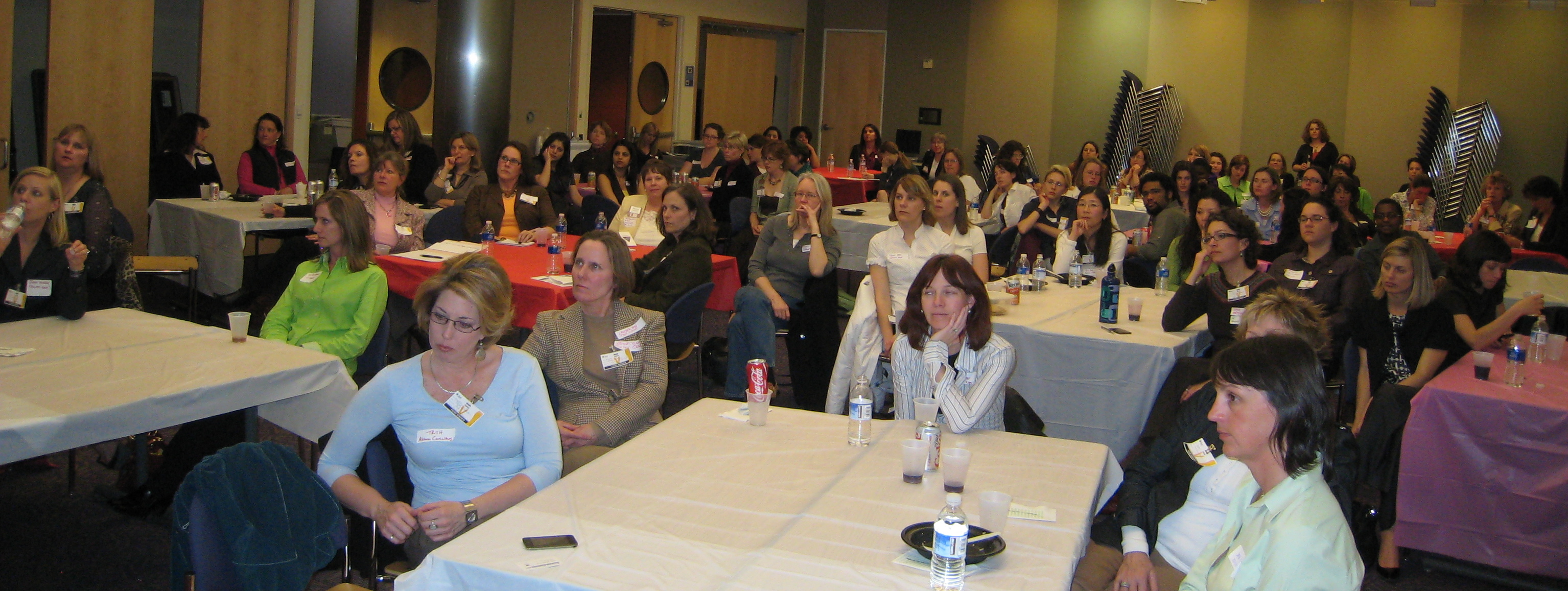
The first Colorado Front Range Girl Geek Dinner was held on Thursday, March 5th, on Sun’s Broomfield campus. More than 80 people attended, only one of whom was (a very brave) male.
Sun sponsored this first one with food, drink, and venue. There was plenty of interest from other individuals and businesses in helping with the next (contact me to be put in touch with the now-being-formed committee). Thanks to the many who helped spread the news (including Jeremy Tanner, who helped get the word out to startups and other smaller businesses). We had at least 80 attendees (probably more – I don’t think we caught quite everybody at the registration desk), and were in touch with several dozen more who couldn’t attend on this particular date but definitely want to participate.
With this kind of momentum, I think the next CO FR GGD can take place in about two months (but I’ll be leaving it up to others to organize that one as I expect to travel heavily from now through July).
The atmosphere in the room was electric and inspiring, and I hope was encouraging for those who had recently lost their jobs (or fear they might soon). Women helping women can be a powerful resource in the workplace, and that’s what Girl Geek Dinners are about.
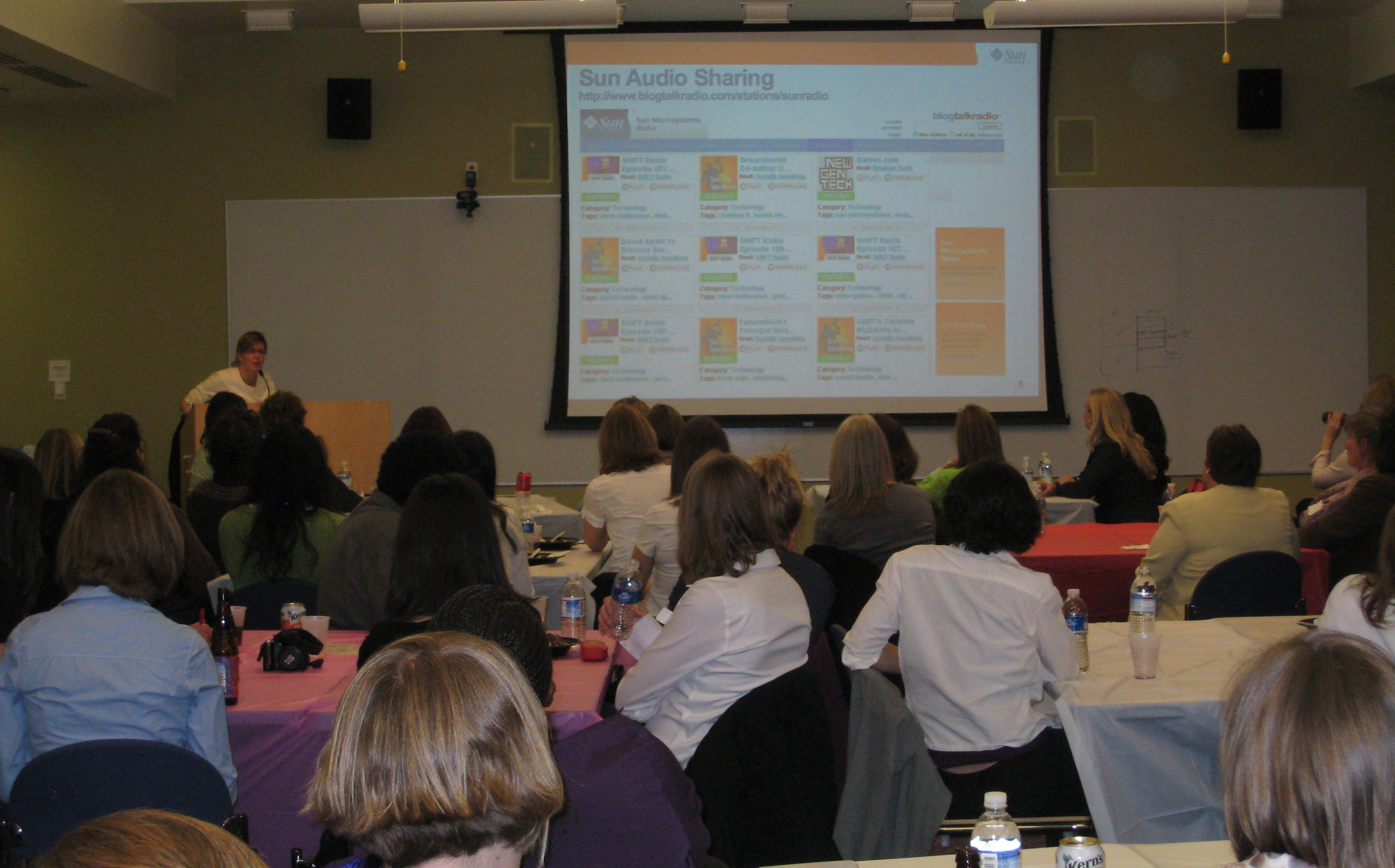
^ listening to Linda, the “voice from on high”
Linda Skrocki put together a presentation which I ended up delivering (with her participating by phone) because she was home with a flu and didn’t want to infect the rest of us.
Our aim was to showcase Sun’s many activities in social media, in order to illustrate how other companies and individuals can use social media to enhance their own brands, win friends and clients, and influence people. Social media is important in just about any job these days, so I hope the information was useful to other women wanting to add to their work skills.
I noted a lot of interest in the room at the idea of managing one’s personal brand and identity online; that might be a topic for a future talk. One attendee wanted to talk more with us about Sun’s “radical transparency” in relation to a project she’s working on. And it seems that people want to hear more about videoblogging, which of course I’m happy to discuss anytime.
My only (personal) disappointment was that I was so busy running the show, I had very little time to talk with anybody – and there was a roomful of fascinating women I’d love to know more about. I look forward to making up for that next time!
Thanks to Kristin Tulp of Level3, we had TV coverage, with a segment by Jodi Brooks of CBS4 news (Denver) on Friday night. As part of a series on “Beating the Recession,” the piece talked about how we “Geek Girls” are rallying together to help ourselves and each other in a hard job market. I don’t know whether the segment will be posted on their site. Perhaps if enough of us ask them…? Here’s the transcript: ‘Geek Girls’ Gather In Broomfield For Networking
In case you’re wondering about the title: Jai Ho is the Oscar-winning song from the end titles of Slumdog Millionaire. The song’s composer, A.R. Rahman, says that Jai Ho translates as “May victory be yours.” Which seems to me a fitting benediction for my fellow girl geeks.






 .
.