Category Archives: food

In the Kitchen at Spankyville

Julia’s grandmother’s recipe for Chinese barbecued ribs, AKA “Sticky Chewy Ribs,” as demonstrated by Julia in her gorgeous new kitchen, presided over by the ghost of Spanky.

Including the amazing KitchenAid mixer, custom-airbrushed with red hot chili peppers!

buy the music

Good Food in Austin

No one should go to Texas without eating Mexican food, and we were fortunate to have my cousin Guy’s guidance to the good stuff. We ate at El Mercado (on Lavaca), some of the best Tex-Mex I’ve ever had. Standard enchiladas and fajitas, but the enchilada sauces (one green tomatillo, one red) were amazing.

We had Sunday brunch at Chez Zee, sitting at the bar because there was a half-hour wait for a table and I didn’t want to spend two hours on a meal. While trying to find decent food over Valentine’s weekend, I had occasion to reflect on the fact that it’s rare to wait for a restaurant in Italy – I can’t think of a single time we’ve done it, perhaps because, if a given restaurant is full, there’s always another great one nearby. Not always the case in the US. Chez Zee might even have been worth the wait, but eating at the bar was fine, especially as we were right behind the talented jazz pianist/singer, to better enjoy her music.

During our wanderings, Ross and I lunched one day at the Kerbey Lane Café near the UT campus, a great place for healthy food (including vegetarian). For one dinner we went the opposite route, with fancy steaks at Dan McKlusky’s. The food was very good, but the dining experience was spoiled by our fellow diners. Due to some weird acoustics where we sat in the front corner, everything seemed very loud, especially from the next table, where a man had invited two people for a business dinner in hopes of “getting your thoughts on this” (some business proposition). I don’t think he got many of their thoughts, because he did 99% of the talking himself – loudly – and we all learned far more about him than we needed to know. Lack of sensitivity to others is a common handicap among computer geeks, which he evidently was (his tales included his early days on punch-card machines and more recent excitement at visiting the world’s largest flight simulator facility). His daughter was student president of something or other at the University of Houston; evidently she is more astute in dealing with humans than her father is.

Our best meal was at the home of Julia and Dani. Julia is a friend of my old friend Barb. Thanks to Barb, she has been reading my newsletter for some time, and we’ve occasionally exchanged emails about something I’d written. So when I knew I was coming to Austin, I dropped her a line, and she invited us for dinner. “Spankyville,” as they call their place (named after their cat Spanky), is one of the most comfortable homes I’ve ever been in. Comfortable in the sense of a nice place to be: as soon as we walked in, we knew that we were among friends in a house full of warmth. It’s hard to explain, but a few rare places in the world make you feel that way. And we sure needed it right then.

The Chinese/Mongolian hot pot dinner was great; it’s a tradition in Julia’s family ever since her father, years ago, invited the entire Chinese Students’ Association of Texas Tech home for Thanksgiving dinner.

cooking at Spankyville

Moghul Shredded Chicken Curry

^ These are all Indian cookbooks that I own and use.

To make the chicken broth for the scripelle, Enrico had boiled two chicken thighs. Which meant I had lots of cooked chicken, plus leftover white rice from several previous meals (I always manage to overestimate how much rice everyone will eat). So Saturday night I made Moghul Shredded Chicken Curry, from Royal Indian Cookery. The recipe calls for steamed chicken breasts, but boiled thighs worked just as well. I pulled all the meat off the bones and shredded it, then:

  • fry 1 tbps cumin seeds in ghee or oil for 1 min
  • add one chopped onion, cook til soft
  • grind into paste 2 cloves garlic and a 1-inch cube of fresh ginger (actually, I used the food processor to chop very fine, not quite the same as paste…)
  • add to the pot with cayenne pepper and 1 tsp turmeric
  • in a separate pan, fry a finely chopped small onion in oil til brown
  • food-process this, along with 1 cup cashews, 1/4 cup blanched almonds, 2/3 cups dried coconut, into a fine-ish crumble
  • add to main pot, stir for a few minutes, add about 1/3 cup water, cook low for 5 minutes
  • add 1/4 cup yogurt and 1/3 cup raisins (previously soaked in water to soften), and salt, cook some more
  • add chicken, cook another 10 minutes or so

The recipe calls for a garnish and a final two tbsps of cream, but I didn’t bother – with the yogurt, it was plenty creamy. Along with this we had the leftover rice (I bought a microwave this year mostly to heat pasta and rice in) and a simple dish of green beans and peas (clearing odds and ends from the freezer!) with coriander, another Madhur Jaffrey recipe. And lots of chutneys.

Making Chutney

I had been saying all summer that I was going to make tomato chutney during this season, while the tomatoes are at their best – and, in Italy, that is very good indeed! My favorite fruttivendolo was selling pomodori ramati – tomatoes on the vine – at 3 euros for 3 kilos, so I bought 3 kilos (~ 10 lbs.).

I first scalded all the tomatoes, in batches, in boiling water for 15-30 seconds, lifting them out with a slotted spoon and letting them drain and cool in a colander. When they were cool enough, I peeled them (at this point, you can just strip the peels off with your fingers), chopped them, and removed most of the seeds – this is a personal thing, I just don’t like the seeds. If you don’t care, you can leave them in.

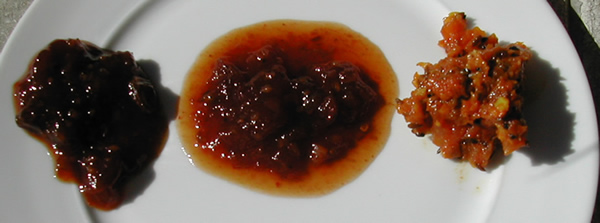
3 kilos is a lot of tomatoes, so I decided to make two different kinds of chutney, both from Madhur Jaffrey recipes. First was a Hyderabadi chutney – very peppery and garlicky, a bit yellow from turmeric. Unlike most of the chutneys I’ve made so far, this one is sauted. It is tasty, and VERY hot.

The bulk of the tomatoes (2.3 kilos) I used for my usual sweet tomato chutney, again a Madhur Jaffrey recipe. I can’t find online the exact recipe I’m using, but this one is similar – just use fresh tomatoes prepared as described above.

This recipe calls for cooking the tomatoes in vinegar and sugar, with lots of minced garlic and some spices and salt, for about an hour and a half. The recipe calls for raisins, which maybe help it densify (is that a word?) faster, but I decided to leave them out since I still have a batch of apricot chutney made a few weeks ago, with raisins. So the cooking time got longer, and it got slightly burned on the bottom before it really got dense enough. But I picked out most of the black specks, and they don’t seem to affect the flavor, which is sweet, sour, and garlicky, all at the same time.

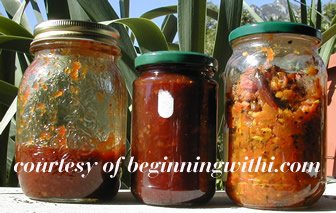
chutney jars

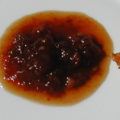
The pictures show all three chutneys – apricot, sweet tomato, and spicy tomato. Hmm. I still have some things to learn about food photography. The first two will go well with cheeses – aged and sharp cheeses such as parmigiano for sure, and probably with some kinds of pecorino (sheep’s milk) or caprino (goat’s milk) cheese as well, especially aged ones. The third one is more like a relish; I’ll have to see what it goes well with, though Ms. Jaffrey says it “could brighten up almost any meal.”

Craving Flavor

New studies every year show that Americans are becoming fatter and fatter. It’s something Europeans remark on every time they travel to the US (and Canada): “I saw more truly obese people in one trip to the supermarket than I’ve seen in all my life in Italy!” an Italian friend said to me.

Conversely, Americans are amazed that Italian food is so wonderful, and Italians eat so much of it, yet there are relatively few overweight people here. What’s the secret?

I think it’s the quality of the food. In Italy, the things that are good for you (fruit, vegetables, fish, pasta, bread, lean meat) are full of flavor, and taste wonderful with very little alteration. A salad gets a dressing of olive oil and balsamic vinegar, because that’s all it needs – you don’t want to drown the natural flavors in heavy, globby sauces. Meat and fish are lightly grilled and served with a squeeze of lemon juice, maybe a dash of olive oil. Pasta is accompanied by rich sauces, but only enough so that the noodles are coated lightly – not swimming. You might have a spoonful of sauce left in the plate when all the pasta is gone, just enough to mop up with your bread and relish to the last drop.

In America, fruits and vegetables have been bred to be transported. They have to survive the journey in trucks from California to Maine, and still look good on supermarket shelves when they arrive. As far as the producers are concerned, flavor is unimportant. American consumers have accepted this logic for years, buying for looks and apparently not noticing that their food has almost no flavor.

Picture the average supermarket tomato in America: it’s large, evenly-shaped, firm, shiny-skinned, in color a pale pinky-orange. The flesh inside looks like crystals of pinkish ice. And the taste? A mouthful of cold, dull mush.

On my first visit to Italy, Enrico (now my husband) and I visited a friend in Firenze, who took us to eat at a workers’ restaurant. The food was simple, but very good. Enrico was amused by the irony of an American capitalist eating lunch in a hotbed of communism. I was mesmerized by the tomatoes. It was summer, the height of tomato season, and these tomatoes were so red they were almost fluorescent (to match the politics, perhaps). And the flavor, ohmigod the flavor! I ate a huge plate of sliced tomatoes with just olive oil and a pinch of salt.

Between 1994 and 2001 I lived in Italy but travelled to the US a great deal, sometimes staying for extended periods. Every time I was there, though I ate portions that seemed normal for me, I gained weight. When I was able to cook, I tried to reproduce the simple meals I make in Italy, but had only limited success.

I realized that I was eating more fried and sweet foods, and heavy sauces and dressings, than I ever did in Italy, because I longed for flavor. We all crave tasty food, and find it more satisfying, portion for portion, than dull food (if this weren’t the case, we could all live on crackers and oatmeal). When the foods that are good for us don’t satisfy our cravings for flavor, we dress them up with sugar and fats, to keep our tastebuds happy. Thus we get fat.

Is there a solution in reach of American consumers? Probably. As a first step, Americans are already becoming more food-conscious, more interested in flavor and quality, and willing to pay for it. Farmers’ markets are available in many places, and are usually your best bet for finding truly flavorful fresh produce. Once found, resist the urge to dress it up or drown it; learn to like vegetables the way God made them.

Yup, that’s my lesson for the day: eat your veggies.