My birthday present this past weekend was a trip to Bormio, to indulge in the natural hot spring water as we have before. Enrico and I left Saturday morning, while Ross was in school – we are thankful that she is now old enough to be left home alone from time to time!
To get to Valtellina, you head north from the top of Lake Como and turn right. It’s a deep valley surrounded by high, rocky mountain faces.
As we neared Sondrio, where most of Valtellina’s wineries are headquartered, we debated whether to try visiting any, though I knew from recent research that none offered Saturday visits without advance reservation. But we decided to try Nino Negri, the area’s biggest wine producer, whose offices are a recently-refurbished 14th century castle.
The lady at reception was willing to sell us some wine, but, as expected, said we couldn’t have a tour of the cantina without a previous reservation. While we were choosing a dozen different bottles (including some new to us, one completely new developed to celebrate the re-opening of the castle, and the Novello that I enjoyed so much a few years ago and never was able to find again), I mentioned to her that I had emailed recently about the possibility of a visit. As I suspected, she was the same woman I had corresponded with. I talked about my website and how we had met Casimiro Maulé, the enologist and managing director of the Nino Negri winery, some years before.
“I’ll go see if Dr. Maulé is still around,” the lady said. “He was here just a minute ago.” He was, and gave us an hour-long tour of the cantina, with a head-spinning recital of facts and figures.
What I took away was that Valtellina before the 1900s was one of Italy’s chief wine-producing regions – da Vinci centuries ago mentioned that the area produces “wines that are very strong – and how!” The phylloxera plague that destroyed most of Europe’s vines took a heavy toll on this region as well, from which it has not yet recovered its previous glory. Nino Negri, founded in 1897, is the largest producer in the area now, thanks to Dr. Maulé’s talents as both enologist and businessman… and I will write more about all that when I have time to go into the details.
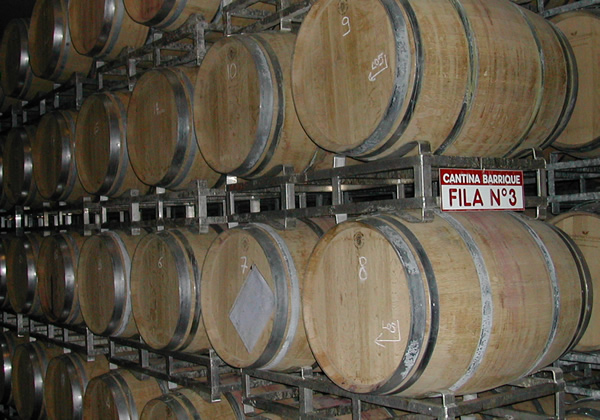
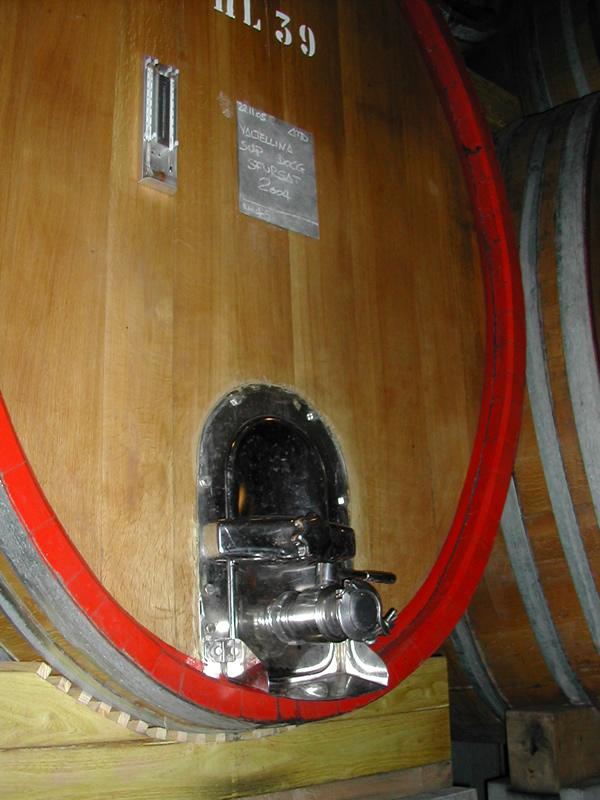
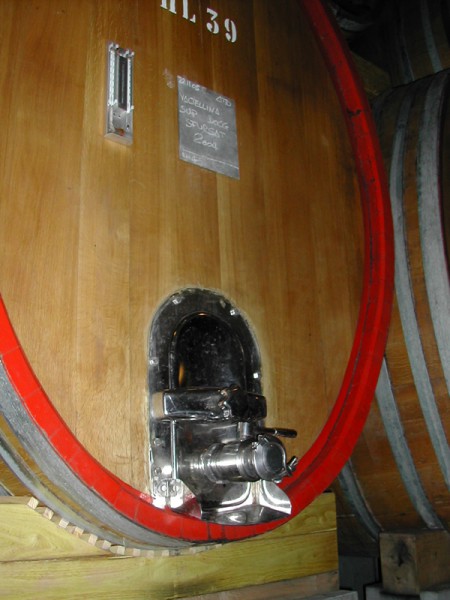
wine being aged in wooden barrels (barriques) for additional flavor
The winery goes several stories down, covering a city block or more underground in cavernous vault-ceilinged rooms and long, sloping tunnels. On a Saturday, no workers were around, and an eerie silence reigned in which it was easy to concentrate on the all-pervading odohuger of wine – unfamiliar and sour at first, then overwhelming and heady in the room where the first “cooking” of the grapes takes place in big fat stainless-steel tanks.
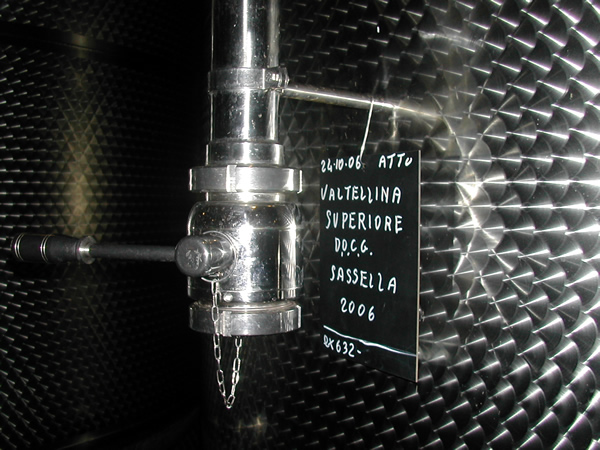
Other rooms contain rows and rows of wooden barrels two or three meters in diameter, or rows of stainless-steel fermentation tanks, and other equipment, all of which Dr. Maulé explained in every kind of detail – the tour was an education in both the art and the business of wine-making.
You can arrange your own tour, including tasting (and, of course, buying), Monday through Friday from 8 to 12 and 14 to 18, Saturday from 9 to 12:30. Call the winery in advance on 0342 485211 (or write to negri@giv.it) to arrange it, especially if you will need a tour in English as they have to get someone in for that. Nino Negri is located in the town of Chiuro, just outside Sondrio, in Via Ghibellini 3.
(NB: I hope to be able to report on other Valtelline wineries in the next few months.)
As we prepared to leave, it was nearing lunchtime, so we asked Dr. Maulé to recommend a restaurant on the way to Bormio. He said that it would have been easier to recommend one in the other direction (Chiavenna): Lanterna Verde, Passerini (where Enrico and Ross have eaten once before – they tell me it’s good) and il Cenacolo, which we hadn’t heard of and will have to go try sometime. He was less pleased about the options on the way to Bormio, until he remembered a place in Grosio, a hotel called Sassella with “Ristorante Jim” attached, which proved to be an excellent choice.
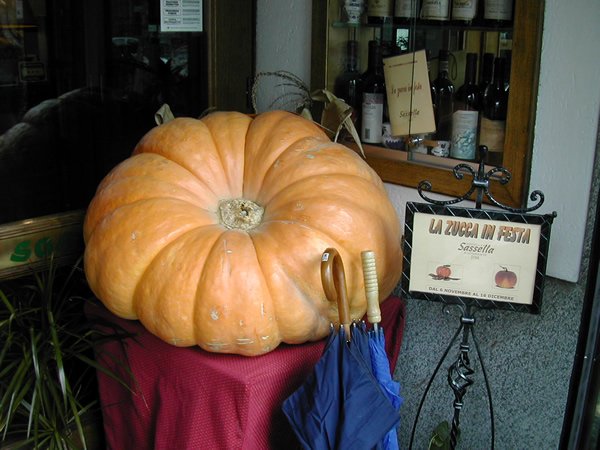
Jim (named after found Jim Pini), in addition to a very interesting general menu, was offering a “Festival of Pumpkin”, which made me very happy – I adore pumpkin. The little welcoming taster was two different yummy pumpkin-based spreads, with a basket of very good whole-wheat bread. I then had a mixed platter of pumpkin based antipasti (some good, some a bit strange).
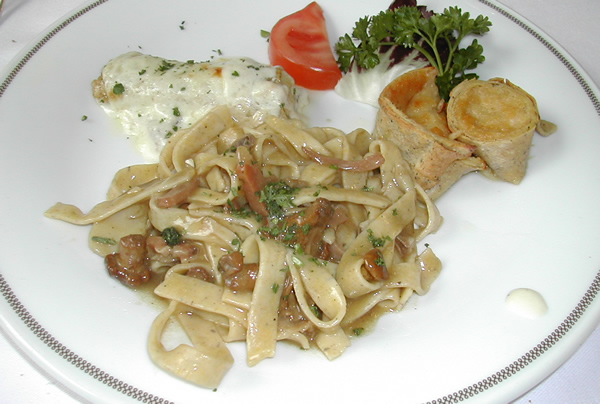
For our first course, we had a trio of local specialties (clockwise from upper left):
- Toscanei di baita – a whole-wheat crepe with creamy melted cheese inside and out, toscanei being the name of the crepe while a baita is a mountain hut where cheeses are made.
- Manfriguli alla Grusina – manfriguli are another type of whole-wheat crepe (Grusina derives from Grosio, the name of the town), this time filled with a mixture of breadcrumbs soaked in milk and grated cheese. These are sliced into rounds and then gratined in the oven to a crisp brown.
- Bastardelle di Fraina in Salsa Alpina – bastardelle are whole-wheat ribbon pasta (I have no idea what Fraina means), in this case served with an “Alpine” sauce of pancetta (bacon) and wild mushrooms.
We were full after all that, but there were so many tempting secondi on the menu that begged to be tried. Jim is a Ristorante del Buon Ricordo (part of the “good memories” restaurant group) whose signature dish is cervo (venison). But the Piatto del Buon Ricordo was an expensive piatto unico (single-course meal) that included gnocchi, and I’d already had enough pasta. So I ordered a costoletta di cervo (venison rib steak), which was somewhat disappointing – it seemed very heavy. I might have enjoyed it more had I not already eaten so much.
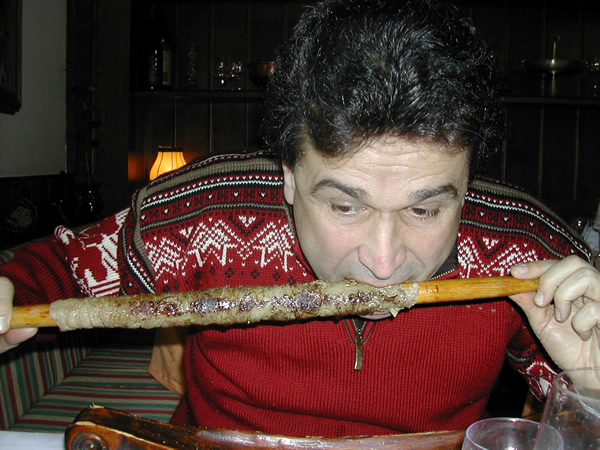
Enrico made the better choice with a bastone (stick). This was a wooden rod wrapped in a thin layer of pancetta, then a thin layer of beef, and cooked on the piotta (or pioda), a heated stone – a local tradition. Designed to be eaten, as the waiter said, alla primitiva – primitive style:
Seated by a window at street level, we were startled to see a procession of priests and other men/boys in vestments, carrying tall golden croziers – and one carrying a pair of loudspeakers on a pole. “Don’t be scared,” said the waitress. “It’s just a funeral. They’re going to pick up the body from the house. There are only 5000 people in this town and they all know each other so, since it’s Saturday afternoon, everyone will turn out for the procession to the church.”
Sure enough, we soon saw a parade of townsfolk going in the other direction. “They take the old people first,” explained the waitress, “to make sure they get seats in front.”
We finished off our meal by sharing a pumpkin-apple-chocolate cake with pumpkin ice cream and amaretto (dessert goes into a different compartment in the stomach, right?), then coffee to brace us for the drive on to Bormio. The whole meal, including a half-bottle of wine (Inferno; the entire wine list is from Valtellina), cost only 69 euros – a steal by today’s standards. There were many other intriguing items on Jim’s menu – we’ll be going back.
Another thing we’ll be going back for, leaving from nearby Tirano, is the Rhaetian Railway, a little train that goes up the Bernina Alps, reportedly the highest railway in the world (or something; at any rate, it should be a beautiful ride).
We reached Hotel Miramonti in Bormio around 4, and I immediately had to try out the big tub in our “junior suite,” which had a lovely (if somewhat head-endangering) sloped wooden ceiling with heavy beams. We took a nap to sleep off some of that lunch, followed by a walk around downtown Bormio – which didn’t take long, especially as some shops and restaurants were closed. Bormio is mostly a ski resort, and it’s not quite ski season there yet – even less so than usual as this month has been unseasonably warm and dry.