One of the activities at the Open Storage Summit party was to have our portraits drawn by talented caricature artist Doug Shannon.
I’ve been thinking lately about the differences between videoblogging and professional video.

One of the activities at the Open Storage Summit party was to have our portraits drawn by talented caricature artist Doug Shannon.
I’ve been thinking lately about the differences between videoblogging and professional video.
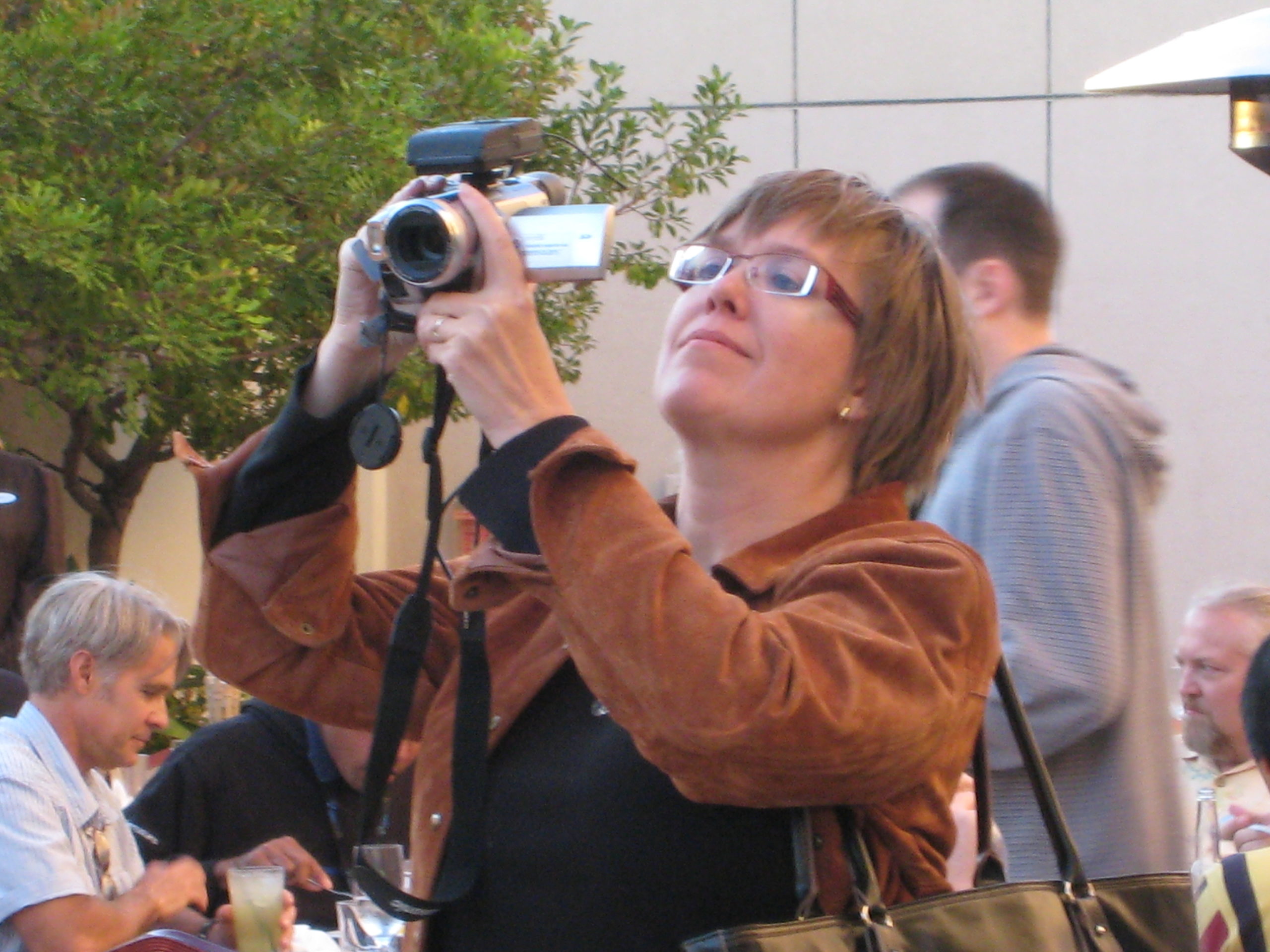
^ filming at the Open Storage Summit after-party
I don’t claim to be a professional videographer (for one thing, I’m entirely self-taught). I do videoblogging, which is fundamentally different.
From my (very limited) experience, it seems that professional corporate video is, usually:
Videoblogging, on the other hand:
My life is lived in multiples.
I’ve read books, articles, and blogs about multicultural marriage, living, and child-raising. I have written about being a third-culture kid, raising a bilingual child, and living and trying to work in a foreign country.
But this is the big question, more difficult than any of the above: how can a marriage survive being made up of two people whose careers are equally important to each?
If you have ever been part of a two-career couple, you know how hard it can be to find jobs that make both of you happy in the same location, especially (but not only) when that location is far from home for one or both of you. When a couple expatriates for one member’s job, the “following” spouse may not even be allowed to work, depending on the working spouse’s visa in the foreign country.
When you follow a foreign spouse to settle in his or her country, there probably won’t be legal obstacles to your working (you may take on the citizenship of your spouse, or you can usually get a work visa), but there are many other hurdles: language, culture, job market, and your own feelings about who you are and what you want to do with your life.
When Enrico and I married in 1989, I gave up an interesting job just then getting off the ground (doing technical training in far-flung countries) in order to be with him in New Haven and give birth to our daughter. In retrospect, my “accidental” pregnancy was probably subconsciously designed to resolve our increasing conflict over my exotic (and from Enrico’s point of view, dangerous) travels: a baby was a reason we could both agree on for me to stay home.
And stay home I did: I was mostly a full-time mom for 18 months. I did not resent or regret this; indeed, one reason that I never had another child was that I would have wanted (and felt it fair) to do the same for any other child of mine, but, once I had got my career off the ground again, there was never a “right” time to take off 12-15 months.
Moving to Italy was, for many reasons, the obvious thing to do when we did it. Though Enrico, fresh out of a Yale PhD, could have landed a university position somewhere in the US, it would have been the usual long start to an American academic career: post-doc here, assistant position there, teach a lot, and pray for tenure.
The situation is very different in Italian universities: a ricercatore (researcher, the entry-level position) can stay in the same place as long as he or she desires, although (ideally) you eventually move up the ladder to become professore associato (associate professor) and then ordinario (full professor). Positions are few and promotion takes decades (and political savvy), but in the meantime you are guaranteed a stable, reasonably well-paid job in a single location. The teaching load is light, and Enrico can direct his own research as he pleases. Nice work if you can get it…
As for me, I didn’t have a strong desire to remain in the US, my putative homeland – I’d lived out of it as much as in it. I didn’t have a job to leave right then, nor was I established in any field. There was no strong reason for me not to move to Italy, and plenty in favor of doing so.
Enrico sought and won a university position in Italy, and to Milan we came.
I had no idea what work I might be able to do there (aside from the far-too-obvious: teach English), but I figured I’d figure something out, as I always had. In 26 years of being moved around the world mostly by others’ decisions, it had never occurred to me to express or even to have strong desires about the parameters of my own life. I simply responded as best I could to the situations in which I found myself.
It was mostly luck that I found a job in Milan; it took hard work and talent to develope that job into a career. But I was still in reactive mode: taking advantage of opportunities as they came my way, but not making any effort to create my own opportunities. It simply didn’t occur to me that I could.
The first proactive thing I did to influence my own future was the MBA (from the Open University, the world’s oldest distance-learning institution) that I began in 1999 and completed (with interruptions) in 2004. I had realized that I wanted a career in which I could really make a difference, and that an MBA was a basic requirement to thrive in the corporate world.
But it’s unlikely that I could have an important career in Italy. I work in high tech, and there’s not much original going on in high tech in Italy – not because there are no technical or entrepreneurial Italians, but because it’s so damned hard to do the American-style startup thing in Italy (which could be the topic of a long article in itself, but it would depress me too much to write it).
Many of the world’s large high-tech companies have Italian offices, but these usually concentrate on regional sales and support engineering. The things I’m good at are run mostly from US headquarters.
Twice during the Internet boom I tried to persuade Enrico that we should move to the US to let me pursue my career. The second time he agreed, reluctantly, to come with me for a year or two while I helped to launch Roxio, the software group being spun off from Adaptec in 2000-2001. For a number of reasons, that move was aborted, and I returned to Italy, beaten and frustrated, to the same distance-working situation in which I had previously felt so alienated and vulnerable. I quit after a few months, and would have been laid off soon thereafter in any case, as the bubble burst and the economic downturn began.
Fabrizio Caffarelli, my former boss at Incat Systems, is a rare example of a successful Italian high tech entrepreneur, and I was happy to join his new startup a few years later (as the consulting/tech writing gigs I’d had after leaving Roxio also dried up). I had high hopes for TVBLOB when it began, but four years in startup mode at a salary I could have equalled as a supermarket cashier… well, that got old, and personal circumstances conspired to force a change.
I began working for Sun Microsystems as a contractor in March of 2007; they hired me as a regular employee a year later, on the condition that I move to the US and work from an office.
I was ready to go. I had initially loved Sun’s willingness to let me, and many other employees, work from home. I still believe that this works very well for many people, especially those who have kids at home: workplace flexibility is a huge help in achieving the much-prized “work-life balance.”
But the year I had spent as a mostly long-distance contractor reminded me of all the problems I had experienced before, as a very long-distance employee of Adaptec. It’s hard to schedule meetings when you’re eight or nine time zones away from most of your colleagues; you end up having them late at night in Europe – not my best time of day, I’m a morning person. And when you can be neither seen nor heard by your colleagues… well, out of sight, out of mind, out of the decision-making loop – and, eventually, out of a job.
Conclusion: if I want a challenging job, I need to be in the US (or, at least, not in Italy). So here I am, with a job that I enjoy very much both for its current realities and its future possibilities.
But my life here so far is mostly about my job. So much for work-life balance (said she ruefully). It appears that I can have work or have a life, but not both. At any rate, I can’t have a regular home life with my husband, because his job is there, and mine is here, and there doesn’t seem to be any way to make the two meet.
And I don’t have an answer to that one.
Update, 2014: Enrico and I never did find a solution. We separated in 2009 and are now divorced.
Update, 2017: I have since found someone with whom I happily share both the personal and professional sides of me.
Note: The images in this post were originally on a Sun site, and were lost in the Oracle transition.
About a year ago, Dan Maslowski had a simple-but-brilliant idea to increase the reach of some of Sun’s Open Solaris Storage blogs: translate them! Sun’s globalization team was initially cautious: they already had their hands full translating interfaces and documentation, and weren’t sure where this blogging thing fit into their scope of work. But they agreed to give it a shot.
We started with Bob Porras’ blog. Based on attendance at Sun Tech Days worldwide, he opted to have it translated into Chinese (first post July 9th), quickly followed by Spanish (first post August 17th) and Russian (August 20th). We’ve recently added Japanese (April 30th) and Brazilian Portugese (May 22nd).
The results were good, though not surprising: traffic increased.
What’s more interesting than the simple increase in page views is the range of countries now represented in Bob’s readership. Here’s a breakdown of traffic by (roughly calculated) language areas:

New entrants Japanese and Brazilian Portugese are already making a noticeable contribution – clearly, there was demand for material in these languages. (Note that “all others” refers to all other countries that have sent traffic to Bob’s blog – folks from these countries are obviously reading one of the six languages so far represented.)
Our geographic reach increased. For example, look at the number of Spanish-speaking countries from which people are reading Bob’s blog each month:
| Jun | Jul | Aug | Sep | Oct | Nov | Dec | Jan | Feb | Mar | Apr | May |
| 3 | 6 | 8 | 8 | 9 | 13 | 8 | 10 | 10 | 12 | 11 | 11 |
The list varies a bit from month to month, altogether 15 Spanish-speaking countries are represented so far:
Andorra
Argentina
Bolivia
Chile
Colombia
Costa Rica
Dominican Republic
Ecuador
El Salvador
Guatemala
Honduras
Mexico
Peru
Puerto Rico
Saint Lucia
Spain
Venezuela
Some of these are tiny countries bringing us only one or two visitors a month – but that’s one or two more people we’re talking to that we weren’t before.
Now let’s look at Storage Stop, a very different kind of blog which we began translating into Chinese in November, but have neglected to since March. Umm, we’ll just claim that was a web traffic experiment, not an oversight, right?

I wonder whether translating Storage Stop is useful, because it’s primarily an aggregator, pointing at material on other blogs (so far mostly in English), and a venue for videos which are so far entirely in English. (We’re looking into ways to translate videos.) For that or whatever reason, Storage Stop never got a lot of traction in Chinese, and I may abandon that experiment to spend translation resources more productively.
Since December we’ve also been translating Scott Tracy’s blog and Lynn Rohrer’s blogs into Chinese.
But it was clear from the overall trends of traffic to Sun storage blogs that our most-valued material is mostly highly technical. So over the last few months we’ve been translating selected posts into various languages. Examples include:
These translations are mostly too recent to draw conclusions; I’ll report back after we’ve got some numbers to analyze.
We also translated one important post by Jim Grisanzio on Building OpenSolaris Communities, into multiple languages. Early returns show that this is having an effect on traffic and, more importantly, as Jim had hoped, it’s opening up new conversations.
Sun’s globalization team are now enthusiastically and ably taking over more of the blog translation process: all I have to do is identify the posts to translate, and they do the rest. With their help, more blogs are being translated all over Sun, in other technology areas such as Sun Cluster.
We’re opening up to the global conversation, and the world is talking back. Sometimes the simplest ideas have the profoundest effects.

One of my reasons for coming to Bangalore was to work with the Sun Cluster team here on some short films. They had great ideas (no, I’m not going to tell you what they were – don’t want to spoil the fun before the films are edited and released), loads of enthusiasm, and the talent to back it all up.
This was my first attempt to direct anything: usually I just film what’s in front of me as best I can. I’m not sure they really needed me to do it, either, except perhaps as a catalyst. Now that the ball is rolling, I suspect the team will find inspiration to make plenty more films on their own.
Just call me Farah Khan, without the choreographic talents.
It was a privilege and a blast to work with these folks. Once we release these films, we’ll issue a company-wide challenge: I’d like to see whether any other team at Sun can do as well!